
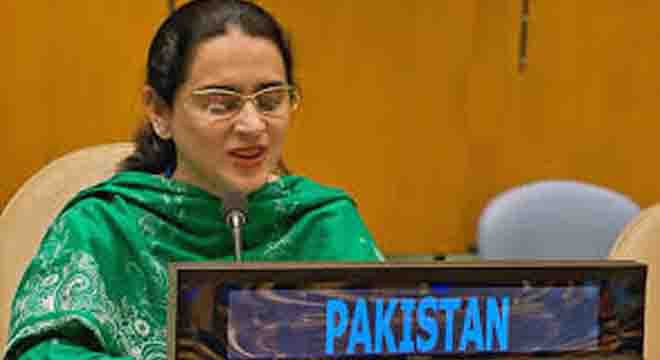
UNITED NATIONS, May 21 (APP): A Pakistani diplomat on Wednesday strongly rejected Indian allegations accusing Pakistan of targeting Afghan civilians, stating that it was in fact India that had been involved in sponsoring terrorism against Pakistan. Speaking during a UN Security Council debate on the Protection of Civilians in Armed Conflict, Pakistan Mission Counsellor Saima Saleem said India’s “state sponsorship of terrorism against Pakistan is not abstract; it has a human cost.”
The Pakistani diplomat was exercising the right of reply in response to remarks made by India’s Permanent Representative to the UN, Harish Parvathaneni, who had accused Pakistan of harming Afghan civilians and also repeated allegations regarding the events of 1971. The Indian envoy was reacting to an earlier statement by Pakistan’s Permanent Representative to the UN, Asim Iftikhar Ahmad, who had highlighted the plight of Kashmiri women and girls under Indian occupation in Jammu and Kashmir.
In her response, Saima Saleem said India was attempting to portray itself as a victim while concealing what she described as its own policies of aggression, repression and support for terrorism. She alleged that India had financed and supported militant groups including the TTP, BLA and Majeed Brigade, which, she said, had carried out attacks against Pakistani civilians, including women and children, in mosques, schools, markets and public places through networks operating from Afghan soil.
Referring to Pakistan’s counter-terrorism operations, she stated that Pakistan had conducted precise and professional actions targeting terrorist hideouts, training camps, ammunition depots and support networks used to launch attacks against Pakistan. She emphasized that these operations were directed only against terrorists and their infrastructure and not against the Afghan people or civilian facilities. The allegations made by the Taliban authorities and echoed by India, she added, were part of a disinformation campaign aimed at concealing their own failures.
Highlighting the situation in Indian Illegally Occupied Jammu and Kashmir (IIOJK), the Pakistani delegate said civilians there continued to face killings, arbitrary detentions, demolitions of homes, restrictions on freedoms and denial of their right to self-determination. She further alleged that under “state-sponsored Hindutva extremism,” Islamophobia had become institutionalized in India, while Muslims and other minorities, including Sikhs, Dalits and Christians, were facing growing discrimination and violence.
Saima Saleem also criticized India’s decision to place the Indus Waters Treaty in abeyance, stating that threatening the water security and livelihoods of millions of Pakistanis was contrary to the principles of civilian protection and international law. She reaffirmed Pakistan’s commitment to peace, dialogue and the peaceful settlement of disputes in accordance with international law.
Earlier in the debate, Ambassador Asim Iftikhar Ahmad stressed that situations of foreign occupation heighten the obligations of occupying powers under international law. Referring to Palestine, he called for unhindered humanitarian access, accountability and recognition of the Palestinian people’s right to self-determination and statehood. He also said that civilians in IIOJK continued to suffer under foreign occupation, militarization, arbitrary detentions, demographic changes and restrictions on fundamental freedoms.