The first thing I sold while my daughter was in intensive care was my wedding ring.
Not because I had stopped loving my husband. He had been dead for eleven months.
I sold it because the parking garage charged eighteen dollars a day, my employer had stopped paying me, and grief had become a luxury I could no longer afford.
By the fourth week, I knew which hospital bathroom had hot water, which waiting-room chair didn’t tilt, and how slowly I could drink a paper cup of tea before somebody noticed I hadn’t ordered food.
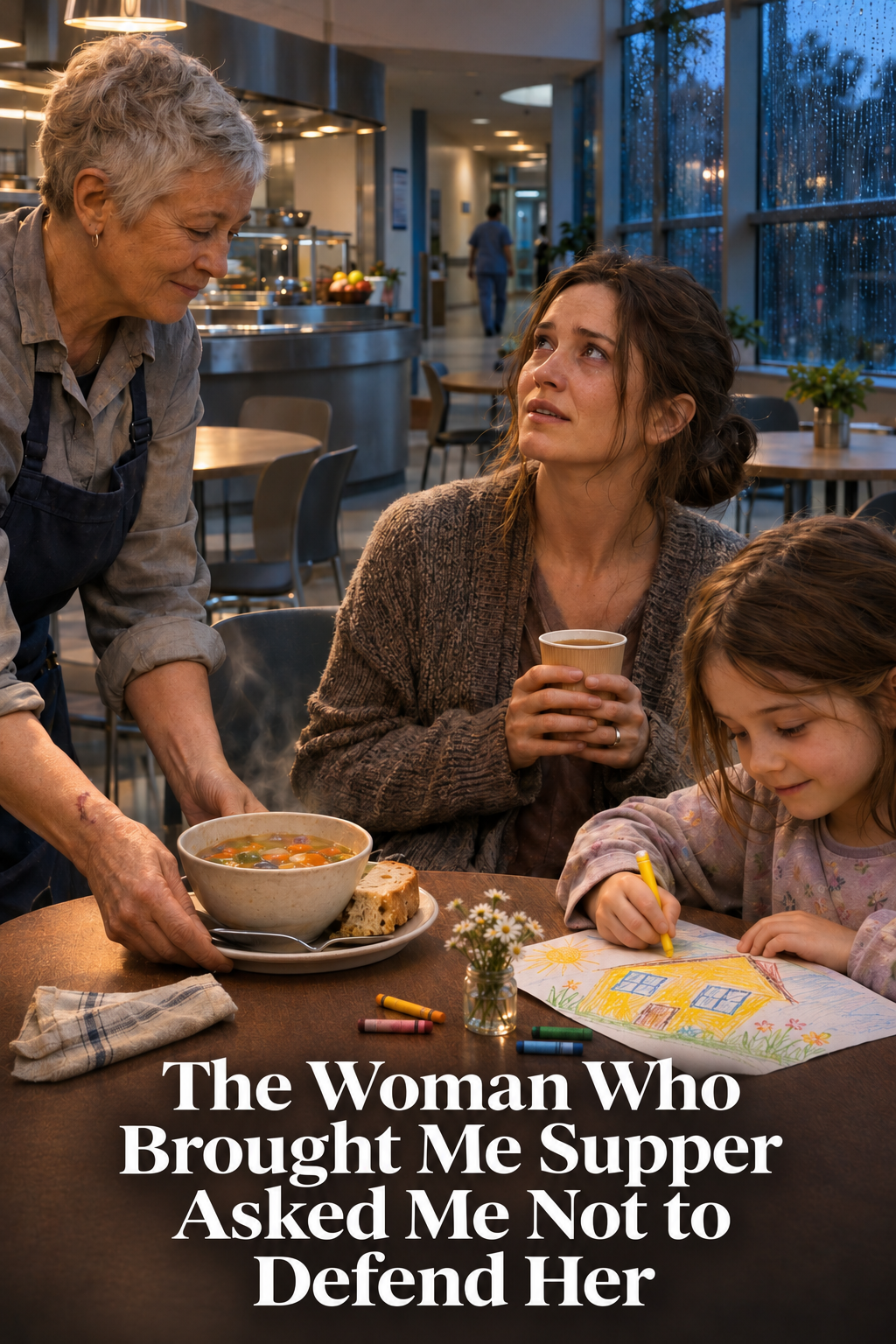
That was when the woman from the cafeteria sat opposite me.
She had silver hair cropped close to her head and a burn scar shaped like a comma on her wrist.
“You’re staring at that sandwich like it owes you money,” she said.
“I’m deciding.”
“It’s egg salad. There’s nothing to decide.”
She placed a bowl of soup beside my untouched tea.
“I didn’t order that.”
“Then we’ve both made mistakes. Eat before mine gets cold.”
Her name was Celia Mercer.
My daughter, Wren, was six. An infection had damaged her heart, and we had been transferred to the regional children’s hospital ninety miles from home.
Every morning, I promised Wren I would be beside her when she woke. Every evening, I wondered whether I would still have an apartment when we returned.
Celia never asked for the whole story.
She asked whether I preferred potatoes or rice.
Over the next month, supper appeared whenever her shift overlapped with my vigil. Sometimes she sat with me. Usually she had only a minute before somebody shouted from the serving counter.
She was impatient with complaints, fiercely protective of the young dishwashers, and capable of remembering thirty people’s coffee orders while insisting she disliked everyone.
One evening, I asked why she kept feeding me.
“My son spent a summer upstairs when he was little,” she said. “I remember the prices.”
“Did he get better?”
She rubbed the scar on her wrist.
“He grew up.”
I understood that she didn’t want another question.
When Wren was finally discharged, she made Celia a picture of a yellow house with enormous windows.
“So you can see everybody coming,” she explained.
Celia studied it carefully.
“Useful. Especially people selling things.”
She tucked it into her apron.
Eight months later, I returned to the hospital with a bakery box and fifty dollars in an envelope.
Wren was back at school. I had found steady work dispatching repair crews. It wasn’t much, but it was enough to begin repaying small debts.
At the cafeteria, the young cashier’s smile disappeared when I asked for Celia.
“She doesn’t work here anymore.”
“Do you know where I could find her?”
He glanced toward the kitchen.
“You should speak to the manager.”
In a cramped office, a woman named Mrs. Voss listened while I explained.
Then she asked, “Did Celia ever give you a receipt?”
“No. She said the meals were covered.”
Mrs. Voss closed the office door.
“There’s an investigation into charges made to a hospital assistance account. Some families may be contacted.”
I looked down at the bakery box on my knees.
“What charges?”
“Meals entered under approval numbers that weren’t hers to use.”
“Meals for parents?”
“Yes.”
“Then surely—”
“That account had a limit,” she said quietly. “When it emptied, other requests were turned down.”
I had arrived expecting to thank someone.
Instead, I left wondering whose supper I had eaten.
Celia’s address came from the return label on a birthday card she had sent Wren.
She lived above a closed hardware store. When she opened the door, she looked smaller without her apron.
“I wondered when you’d hear.”
“Tell me they’re wrong.”
She stepped aside.
On her kitchen table lay a stack of envelopes, a calculator, and Wren’s yellow house in a cheap wooden frame.
“I found an old supervisor code,” she said. “At first, I used it for one meal.”
“And then?”
“And then there was another hungry person.”
I waited for the explanation that would make everything simple.
It never came.
“The social worker was investigating another source of funding,” Celia said. “I decided people couldn’t wait. Then I kept deciding.”
“Why didn’t you tell me?”
“Would you have eaten?”
“No.”
“There you are.”
Anger rose so suddenly that I had to put the bakery box down.
“You let me believe somebody had approved it.”
“I did.”
“And someone else lost help.”
She nodded.
That hurt more than an excuse would have.
I pushed the envelope toward her.
“For my meals.”
“No. Keep it.”
“Celia.”
“Pay the hospital if you want. I’m paying back what I charged.”
She showed me the letter beside her calculator. The hospital had agreed to a repayment schedule. Her dismissal would stand.
“I’ve written something for the review,” she added. “About how easily I got into the account.”
“I’ll write too.”
Her expression hardened.
“Don’t make me into a saint because you were hungry.”
“I wasn’t going to.”
But driving home, I realized that was exactly what I had wanted to do.
My first letter was four pages long.
It described Wren’s illness, my husband’s death, the ring, the soup. It made Celia sound like the only decent person in a building full of rules.
I tore it up.
The next letter was shorter.
I explained that I had received meals without knowing how they were funded. I described what they had meant to me. Then I asked why a parent sleeping beside a critically ill child had needed a cafeteria worker to notice she was hungry.
Mrs. Voss called a week later.
“Would you come to a meeting?”
There were seven of us around the table: cafeteria staff, a social worker, two parents, and the administrator responsible for family assistance.
Nobody offered Celia her job back.
Nobody pretended the missing money didn’t matter.
But the social worker brought a list of requests she had been unable to approve. Some parents had struggled with the forms. Others hadn’t known assistance existed.
We spent two hours arguing over what could change.
I returned the following month. And the month after that.
We started with one evening meal for caregivers who had been at the hospital longer than three days. A local grocer donated produce. The hospital supplied kitchen time. We raised the rest.
Celia helped us calculate portions from her kitchen table.
“People always underestimate potatoes,” she muttered, crossing out my first budget.
Our first supper was served on a Thursday in November.
Celia came as a guest. She had taken a job preparing lunches at a small factory and was still making monthly repayments.
For a while, she stood near the doorway with her coat buttoned.
Then Wren spotted her.
“You came!”
“I heard there might be potatoes.”
Wren led her to a table beneath a window.
Mrs. Voss brought over two plates. Celia looked up, surprised.
“I wasn’t sure you’d want me here,” she said.
“I know,” Mrs. Voss replied. “Your supper’s getting cold.”
They ate together awkwardly at first, then began discussing a kitchen oven that had apparently been unreliable for years.
Across the room, a father in yesterday’s clothes approached the serving counter.
“How much?”
“Nothing tonight,” I told him. “It’s covered.”
He hesitated, just as I once had.
I pointed to the sign explaining the meal program, its funding, and who could use it. He read every line before accepting a plate.
Later, while we cleared the tables, Celia handed me a dish towel.
“You made a lot of work for yourself.”
“Yes.”
“Worth it?”
At the window, Wren was showing the tired father how to fold a paper bird. For the first time since he had entered, his shoulders had relaxed.
I took the towel.
“Come back next Thursday,” I said. “We’ll need someone who understands potatoes.”