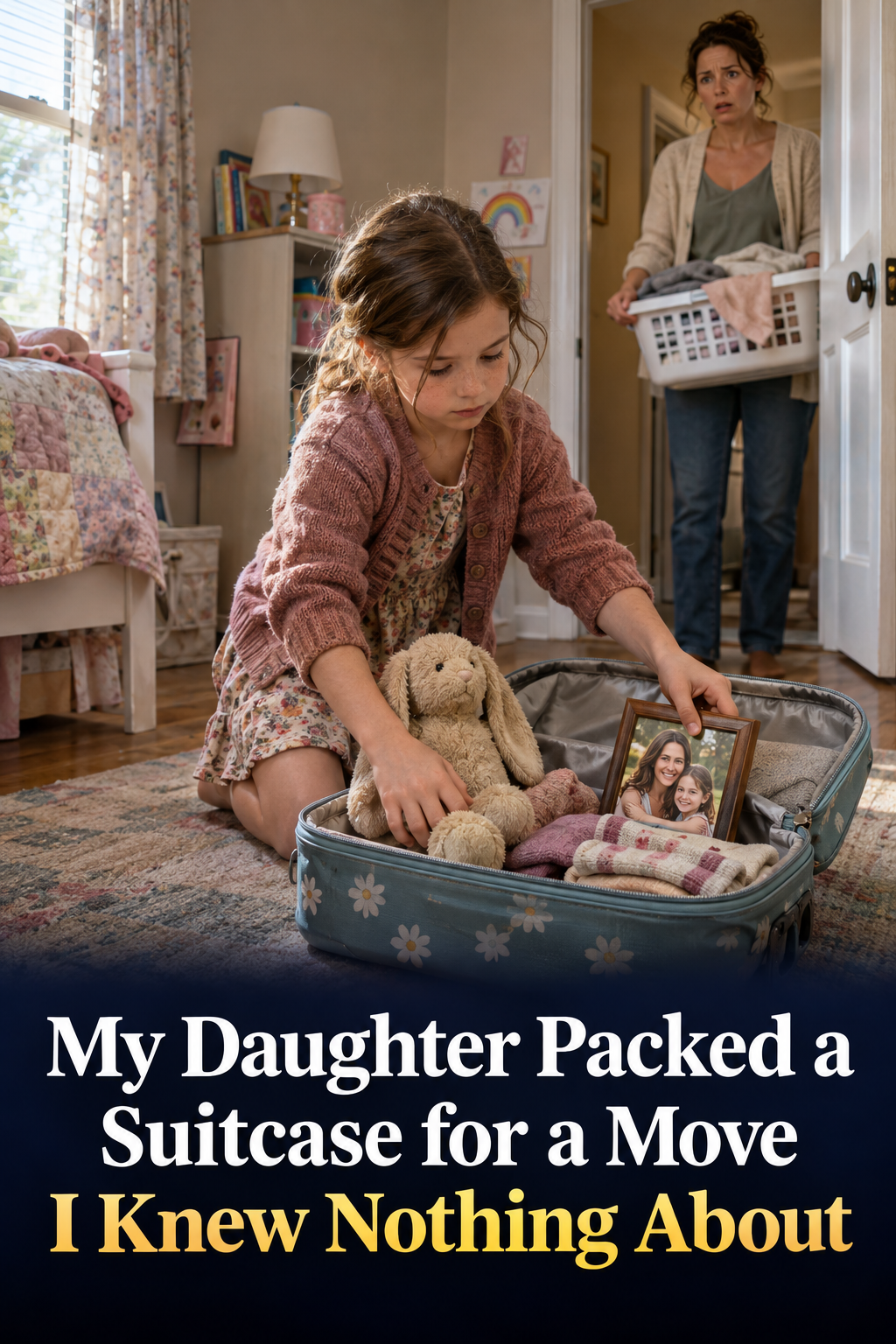
The suitcase stood beside my daughter’s bedroom door on a Tuesday morning.
Inside were three pairs of socks, a stuffed rabbit, and the photograph of us she normally kept beneath her pillow.
“Are we going somewhere?” I asked.
Celia looked up from fastening her shoes.
“Daddy said I should choose what matters before the moving people come.”
I set down the laundry basket.
“What moving people?”
Her expression changed. At seven, she already knew the uncomfortable silence that followed saying something an adult hadn’t expected.
“I wasn’t supposed to start yet.”
My name is Miriam. I was thirty-eight, worked as a hospital laboratory supervisor, and believed I understood the pressures inside my own home.
My husband, Adrian, repaired antique furniture. He could spend six hours matching a broken chair leg and forget the electricity bill sitting beside his coffee. I handled schedules; he made our daughter pancakes shaped like woodland animals.
We occasionally frustrated each other. Mostly, we worked.
The house had belonged to my grandmother, who left it to me before Adrian and I married. Nothing about it was grand. The upstairs pipes complained, and the kitchen floor sloped enough to send dropped blueberries rolling toward the pantry.
But Celia’s height marks climbed the kitchen doorframe. Adrian had built his workshop behind the garage. My grandmother’s roses still flowered beside the steps.
We had discussed moving once.
I had said I would consider it after Celia finished primary school.
That was four years away.
That morning, I called Adrian from the kitchen.
“Why is our daughter packing?”
He was quiet for a moment.
“Because she takes everything literally.”
“Then tell me what you said.”
He sighed.
“A developer has been asking about the street. I mentioned that we might move someday.”
“She said moving people are coming.”
“Miriam, I’m sanding a dining table. Can we do this tonight?”
I agreed.
Then I opened the cupboard for a mug and found an envelope addressed to both of us.
Inside was an appointment confirmation for a property valuation.
Thursday. Ten o’clock.
During my shift.
Adrian came home carrying takeaway food, something he usually did when he hoped a difficult conversation might dissolve over dinner.
I waited until Celia was asleep.
“Who arranged the valuation?”
“I did.”
“Why didn’t you tell me?”
“Because every conversation about this house ends before it starts.”
“That doesn’t give you permission to start selling it.”
“I haven’t sold anything.”
He sounded offended, which briefly made me feel unreasonable.
Then he added, “I wanted numbers before we argued.”
I asked whether his workshop was struggling.
He pushed a carton of rice away.
“Orders are slow. That’s all.”
We had savings. We had options. I told him both.
He nodded without meeting my eyes.
The following afternoon, I canceled the valuation.
The agent sounded surprised.
“Your husband said you were both keen to proceed.”
“We aren’t.”
“I understand. Shall I also tell the clearance company to hold off?”
My hand tightened around the phone.
“What clearance company?”
There was no affair. No stranger living upstairs. Nothing I could confront in one terrible, decisive moment.
Instead, there were bookings.
A storage unit.
A removal estimate.
An appointment to view a house forty miles away.
Adrian had been constructing a different life around us while I worked evening shifts and signed school forms.
When I confronted him again, he finally admitted the workshop owed money.
“How much?”
“Enough that selling would make sense.”
“That isn’t a number.”
He named a figure that made me sit down.
He had leased expensive equipment, expecting a hotel restoration contract to cover it. When the contract collapsed, he borrowed more to keep the business open.
For nearly a year, he had let me believe things were improving.
“I was going to fix it,” he said.
“With my house.”
“With a smaller house. We’d still have somewhere to live.”
“You asked our daughter to prepare before you asked me.”
His face reddened.
“I didn’t want her frightened.”
“She packed our photograph, Adrian.”
For the first time, he had nothing to say.
I thought I had finally uncovered the whole problem.
Then Celia’s teacher asked whether everything was all right.
“She’s been very worried about making mistakes,” Mrs. Bell told me. “Yesterday she cried because she accidentally mentioned the blue folder.”
“What blue folder?”
“She wouldn’t explain.”
That evening, I sat beside Celia while she drew at the kitchen table.
“You haven’t done anything wrong,” I told her.
Her pencil stopped.
“Even if Daddy gets in trouble?”
“Adults are responsible for their own decisions.”
She studied me for a long time.
Then she whispered, “He said you work so hard already. I was helping by not making you worry.”
I had been angry before.
This felt worse.
My daughter had been carrying part of our marriage around in her schoolbag.
The blue folder was in Adrian’s workshop.
I asked him to bring it inside and open it in front of me.
Among the estimates was a letter he had written but never sent.
It began: Miriam, by the time you read this, I hope you can understand why I couldn’t keep waiting.
Below it was a plan for moving our belongings while I attended a weekend training course.
He had intended to empty the house.
“Then what?” I asked.
Adrian stared at the table.
“Once you saw the new place—”
“You thought I would agree because everything was already gone?”
“I thought we could start again.”
I looked at the photographs of the rental property. He had circled a small room and written Celia beside it.
For weeks, he had imagined my eventual acceptance so vividly that my actual consent had become an inconvenience.
That night, I asked him to stay with his father.
Over the next month, the picture became clearer.
A financial adviser helped separate the business debts from our household expenses. Some equipment could be returned. Some furniture could be sold. Adrian would have to close the workshop and take paid employment while arranging repayment.
It would be painful.
It did not require secretly dismantling our home.
Adrian began counseling. I found someone for Celia to speak with, too.
Once, outside her appointment, he said, “I thought if I kept everyone calm, I was protecting them.”
I watched our daughter sorting pebbles beside the pavement.
“She was frightened all the time,” I said. “You just made sure she was quiet about it.”
He cried then.
I believed his remorse.
I also stopped treating remorse as a reason to hurry.
Six months later, Adrian rented a small flat near Celia’s school.
We were living separately. I hadn’t promised reconciliation, and he had finally stopped asking for a deadline.
He kept his visits. He paid what we had agreed. When Celia asked difficult questions, he answered without telling her what she should keep from me.
Those were small things, but I watched them carefully.
One Saturday, Celia found the suitcase beneath her bed.
“Can we use this for the seaside?” she asked.
I had booked two nights away during the school holiday—our first trip since everything happened.
“Of course.”
She packed her swimming costume, her rabbit, and enough socks for a month.
Then she reached beneath her pillow.
“You can bring the photograph,” I said.
She looked at it, considered, and placed it back.
“It can stay here.”
I helped her zip the suitcase.
For the first time in months, she left it open beside the door until she was ready.