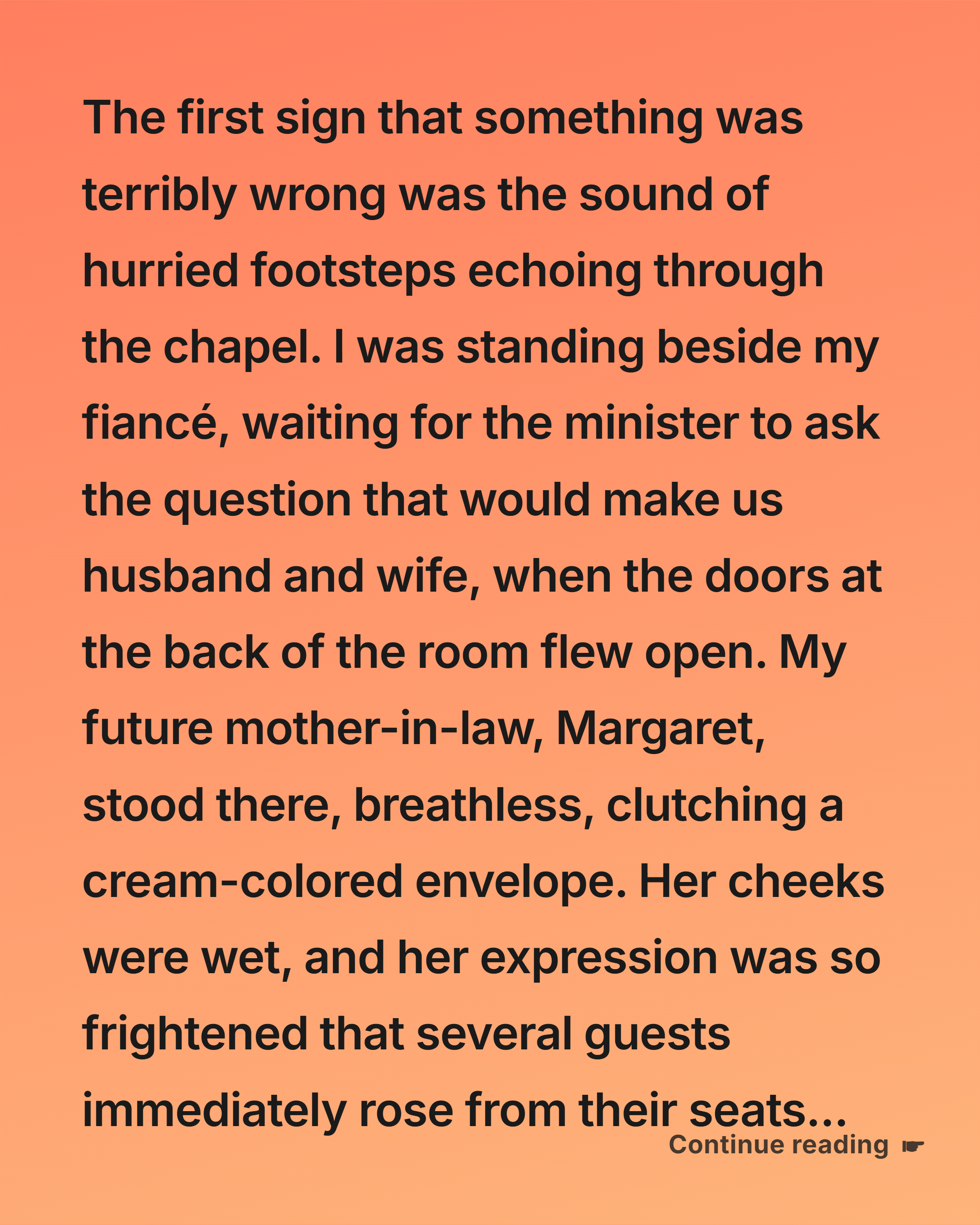
The first sign that something was terribly wrong was the sound of hurried footsteps echoing through the chapel.
I was standing beside my fiancé, waiting for the minister to ask the question that would make us husband and wife, when the doors at the back of the room flew open. My future mother-in-law, Margaret, stood there, breathless, clutching a cream-colored envelope. Her cheeks were wet, and her expression was so frightened that several guests immediately rose from their seats.
“Please, nobody let them exchange vows!” she cried.
For a moment, I genuinely thought someone had died.
My fiancé, Daniel, turned toward his mother with an expression of disbelief. The minister lowered his book, and a ripple of whispers traveled through the chapel. I stood frozen in my ivory dress, wondering what could possibly have happened to make a woman who had spent nearly a year planning our wedding interrupt it in front of two hundred people.
What none of us knew was that the envelope in her hands contained information that would change the meaning of family for all three of us.
Margaret had always been more than accommodating during our engagement. She was the sort of woman who remembered everyone’s favorite dessert, sent handwritten birthday cards, and insisted that nobody leave her house without taking leftovers.
When Daniel first introduced us, I had been nervous. I had grown up with my adoptive parents in a quiet town in northern Michigan, and I wasn’t particularly experienced at navigating the expectations of a large family. Margaret, however, had welcomed me without hesitation.
She even offered me her wedding gown, a beautiful ivory dress that had belonged to her grandmother. It had delicate lace sleeves, tiny pearl buttons, and a long train that required several weeks of careful restoration.
I remember standing in front of her bedroom mirror while she adjusted the waistline.
“You know,” she said, stepping back to admire the dress, “I never imagined anyone else wearing this. But somehow, it looks as though it was waiting for you.”
I laughed nervously.
“I’m afraid I’ll ruin something so precious.”
“You couldn’t,” she replied, gently smoothing the lace. “Some things become more valuable when they’re passed on.”
Her words had stayed with me.
Margaret had also helped us choose the reception menu, arranged flowers with a local florist, and spent countless evenings discussing tiny details that Daniel and I would probably never have noticed. She seemed genuinely excited about welcoming me into her family.
I had never questioned her affection.
That was why her behavior on our wedding day was so difficult to understand.
Just three hours before the ceremony, she had been in the bridal suite, fastening the last buttons on my dress. She had held my shoulders and looked at me with tears in her eyes.
“You’re going to make a wonderful wife,” she whispered.
“Thank you for making me feel like I belong here,” I told her.
She had hugged me tightly but said nothing.
At the time, I assumed she was simply emotional. Looking back, I realize that something had been troubling her long before she entered that room.
When Margaret finally reached the altar, she looked directly at me.
“Claire, sweetheart,” she said, her voice trembling. “I am so sorry. I should have told you sooner.”
I looked at Daniel. His jaw had tightened.
“Mom, what are you doing?” he demanded. “We are literally in the middle of our wedding.”
“I know,” she answered, struggling to catch her breath. “And I wish more than anything that I could let you finish. But I can’t allow you to make a decision without knowing the truth.”
The minister quietly stepped aside.
My adoptive father, Richard, stood from the front row. He had raised me since I was an infant, and I could see the protective anger building in his expression.
“Claire, do you want me to come up there?” he asked.
I swallowed.
“Not yet, Dad. Let me hear what she has to say.”
Margaret looked around at the assembled guests, visibly embarrassed.
“I apologize to everyone. I need a few minutes with Claire and Daniel. Please.”
Daniel shook his head, but I reached for his hand.
“Let’s go outside,” I whispered.
We followed Margaret through a side entrance into the small courtyard beside the chapel. A cold breeze moved through the bare branches of the trees, and the sound of the guests’ conversations faded behind us.
Margaret stood beneath an old stone archway, still holding the envelope.
For several seconds, she couldn’t speak.
“Please,” Daniel finally said. “Tell us what happened.”
Margaret looked at me, then reached up and touched the area just beneath her left ear.
“Do you have a small mark here?” she asked.
I stared at her.
“What?”
“A little crescent-shaped birthmark. Just behind your ear.”
My hand immediately moved to the spot.
“Yes. I’ve had it since I was born. Why?”
Margaret closed her eyes.
“Because I have the same one. Exactly the same shape, in almost the same place.”
Daniel let out an impatient breath.
“Mom, that’s why you stopped the wedding? Because Claire has a birthmark?”
“No,” she whispered. “The birthmark was only what made me start asking questions.”
She opened the envelope and removed several pages.
“A few months after Daniel introduced you to me, I began noticing similarities between us. It wasn’t just the mark. The way you tilt your head when you’re listening, the little habit you have of rubbing your thumb against your fingers when you’re nervous…”
She looked down at the papers.
“I tried to convince myself that I was imagining things. But I couldn’t stop thinking about it.”
I felt a strange pressure building in my chest.
“What are you trying to tell me?”
Margaret took a shaky breath.
“Last week, after you visited our house, I found a strand of your hair caught in the back of the chair where you’d been sitting. I made a terrible decision. I sent it to a private laboratory for comparison with my own DNA.”
Daniel stepped forward.
“You tested her DNA without her permission?”
“I know how wrong that was,” Margaret replied. “I know. I should have spoken to her instead. But I was frightened of what I might discover, and even more frightened that I might never get another chance.”
She handed me the first page.
“The results arrived this morning.”
I looked at the document, but the words seemed to blur. I could barely concentrate enough to read the laboratory’s name.
“What does it say?” I asked.
Margaret’s lips trembled.
“It says I’m your biological mother.”
For a moment, I heard absolutely nothing.
The distant traffic, the wind, Daniel’s breathing—all of it seemed to disappear.
I stared at her.
“No.”
Margaret began crying.
“Claire…”
“No, that’s impossible.”
I looked at Daniel, expecting him to tell me this was some terrible misunderstanding.
Instead, he stood motionless, his face drained of color.
“You’re saying…” I began, struggling to form the sentence. “You’re saying you gave birth to me?”
Margaret nodded.
“When I was sixteen, I had a baby girl. I was still in school, and the boy responsible for the pregnancy disappeared when he found out. My parents were furious. They were strict, religious people, and they believed having a child at that age would destroy my future.”
She wiped her cheeks.
“They arranged for me to give the baby up for adoption. I was sent to stay with relatives in another state, and after the birth, I was told that the adoption would be closed. I was barely old enough to understand what was happening, and I was too frightened to fight them.”
My knees weakened.
“What happened to the baby?”
Margaret looked straight at me.
“She was adopted by a wonderful couple. I was given almost no information about them. I knew her birth date, and I knew she had a tiny crescent-shaped mark behind her ear. That was all.”
I shook my head.
“Why didn’t you ever look for her?”
“I did,” she answered immediately. “For years. I contacted agencies, searched old records, and even hired someone to help me understand what information I could legally access. But the adoption was sealed, and I had no reliable way of finding her.”
Her voice cracked.
“I eventually married Daniel’s father. We tried for years to have children, but we couldn’t. When Daniel was seven, we adopted him. I loved him from the moment he walked through our front door. He became my son in every way that matters.”
She paused.
“And then, years later, you walked into my house.”
I felt sick.
“Then Daniel and I…”
Margaret immediately understood.
“No, Claire. You and Daniel are not biologically related.”
Daniel finally spoke.
“Mom, please explain that part carefully, because I don’t think I’m understanding anything anymore.”
Margaret nodded.
“When Daniel was adopted, his biological parents were listed in the records. I later learned that he had been born to a completely different family. There is no biological connection between you two.”
Daniel pressed both hands against his forehead.
“I remember the adoption,” he murmured. “I remember being afraid you wouldn’t like me.”
Margaret reached toward him.
“You were seven years old. You had spent months moving between temporary homes. I remember you standing in the doorway with that ridiculous little backpack, asking whether you could keep your stuffed dinosaur if you moved in.”
Daniel gave a broken laugh.
“You said he could have his own room.”
“And he did,” she replied through tears. “For years, that dinosaur sat on your pillow.”
He looked at her, his eyes shining.
“You always told me I was the child you had waited for.”
“You were,” Margaret whispered. “And you still are.”
I stood between them, struggling to process the impossible situation.
The woman who had helped me choose my wedding flowers was my birth mother. The man I was about to marry had been adopted by her. My biological mother and my future husband had spent years building a relationship long before either of them knew I existed.
I felt as though my entire history had suddenly been rewritten.
“But why tell me today?” I asked. “Why not yesterday? Why not last week?”
Margaret lowered her eyes.
“Because I was afraid.”
“Afraid of what?”
“Afraid that the results would confirm it, and that you would hate me. I kept telling myself I needed more time to be certain. But this morning, when I saw you wearing my family’s wedding dress, I realized I was about to watch my daughter marry my son without telling either of you the truth.”
She covered her mouth.
“I couldn’t do it. I couldn’t stand there smiling while keeping something this important from you.”
Daniel looked furious and heartbroken at the same time.
“You should have trusted us enough to tell us privately.”
“You’re right,” Margaret whispered. “I should have.”
I looked at the laboratory report again.
There was a part of me that wanted to tear it apart and pretend none of this had happened. Another part desperately wanted to ask Margaret a thousand questions.
But the strongest feeling was an unexpected sadness.
I had spent my entire childhood wondering about the people who had brought me into the world. I had never been unhappy with Richard and Susan, my adoptive parents. They had loved me unconditionally. Still, there had always been a small, unanswered question sitting somewhere in the back of my mind.
Who had I inherited my eyes from? Where had my stubbornness come from? Had my birth mother ever wondered what happened to me?
Now she was standing in front of me, crying.
And I didn’t know what to call her.
“Can we go inside?” I finally asked.
Margaret nodded, wiping her face.
“Yes, sweetheart. Whatever you decide.”
I looked at Daniel.
“Do you still want to get married?”
He took both my hands.
“More than anything. But I don’t want us to pretend today hasn’t happened. We need to make sure we’re both comfortable with what we’ve learned.”
I nodded.
For the first time that morning, I felt as though someone had given me permission to breathe.
We returned to the chapel, where the guests were still waiting anxiously. Richard immediately approached me.
“Claire, what’s happened?”
I looked at him, then at Margaret.
“Dad, there’s something we need to talk about. All of us.”
It was one of the strangest conversations of my life. Daniel and I explained what Margaret had discovered, while Richard listened in stunned silence. Susan, my adoptive mother, was sitting beside him, holding a tissue against her lips.
When we finished, Richard looked at Margaret.
“Are you absolutely certain?”
She handed him the laboratory report.
“I know I have no right to ask you to believe me immediately. But the results are clear.”
Richard studied the document before slowly returning it.
Then he looked at me.
“Whatever happens today, you’re still our daughter. That will never change.”
I felt tears spill down my cheeks.
Susan reached for my hand.
“We always knew there might be questions you wanted answered one day,” she said gently. “We just never imagined the answers would arrive wearing the same dress as you.”
Her attempt at humor made me laugh through my tears.
After a long discussion, Daniel and I decided to continue with the ceremony. We weren’t doing it because anyone expected us to, or because we wanted to avoid embarrassing our guests. We did it because we loved each other, understood that we weren’t biologically related, and wanted to begin our marriage with honesty rather than fear.
The minister resumed the service.
When Daniel slipped the ring onto my finger, his hands were trembling. Mine were too.
Our vows sounded different now. They weren’t simply promises about building a future together. They were promises that we would face whatever unexpected history life placed between us.
When the minister finally pronounced us husband and wife, the applause was unusually emotional.
I saw Margaret crying in the front row. Richard had his arm around Susan, and both of them were smiling through their tears.
The reception was beautiful, but I barely remember the meal. My mind kept returning to the same impossible thought.
I had married my biological mother’s adopted son.
It was a sentence I never imagined saying, and certainly not on my wedding day.
During the father-daughter dance, Richard held me close while the band played a slow song.
“Are you frightened?” he asked quietly.
“A little.”
“That’s understandable.”
I rested my head against his shoulder.
“Dad, does this change anything for you?”
He pulled back just enough to look at me.
“Claire, I changed your diapers, taught you how to ride a bicycle, sat beside you through every school performance, and drove three hours in a snowstorm when you broke your ankle at college. Do you honestly think a piece of paper can change who your father is?”
I started crying.
“No.”
“Good,” he said, kissing my forehead. “Because I’m not applying for retirement.”
I laughed, and he smiled.
Then his expression softened.
“But I hope you’ll give Margaret a chance to explain herself. She lost something important a long time ago. You don’t have to fix that for her, but you don’t have to close the door either.”
Across the room, Daniel was speaking with Margaret. He looked over and raised his glass toward me.
Later, when we finally had a moment alone, he pulled me into his arms.
“Still glad you married me?” he asked.
I gave him a weak smile.
“Ask me again after I’ve had a few days to process everything.”
He laughed.
“Fair enough.”
Then he became serious.
“I know today wasn’t what we planned. But I don’t want you to feel responsible for making everyone happy. We can take this slowly. Your relationship with my mother—or with your biological mother, I suppose—doesn’t have to be figured out overnight.”
“I’m afraid things will never feel normal again.”
“Maybe normal wasn’t as important as we thought,” he replied. “Maybe being honest with each other is.”
I looked across the reception hall at Margaret.
For the first time, I wondered whether she was feeling the same confusion I was. She had spent years imagining what her daughter might look like as an adult. Now that daughter was sitting across the room, wearing a dress that had belonged to her family, married to the boy she had raised.
It was an extraordinary situation, and none of us had a guidebook for it.
The following weeks were complicated.
Margaret and I began meeting for coffee, usually somewhere quiet where we could talk without feeling watched. At first, our conversations were awkward. We knew plenty about each other, yet we were also strangers in many ways.
She told me about growing up in a small Pennsylvania town, about her parents’ strict expectations, and about the lonely months following my birth.
She also told me something she had never shared with Daniel.
“For a long time, I kept a journal,” she said one afternoon. “I wrote down everything I wished I could tell you. Your first birthday. Your second Christmas. The day I graduated from nursing school. Even the silly things, like the kind of music I thought you might enjoy.”
She paused, staring into her coffee.
“I used to imagine that one day you might find me. I thought I’d recognize you immediately, but I was never sure what I would say.”
“What did you imagine I’d be like?” I asked.
She smiled sadly.
“Happy. Safe. Loved. I didn’t care whether you became a doctor or a teacher or decided to travel the world. I just wanted you to have the childhood I couldn’t give you.”
I reached across the table.
“I did have a happy childhood.”
Her eyes filled with tears.
“Then your parents gave you everything I hoped someone would.”
That evening, she brought a small wooden box to my house.
Inside were photographs, newspaper clippings, and several notebooks. There were also dozens of envelopes, each marked with a date.
“I never mailed these,” she explained. “I didn’t know where to send them. Some were written on birthdays. Others were written when I was having a particularly difficult day.”
I picked up one envelope.
My name was written across the front in careful handwriting.
“Why are you giving me these?”
“Because they’re yours,” she replied. “You can read them, keep them, or put them away. I won’t be offended if you need time.”
I didn’t open them that evening.
Instead, I asked her about the years after my birth. I wanted to know what happened to the girl she had been, how she had built a life afterward, and whether she had ever regretted the decisions she made.
She answered honestly.
There were things she wished she had done differently. There were also circumstances she couldn’t control. She didn’t ask me to excuse her or pretend that everything had been simple.
That mattered more to me than any dramatic apology could have.
A month after the wedding, Margaret invited Daniel and me to Sunday dinner.
She had prepared roast chicken, mashed potatoes, and the apple pie Daniel had loved since childhood. Richard and Susan came too, which made the evening feel a little less intimidating.
For the first time, everyone sat around the same table.
Daniel entertained us with stories from his childhood, including the time he had attempted to build a homemade submarine in the bathtub.
“You flooded the entire upstairs bathroom!” Margaret reminded him.
“It was a scientific experiment,” he protested.
“It was a plumbing emergency,” Richard corrected.
Everyone laughed.
I watched Margaret as she listened to Daniel teasing her. There was a tenderness in her expression that I had never noticed before. I realized that the love she had given him wasn’t something I needed to compete with or question.
It was simply part of the family we now shared.
After dinner, while the others were clearing the table, Margaret approached me.
“I have something else I wanted to tell you.”
My stomach tightened.
“What is it?”
She reached into her handbag and pulled out a small, faded photograph.
It showed a teenage girl sitting on the steps of an old house, holding a newborn baby wrapped in a knitted blanket.
“I kept this for years,” she said. “It’s the only photograph I have from the hospital.”
I stared at the picture.
The girl looked so young. Her expression was frightened, but there was unmistakable affection in the way she held the baby.
“That’s you,” Margaret whispered. “And that’s me.”
I touched the photograph carefully.
For the first time, I wasn’t looking at a woman who had suddenly appeared in my life with a shocking claim. I was looking at a frightened teenager who had once held me, knowing she might never see me again.
I felt something inside me soften.
“I think I’d like to read one of your letters,” I said.
Margaret’s face brightened, though she tried not to show too much excitement.
“Are you sure?”
I nodded.
She handed me an envelope dated twenty-nine years earlier.
Inside was a short letter written in blue ink. The paper had yellowed at the edges, and several words were smudged.
Margaret had written about the sound of rain against the hospital window. She had written about being afraid, about wishing she were older and stronger, and about hoping the people who adopted me would give me a beautiful life.
At the end, she had written something that made me stop reading.
If you ever wonder whether someone loved you before you could remember, please know that I did. I loved you from the moment I knew you existed.
I folded the letter carefully.
Margaret was watching me, her eyes full of uncertainty.
“I don’t know what our relationship will look like,” I told her. “I can’t suddenly make up for all the years we didn’t know each other.”
“I understand.”
“But I don’t want to lose the chance to know you now.”
She covered her mouth, struggling to hold back tears.
“That’s more than I ever dared hope for.”
Daniel appeared behind us and rested his hand on my shoulder.
“Are we having another emotional family moment without me?”
I laughed.
“Apparently.”
He looked at the photograph in my hand.
“Is that you?”
I nodded.
He studied it for a moment before looking at Margaret.
“You know, Mom, you have a talent for turning an ordinary Sunday into something unforgettable.”
She laughed through her tears.
“I’m afraid that’s been my specialty.”
As the evening came to an end, Richard and Susan prepared to leave. Margaret stood at the doorway, looking slightly uncertain.
“Thank you for coming,” she told them. “I know this situation hasn’t been easy for anyone.”
Richard nodded.
“It hasn’t. But I think we’re all trying to do what’s best for Claire.”
Susan reached over and squeezed Margaret’s hand.
“We may have different places in her life, but we all want the same thing. We want her to be happy.”
Margaret’s eyes filled again.
After they left, I returned to the living room and placed the old photograph beside the wooden box.
I had spent much of my life believing that family was something you were either born into or fortunate enough to find. Now I understood that it could be more complicated than that.
Richard and Susan were still my parents. Nothing could erase the years of love, sacrifice, and shared memories that had made them my family.
Margaret was the woman who had given birth to me, a person I was only beginning to know.
And Daniel was still the man I had chosen to spend my life with.
Our story hadn’t become simpler after the wedding. In some ways, it had become considerably more complicated. But it had also given us an opportunity none of us had expected: the chance to build a family without pretending that the past didn’t exist.
Before going to bed, I placed Margaret’s letter in the bedside drawer.
I wasn’t ready to read all the others yet. There were too many emotions attached to those envelopes, too many years of unanswered questions.
But I knew I would eventually open them.
The following morning, Margaret sent me a message.
Good morning, sweetheart. I hope you slept well. No pressure to reply. I just wanted you to know I’m thinking about you.
I stared at the screen for a moment before typing my response.
Good morning, Mom. I’d love to have coffee with you next week.
I hesitated before pressing send.
Then I smiled.
It was the first time I had called her Mom.
And although I knew one word couldn’t erase nearly three decades of separation, it felt like a small beginning.
A few minutes later, Daniel walked into the kitchen, wrapped his arms around my waist, and glanced at my phone.
“Looks like someone has a new favorite mother-in-law,” he joked.
I nudged him with my elbow.
“Don’t push your luck.”
He laughed and kissed my forehead.
For years, I had imagined that discovering my biological family would answer every question about where I came from. Instead, it had taught me something much more important.
Family isn’t a competition between the people who raised you and the people who gave you life. Love doesn’t become smaller because there is more of it to share.
Sometimes the truth arrives at the worst possible moment, turns an ordinary celebration upside down, and leaves everyone wondering what happens next.
But sometimes, if people are willing to be patient, honest, and forgiving, that same truth opens a door they never knew was still waiting for them.
Our wedding day hadn’t given us the perfect beginning we had planned.
It had given us something far more complicated, unexpected, and precious: a chance to begin again, together.