The first stranger arrived carrying a tape measure.
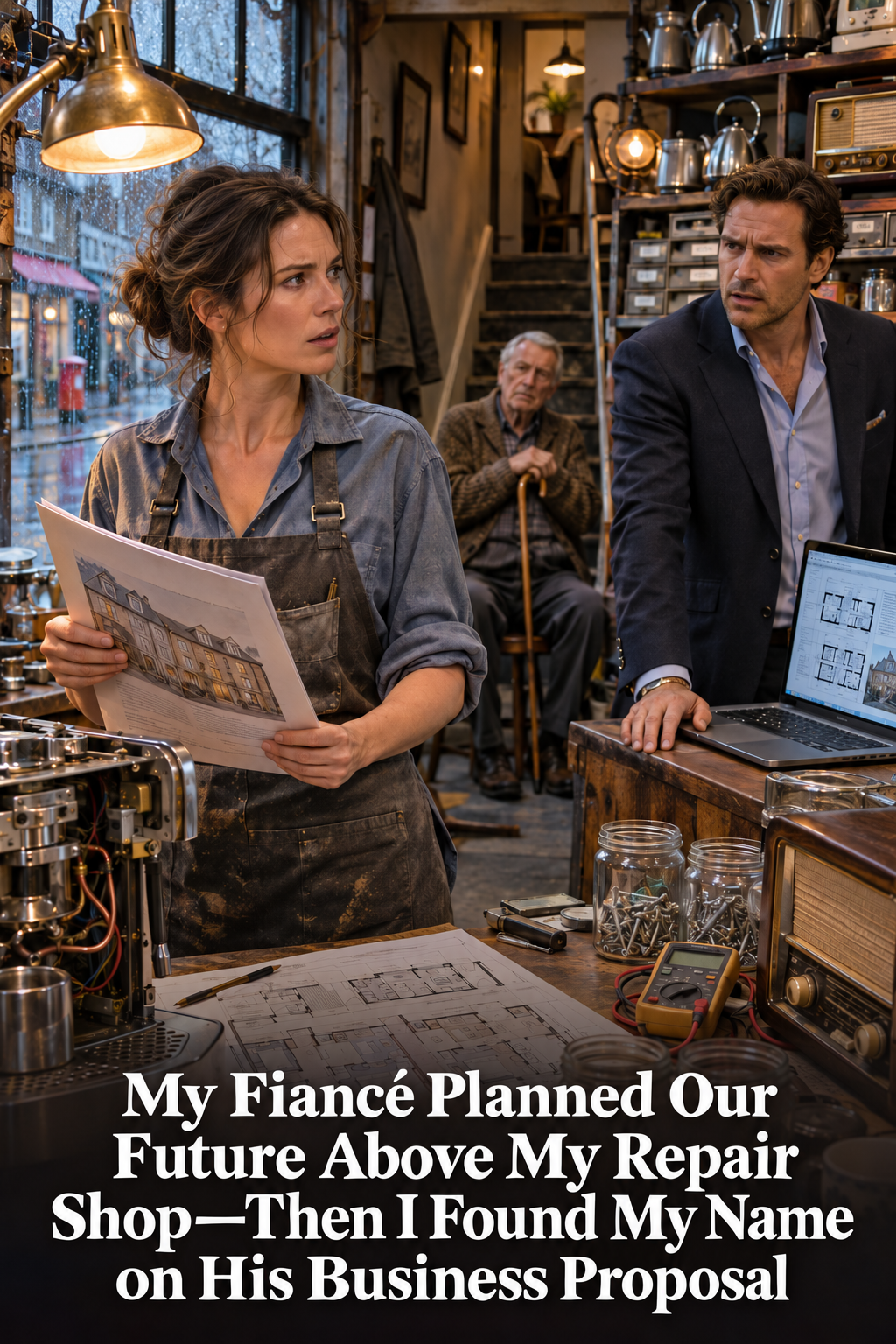
He stood in the doorway of my repair shop on a wet Tuesday morning, shaking rain from his coat while I held a dismantled espresso machine against my hip.
“Lovely building,” he said. “Where’s the staircase?”
I pointed toward the back.
“Are you here about the leak?”
He looked confused.
“No. The short-stay accommodation.”
Upstairs, my father was asleep in the room where I had helped him button his shirt two hours earlier.
“There’s no accommodation here.”
The man checked his phone.
“Forty-eight Calder Street?”
“Yes.”
“Then perhaps you should speak to Mr. Voss.”
My fiancé, Adrian Voss, was standing behind the counter. He had gone very still.
For eleven months, I had mistaken that expression for thoughtfulness.
That morning, I finally recognized it as calculation.
I met Adrian at a railway station during a power cut.
He was the man making stranded passengers laugh while everyone else argued with a vending machine. By the time the lights returned, he had organized a taxi share for an elderly couple and persuaded the café manager to give away the sandwiches she would otherwise throw out.
I liked how easily he moved through the world.
I was thirty-seven, practical, and more comfortable repairing a broken appliance than making conversation at a party. Adrian could charm a room before I had worked out where to put my coat.
We were together for nearly three years before he moved into the flat above my shop.
The building was modest: a narrow storefront downstairs, two bedrooms above it, and a roof that complained whenever the weather changed. I had bought it with my father fifteen years earlier, working six days a week until we finally cleared the loan.
Dad taught me the trade. By sixty-nine, he still claimed he could identify a washing-machine fault by listening from the pavement.
Then a stroke took away the steadiness in his right hand.
He recovered enough to walk with a stick, but stairs became difficult, and he could no longer live alone. I brought him into the flat, installed a second banister, and moved my paperwork into a cupboard to make room.
Adrian arrived with a suitcase, a coffee grinder, and a promise.
“You’ve spent your whole life holding things together,” he told me. “Let somebody look after you for a change.”
For a while, he did.
He collected Dad’s prescriptions. He cooked elaborate Sunday breakfasts. He made me leave work early on my birthday.
When the hotel where he worked changed management, he resigned.
“They want someone who follows instructions,” he said. “I want to build something.”
I understood that feeling.
So when he asked for a few months to develop a hospitality consultancy, I said yes.
We agreed he would manage the household, help with Dad’s appointments, and take over the shop’s website while I covered our expenses.
It seemed fair.
The trouble was that every responsibility Adrian accepted gradually found its way back to me.
A prescription went uncollected because he had a networking lunch.
Dad missed physiotherapy because Adrian thought the appointment was on Friday.
The new website remained “nearly ready” for so long that customers began asking whether the shop had closed.
Whenever I tried to discuss it, he looked wounded.
“You can’t demand progress and then stand over me checking every hour.”
I didn’t want to become that sort of partner.
I stopped asking every hour.
Eventually, I stopped asking at all.
Adrian’s business had a name before it had a client.
Voss & Vale Hospitality.
“Vale?” I asked.
“It sounds established.”
“My surname is Vale.”
“And one day it’ll be our name together.”
He kissed my forehead, and I let the answer pass.
There were brochures, a new laptop, and a professional headshot in which he stood beside a window looking as though someone had just offered him a very large contract.
Meanwhile, I postponed replacing the shop’s extraction fan.
I worked late repairing commercial coffee machines because those jobs paid better. I ate sandwiches over the sink. When Dad apologized for needing help, I told him we were managing.
One evening, I came upstairs to find three men drinking wine around our kitchen table.
Adrian introduced them as potential investors.
I was wearing an apron stained with descaling fluid. Dad sat quietly in the corner with his supper untouched because nobody had brought him a fork.
“Here she is,” Adrian announced. “The engine room.”
Everyone laughed pleasantly.
I found Dad a fork.
Later, I told Adrian I didn’t like being introduced that way.
“It was a compliment, Tessa.”
“It didn’t feel like one.”
“You’re exhausted. Everything sounds worse when you’re exhausted.”
Then he showed me photographs of a hotel roof terrace and talked until I forgot what I had been trying to say.
The first boundary I set was small.
Dad’s occupational therapist recommended an adapted bed. It was expensive, but I had saved enough.
I transferred the deposit before dinner.
Adrian saw the confirmation on my phone and frowned.
“We should discuss purchases that size.”
“We did. Last week.”
“I thought we were still considering options.”
“Dad needs it.”
“And I need working capital. My money is tied up until the consultancy launches.”
“What money?”
He put down his glass.
“That tone is exactly why I don’t involve you in everything.”
For the first time, I didn’t rush to soften my voice.
“I’m paying the bills, Adrian. I’m allowed to ask.”
He left the table.
For two days, he spoke only when necessary.
On the third, he told me our relationship had become unhealthy.
“You only respect what you can count,” he said. “Invoices. Hours. Money.”
“I respect showing up.”
“I need space.”
He suggested staying in the second bedroom.
“That’s Dad’s room.”
“There are excellent residential places.”
I stared at him.
He raised both hands.
“I’m talking about options. Apparently that’s allowed when you want something.”
That was the evening I took off my engagement ring.
No one shouted.
Adrian looked at the ring on the table, then asked whether we could avoid making any decisions about living arrangements until after his investor presentation.
I said we could discuss a practical departure plan the next morning.
Instead, he was gone when I woke, leaving a note that said he needed to clear his head.
Six days later, the man with the tape measure arrived.
Adrian ushered him outside before I could ask another question.
Through the front window, I watched them speak beneath the awning. The man looked from Adrian to the building, folded his tape measure, and walked away.
When Adrian returned, he sighed.
“That was handled badly.”
“What was?”
“A possibility. Nothing signed.”
“What possibility?”
He opened his laptop on the counter.
There were drawings of our building.
My workbench was gone. So were the parts shelves, Dad’s bedroom, and the kitchen where I knew every cracked tile.
In their place were six compact guest suites and something called an arrival lounge.
At the bottom of the proposal appeared my name.
Tessa Vale — Property Partner and Operations Lead.
I read it twice.
“You put my name on this?”
“Because we were building a future.”
“You told people I’d agreed?”
“I said discussions were advanced.”
“We haven’t had a discussion.”
“We’ve had dozens. You keep saying the shop is exhausting.”
I had.
I had also said my feet hurt. It didn’t mean I wanted someone to sell my shoes.
“Who has seen this?”
“A few interested people.”
“How many?”
He closed the laptop.
“You’re getting stuck on the wrong part.”
For months, I had wondered why he never seemed frightened by our shrinking savings.
Now I wondered what else he believed he could offer.
I spent that night at the kitchen table with copies of the proposal.
Adrian stayed downstairs, making calls I could hear but couldn’t distinguish.
Near midnight, Dad came out of his room.
“Put the kettle on,” he said.
“You should be asleep.”
“So should you.”
I told him enough to explain why my hands were shaking.
He listened without interrupting.
Then he said, “Did you agree to any of it?”
“No.”
“Then start there.”
I wanted to start by demanding explanations. I wanted Adrian to sit still until he understood what he had done.
Instead, the next morning, I made an appointment with a solicitor.
She asked for documents, dates, and exact wording.
I brought what I had.
On her advice, I separated our household accounts, changed the shop’s passwords, and sent Adrian written notice that he had no authority to represent me or offer the property for any business arrangement.
We also worked out a lawful timetable for him to leave.
It was ordinary, careful work.
That helped.
Fear had made the whole situation feel enormous. A list gave it edges.
The hardest discovery came from a woman named Celia Trent.
She called the shop asking when the refurbishment would begin.
When I told her there would be no refurbishment, she went silent.
“I paid a reservation deposit.”
My stomach dropped.
“For what?”
“A long-term suite for visiting staff. Adrian said you were handling the property side.”
“How much?”
“Eight thousand pounds.”
I wrote down the number because I couldn’t trust myself to remember it.
Celia forwarded the documents.
They didn’t contain my signature.
They did contain my photograph, copied from an old trade-magazine interview, beside a paragraph about my commitment to the project.
She wasn’t foolish. She had visited the shop after hours, met Adrian in the kitchen, and seen the building plans spread across our table.
My coat had been hanging by the door.
Dad’s walking stick had been hidden in the cupboard.
The whole place had been arranged to make a lie look ordinary.
“I’m sorry,” Celia said when I explained.
I nearly cried at that.
She was the one who had lost money.
Yet she was the first person who didn’t ask me how I had failed to notice.
Adrian was furious when he learned I had spoken to her.
“You should have sent her to me.”
“She called my business.”
“You’re destroying the chance to fix this.”
“Did you take her money?”
“It was a refundable reservation.”
“Can you refund it?”
He looked away.
There it was.
No clever answer. No injured expression.
Just the money, gone.
“How many others?”
“Two.”
I sat down.
He stood across from me, rubbing his forehead.
“I was going to make it work.”
“You needed my building.”
“We could have made more from that place in a year than you make fixing broken kettles in five.”
The contempt surprised him almost as much as it hurt me.
I saw him realize he had said the quiet part aloud.
“Tessa—”
“My father built that business.”
“And now you’re trapped in it.”
I thought about the customers who trusted me with things they couldn’t afford to replace. The apprentice I hoped to hire. The mortgage payments Dad and I had celebrated clearing with fish and chips eaten off paper.
For a long time, I had accepted Adrian’s version of ambition because it sounded more impressive than mine.
That evening, mine became perfectly clear.
“I want you out on the date we agreed,” I said.
He stared at me.
“And until then, you don’t bring anyone here.”
He tried charm after that.
Then panic.
Then a long speech about how couples survived worse.
I stopped debating whether we qualified as a couple.
We communicated about boxes, bills, and collection times.
Celia and the other two people pursued their deposits directly. My solicitor supplied what was needed to establish that I had not authorized the scheme.
There was no dramatic moment when everyone received their money and Adrian confessed.
One person agreed to a repayment arrangement. Another reported the matter. Celia told me she was taking legal advice.
I learned to tolerate an unfinished problem without volunteering to become its solution.
That was harder than I expected.
On Adrian’s last afternoon, he stood beside the front door with a cardboard box under one arm.
“You know,” he said, “you’ll still be here in ten years.”
He meant the shop.
He meant Dad.
He meant the small life he believed I had chosen out of fear.
I looked past him at the workbench, where a customer’s battered radio waited beside a jar of neatly sorted screws.
“Maybe,” I said.
He waited for more.
I opened the door.
Winter came early that year.
The new bed arrived. Dad complained about its price, then slept through the night for the first time in months.
I hired an apprentice named Mariam, who asked difficult questions and could solder more neatly than I could by her third week.
On Saturdays, we began holding repair mornings at the community hall.
People brought lamps, fans, and toasters they had been told to throw away.
Dad sat at a table by the window, showing anyone interested how to test a fuse. Sometimes his hand tired, and Mariam took over without making a fuss.
The shop didn’t become famous.
My debts didn’t disappear.
Some evenings, I still went upstairs too tired to cook.
But when I said I was tired, nobody explained that it meant I wanted a different life.
In February, I found Adrian’s hotel drawings behind a cupboard.
I nearly threw them straight into the recycling.
Then I turned one over.
The paper was thick, the reverse blank.
I carried it downstairs and drew a new workbench, lower than the old one, with space beneath it for Dad’s chair.
When he saw it, he studied the measurements for a long time.
“You’ve put the lamp on the wrong side,” he said.
I handed him the pencil.
“Show me.”
He pulled the page closer, and together we made room.