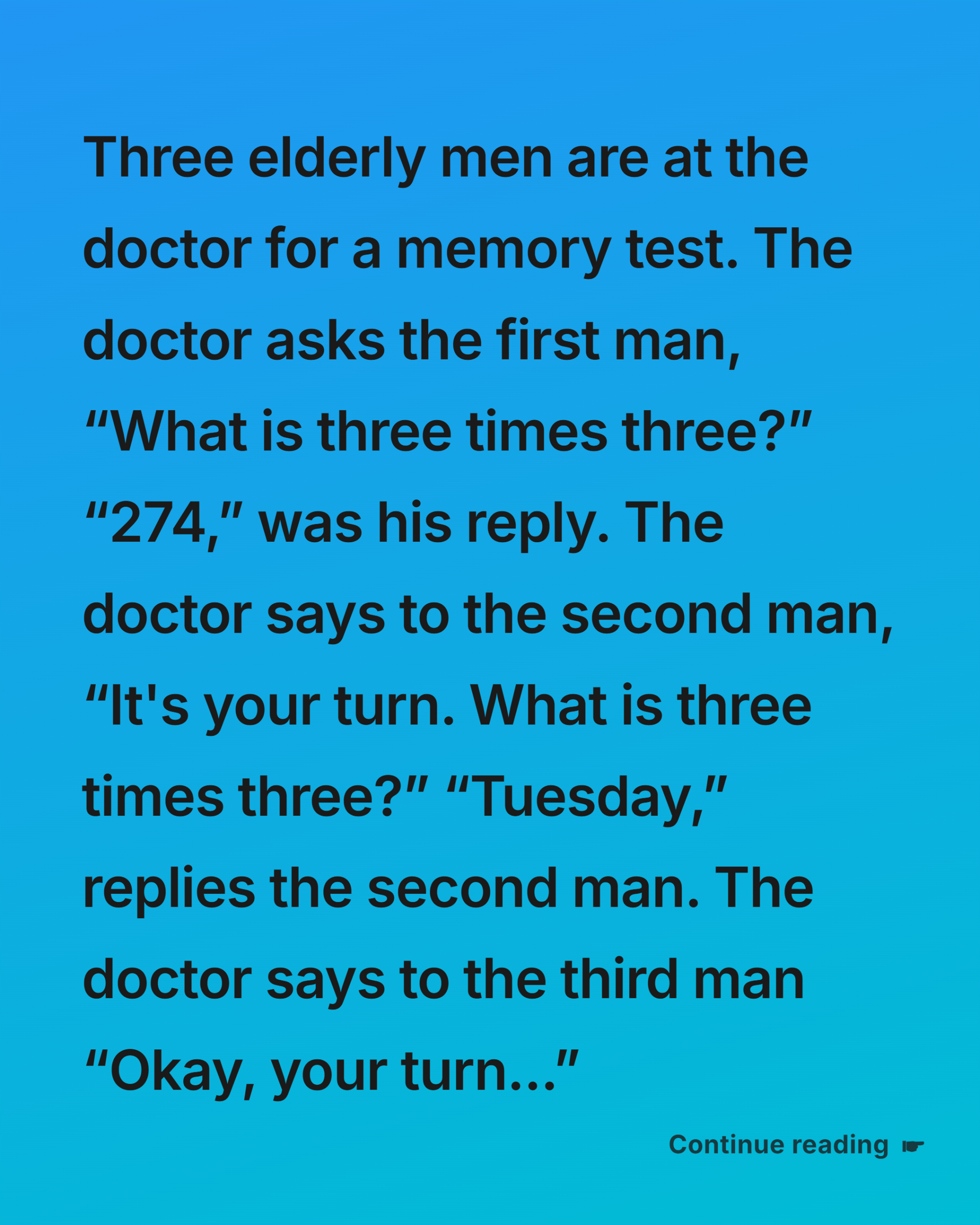
Three elderly men sat in the doctor’s office, waiting for a memory test none of them particularly wanted to take. They had been friends for decades, and although each had joked about growing older, the idea of having their minds measured made them unusually quiet. The doctor began with the first man: “What is three times three?” The man puffed out his chest and proudly answered, “274.” The doctor kept a polite smile, jotting down a note while wondering how on earth he arrived at that number. Turning to the second man, he asked the same question.
“Tuesday,” the second replied confidently, as if math and calendars worked the same way. The doctor nodded, amused and bracing himself for the third answer. The nurse standing near the doorway covered her mouth, already struggling not to laugh. The third man looked at the doctor with a strangely serious expression, as though the entire fate of the examination rested on his answer. For a few seconds, nobody spoke.
But after a thoughtful pause, the third man calmly answered, “Nine.” The doctor raised his eyebrows—finally, someone got it right. But then the man leaned forward and added proudly, “Because I used your calculator when you weren’t looking.” The room went completely silent for one stunned second before everyone burst into laughter. Even the doctor had to put down his pen because his hands were shaking from laughing. In that moment, he realized these men were coping with age in the way many do—not by pretending the years haven’t passed, but by facing them with humor, friendship, and resilience.
Rather than continue with rigid testing, the doctor shifted the visit. He closed the folder containing his notes and invited them to share stories from their youth—adventures, mischief, triumphs, and the moments they still remembered as clearly as if they had happened yesterday. The first man immediately recalled building radios from spare parts, describing how he once stayed awake all night trying to make one work, only to discover the next morning that he had connected the wrong wires.
The second spoke about traveling from town to town with nothing but curiosity, a battered suitcase, and just enough money to get to the next place. He remembered strangers who became friends, unexpected jobs, missed trains, and one unforgettable night when he slept beneath the stars because he had spent his last coins on dinner. The third reminisced about fixing clocks, insisting that even when time falters, life keeps ticking forward. He told the doctor that he could still remember the sound of tiny gears clicking into place and the satisfaction of watching a clock that had been silent for years suddenly begin to move again.
Their stories warmed the room, reminding the doctor that memory isn’t only measured by numbers—it’s held in the experiences that shaped us, the people we loved, the mistakes we survived, and the laughter we refuse to lose. The doctor noticed something else, too. Although the men struggled with certain questions, they remembered emotions, sounds, faces, places, and stories with remarkable detail. Their memories had not disappeared; they simply lived in different places than a test could measure.
Before they left, the first man looked at the doctor’s clipboard and asked, “So, Doctor, how did we do?”
The doctor smiled. “Honestly? I’m not sure.”
The three men exchanged worried glances.
Then he added, “But I’ve learned something today. A person can forget an answer and still remember how to make everyone in a room laugh. That counts for something.”
The men grinned, and the third man pointed toward the doctor’s calculator. “Keep that hidden next time.”
The following week, the doctor had an idea. Instead of treating memory as something that could only be tested with numbers and questions, he created a weekly “Memory Circle,” a small gathering where seniors could tell stories, play games, solve puzzles, share jokes, listen to music, and most importantly, talk to one another. At first, only the three men attended. Then they invited friends. Those friends brought neighbors, and soon the little group became something much larger.
Weeks later, the once-quiet waiting room was filled with chatter and joy. People who had once arrived with their heads down were now arguing over old songs, laughing about youthful mistakes, and competing fiercely over simple games. The three original friends became the unofficial leaders of the group. The first taught others how to build simple radios, the second told stories about his travels, and the third began bringing broken clocks from home so everyone could watch him repair them.
One afternoon, the doctor walked into the room and found all three men gathered around a table. In the middle sat an old clock that had stopped years earlier.
“What’s the problem?” the doctor asked.
The third man smiled mysteriously. “We’re trying to bring it back to life.”
The doctor watched as the three friends carefully examined the tiny gears. They disagreed, laughed, argued, and finally worked together until the second hand suddenly jerked forward.
Tick.
Everyone froze.
Tick.
Then the room erupted in applause.
The third man leaned back in his chair and smiled. “See, Doctor? I told you. Even when time falters, life keeps ticking.”
The doctor looked around the room at the smiling faces and realized that the lesson had never really been about memory tests. It was about refusing to let age convince you that your best moments were already behind you.
And though the three men still mixed up a fact or two—and occasionally gave answers that made absolutely no sense—they discovered something far more important: age may change the mind, the body, and the pace at which we move through the world, but it never dims the value of a life well lived.
Sometimes, the most important things we remember aren’t the answers to three times three.
They’re the people who made us laugh when we were afraid of forgetting, the stories we carried for a lifetime, and the friendships that stayed beside us as the years quietly ticked away.