
WASHINGTON: As the conflict with Iran continues with no clear end in sight, internal divisions within the White House are shaping US President Donald Trump’s evolving public stance on the war, with advisers debating when and how to declare victory while the crisis spreads across the Middle East.
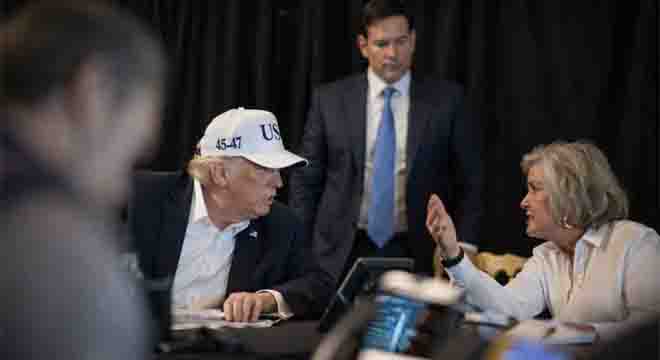
According to sources familiar with the discussions, a complex tug-of-war has emerged among Trump’s advisers. Some officials are warning that rising gasoline prices and economic pressure could create political fallout from the US-Israeli military campaign against Iran. Others, particularly hawkish figures in Washington, are urging the president to maintain military pressure on Tehran.
The behind-the-scenes debate offers a rare look into the administration’s decision-making as it manages the largest US military operation since the 2003 Iraq war.
Trump, who returned to the White House last year promising to avoid “stupid military interventions,” now faces growing political and economic stakes nearly two weeks after launching the conflict on February 28. The war has shaken global financial markets and disrupted international oil supplies.
Mixed Messages From the President
In recent days, Trump’s messaging on the war has appeared inconsistent. While he initially presented the campaign as a broad effort against Iran, he has recently described it as a limited operation whose main objectives have already been achieved.
At a campaign-style rally in Kentucky on Wednesday, Trump declared that “we won” the war, before adding moments later: “We don’t want to leave early… we’ve got to finish the job.”
The shifting signals have created uncertainty in global energy markets, which have reacted sharply to the president’s statements.
Economic advisers from the Treasury Department and the National Economic Council have warned that an oil shock and higher gasoline prices could quickly erode public support for the war.
Political advisers, including White House Chief of Staff Susie Wiles and deputy chief James Blair, have reportedly urged Trump to define victory narrowly and signal that the military campaign is limited and nearing completion.
Pressure From Hawks and Populists
At the same time, hawkish voices — including Republican senators Lindsey Graham and Tom Cotton — are pushing the administration to sustain military operations against Iran, arguing the United States must prevent Tehran from obtaining nuclear weapons and respond forcefully to attacks on US forces and shipping.
A third pressure group comes from Trump’s populist political base. Figures such as strategist Steve Bannon and television personality Tucker Carlson have warned against being drawn into another prolonged Middle East war.
According to one adviser, Trump is attempting to balance these competing pressures — allowing hawks to believe the campaign will continue, reassuring markets that the conflict may soon end, and convincing his political base that escalation will remain limited.
Responding to the reports, White House Press Secretary Karoline Leavitt dismissed the claims, saying the story relied on speculation from anonymous sources.
“The president is known for listening to many perspectives,” she said in a statement, “but ultimately he is the final decision-maker and his team remains focused on achieving the objectives of Operation Epic Fury.”
Searching for an Exit Strategy
Trump has offered varying explanations for launching the war, ranging from preventing an imminent Iranian attack to crippling its nuclear programme and even weakening its leadership.
Behind the scenes, advisers are reportedly encouraging the president to move toward an exit strategy that can be presented as a military success, even if Iran’s leadership remains in place and parts of its nuclear programme survive.
US and Israeli air strikes have killed several Iranian commanders and significantly damaged Iran’s missile capabilities, naval assets and regional proxy networks.
However, Iran has responded by escalating attacks on oil tankers and shipping facilities in the Gulf, pushing global oil prices higher.
Strait of Hormuz Crisis
The Strait of Hormuz — a crucial waterway through which roughly one-fifth of the world’s oil supply passes — has become central to the conflict’s outcome.
Shipping through the narrow strait has slowed dramatically after Iranian forces struck vessels in nearby waters. Iran’s new Supreme Leader Mojtaba Khamenei has vowed to keep the strait closed in response to the US-Israeli assault.
If the disruption drives US gasoline prices sharply higher, analysts say domestic political pressure could grow on Trump to end the military campaign, particularly ahead of November’s midterm elections where Republicans are defending narrow congressional majorities.
A Harder Fight Than Expected
Some of the confusion surrounding the war’s direction may stem from comparisons within the administration to the rapid US success in Venezuela earlier this year, when a surprise operation led to the capture of President Nicolas Maduro.
But advisers have struggled to convince Trump that Iran — with its entrenched political leadership and stronger military capabilities — represents a far more complex and resilient adversary.
Despite US claims that air strikes destroyed Iran’s nuclear programme, experts say much of the country’s stockpile of highly enriched uranium was buried rather than eliminated, meaning it could potentially be recovered and refined further.
For Iran’s leadership, analysts say simply surviving the US-Israeli military assault may allow them to claim victory domestically.
Meanwhile, Trump’s political base has so far largely remained supportive, giving the president some room to maneuver despite growing criticism of the war’s economic and strategic costs.
Follow the PNI Facebook page for the latest news and updates.