

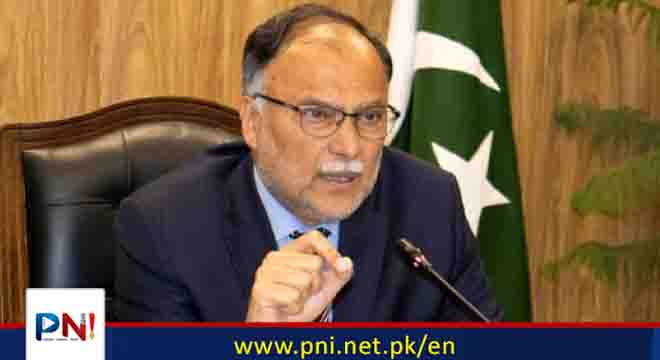
Federal Minister for Planning, Development and Special Initiatives Professor Ahsan Iqbal has clarified his remarks regarding new provinces, saying most of Pakistan’s social and human resource indicators have continuously declined over the last fifteen years and need significant improvement to achieve national development goals.
He said the main reason for the country’s poor performance in the social sector was the lack of transfer of powers and resources to the grassroots level after the 18th Amendment and the centralization of powers at the provincial level.
Ahsan Iqbal said that to accelerate national development, Pakistan needed to overcome its weaknesses in human resources and the social sectors at a very fast pace.
In this regard, he said the country had two options. The first was to establish empowered local governments in 160 districts that would be directly provided resources from the Provincial Finance Commission, or to establish 12 or 15 new provinces through consensus, as the current administrative structure had become overloaded with a population of 260 million.
He further said the formation of 160 district governments was the need of the hour so that powers could be transferred to the lowest level and development could be made possible in backward areas.
He said results in any sector depended on effective implementation of projects and their local monitoring.
The minister said that around the world, powers were being transferred to people’s doorsteps so that service delivery could be brought closer to them, while in Pakistan, no effective action had been taken in this direction.
Ahsan Iqbal clarified that sustainable solutions to public problems were not possible unless powers were transferred to the grassroots level.
He said the success of any administrative structure depended on its ability to change and reform itself according to changing circumstances. “A system that remains static falls apart,” he remarked.
He said the discussion on the country’s administrative structure should remain above political interests and be held in light of the requirements of national development.
He added that politicians themselves should take the matter forward.