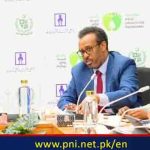


ISLAMABAD: Federal Minister for Planning, Development and Special Initiatives Professor Ahsan Iqbal chaired a multi-party consultative session on civil service reforms, bringing together political leaders, policy experts and sectoral stakeholders to build broad-based ownership of a long-term institutional reform agenda for Pakistan.
The minister highlighted a framework for civil service reforms aimed at building a specialised, merit-based, accountable and technology-enabled public administration capable of responding effectively to Pakistan’s contemporary development challenges, a news release said on Saturday.
The minister said the proposed framework had been developed through approximately 15 meetings of the Prime Minister’s Committee on Civil Service Reforms.
The committee formulated 46 recommendations, with broad agreement reached on 43, while a small number of outstanding issues would be further refined through political and stakeholder consultation.
The session was attended by Senator Saleem Mandviwalla, Federal Minister Abdul Aleem Khan, former federal minister Asad Umar, senior policymakers, sector specialists and other stakeholders.
The consultation was convened to build wider political and institutional ownership of reforms that would have long-term implications for the structure and performance of the state.
Ahsan Iqbal said Pakistan’s administrative structure has roots in a colonial system designed primarily to maintain law and order and collect revenue.
While these functions remained important, he noted that the system had not adequately evolved to address the increasingly complex economic, social, technological and developmental needs of a modern state.
He said an administrative system focused predominantly on regulatory control and revenue collection could not, by itself, deliver the specialised knowledge, institutional capacity and implementation capability required for sustained national development.
Ahsan Iqbal identified five principal features that must be embedded in a modern civil service. First, he said, the country must move towards more professional and domain-specific recruitment.
Under the existing model, allocation to an occupational group was often determined by examination scores without any relevance to an individual’s academic background, professional expertise and assigned responsibilities.
He said this mismatch deprived ministries of the specialised knowledge required for effective policymaking and implementation.
The proposed framework would, therefore, create professional cadres in key sectors so that officers could develop expertise and pursue long-term careers within their respective domains.
The minister said specialised areas such as education, health, finance, information technology, agriculture, engineering and commerce required officers with relevant qualifications, experience and sustained exposure.
Second, he said, the civil service must establish meritocratic leadership by linking appointments and promotions more closely with competence and demonstrated performance.
Career advancement, he stressed, should reflect an officer’s contribution and ability to deliver rather than operate primarily as an entitlement arising from length of service.
Third, the minister called for stronger accountability for results. He said measurable key performance indicators and outcome-based assessments should be incorporated into career management so that individual performance could be evaluated against clearly defined institutional objectives.
Fourth, he emphasised the need to make civil service recruitment more inclusive. He observed that the disproportionate emphasis placed on advanced English-language proficiency could exclude otherwise capable and talented candidates, particularly those educated outside elite institutions.
Ahsan Iqbal said functional proficiency in English was necessary for official responsibilities, but Shakespeare-level language should not become an artificial barrier preventing competent candidates from entering public service.
Fifth, the minister underscored the importance of technological enablement.
He said digital literacy had become indispensable for public administration and that civil servants must be prepared to use artificial intelligence, data systems and digital applications to improve decision-making, productivity and public service delivery.
Ahsan Iqbal said the committee had studied civil service systems in Australia, New Zealand, Malaysia and the United Kingdom, particularly countries with Commonwealth traditions and parliamentary systems.
He said these comparisons demonstrated that modern public administrations had become considerably more open, specialised and merit-driven.
Dr Adnan Rafique, Member Governance at the Planning Commission, briefed participants on the salient features of the proposed reform framework.
Senator Saleem Mandviwalla, Federal Minister Abdul Aleem Khan and former Finance Minister Asad Umar welcomed the consultative initiative and endorsed the need for structural reform, professional specialisation and stronger political ownership of the process.
They supported efforts to move beyond recurring reform reports towards practical and sustainable implementation.
The participants broadly recognised that civil service reform could not be treated as the agenda of a single government or political party.
They stressed that lasting institutional change would require continuity, implementation discipline and ownership across political divides.
Ahsan Iqbal said the participation of leaders with experience in different governments and sectors was intended to develop durable political consensus around the reform process.
He invited participants to assess the recommendations in light of their experience in government and propose measures for strengthening the capacity and effectiveness of the civil service.
The minister reiterated that civil service reform must be pursued as a continuing reform of the state rather than a time-bound initiative of one administration.
A modern, professional and citizen-focused civil service, he said, was essential for translating public policy into measurable development outcomes and equipping Pakistan’s institutions to meet the demands of the digital age.
Following the presentation, Asad Umer said if the proposed framework was implemented, it would be the minister’s biggest legacy and service to Pakistan and “Let it be called the Ahsan Iqbal Committee/Report.”