
By Fakhar-e-Alam
Peshawar came alive with green-and-white flags, patriotic songs and colourful ceremonies as families, students and government officials gathered to celebrate Pakistan’s Independence Day with national enthusiasm.
Among those attending the flag-hoisting ceremony at the Civil Secretariat was seven-year-old Ismail Khan. Dressed in the national colours, holding a small Pakistani flag and sporting green-and-white face paint, he watched the ceremony while standing beside his father.
For Ismail, it was more than a familiar Independence Day ritual—it was the fulfilment of a long-held wish.
As the national flag rose alongside colourful balloons and a police band began playing patriotic music, Ismail’s face lit up. He stood respectfully during the national anthem before dancing joyfully and waving his flag.
“Watching a flag-hoisting ceremony and the police band perform was my dream,” Ismail said. “A big thank you to my father for fulfilling it today.”
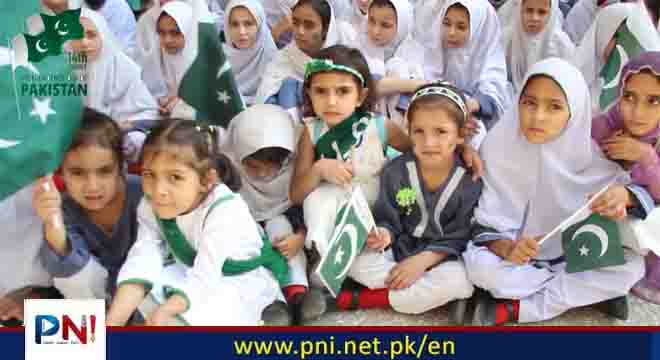
Schoolchildren performed patriotic songs, including Dil Dil Pakistan and Sohni Dharti Allah Rakhay, filling the gathering with excitement. Children waved miniature flags and joined in the singing.
Similar ceremonies were held across Peshawar at Governor House, Police Lines, Peshawar Railway Station, Islamia College, the University of Peshawar and the offices of the commissioner and deputy commissioner.
Flag-hoisting events were also organised at deputy commissioner offices throughout Khyber Pakhtunkhwa, including the seven merged tribal districts.
By midday, green and white dominated the city. National flags fluttered from rooftops, public buildings, cars and motorcycles, while children dressed in patriotic colours moved through markets carrying flags and wearing badges.
Peshawar’s historic Qissa Khwani Bazaar was crowded with families buying Independence Day merchandise. Shops displayed wristbands, caps, scarves, horns, sunglasses, brooches, stickers, ribbons and decorative pins in the national colours.
Twelve-year-old Malaika Khan, who was shopping with her mother, said Pakistan was a beautiful homeland and its citizens should work together for its progress.
“We should love our country, respect our elders, help others and work hard to make Pakistan strong and successful,” she said.
Her mother, Sumbul Bibi, said Independence Day should remind parents of their responsibility to raise honest, compassionate and responsible citizens.
“Freedom is not only a gift but also a responsibility,” she said. “Love your country, respect its people, value its diversity and always stand for truth and justice.”
Ten-year-old Ibrahim Khan, who was also buying Independence Day accessories, urged people to treat the national flag respectfully.
“The flag should never be allowed to touch the ground, become damaged or be discarded as waste after the celebrations,” he said.
He added that badges, ribbons, caps and flags might be temporary, but their message of national unity, responsibility and pride should endure.
The national flag remained the central symbol of the celebrations. Its green field represents Pakistan’s Muslim majority, while the white stripe represents religious minorities. The crescent symbolises progress, and the star stands for light and knowledge.
The celebrations also revived memories of Pakistan’s struggle for independence and the vision of Quaid-e-Azam Muhammad Ali Jinnah.
Former ambassador Manzoorul Haq said Pakistan was created through the sacrifices of its forefathers, and the best tribute to them would be to follow the principles of unity, faith and discipline.
He recalled Quaid-e-Azam’s emphasis on education and his repeated appeal to young people to work hard and contribute to national development.
Former Islamia College Pakistan Studies Department chairman Muhammad Younas Khan said the institution had played an important role in the Pakistan Movement. Quaid-e-Azam visited Islamia College Peshawar in 1936, 1945 and 1948 and acknowledged the contributions of its students.
During his address at the college on April 12, 1948, Pakistan’s first governor-general described students as the future builders of the country and urged them to work with dedication, sincerity and discipline.
Eight decades later, that message continues to resonate as a new generation gathers beneath the national flag.
Throughout the day, families decorated their homes and vehicles, children rode bicycles adorned with flags, and young people posed for photographs in green-and-white clothing.
For Ismail, however, the celebration remained deeply personal. His joyful dance beneath the fluttering national flag reflected the happiness of a child whose dream had come true.
It also symbolised the passing of national hopes, memories and values from one generation to the next.
For children such as Ismail, Malaika and Ibrahim, Independence Day offered not only an opportunity to celebrate Pakistan but also an early lesson in what it means to belong to—and help build—their country.