The first time I met Harper, she was seven years old and holding a half-eaten grape popsicle that was dripping onto her white sundress. She looked at me with eyes that were far too old for her face and told me, quite plainly, that she didn’t need another person to tell her when to go to bed. I didn’t push back then, and I didn’t push back for the next decade, even as those small defiances grew into a wall of cold granite. For ten years, the refrain was always the same: “You’ll never be my real mom.” It was a phrase she used like a shield, or maybe a weapon, whenever I tried to show her a sliver of affection or guidance. Every birthday, every Christmas, every family photograph seemed to remind me that I was standing just outside the place in her heart where I desperately wished I belonged.
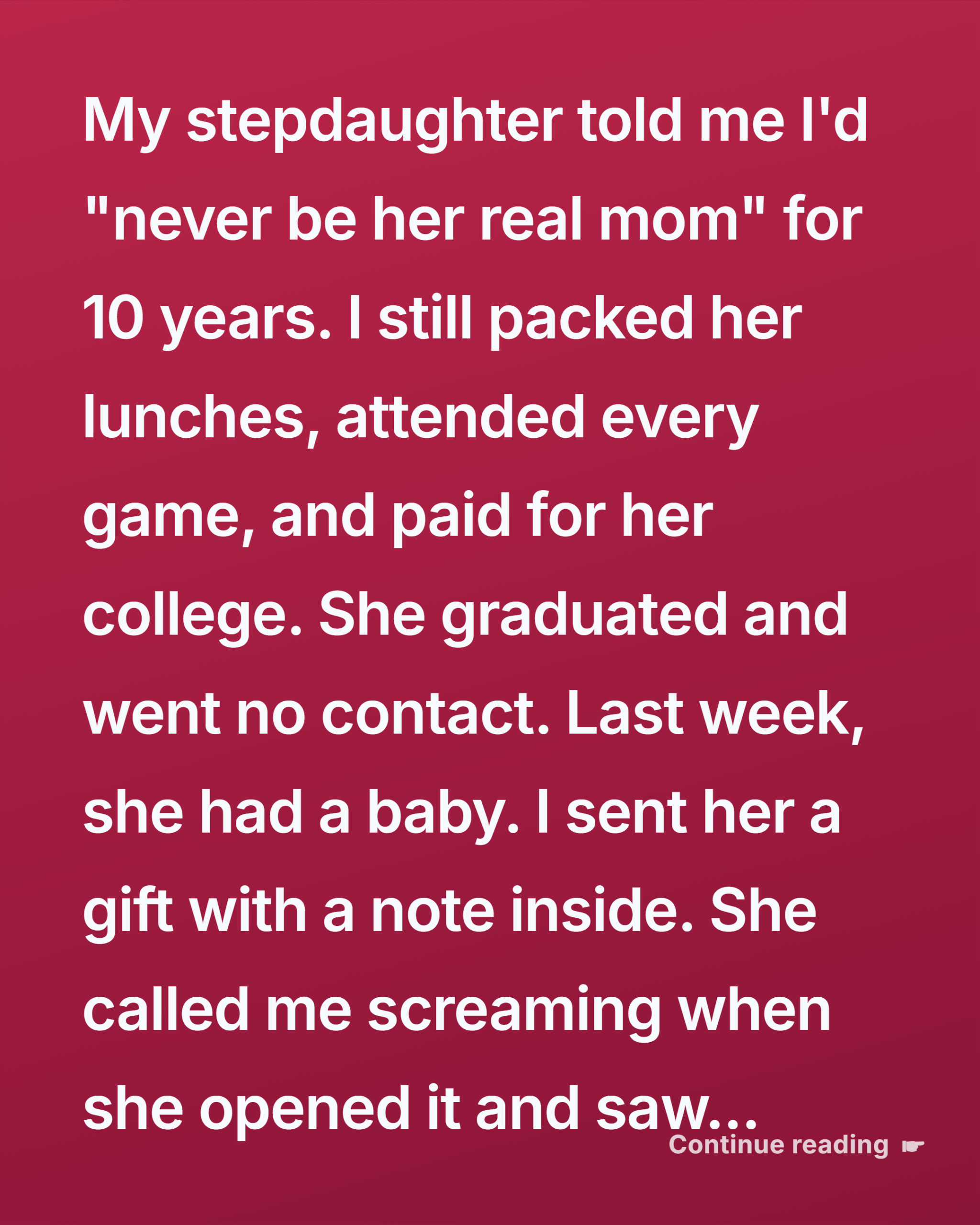
I didn’t let it stop me because I had made a promise to her father, Julian, and more importantly, a promise to myself. I packed her lunches every single morning, making sure to cut the crusts off just the way she liked even when she wouldn’t look at me at the breakfast table. I attended every single field hockey game, sitting in the freezing rain in a fold-out chair while she purposely avoided looking toward the bleachers where I sat. When the time came for university, I dipped into the inheritance my own parents had left me to ensure she could go to her dream school in London without a single debt to her name. I did it all without expecting a thank you, though a small part of me always hoped the wall might eventually crumble. Julian often told me I was doing more than anyone could ever ask, but I never saw it that way. Loving Harper had never felt like an obligation. It felt like breathing.
Instead of crumbling, the wall became a fortress once she moved out. After her graduation ceremony—a day where she took photos with everyone except me—she simply stopped answering my calls and texts. It wasn’t a loud argument or a dramatic falling out; it was just a slow, deliberate fade into silence. My messages were delivered but never answered. Birthday cards came back unopened. Christmas gifts disappeared into the postal system without acknowledgment. Julian was heartbroken, caught between the woman he loved and the daughter he adored, but I told him to let her have her space. I figured that maybe, out there in the real world, she would finally find the peace she couldn’t seem to find while living under my roof. Secretly, though, every unanswered call felt like another door quietly locking.
Three years of silence passed, marked only by the occasional update Julian would get from his sister. We found out she had moved to a small town in the Cotswolds and had started a career in interior design. Then, the biggest news of all came through the grapevine: Harper was pregnant. My heart leapt for her, but it also ached with the realization that I probably wouldn’t be allowed to be a grandmother to that child. I spent weeks knitting a blanket in a soft, neutral cream color, pouring every bit of unspoken love I had for her into the stitches. More than once I found myself stopping halfway through a row because my eyes had blurred with tears. I wondered if the blanket would ever touch the baby it had been made for.
Last week, Julian told me that Harper had given birth to a healthy baby girl named Elsie. I didn’t want to intrude or cause stress during such a delicate time, so I didn’t show up at the hospital or call her cell phone. Instead, I carefully wrapped the blanket and a small, antique wooden music box that had been in my family for three generations. Inside the music box, I tucked a small, hand-written note that I had spent hours composing. Before sealing the lid, I hesitated with my fingers resting on the tiny brass clasp. There was something I had never checked—a hidden compartment beneath the velvet lining that had remained unopened for years. I almost looked inside, but the courier was already waiting outside, so I closed the box, convinced there was nothing left in it except old memories. I sent the package off via a courier, sat back on my porch, and waited for a reaction I wasn’t even sure would come.
The reaction came three days later in the form of a phone call that started with screaming. I picked up the phone to hear Harper’s voice, raw and frantic, demanding to know why I would send her “that thing.” She was sobbing, the kind of deep, chest-heaving sobs that make it hard to breathe, and she kept repeating that I had no right to do this to her now. My stomach dropped. For one terrifying moment, I thought something inside the package had hurt the baby or that the antique music box had somehow broken apart. I stayed quiet, letting the storm of her emotions wash over me, waiting for the moment the anger turned into something else. She finally caught her breath and asked, “How did you know? How could you possibly have kept this from me for so long?” The question stunned me because I genuinely had no idea what she was talking about.
What Harper had seen when she opened that music box wasn’t just a note, but a folded piece of yellowed parchment tucked into a hidden compartment at the bottom. It was a letter written twenty-two years ago by her biological mother, Catherine, just weeks before she passed away. I had completely forgotten that the music box even had a secret compartment. Catherine and I had actually been close friends in college, long before I ever started dating Julian. When she knew she was sick, she had sat me down in a hospital cafeteria and asked me for a favor that seemed impossible at the time. She asked me to look after Julian, and if the stars ever aligned, to look after the daughter she wouldn’t get to see grow up. After her death, Julian had quietly placed Catherine’s letter inside the music box, telling me he would only reveal it if Harper ever truly needed it. Over the years, grief and time had buried that memory so deeply that I had unknowingly mailed the box exactly as he had stored it.
Harper never knew that I hadn’t just stumbled into her life by accident or through a random dating app. I had spent years watching from the periphery, honoring Catherine’s memory by making sure Julian didn’t spiral into despair. When we eventually fell in love, it was built on a foundation of shared grief and a mutual devotion to the little girl Catherine had left behind. I had kept my silence because Catherine’s final wish was for Harper to love me for who I was, not because a letter told her she had to. I wanted to earn my place in her heart on my own merits, even if it took a lifetime. There were countless evenings when I considered telling Harper the truth, but every time I looked at her, I knew forcing the story upon her would only make her feel manipulated. Some truths have to arrive at exactly the right moment—or they become just another burden.
In the letter, Catherine described the exact shade of Harper’s eyes and the way she hoped her daughter would grow up to be fierce and independent. She specifically wrote: “If you are reading this, it means the woman holding this letter has been there for all the moments I missed. She isn’t a replacement; she is the answer to a prayer I made when I was at my weakest.” Harper told me through her tears that she had spent ten years hating me because she felt that loving me was a betrayal to the mother she lost. Seeing her mother’s own handwriting giving her “permission” to love me had shattered the guilt she had been carrying like a heavy stone. She admitted she had read the letter over and over again until the paper had become damp from her tears.
But there was a second revelation that day that I hadn’t expected either. As Harper calmed down, she confessed that the reason she had gone no contact wasn’t out of lingering hatred, but out of deep, paralyzing shame. She told me that during her first year of college, she had realized how much I had sacrificed for her, and she didn’t know how to apologize for a decade of cruelty. Every tuition payment, every packed lunch, every late-night ride home and every quiet act of love came rushing back to her all at once. She felt that it was easier to disappear than to face me and admit she had been wrong about everything. She had been living in a self-imposed exile, thinking she didn’t deserve the kindness I had always shown her. The longer she stayed away, the more impossible coming home seemed.
“I named her Elsie,” Harper whispered into the phone, her voice finally steady. “It was my mother’s middle name, but I also chose it because it sounded like your mother’s name, Elena. I wanted her to have a piece of both of you, even if I was too scared to tell you.” I felt a warmth spread through my chest that I hadn’t felt in years, a sense of completion that bypassed all the old hurts and “never be my mom” barbs. The music box was playing a soft lullaby in the background of the call, the same tune I used to hum outside her door when she had nightmares as a child. For the first time since she was seven years old, I could hear something in her voice that had never been there before: trust.
We talked for four hours that day, bridging the gap of a decade with every word. She told me about the labor, the way the baby smelled like milk and sunshine, and how Julian had already sent her a dozen roses. She invited me to come visit the following weekend, not as a guest, but as a grandmother who was desperately needed. I realized then that my persistence hadn’t been in vain; it had just been waiting for the right key to unlock the door. The letter was that key, but the years of packed lunches and attended games were the house that the key finally opened. Without those years of quiet devotion, the words on that faded parchment would never have carried the same weight.
The following Saturday, I drove to the Cotswolds with a heart full of nervous energy. Every mile felt longer than the last. I kept wondering whether the phone call had been an emotional moment that might disappear by morning. When I pulled up to the small cottage, Harper was standing in the doorway holding a bundle wrapped in the cream-colored blanket I had knitted. She didn’t say a word as I walked up the path; she just stepped forward and tucked the baby into my arms. For one suspended moment, neither of us moved. Then, for the first time in my life, Harper didn’t pull away when I reached out to touch her hair. She leaned her head on my shoulder and whispered, “Hi, Mom,” and the wall that had stood between us for more than a decade finally, beautifully, turned to dust.
I spent the weekend changing diapers, making tea, and listening to Harper talk about her dreams for Elsie. We didn’t dwell on the ten years of silence or the harsh words of her teenage years. We focused on the fact that Elsie now had an entire village of people who loved her, both on earth and watching from somewhere else. I looked at the music box sitting on the nursery shelf and felt a profound sense of gratitude for Catherine’s foresight. What had seemed like an ordinary family heirloom had quietly carried the truth through twenty-two years of heartbreak until the exact day it was needed most. She knew that motherhood isn’t just about biology; it’s about the person who stays when things get hard.
This journey taught me that love isn’t always a straight line; sometimes it’s a long, winding road with dead ends and steep climbs. You can’t force someone to see your heart, but you can keep your heart open until they are ready to look. Being a “real” parent isn’t about the title you’re given at birth, but the consistency of your presence in the shadows. It’s about being the person who holds the flashlight when everyone else has turned out the lights—and trusting that one day, even after years of darkness, the person you never stopped loving will finally find their way home.