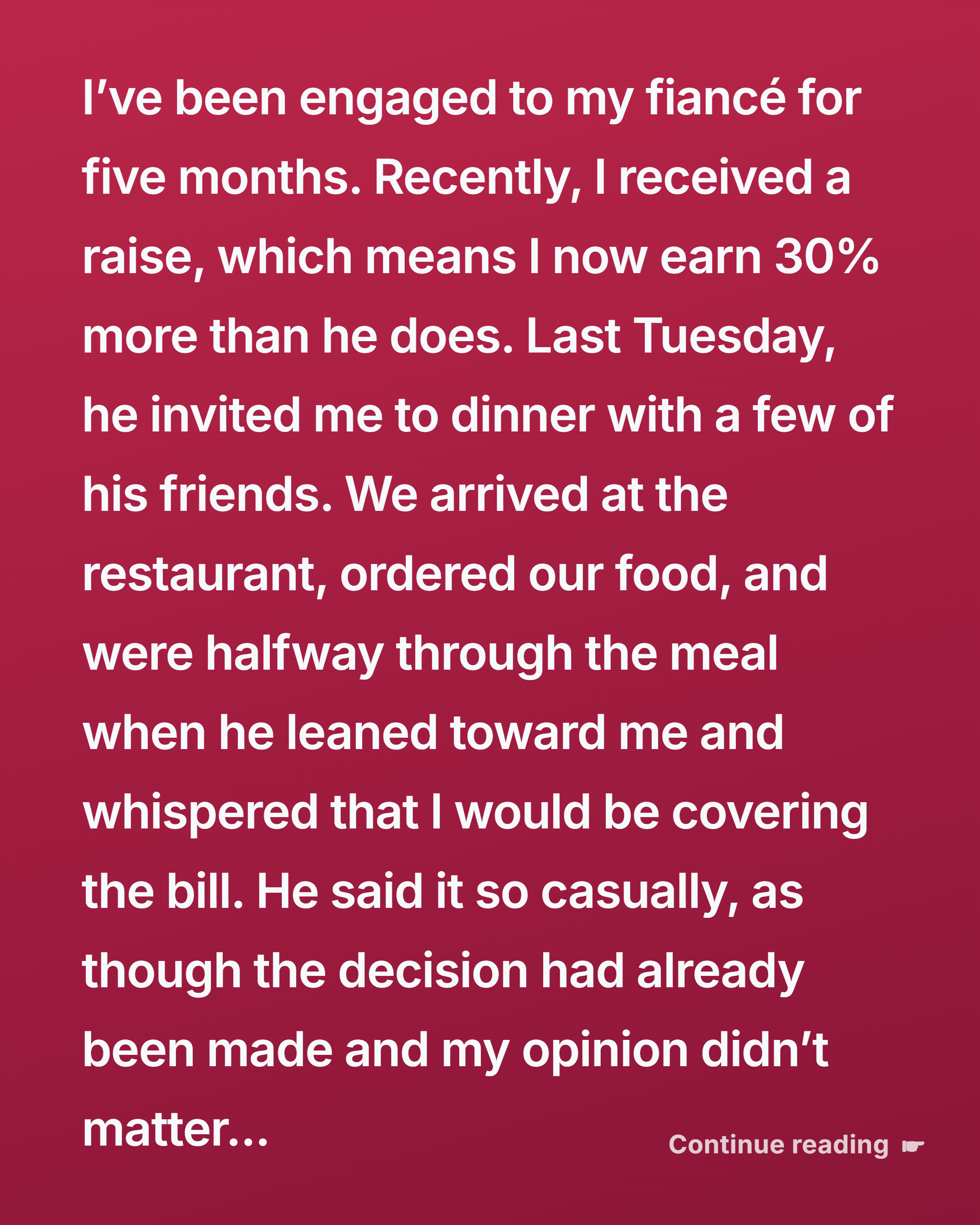
I’ve been engaged to my fiancé for five months. Recently, I received a raise, which means I now earn 30% more than he does.
Last Tuesday, he invited me to dinner with a few of his friends. We arrived at the restaurant, ordered our food, and were halfway through the meal when he leaned toward me and whispered that I would be covering the bill. He said it so casually, as though the decision had already been made and my opinion didn’t matter.
He was convinced I wouldn’t make a scene in front of his friends. With a smug little smile, he added, “30%, remember?” I was absolutely fuming inside, but instead of giving him the reaction he expected, I decided to play along and teach him a lesson he wouldn’t forget. So I smiled sweetly and replied, “Of course, honey. But…”
“…I left my wallet at home. Can you spot me first?”
He blinked at me. For a moment, his confident smile faltered, and I watched as he struggled to figure out what to say next. The boldness he’d displayed just seconds earlier seemed to evaporate. Meanwhile, his friends continued laughing about something trivial, completely unaware of the little standoff happening at our end of the table.
“I, uh… didn’t bring enough money for everyone,” he mumbled, suddenly looking much less confident. I leaned closer, still wearing my sweetest smile, and whispered, “Then maybe next time, don’t volunteer my wallet without asking me first.”
I ended up paying the bill that night—*this time.* But as I handed over my card, I realized something important: this wasn’t an isolated incident. It was becoming a pattern, and the more I thought about it, the harder it was to ignore. That little exchange at dinner had brought something into focus that I’d been trying not to see.
Last month, he had signed us up for a weekend getaway with another couple. Everything had apparently been arranged, and we were already halfway to our destination when he casually dropped the financial bombshell. *“You’ve got this, right? You make more now.”* He said it as though my raise had automatically made every shared expense my responsibility.
That line was becoming his favorite excuse for everything. Whether we were going out with friends, making plans for the weekend, or discussing something as simple as dinner, he somehow managed to turn my promotion into a reason I should pay. And whenever I hesitated, he acted as though I was being unreasonable for not wanting to foot the bill.
I started thinking back to when we first met. He had been sweet, attentive, and thoughtful, and he had never made me feel as though money determined the value of our relationship. We used to enjoy spending time together without keeping track of who paid for what. But after I received my promotion, something changed. At first, it was subtle—little jokes about having a “sugar mama” or how he could “retire early” if I kept moving up the career ladder. Back then, I’d laughed along, assuming he was simply teasing me. Now, those same jokes felt less like harmless humor and more like little tests to see how much he could get away with.
The problem was never the money itself. I have always believed that treating the people you love is one of the small pleasures of life, and I had no objection to occasionally paying for dinner or covering a trip. What bothered me was the assumption that my success gave him the right to make financial decisions on my behalf. I didn’t mind being generous, but I absolutely *did* mind being manipulated.
So I decided to test him back. I wanted to see whether he could appreciate my generosity when it was freely offered or whether he had started viewing it as something he was automatically entitled to. I also wanted to find out how he would behave when the situation was set up in a way that gave him every opportunity to show me who he really was.
The following Friday, I invited him and a few of my friends out for drinks. I chose a relaxed rooftop bar decorated with fairy lights, with live acoustic music playing in the background. It was the kind of place that felt romantic without being overly formal, perfect for a casual evening with good company. Before we left, I casually mentioned, “I’ve already booked a booth and a few bottles. Don’t worry, it’s on me tonight.”
His eyebrows shot up, and for a second, he looked genuinely surprised. “Really?”
I shrugged as though it were no big deal. “You’ve been stressed lately, and I thought I’d treat *you* for once.” I wanted him to understand that I was perfectly happy to spend money on him when it came from a place of affection rather than obligation.
He immediately brightened, leaned over, and kissed my cheek. “You’re the best.”
The evening started pleasantly enough. Everyone was chatting, the music was good, and my friends seemed to be enjoying themselves. They had all adored my fiancé—or, at least, they *used to.* As the night went on and a few drinks loosened everyone up, he leaned back in his seat and announced, loudly enough for the entire group to hear, “Must be nice having a rich fiancée, huh?”
One of my friends, Amanda, shot me a quick, questioning look. I forced a laugh and brushed off his comment, not wanting to turn a fun evening into an uncomfortable confrontation. But even as I laughed, I felt that familiar irritation creeping back in. Why did he always have to turn my accomplishments into a joke about what I could buy him?
Unfortunately, that wasn’t the end of it. When the check arrived, I paid exactly as I had promised. I was prepared to cover the evening, so the bill itself wasn’t an issue. But just as I finished paying, he added, “She can afford it. She’s management now, remember?”
His words stung more than I expected. I had invited everyone because I wanted to spend time with them, not because I wanted to put my salary on display. Yet he seemed determined to make sure everyone understood that my promotion meant I could afford whatever he wanted. For the first time, I felt embarrassed—not about my income, but about the way the man I planned to marry was using it to make me the punchline.
Later, Amanda walked with me to the restroom. Once we were away from the others, she turned to me and asked gently, “Hey… does he always talk like that? About your money?”
I let out a tired sigh. “Lately, yeah. It’s like he thinks I owe him something just because I got promoted.” Saying it aloud made the situation sound even worse than it had in my head. I had spent weeks making excuses for him, telling myself he was joking or adjusting to the change in our incomes. But I was beginning to wonder whether I had been giving him too much credit.
Amanda tilted her head and studied me for a moment. Then she asked a question I hadn’t expected: “Does he *support* you? I mean, really support you? Not just when things are going well for him, but when it comes to your goals, your happiness, and the things that matter to you?”
I opened my mouth to answer, but nothing came out. I wanted to say yes. I wanted to believe that the man I had agreed to marry was still the same thoughtful person I had fallen in love with. But if I was being completely honest with myself, I couldn’t answer her question truthfully without admitting that something fundamental had changed between us.
Over the next few weeks, I began paying closer attention to his behavior. I stopped brushing off the little comments and started looking at them as part of a bigger picture. And the more I observed, the harder it became to deny what was happening. What I had initially dismissed as a few thoughtless jokes was turning into a consistent pattern of entitlement.
He wasn’t proud of me—he was *using* me. That realization hurt, especially because I had genuinely wanted to celebrate my success with him. Instead of seeing my promotion as something we could both be happy about, he seemed to view it as an opportunity to make his own life easier at my expense.
He would conveniently leave his wallet at home, suggest hosting game nights that I would end up paying for, and find subtle ways to turn ordinary plans into expenses I was expected to cover. Whenever I gently pushed back, he would pout, act wounded, and repeat the same tired line: “Well, *you* make more.” It was as though that single fact settled every argument before it even began.
One evening, after another round of those comments, I decided I had reached my limit. I asked him to sit down with me because I wanted to have an honest conversation before resentment took over completely. I wasn’t interested in starting a fight, but I also wasn’t willing to keep pretending that everything was fine.
“I’ve noticed you’ve been making a lot of comments about my raise lately,” I began, trying to keep my voice calm.
He chuckled and shrugged. “Well, you’re the breadwinner now! I’m just adjusting.” He delivered the line as though it were an obvious joke, as if I were supposed to laugh and move on rather than question what he meant by it.
“But are *you* adjusting,” I asked, holding his gaze, “or are you just riding the wave?” I wanted him to consider the difference between adapting to a change in our financial circumstances and taking advantage of it.
He blinked, clearly caught off guard. “What’s that supposed to mean?”
“It means you don’t ask *me* if I want to pay. You simply *expect* me to pay, and that’s not okay. I’m happy to contribute more when we agree on it, but I’m not going to have every expense dumped on me just because I earn more.”
He scoffed and leaned back, immediately turning defensive. “Wow. So now I’m a gold digger?”
I took a slow breath before answering. “I didn’t say that. But the way you’ve been acting lately doesn’t make me feel as though we’re equals anymore. It feels like you see me as an ATM with a ring attached to it. And that is not the kind of relationship I want to build a marriage around.”
His expression hardened. “You think I don’t contribute? I clean the house, I cook—”
“You cooked *twice* last month, and the cleaner comes every Thursday, which I pay for.” The words came out more bluntly than I had intended, but I was tired of having the conversation reduced to vague claims about everything he supposedly did. I wanted us to talk honestly about the reality of our shared responsibilities, not just the things he could point to when he felt criticized.
Silence settled between us. For once, he didn’t have an immediate comeback. I could tell he hadn’t expected me to challenge him with specifics, and the absence of his usual jokes made the room feel strangely heavy.
I wasn’t trying to humiliate him or turn our relationship into a contest over who contributed more. I simply wanted him to understand that I had noticed what was happening and that I was no longer willing to dance around the truth to protect his feelings. If we were going to get married, we needed to be able to discuss money, responsibility, and respect without one of us turning every disagreement into an accusation.
He sulked for days after that conversation. First, he gave me the cold shoulder, barely speaking to me unless absolutely necessary. Then, almost overnight, his behavior changed. He became unusually affectionate, bringing me flowers, showering me with compliments, and even attempting to cook dinner. The food wasn’t particularly good, but I appreciated the effort and initially hoped that perhaps our conversation had finally gotten through to him.
For a little while, things felt almost normal again. He was attentive, affectionate, and eager to make me smile. I began wondering whether I had been too harsh and whether he was genuinely trying to repair the damage between us. But the longer it went on, the more I noticed that his sudden sweetness seemed to come with an unspoken expectation. It didn’t feel as though he was simply trying to reconnect with me. It felt as though he was trying to soften me up for something.
Sure enough, about a week later, he brought up an idea that made everything click into place. We were talking casually when he suddenly said, “Babe, I’ve been thinking—what if we bought a house together?”
I blinked, surprised by how quickly he had moved from acting hurt over our financial conversation to proposing a major joint investment. “Together?” I asked, making sure I had heard him correctly.
“Yeah!” he replied enthusiastically. “Like, you put up the down payment, and I handle the renovations. I mean, you know I’ve always wanted to flip houses!” He spoke with the excitement of someone describing an exciting new adventure, but there was a glaring omission in his plan: almost all the financial risk would fall on me.
That was the last straw. Suddenly, his recent flowers, compliments, and badly cooked dinners made a lot more sense. He had no savings to put toward the house and no concrete plan for how the project would work. What he had was a *dream*—and apparently, he expected me to finance it simply because I had the means to do so. He was talking about building a future together, but the more he explained, the more it sounded as though he wanted me to pay for the future he had imagined for himself.
I kept my expression neutral and told him I would think about it. I didn’t want to make a rushed decision in the heat of the moment, and I certainly wasn’t going to agree to a major financial commitment just to keep him happy. Instead, after giving the matter some thought, I called my cousin Dave, who is a lawyer, and asked him for advice about the engagement ring.
It turned out that, under the law in our state, the fact that *I* had purchased the ring—which I had done because he was short on cash at the time—gave me the right to ask for it back. That information settled one practical concern, but it also made me realize how far things had deteriorated. I had bought the ring because I loved him and wanted to take that step together. I had never imagined that I would one day be discussing its return with a lawyer because the relationship had become so unequal.
I didn’t make an announcement or start another argument. Instead, I waited until I felt ready to have the conversation I had been avoiding. One evening, I made us dinner, lit some candles, and put on soft music. I wanted the setting to be calm, not because I was uncertain about my decision, but because I wanted to end things with the same care and dignity I had tried to bring to our relationship.
Over dessert, I put down my fork and said gently, “I’ve been doing a lot of thinking lately.”
He smiled, apparently expecting another conversation about our future. “Yeah?”
“Yeah. About us. About what I want in a partner.” I paused for a moment, gathering my thoughts and making sure I said what I needed to say without getting drawn into another argument.
His smile faltered. Perhaps he sensed that this conversation was different from the others, or perhaps he simply wasn’t accustomed to hearing me speak with such certainty.
“I’ve realized that I want someone who sees my success as *our* success. Someone who celebrates my achievements without treating them as an opportunity to benefit personally. I want a partner who talks to me before making financial decisions that affect us both, and who respects me enough to understand that earning more doesn’t mean I owe him everything.”
“Wait—what are you saying?” he asked, his expression shifting from confusion to alarm.
“I’m saying I don’t think we should get married.” The words hung between us, heavier than I had expected them to feel. Even though I had thought carefully about my decision, saying it aloud made the end of our engagement suddenly, unmistakably real.
He let out a nervous laugh, shaking his head as though he could dismiss the entire conversation with a joke. “You’re joking.”
“I’m not.” I reached for a small box and slid it across the table toward him. “I’d like my ring back.”
He stared at me as if I had slapped him. His face tightened with disbelief, and then his voice rose. “Unbelievable. After *everything* I’ve done for you?”
I looked at him, trying to understand how he could still see himself as the wronged party after everything we had discussed. “You mean letting me pay for your friends’ dinners? Asking me to buy us a house when you have no savings or plan? Or joking about being my kept man in front of everyone? This isn’t about one bill or one bad comment. It’s about the way you’ve treated me since I started earning more.”
He pushed back his chair, stood up, and stormed out without offering a meaningful response. The candles continued flickering on the table, and the dinner we had shared sat between us like the remains of a life I had once imagined would turn out very differently. I sat there for a moment, letting the silence settle, and then finished my dessert in peace. For the first time in weeks, I didn’t feel the need to explain myself or make someone else comfortable with a decision that was right for me.
Two weeks later, I heard that he had moved back in with his parents. My friends were supportive, and although ending a five-month engagement wasn’t exactly how I had imagined this chapter of my life would go, I knew I had made the right decision. Amanda came over one evening with a bottle of wine, settled onto my couch, and said, “I never liked him anyway.” I laughed, grateful for her honesty and even more grateful that I no longer had to defend his behavior to the people who cared about me.
But the real twist came three months later. I happened to run into one of his old friends at a coffee shop, and we fell into the usual small talk. For a few minutes, we chatted about ordinary things, and I assumed that would be the end of it. Then, just as we were about to move on, he asked a question that caught me completely off guard.
“Hey, did you ever find out about the fund?”
I frowned, trying to work out what he could possibly mean. “What fund?”
He looked genuinely confused by my reaction. “The group fund. You know, how we used to split bills and he’d collect the money from us in advance? He said he was pooling it so you wouldn’t have to cover everything alone.” He explained it as though he were reminding me of something I should have known all along.
My stomach dropped. “He *collected* money from you guys?”
He nodded. “Yeah. Every time. Like $40 each. We thought you were just super generous, and he told us the fund was there to help balance things out so you wouldn’t always be paying for everyone.” He seemed surprised that I hadn’t known about it, which made the revelation even more unsettling. As far as he understood, my ex had been collecting contributions from his friends under the impression that the money would help cover shared expenses.
I stood there trying to process what he had just told me. All those dinners, all those occasions when my ex had confidently announced that I could afford to pay, and all those times I had wondered why he seemed so comfortable letting me cover the bill—it was bad enough that he had treated my income as his personal safety net. But if his friends had been handing him money because they believed he was helping ease my financial burden, then he had been allowing them to believe one thing while letting me pay anyway.
So not only had my ex expected me to cover expenses that should have been discussed and shared, but he had apparently been collecting money from his friends while doing it. I couldn’t know from that conversation exactly where every dollar had gone, but the implication was difficult to ignore. The man who had repeatedly told me I could afford everything had also been presenting himself to his friends as someone trying to make things fair for me.
I laughed—not because any of it was funny, but because the revelation was so perfectly in keeping with the behavior I had spent months trying to understand. What I had initially seen as laziness and entitlement now looked even more troubling. It wasn’t just that he had grown comfortable relying on my income; he had apparently been telling other people a story that made him look considerate while concealing the reality of what was happening. The more I thought about it, the more I realized how fortunate I was to have walked away before tying our lives together through marriage, property, and shared financial commitments.
I didn’t argue with him or send a long message demanding explanations. I simply took out my phone and texted him one sentence: “Your friends know.”
He never replied. I don’t know what he told himself after reading that message, and by then, I no longer felt responsible for finding out. Whether he was embarrassed, angry, or simply unwilling to answer didn’t matter to me anymore. Whatever explanation he might have offered would not have changed the choices he had made or the reasons I had ended our engagement.
Since then, life has been calmer. I focus on my work, spend time with the people who genuinely support me, and enjoy the freedom of making decisions without worrying that someone will turn my success into an obligation. I’ve also stopped apologizing for doing well. Earning more money is something I’ve worked for, and I refuse to feel guilty because my career is moving in the direction I hoped it would.
The lesson I’ve taken from all of this is simple: never let someone weaponize your success against you. A healthy relationship isn’t a competition over who earns more, who pays for dinner, or who has the upper hand. Real love doesn’t keep a scoreboard, and it certainly doesn’t involve secretly collecting money from friends while expecting your partner to cover the same expenses. It’s built on honesty, mutual respect, and the understanding that financial differences should be discussed openly rather than used as leverage.
And if someone only claps when *they’re* winning, pay attention. The people who truly love you will celebrate your achievements without trying to turn them into personal benefits. You are not selfish for setting boundaries, and you are not obligated to fund someone else’s dreams simply because you can afford to. Sometimes, knowing your worth means recognizing when a relationship has stopped being a partnership—and having the courage to walk away before you lose even more than money.