Family dynamics, especially with in-laws, can be challenging, and tensions often rise when boundaries are tested. Respect and trust are essential, but when they’re broken, conflicts can quickly escalate. This is especially true when a new baby is involved, adding more emotions to the mix. One Reddit user recently shared her story about a mother-in-law who overstepped a boundary so deeply that it sparked a family-wide conflict and left relationships hanging by a thread.
She wrote:
I (28F) gave birth to my first child, a beautiful baby girl, three weeks ago. My husband (30M) and I have been over the moon, but his mother has been causing nonstop drama.
For context, my MIL never liked me. From the start, she made snide comments about how I “trapped” her son, even though we’ve been happily married for four years. When I got pregnant, she constantly joked about how the baby might not be his. At first, I tried to laugh it off and convince myself it was just another one of her passive-aggressive digs. But deep down, every comment stung. What I didn’t realize was that her suspicions weren’t jokes at all—they were accusations she was willing to repeat behind my back.
She added:
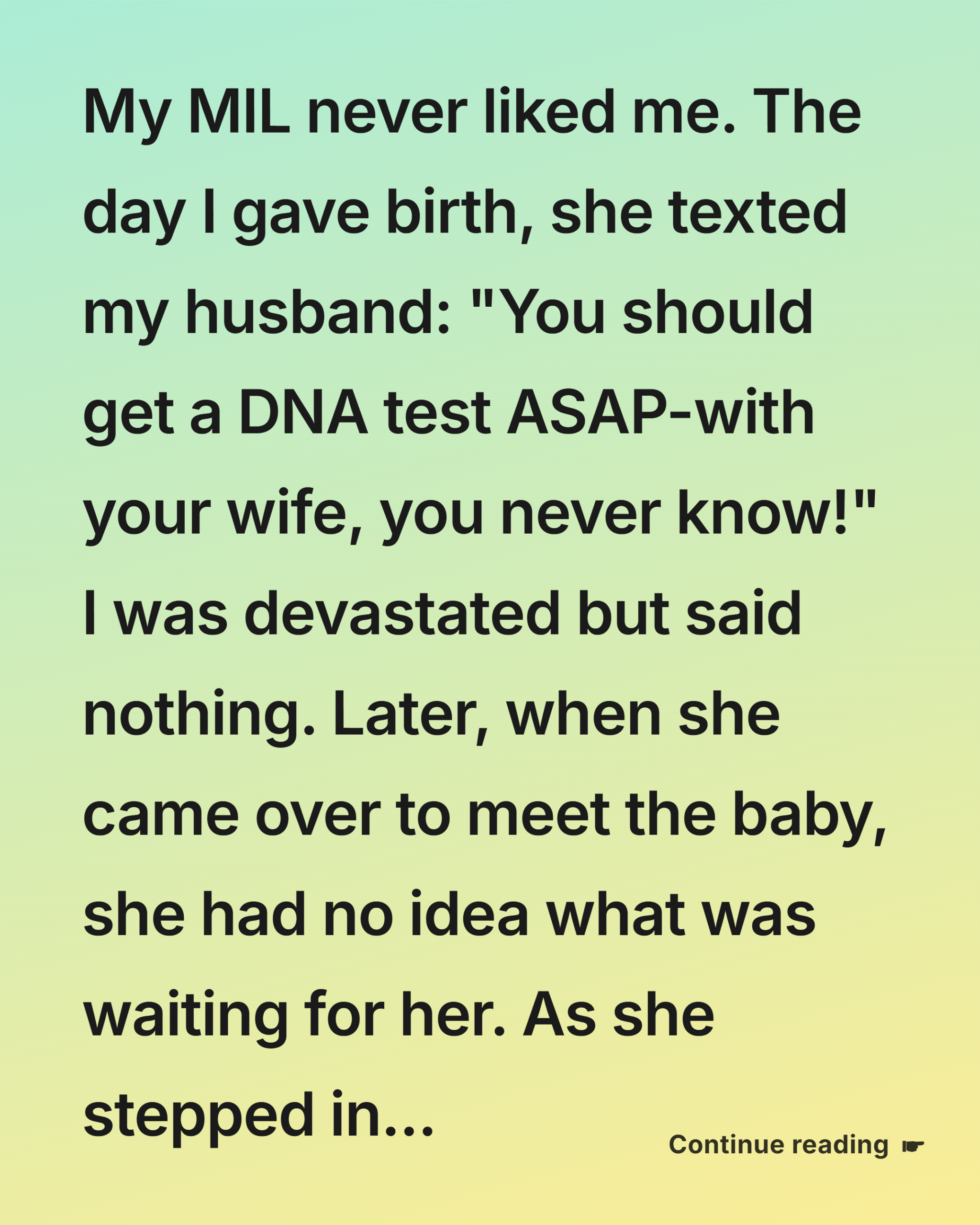
The day I gave birth, she texted my husband: “You should get a DNA test ASAP—with your wife, you never know!” I was devastated but said nothing. My husband was furious and told her off, saying he had zero doubts about me and that her comment was disgusting. She tried to backtrack, saying she was “just looking out for him.”
For days, I replayed those words in my head. While I was recovering from childbirth and adjusting to life with a newborn, I couldn’t stop thinking about the fact that someone who was supposed to be family had openly questioned my loyalty and my child’s identity. Then came the day she was scheduled to meet the baby.
Later, when she came over to meet the baby, she had no idea what was waiting for her. As she stepped in, smiling and eager to hold her granddaughter, the atmosphere immediately changed. I told her that she will not be holding our daughter! If she wants to question whether my child is even her grandchild, then she doesn’t get the privilege of bonding with her.
The room fell silent. Her smile vanished instantly. She looked at my husband, expecting him to intervene, but he stood by my side. For a moment, nobody spoke. Then the tears started. She claimed she had been misunderstood, insisted it was “just a question,” and accused me of trying to turn her son against her. But the damage had already been done.
She concluded, saying:
My husband understands why I’m upset, but he thinks we should let her come “just once” so she doesn’t play the victim with the rest of the family. Now she’s crying to everyone, saying I’m “keeping her granddaughter from her” and that I’m punishing her over a “harmless question.”
Since then, the situation has only escalated. Relatives have started calling, texting, and weighing in. Some are pressuring me to forgive and forget, while others quietly admit that what she said was unforgivable. Every conversation seems to end in an argument, and every family gathering feels like a battle waiting to happen.
Some family members think I’m being dramatic and should “be the bigger person.” But I’ll never let someone who disrespected me and my child hold her like nothing happened! To me, this isn’t about revenge—it’s about trust. And trust, once shattered, isn’t restored simply because someone wants access to a baby.
Other Redditors chimed in with their perspectives, leaving comments under her post such as:
It was not a “harmless question” since a person was harmed by it.
I wouldn’t be allowing her near the child because at some stage, she will gather enough genetic material to do a quiet DNA test to make sure “nothing harmful there, dear.”
Let her play the victim, but the moment any family member comments, point out that she has already expressed doubt that the child is in fact her grandchild, so what’s the problem?
She’ll keep making mean comments, and you’ll be expected to put up with them… Set your boundaries. She doesn’t get to see your child until she gives you a sincere apology. Don’t ever leave the child alone with her because she’ll do a DNA test!
Some family members think I’m being dramatic and should “be the bigger person.” How about all these family members tell her she crossed a line and should apologize because she was way out of line.
This happened exactly to me. My MIL didn’t demand a paternity test (because she was probably scared we would ask for the money from her, probably) but she outright told my late husband that my son was not his. For 2 years, she didn’t get to see my son.
My late husband’s relatives from both sides had commented on how the baby looked like her, often chiding her about it. My late husband died when my son turned 3. My MIL asked me to give her custody of him and move on by marrying someone else. I told her that would never happen.
When my son was 6, he told me he never wanted to see his grandma again. Now he’s 20 and still doesn’t want to see her.
That’s not a “harmless question” at all. She’s indirectly accusing you of cheating and asking her son not to trust you. Unless she has extremely VALID reasons, which she doesn’t in this case, that’s just so disrespectful.
You can say, “I’m not keeping her away; she’s the one who created this distance by questioning my child’s paternity. If she doesn’t believe my baby is hers, then why does she even care about seeing her?!”
I’d screenshot the message, send it to EVERYONE, and say, “Well, if she doesn’t think it’s her grandchild, then there’s no need to visit, right? She should have no problem not visiting a baby that’s not her grandchild. It’s not ‘Schrödinger’s Baby’—both her grandchild and not. She can’t have it both ways.”
Personally, given some of the stories I’ve read on Reddit, I’d suggest getting a DNA test (without telling her) just so she can’t show up later with fake results, claiming your husband isn’t the father. Well, fake DNA test paperwork is often hard to tell from real DNA test paperwork. So, best to take that power from her.
As the debate continued online, one thing became clear: this was never really about a DNA test. It was about respect, trust, and the consequences of reckless accusations. Whether the grandmother eventually apologizes or the family finds a way to heal remains uncertain. But for many readers, the mother’s decision sent a powerful message—being a grandparent is a privilege, not a right, and privileges can be lost when trust is broken.