The eviction notice arrived between a broken toaster and a wooden horse missing one leg.
My mother read it at the counter, turned it facedown, and asked the horse’s owner whether his granddaughter preferred a blue saddle or a red one.
“Red,” the old man said.
“Good choice. Faster.”
He laughed. I didn’t. I was sixteen, old enough to recognize the expression my mother wore when she was calculating how much trouble she could hide from me.
Outside, rain battered the windows of Bellwether Repairs. Inside, water dripped into a saucepan beside the sewing machines.
After the customer left, I reached for the notice.
Mom caught my wrist.
“Let me understand it first, Iris.”
“You’ve read it three times.”
“And I’m hoping the fourth will improve it.”
Her name was Mara Vale. She could coax another year out of a dying refrigerator and mend a zipper while holding a conversation, but she had never learned how to make a joke sound convincing when she was frightened.
The notice gave her seventy-two hours to remove her belongings.
For eleven years, she had run the repair counter inside the old Bellwether Market. She fixed lamps, radios, prams, and the occasional treasured object that cost less to replace than repair.
Those were usually the jobs she stayed late to finish.
The building’s new owner, a local property company, planned to replace the market with offices. Most of the stalls had already closed. Our workshop was the last occupied space.
“What about the lease?” I asked.
“Six-month renewals. This one ends Friday.”
“What about us?”
She folded the notice along its existing crease.
“We’ll work something out.”
I hated that sentence. Adults used it when they needed children to stop asking sensible questions.
Two days earlier, I had been accepted into a summer engineering course three counties away. There was a scholarship, but it didn’t cover accommodation.
Mom had pinned the acceptance letter above our kitchen table.
Now I found it in the drawer beneath the electricity bills.
I took it out and laid it beside her plate that evening.
“I can go next year.”
“No.”
“You don’t even know what I’m going to say.”
“You’ve been practicing your brave voice all afternoon.”
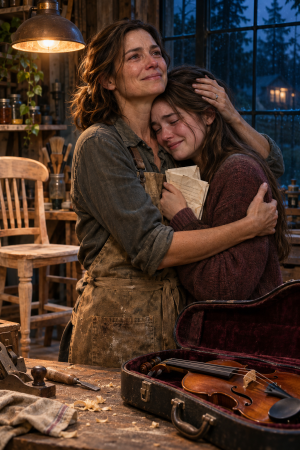
She sat opposite me, still wearing her work apron. A tiny brass screw clung to her sleeve.
“Iris, you’re allowed to want a life that doesn’t involve rescuing mine.”
I looked away.
Until then, I hadn’t realized she knew that was what I was trying to do.
The following morning, a woman in polished boots appeared at the workshop carrying a clipboard.
“I’m Celia Trent. I’m coordinating the clearance.”
Mom put down her screwdriver.
“You said Friday.”
“It is Friday.”
“Friday evening. I have customers collecting things.”
Celia glanced at the shelves.
“Anything remaining after five will be treated as abandoned.”
Some objects had been there for months. A green radio. A child’s music box. A battered kitchen clock whose owner had moved into residential care.
“They belong to people,” Mom said.
“Then those people should collect them.”
After she left, Mom stood very still.
I wanted her to shout. Instead, she took a cardboard box from beneath the counter and began wrapping the green radio.
That made me angrier than shouting would have.
“You’re just letting them do this?”
She stopped.
“What would you like me to do?”
“Fight.”
“With what money? For how long?”
“You always have an excuse.”
The moment I said it, I wanted it back.
Mom lowered the radio into the box.
“Go to school, Iris.”
I didn’t go straight there.
At the library, I searched the market’s name, expecting to find something useful: a preservation order, a forgotten promise, a reason the owners couldn’t close it.
Instead, I found a photograph from twenty-three years earlier.
My mother stood outside Bellwether Market in dark overalls, holding an enormous pair of scissors beside the original owner.
The caption called her workshop co-founder Mara Vale.
I stared at it.
Co-founder.
Not assistant. Not stallholder.
I printed the page and carried it home.
That evening, she looked at the photograph for a long time.
“I had forgotten that haircut.”
“Why didn’t you tell me?”
“About the haircut?”
“Mom.”
She pulled out a chair.
Before I was born, she explained, she and a friend had started the workshop together. Then her friend moved abroad, the market changed hands, and my father became ill.
“There were hospital appointments. Bills. You were little. The market owner offered to take over the business debts and employ me.”
“So you gave it away?”
“I sold it.”
“For what?”
“Enough to keep our home.”
I looked down at the photograph again. She was younger than I could easily imagine her being, laughing at something outside the frame.
“I’m sorry,” I said.
“For asking?”
“For yesterday.”
She nodded, accepting it without making me feel better too quickly.
Then she touched the printed photograph.
“I made the decision I could make at the time. But I’ve stayed longer than I wanted to.”
“Why?”
She glanced toward the box of uncollected repairs beside the door.
“People knew where to find me.”
The next morning, I asked permission before helping.
It felt strangely formal.
“Can I contact the customers who still have things here?”
Mom considered me.
“To arrange collection. No campaigns.”
“Collection,” I promised.
She handed me her battered appointment book.
The first person I called was Mr. Doran, the owner of the green radio.
He arrived before lunch with a walking stick and a question.
“Where are you moving?”
“I haven’t found anywhere yet,” Mom said.
He frowned.
“Then who’s going to fix my kettle?”
“You could buy a new one.”
“I could buy a new radio, too. Apparently I’m difficult.”
As more customers came, they asked the same question.
Where would she go?
By three, Mom had stopped pretending she had an answer.
The last collection belonged to a woman named Nessa Cole, who managed the community laundry on Alder Street.
Her repaired wall clock cost twelve pounds.
She counted out the money, studied the packed boxes, and said, “Come look at something.”
Mom shook her head.
“I have to clear this place.”
“It’s six minutes away.”
“I can’t afford a shop.”
“Then it’s fortunate I don’t own one.”
Behind the laundry was a small room with a separate entrance. It had once housed the caretaker’s tools. There was a sink, one narrow window, and enough space for a workbench.
It also smelled strongly of damp cardboard.
Nessa opened the window.
“I need repairs done here,” she said. “Loose handles, jammed doors, things my maintenance contract takes three weeks to cover. You need somewhere to work. We could discuss an arrangement.”
Mom walked around the room without speaking.
I could practically see the workbench against the wall.
Then she said, “I’d need the terms written down.”
Nessa smiled.
“So would I.”
It wasn’t a rescue that happened neatly.
The room needed rewiring. Mom couldn’t afford the electrician’s first quote. The laundry’s insurer wanted a lockable door between the businesses, and the council paperwork took longer than anyone expected.
For three weeks, our kitchen table disappeared beneath tools and half-finished repairs.
Mom took temporary evening work assembling furniture.
Sometimes she was so tired she fell asleep with the television remote in her hand.
But she and Nessa reached an agreement: modest rent, a fixed number of maintenance hours, and a review after six months.
Her own business. Her own name on the invoices.
The night before I left for my engineering course, we painted the new door yellow.
“What should the sign say?” I asked.
She stepped back, inspecting a drip near the handle.
“Mara Vale Repairs.”
“No clever slogan?”
“I’ve spent eleven years answering to ‘the woman at the back.’ My name will do.”
On opening morning, I expected a queue.
There wasn’t one.
A woman brought in a sewing machine. Someone asked for directions to the bakery. Mr. Doran arrived with his kettle, which turned out to need descaling.
Mom charged him nothing.
After he left, she caught my expression.
“I know. I’m working on it.”
Before I boarded my coach that afternoon, I checked my phone.
She had sent a photograph of the workshop window.
My engineering acceptance letter was taped inside, beside her opening hours.
Underneath it was a message.
Your room will still be here when you get back. The kitchen table should be, too.
I was laughing when the driver asked for my ticket.
For the first time in weeks, I handed it over without wondering whether I should stay.