The first time my daughter knocked on my workshop door after midnight, she was carrying a violin case and wearing only one shoe.
“Please lock it,” she said.
I set down the chair leg I was sanding.
“Where’s your grandmother?”
“Looking for me.”
Until that night, I would have asked what she’d done wrong.
That was the part I would later struggle to forgive myself for.
My mother, Celeste, owned three hotels along the Oregon coast and could make a waiter apologize for rain.
I repaired furniture behind a hardware store. I liked damaged things with obvious problems: a split joint, a broken spindle, something you could fix without guessing what it wanted from you.
When my husband, Owen, died in a road accident, our daughter, Wren, was seven. For months, I remembered to feed her only because she reminded me.
My mother arrived with groceries, clean towels, and a calendar.
“Let me carry things for a while, Mara.”
I was grateful enough to hand her almost everything.
She paid for Wren’s school and discovered that my daughter had a remarkable ear for music. Soon there were violin lessons, competitions, weekends at my mother’s house near Portland.
By eleven, Wren had stopped asking me to attend rehearsals.
“Gran says you lose a whole day’s work coming.”
It sounded considerate. I let it.
My mother kept me informed through photographs: Wren beside a conductor, Wren holding a certificate, Wren smiling in dresses I had never seen.
In person, my daughter became careful with me.
“How’s business?” she would ask, sounding like someone making conversation in a lift.
At fifteen, Wren won an audition for an intensive summer programme abroad.
My mother arranged a celebration at her largest hotel. Halfway through dinner, she announced that Wren would also be transferring to a boarding school in September.
I put down my fork.
“We haven’t discussed that.”
“The application deadline was approaching.”
Across the table, Wren stared at her plate.
“Do you want to go?” I asked her.
“She’s frightened,” my mother answered. “That’s natural.”
“I asked Wren.”
My daughter looked up.
Then my mother rested a hand over hers.
“We’ll talk when you’re less tired.”
I said nothing else. There were guests listening, and I had become very good at finding reasons to wait.
Three nights later, Wren appeared at my workshop.
She had walked from my mother’s holiday house, nearly two miles away. Her missing shoe was somewhere on the beach.
I locked the door.
“Are you hurt?”
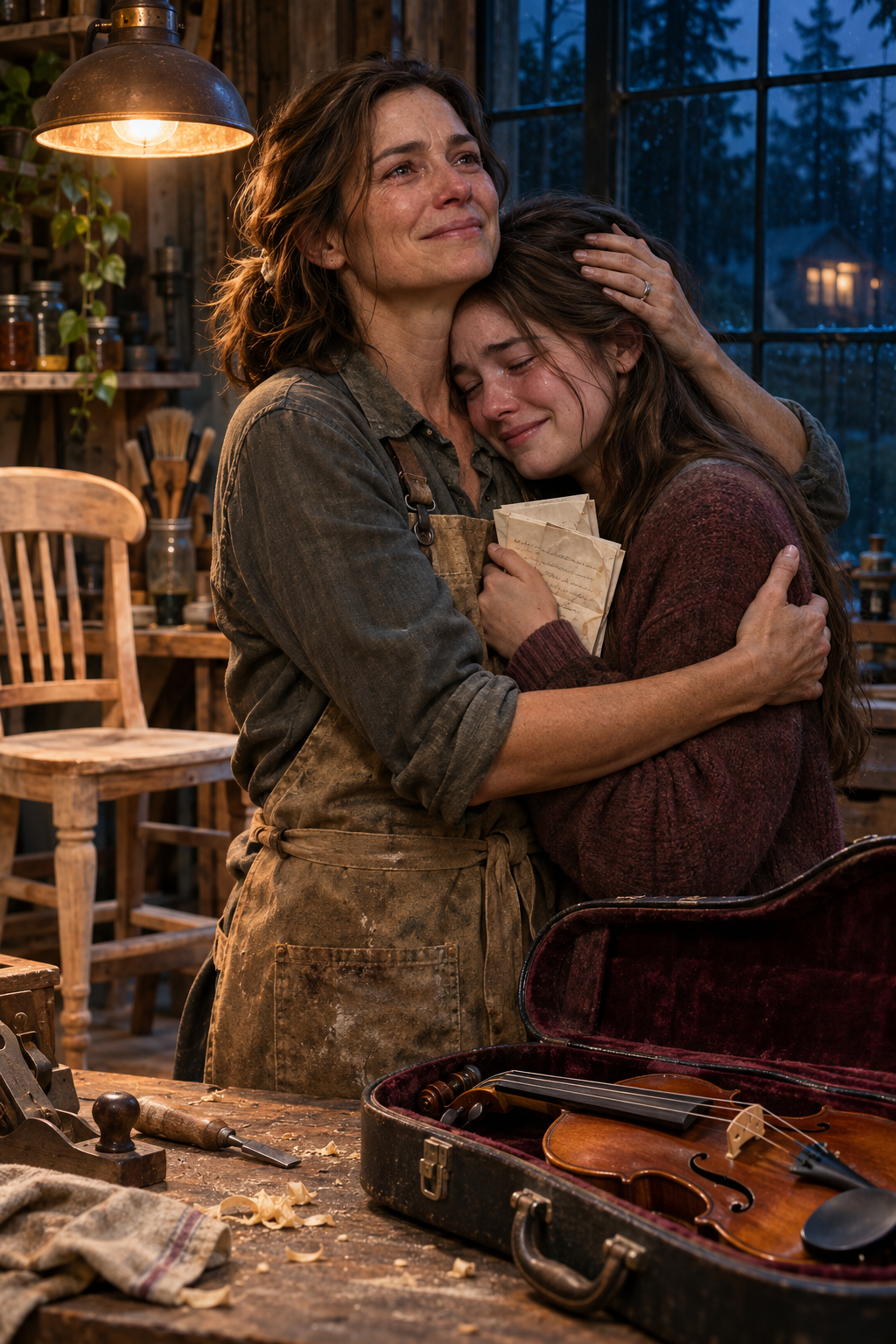
She shook her head and opened the violin case.
Inside, beneath the instrument, lay a stack of envelopes.
“I thought you’d thrown mine away,” she said.
The first letter was addressed to me in Wren’s uneven handwriting. It was three years old.
Mum, could I come home this weekend? I don’t think I’m very good at being here.
There were birthday cards, postcards from competitions, a note asking whether I still made pancakes on Sundays.
None had reached me.
“Where did you find these?”
“In Gran’s desk. I was looking for my passport.”
I sat down on the workbench because my knees had started to shake.
“She said you needed space,” Wren whispered. “That hearing how much I missed you would make you ill again.”
I reached for her, then stopped.
“May I?”
She nodded.
She was taller than I expected. I had missed that happening, too.
My mother arrived twenty minutes later.
Through the glass, she looked irritated rather than worried.
“Mara. Open the door. She has a rehearsal tomorrow.”
I stepped outside and closed it behind me.
“I’ve read the letters.”
For a moment, she said nothing.
Then she sighed.
“You were barely functioning. She needed stability.”
“Three years ago, I was functioning.”
“You were rebuilding. There’s a difference.”
Behind me, I heard Wren move closer to the door.
My mother lowered her voice.
“Do you know what her tuition costs? Her lessons? You can’t sustain this.”
She was right about the money. I had spent years mistaking that for being right about everything.
“We’ll have to change things,” I said.
“You would throw away her future over a few letters?”
Wren opened the door.
“I wrote seventeen.”
My mother turned toward her.
“Darling—”
“I counted them.”
There was no clean break.
My mother cancelled the lessons she funded. Wren cried when we withdrew from the boarding school. She had wanted parts of that life, and losing them hurt even though she had wanted to leave.
I found a counsellor who worked on a sliding scale. We spent several sessions explaining ourselves badly.
Once, Wren asked why I hadn’t fought harder.
I could have told her about grief, exhaustion, the bills my mother paid.
Instead, I said, “I kept accepting the version that asked the least of me. I’m sorry.”
She didn’t forgive me immediately.
I was glad the counsellor had warned me not to expect that.
Wren began lessons with a retired music teacher above the public library. I took on extra repairs, and she worked Saturdays shelving books. Sometimes she practised. Sometimes her violin stayed in its case for days.
I learned to ask whether she wanted company before sitting down.
In October, my mother sent an invitation to a charity concert.
Wren read it twice.
“I might want to see her,” she said cautiously.
“All right.”
“You won’t be angry?”
“I’ll come with you if you want. Or I’ll pick you up afterward.”
She folded the invitation.
“I haven’t decided.”
For once, nobody decided for her.
That evening, I worked late on a walnut dining table while Wren did homework beside the stove. When I reached for the radio, she asked me to leave it off.
Then she took out her violin.
“What’s this one?” I asked when she finished.
“Something I’m trying to write.”
“It sounds difficult.”
“It is.”
She adjusted a string, then looked at me.
“Can I play it again?”
I put down my tools.
This time, I was there for the whole thing.