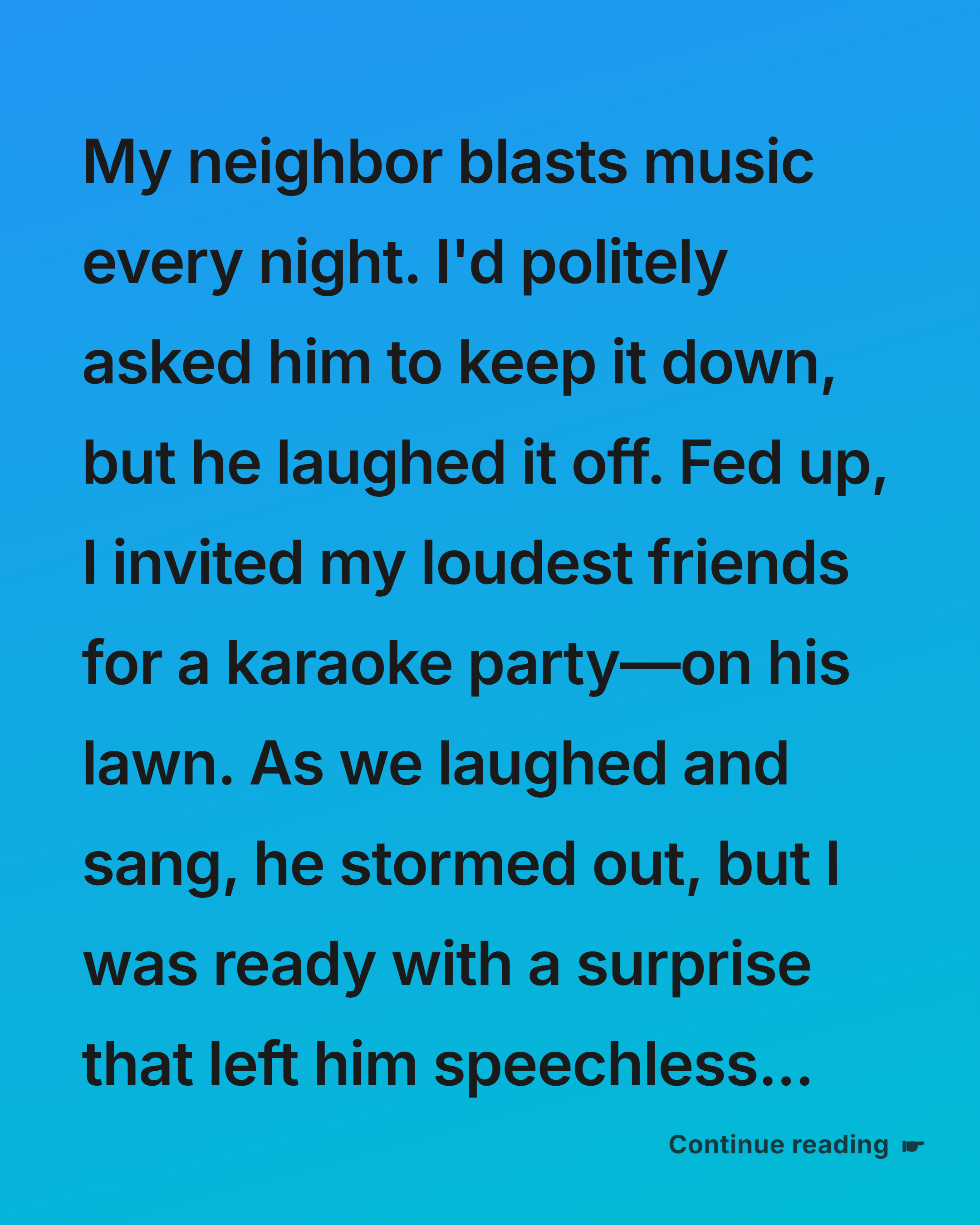
My neighbor blasted music every night. I had politely asked him countless times to turn it down, but he always laughed in my face and acted as though the entire neighborhood existed to accommodate his personal concert. Eventually, I reached my breaking point. Instead of arguing with him again, I invited my loudest, most entertaining friends over for a karaoke party—right on his lawn. We sang, laughed, and turned the quiet street into a musical spectacle. When Roger finally stormed out of his house, furious and ready for a confrontation, I was prepared with a surprise he never saw coming. What happened next transformed our neighborhood in a way none of us could have imagined.
His name was Roger, a tall, broad-shouldered man with a particular passion for rock music and absolutely no consideration for anyone who happened to live within hearing distance of his speakers. Living next door to him had become an exhausting experience. Every night, just when I thought I could finally relax, the walls of my house would begin to tremble beneath the relentless pounding of bass guitars and drums. Sometimes, the music continued well past midnight, making sleep feel like an impossible luxury. I had tried earplugs, closing every window, and even moving my bed to the opposite side of the house, but nothing seemed to help. Roger’s music always found its way through the walls, the windows, and my increasingly frayed patience.
The night before my makeshift karaoke event, I lay awake staring at the ceiling, listening to another thunderous guitar solo coming from next door. The bass line seemed to synchronize perfectly with the pounding in my head, and every time I thought the music was finally fading, another song would begin at an even higher volume. I checked the clock. It was nearly one in the morning. I had work the following day, yet there I was, wide awake, wondering how one person’s hobby could become everyone else’s punishment. That was when I realized something had to change. I could continue complaining, lose sleep, and let resentment consume me, or I could find a way to make Roger experience a little of what he had been putting everyone else through.
It wasn’t just me who suffered from Roger’s nightly concerts. Several other neighbors had complained, too. Some had left polite notes on his door, carefully explaining that the noise was disturbing their sleep. Others had knocked on his porch after particularly loud evenings, hoping a face-to-face conversation might accomplish what written requests had failed to do. One elderly couple had even mentioned that the noise made it difficult for them to rest, but Roger’s response had been the same every time. He would grin, shrug, and insist that people who disliked music should move somewhere quieter. On one occasion, I watched him crumple a neighbor’s handwritten complaint and toss it into a trash can without even finishing the second paragraph. It was becoming clear that ordinary requests meant nothing to him. What bothered me most was not the music itself, but his absolute certainty that nobody else mattered.
The following day was Saturday, and as I sat drinking my morning coffee, an unexpected idea popped into my head. What if, instead of asking Roger to turn his music down, I gave him a taste of what it felt like to have his peace interrupted? I imagined a karaoke party featuring the most enthusiastic singers I knew, none of whom could be accused of being particularly quiet. The thought made me laugh. Perhaps we could create something so ridiculous that Roger would finally understand the situation from the other side. But as I considered the idea, I realized that simply annoying him would accomplish very little. If I wanted a lasting change, I needed to turn the whole thing into something more than a noisy retaliation. I wanted him to see the neighbors he had spent months ignoring—and perhaps discover that music could bring people together instead of driving them apart.
There was a patch of open land near the front of Roger’s property where neighbors occasionally gathered for informal conversations and summer evenings outdoors. The space sat beside the public sidewalk, and with the appropriate arrangements and permission, it could accommodate a small neighborhood gathering. The irony of choosing a spot so close to the source of our nightly misery was almost irresistible. I began imagining Roger peering through his curtains, wondering why the people he had dismissed for so long were suddenly laughing and singing nearby. But I also wanted to make sure our gathering stayed safe, respectful of the surrounding homes, and within any applicable noise rules. I wasn’t interested in trading one endless disturbance for another. My plan was simple: one memorable afternoon, a little humor, and an invitation that would give Roger the opportunity to do something he had never done before—join the people living around him.
I called my friend Ben, who was famous among our old school friends for possessing an operatic voice powerful enough to fill an auditorium without a microphone. Ben answered on the third ring, sounding as though he had just woken from a nap. When I explained the idea, there was a brief silence. Then he burst out laughing. “Let me get this straight,” he said. “You want me to sing opera outside the house of a man who thinks he’s the lead singer of a rock band?” I told him that was precisely the situation. His laughter grew louder. Within minutes, he had agreed to come, promising to bring his most dramatic performance and an outfit worthy of a grand concert. Before hanging up, he added one question that made me pause. “Are you absolutely sure this won’t turn into a fight?” I assured him that I intended to make it a friendly gathering, not a confrontation. Still, as I put down the phone, I couldn’t help wondering what Roger would do when he realized the music wasn’t coming from his speakers for once.
My friends and I began assembling our equipment. We gathered a karaoke machine, a few speakers, microphones, folding chairs, and a playlist containing everything from pop classics and country ballads to dramatic opera and old-school hip-hop. It was a strange mixture, but that was exactly what made it appealing. Ellie, who could rap almost every word of the old-school hip-hop songs she loved, volunteered to be our opening act. Ravi, a devoted country-music fan with an impressive collection of cowboy hats, promised to deliver a heartfelt ballad. Ben prepared a selection of operatic numbers that he claimed would make the windows rattle—although I warned him that we weren’t trying to reproduce Roger’s nightly performances. We invited several other neighbors, explaining that the goal was to enjoy ourselves, meet one another, and perhaps find a more constructive way to address the ongoing noise problem. To my surprise, almost everyone who heard about the gathering wanted to participate. Some brought snacks, others offered chairs, and one neighbor arrived carrying a box of homemade cookies. For the first time in months, people were smiling about the situation instead of exchanging frustrated complaints.
By late afternoon, the sun was lowering in the sky, casting a warm orange glow over the neighborhood. We arranged the equipment in the approved gathering area beside the sidewalk, keeping the walkways clear and leaving enough space for people to come and go comfortably. String lights hung between two portable stands, and a small table held bottles of water, paper cups, and snacks. Everything looked surprisingly festive. I glanced toward Roger’s house, whose windows remained closed and curtains drawn. For a moment, I wondered whether he had gone out and would miss the entire event. Then I heard the unmistakable thud of a guitar coming from inside his home. The music grew louder, as though he had decided to celebrate Saturday by turning his living room into a stadium. I exchanged a look with Ben. “Well,” he said, adjusting his microphone, “I suppose the opening act has already started.” Everyone laughed, and I gave the signal. The karaoke machine came to life.
Our first song was an upbeat pop number that almost everyone knew. Ellie grabbed the microphone and delivered the opening verse with such enthusiasm that people immediately began clapping along. Ravi followed with a country song, swaying dramatically as though he were performing before a packed arena. Ben waited until the crowd was warmed up before launching into an operatic performance so theatrical that even the neighbors who had initially planned to watch from a distance burst into laughter. It wasn’t a polished concert, and that was the beauty of it. People sang off-key, forgot lyrics, and occasionally burst into laughter halfway through a chorus. The atmosphere was cheerful rather than hostile. Nobody was shouting insults at Roger or trying to provoke him personally. We were simply enjoying music together in a place where neighbors could gather, and for once, the sound drifting through the street carried laughter instead of frustration.
Roger’s face appeared in his front window about ten minutes after we began. At first, he looked confused, as though he couldn’t understand why there were people singing outside. Then he leaned closer to the glass, his eyebrows drawing together as he recognized several neighbors he had previously dismissed. His expression shifted from confusion to disbelief, then to unmistakable indignation. He disappeared from the window. A few seconds later, the front door swung open, and Roger stormed onto his porch. His arms were crossed, his face was flushed, and his mouth was already moving before he reached the bottom step. I couldn’t hear his first words over the music, but I could read the irritation in every movement. He marched toward the gathering, clearly expecting to find a group of people who had assembled specifically to insult him. Instead, he found Ben singing with one hand dramatically raised, Ellie laughing into her microphone, and several neighbors clapping along.
Roger stopped several feet away from us, seemingly thrown off by the sight. “What exactly is going on here?” he demanded. I lowered the music and stepped forward, keeping my tone friendly. “We’re having a neighborhood karaoke party,” I explained. “Everyone’s welcome to join us.” He stared at me as if I had spoken another language. “A karaoke party? Right here?” I nodded. “We thought it would be nice to do something together for a change.” His eyes swept over the speakers, the chairs, and the growing crowd. For a moment, I thought he might start shouting. After all, he had spent months treating other people’s requests for quiet as a joke. Now he was the one facing an unexpected disturbance, and I had no idea whether he would respond with anger or embarrassment. He opened his mouth, then closed it again, apparently unable to decide which accusation to make first.
“You’re doing this to annoy me,” Roger finally said, his voice sharp enough to cut through the remaining laughter. I could have denied it entirely, but that would have been dishonest. “Honestly, Roger, your music has been keeping people awake for months. We’ve asked you to turn it down, and you laughed at us. Today, we decided to do something different.” I paused before continuing. “But this isn’t meant to be a war. We invited everyone because we’d rather be neighbors than enemies. If you want to join us, there’s a microphone waiting.” The people around us fell quiet. I could see several neighbors exchanging nervous glances, waiting to see whether Roger would explode. He looked at me, then at the microphone in Ben’s hand, then toward his own house. The music from inside was still playing, although it now seemed strangely distant. His expression softened for just a moment before he quickly covered it with a scowl. “You think this is funny?” he asked. “Not exactly,” I replied. “I think it’s a chance to start over.”
Before Roger could answer, Ben began humming the opening notes of a familiar rock anthem from our school days. It was one of those songs nearly everyone knew, including Roger, who had once mentioned his love for the band during a brief conversation months earlier. His head turned toward Ben almost involuntarily. The first few notes seemed to pull him away from his anger. Ellie recognized the tune and began tapping the rhythm against her leg. Ravi joined in, clapping softly, and soon several people in the gathering were singing along. Roger stood motionless, his expression caught between irritation and nostalgia. For a moment, he looked less like the intimidating man who had dismissed our complaints and more like someone remembering a happier time. Then, unexpectedly, a small smile appeared at the corner of his mouth. He tried to suppress it, but the effort only made it more obvious.
Slowly, Roger stepped off the edge of the lawn and moved closer to the group. Nobody cheered or teased him. We simply made room. Ben held out the microphone with a grin. “You know this one, don’t you?” Roger hesitated, glanced at the faces watching him, and then let out a reluctant laugh. “Of course I know it.” He accepted the microphone, cleared his throat, and sang the next line in a deep, surprisingly rich baritone. His voice wasn’t perfect, but it was good enough to make several people turn in surprise. Ellie immediately improvised a playful rap response, and Ravi followed with an exaggerated country-style harmony. Roger laughed for the first time that evening, a genuine laugh that seemed to surprise even him. Within minutes, the man who had stormed out of his house ready to argue was standing among us, singing a chorus and tapping his foot to the beat. The invitation had become an olive branch, and to our astonishment, he had accepted it.
The evening unfolded in a burst of music, conversation, and unexpected friendship. Neighbors who had barely exchanged greetings before began sharing stories about their favorite bands, embarrassing performances, and childhood memories. Children danced near the string lights while adults took turns at the microphone. Ben delivered another dramatic operatic number, and Roger applauded so enthusiastically that he nearly spilled his drink. At one point, Roger and Ellie attempted a duet that combined classic rock with old-school hip-hop. It was a musical disaster in the most entertaining sense of the word, and the laughter that followed seemed to dissolve months of tension. Roger’s deep baritone added an unexpected richness to the songs, while Ellie brought an energetic rhythm that kept everyone moving. For the first time since he had moved into the neighborhood, Roger was not the person everyone complained about. He was simply another neighbor, laughing alongside the rest of us.
Under the string lights, as the sky deepened from orange to purple, Roger approached me with a thoughtful expression. He had set the microphone aside and was holding a paper cup of water. For several seconds, he seemed unsure how to begin. Then he looked toward the homes lining the street and shook his head. “I didn’t realize how bad it had become,” he admitted. “I knew people could hear my music, but I thought they were exaggerating. I suppose I didn’t want to admit that I was bothering anyone.” I waited, allowing him to continue. “When you asked me to turn it down, I took it as criticism. I told myself that it was my house and my music, so I could do whatever I wanted.” He gave a rueful smile. “I never stopped to think that you were trying to sleep while I was enjoying myself.” His apology was quiet, but there was no joking in his voice this time. I nodded. “We weren’t asking you to stop enjoying music, Roger. We just wanted to enjoy our homes, too.” He looked at me and nodded slowly. “That’s fair. I’m sorry.”
I had expected Roger to become defensive, perhaps to argue that the party had been an unfair response to his behavior. Instead, he stood there looking genuinely embarrassed, and I realized that the evening had reached a turning point. He wasn’t suddenly a different person, and one apology couldn’t erase months of sleepless nights. But for the first time, he seemed willing to acknowledge that his actions had consequences for other people. I told him that we appreciated his apology and hoped we could find a better balance going forward. He agreed, promising to keep his music at a reasonable volume, especially late at night. Then he surprised me by asking whether we could organize another gathering sometime, perhaps with a playlist everyone could contribute to. I laughed. “As long as you promise not to turn it into a midnight rock festival.” He raised both hands in mock surrender. “Deal.” Around us, conversations continued, and the party became less about the original dispute and more about the people who had finally taken the time to get to know one another.
As the night progressed, the gathering began to wind down. We lowered the volume, collected empty cups, and made sure the area was left clean. Some neighbors lingered to talk, while others headed home with promises to meet again soon. Roger helped carry the folding chairs and even offered to store some of the equipment until our next gathering. Before leaving, he approached several neighbors individually and apologized for the late-night noise. One elderly resident, who had endured weeks of sleepless evenings, accepted his apology with a cautious smile. Another neighbor joked that she had been waiting months to hear Roger use his voice for something other than shouting over his speakers. Roger laughed rather than taking offense. It was a small moment, but it revealed something important: he was beginning to understand that being part of a community meant listening as well as being heard. When I finally walked home, the street felt different. The same houses stood along the sidewalk, the same porch lights glowed in the darkness, yet the atmosphere seemed lighter than it had in months.
The real test came the following evening. Around ten o’clock, I was reading on the couch when I heard music begin next door. My shoulders tensed automatically. For months, that sound had been the signal for another sleepless night, and I found myself glancing at the clock, preparing for the familiar assault of bass and drums. But the music remained at a comfortable level. I could hear it faintly through the wall, yet it no longer drowned out my thoughts or rattled the windows. A few minutes later, the volume dropped even further. I sat in silence, almost suspicious of the sudden peace. Had Roger forgotten to turn his speakers on properly? Was this merely a temporary concession after the party? I waited, expecting the noise to surge again. It never did. Instead, the music faded into the background, and for the first time in a long while, I finished my book without reaching for earplugs. It was a simple victory, but it felt enormous.
Over the following weeks, Roger kept his promise. He continued listening to rock music, but he adjusted the volume and paid attention to the hour. When he wanted to host friends, he gave the neighbors advance notice and made sure the gathering ended at a reasonable time. Occasionally, he would play a gentle acoustic set on his porch in the late afternoon, inviting anyone who happened to be passing by to stop and listen. These informal sessions became a pleasant part of the neighborhood routine. People brought chairs, cups of tea, and sometimes homemade snacks. Roger began asking what music others enjoyed rather than assuming everyone wanted to hear the same thing he did. He discovered that Ravi knew dozens of country songs, Ben could teach him a few vocal techniques, and Ellie had a remarkable ability to turn almost any tune into a playful rap. The man who had once treated every complaint as a personal attack was learning to share his passion without forcing it on everyone else.
One Saturday, Roger appeared at my door carrying a small box of cookies and a handwritten note. I opened the door, surprised to see him standing there with an unusually sheepish expression. “I thought I’d bring these over,” he said, holding out the box. “And I wanted to ask you something.” I invited him inside, and he explained that several neighborhood children had been asking about the guitars he kept in his house. He had played for years, mostly for his own enjoyment, but had never considered teaching anyone else. After the karaoke party, he had begun thinking that perhaps music could be something he shared rather than something he used to shut out the world. “Would it be all right if I organized a little guitar session for the kids?” he asked. “Nothing loud. Just a few lessons on the porch in the afternoon.” I smiled. “I think they’d love that.” His face brightened with relief. The cookies, it turned out, were only part of the surprise. He had also written a list of possible songs suitable for beginners and asked Ben whether he might help with singing.
Before long, Roger’s porch became a small gathering place for neighborhood children eager to learn their first chords. He taught them how to hold a guitar, tune the strings, and practice simple melodies without becoming discouraged when their fingers slipped. He was patient in a way I had never expected, encouraging the shyest children to try again and celebrating every little improvement. Parents often sat nearby, chatting while the lessons continued. The sound of music drifted through the street, but it was different now: gentle, intermittent, and filled with laughter. Instead of disturbing people, it gave them a reason to step outside and connect. Roger even created a shared playlist that included everyone’s favorite songs, making sure no single musical style dominated the gatherings. It was astonishing to watch how quickly the atmosphere changed when people felt included rather than ignored.
Our neighborhood soon developed a tradition of small potlucks, weekend barbecues, and occasional campfire evenings where everyone brought something to share. Children played games while adults exchanged stories about their lives, work, families, and dreams. The people who had once communicated mainly through frustrated notes and complaints began checking on one another, offering help when someone was ill, and sharing tools or ingredients when needed. One neighbor organized a community garden, while another volunteered to help older residents with grocery shopping. Roger became involved in these activities, often bringing his guitar along to provide a little background music at the end of the evening. He was no longer seen as the man who kept everyone awake. He was the neighbor who remembered people’s birthdays, helped carry heavy bags, and showed children how to play their favorite songs. None of this had happened because we had defeated him in a battle of volume. It happened because the karaoke party had created an opportunity for him to see us as people rather than obstacles to his enjoyment.
Looking back, I realized how easily the situation could have gone another way. If I had responded to Roger’s arrogance with nothing but anger, we might have spent months escalating the conflict. I could have shouted through the wall, retaliated with louder music, or allowed resentment to shape every interaction. Instead, the karaoke party gave us a chance to address the problem in a way that was memorable without becoming cruel. It was still a response to his behavior, and I won’t pretend that frustration played no part in the idea. After months of interrupted sleep, I wanted him to understand how disruptive his music had been. But the most important part of the evening was not the noise or the surprise on his face. It was the moment when he realized that the people he had dismissed were willing to welcome him if he was prepared to meet them halfway. That realization did more to change the situation than another argument ever could have.
Of course, our neighborhood did not become perfect overnight. There were occasional disagreements about parking, garden maintenance, and the best time to organize gatherings. Sometimes someone played music a little too loudly or forgot to clean up after a barbecue. But the difference was that we had learned to talk to one another before irritation turned into resentment. Roger, in particular, became more receptive to feedback. If someone mentioned that the music was carrying too far, he lowered the volume without taking it as an insult. In return, neighbors were more willing to give him the benefit of the doubt when he wanted to enjoy an afternoon playing guitar. We developed a shared understanding that everyone’s comfort mattered. No one needed to surrender their interests, but everyone had a responsibility to respect the people around them. It was a modest principle, yet it transformed the way we lived together.
Roger eventually admitted that his nightly concerts had been partly a way of avoiding the loneliness he felt after moving into the neighborhood. He had spent years listening to music alone, and the volume had gradually become a habit. When people complained, he interpreted their requests as rejection rather than a simple plea for consideration. That did not excuse his behavior, but it helped explain why he had been so resistant to change. The karaoke party had forced him to confront the contradiction in his attitude: he wanted to enjoy music without interference, yet he had never considered whether his neighbors wanted the same peace. Once he began participating in the community, he discovered that he did not need to fill every quiet moment with sound. Sometimes, a conversation on the porch or a shared meal offered more satisfaction than another night spent alone with speakers turned up to maximum volume.
One evening, several months after the original karaoke party, Roger invited the neighborhood over for a small acoustic performance. He had prepared a handful of songs, including one of the rock anthems Ben had sung on the night everything changed. The children sat near the front, holding paper cups of lemonade, while adults gathered beneath the porch lights. Before beginning, Roger cleared his throat and looked around at everyone. “I owe this street more than one apology,” he said. “I used to think that because it was my house, I could do whatever I wanted. I didn’t understand that living here meant being part of something bigger than myself.” He smiled at me. “And I certainly didn’t expect a karaoke party to teach me that lesson.” Everyone laughed, and I raised my cup in a mock toast. “Sometimes, Roger, the loudest lesson is the one we need to hear.” He shook his head, grinning, and began to play.
The music that evening was beautiful, not because Roger had suddenly become a professional musician, but because it was shared willingly. People listened, sang along when they knew the words, and applauded when he finished. Between songs, he told stories about the bands he had loved as a teenager and the first guitar he had ever owned. Ben offered a few vocal tips, Ellie challenged him to learn a modern song, and Ravi insisted that the next gathering include at least one country ballad. Roger agreed to all of it, laughing as the suggestions piled up. The porch had become a stage, but it was no longer a place where one person’s preferences dominated everyone else. It was a place where different tastes could coexist, where people could disagree without becoming enemies, and where music had finally found the role it should have played all along: bringing people together.
Our little street became known among friends and visitors for its welcoming atmosphere. People who moved into nearby homes were quickly invited to a barbecue or a casual music night, and the old habit of keeping everyone at arm’s length gradually faded. When a new family arrived with young children, Roger was among the first to introduce himself. He offered to help them carry boxes and invited their children to join the next guitar lesson. The parents later told me how relieved they had felt to be welcomed so warmly. Watching Roger make that effort reminded me how much a person could change when given the chance to recognize their mistakes and do better. He was still tall, still passionate about rock music, and still capable of singing louder than anyone else on the street. The difference was that he had learned when to turn the volume down—and when to turn toward the people around him.
My original plan had been to give Roger a taste of his own medicine. I wanted him to feel the frustration he had so casually inflicted on the rest of us, and I expected the evening to end with an argument. Instead, the surprise that left him speechless was not the karaoke equipment, the crowd, or even Ben’s theatrical singing. It was the realization that we had not gathered to humiliate him. We had gathered because we wanted our neighborhood to be a place where everyone could enjoy themselves without making life miserable for someone else. We had given him a choice: continue treating the people around him as enemies, or join them in building something better. To his credit, he chose the latter. That choice did not erase the months of frustration, but it gave all of us a chance to move forward.
The experience taught me that conflict does not always have to end with someone winning and someone losing. Sometimes, the most effective response is one that makes people see a familiar problem from a different perspective. Humor can lower defenses, shared experiences can break down assumptions, and a sincere invitation can open a door that repeated arguments have left firmly shut. That does not mean kindness requires anyone to tolerate ongoing disrespect or abandon reasonable boundaries. If Roger had continued blasting music through the night, we would still have needed to address the problem through appropriate channels. But once he was willing to listen, the opportunity for reconciliation became real. Our karaoke party worked because it combined a little playful defiance with an honest desire for change—and because Roger eventually accepted responsibility for his part in the conflict.
Today, when I hear music drifting from Roger’s house, I no longer brace myself for another sleepless night. Sometimes it is a soft acoustic melody played on the porch. Other times, it is a rock song at a reasonable volume while he works in the garden. Occasionally, he sends a message to the neighborhood group asking whether anyone would like to join him for an afternoon jam session. The sound has become part of the pleasant background of our street, a reminder of how far we have come. The walls of my house no longer tremble, and the evenings that once felt like an endless battle have become opportunities to relax, read, talk with friends, or enjoy the quiet. More importantly, the people who live around me have become a community rather than a collection of strangers separated by fences.
Our story may not be widely known, but it remains one of my favorite reminders that unexpected solutions can sometimes achieve what confrontation cannot. A karaoke machine, a few enthusiastic friends, and one very surprised neighbor helped turn a frustrating situation into a lasting friendship. We did not solve the problem by proving that we could be louder than Roger. We solved it by creating an experience that encouraged him to listen, laugh, and recognize the people he had been ignoring. The result was not merely quieter evenings, but a stronger neighborhood, more meaningful friendships, and a shared understanding that respect works both ways. We learned that one person’s idea of fun should never come at the expense of everyone else’s peace—and that a community becomes stronger when people are willing to make room for one another.
So, the next time you find yourself caught in a frustrating dispute with a neighbor, colleague, friend, or family member, consider whether there might be a constructive way to approach the problem before anger takes over. A little humor and creativity can sometimes open a conversation that repeated complaints have failed to start. At the same time, remember that goodwill works best when it is accompanied by clear boundaries and mutual respect. You do not have to accept behavior that harms your peace simply to keep the peace. You can speak honestly, seek practical solutions, and still leave room for the possibility that the other person may change. Sometimes, the right gesture at the right moment can transform an uncomfortable relationship into something unexpectedly meaningful.
And if this story made you smile, think about sharing it with someone who might appreciate its message. Our neighborhood learned that harmony is not about making everyone enjoy the same music or agree on every little thing. It is about listening, compromising, and recognizing that the people living around us deserve the same consideration we expect for ourselves. Roger’s music had once been the soundtrack to our frustration. Now, it is part of a happier story about second chances, friendship, and the surprising power of a shared song. What began as a playful attempt to challenge an inconsiderate neighbor ended with a street full of people who had learned to look out for one another. Sometimes, the best way to change the atmosphere around you is not to shout louder than everyone else, but to create a moment that finally gives everyone a reason to listen.