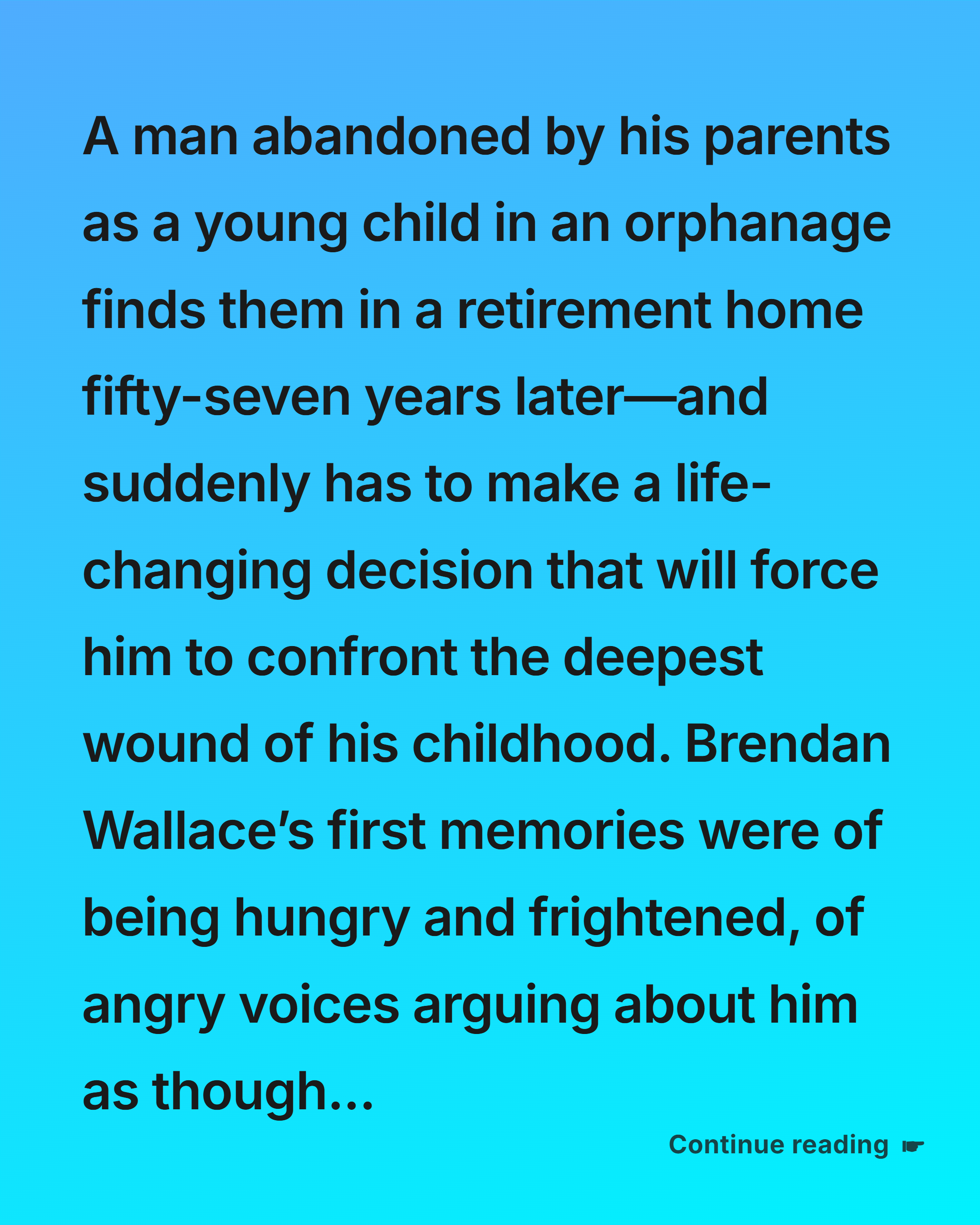
A man abandoned by his parents as a young child in an orphanage finds them in a retirement home fifty-seven years later—and suddenly has to make a life-changing decision that will force him to confront the deepest wound of his childhood.
Brendan Wallace’s first memories were of being hungry and frightened, of angry voices arguing about him as though he were an unwanted burden rather than a child. The hands which cared for him and should have been gentle were often rough instead, and even before he understood the meaning of rejection, he could feel it in the way his parents looked at him.
Brendan remembered climbing out of his little bed and toddling towards the sound of music and laughter, his diaper sodden and heavy. He could hear glasses clinking and people talking excitedly, but the moment he appeared, the laughter stopped. “For God’s sake, we need to get rid of that brat!” a woman’s voice cried. It was his mother. Brendan was too young to understand those words, but something inside him remembered them forever.
Sometimes when his mother was sleepy and happy, she’d let Brendan cuddle up to her warmth, and then he’d feel safe and content, believing for those precious moments that perhaps he really was loved. But mostly, the sight of Brendan irritated his parents, and he quickly learned that affection from them could disappear as suddenly as it appeared.
It would be many years before an adult Brendan understood why little Brendan had been so unhappy and unwanted. His parents were both wealthy, living off trust funds, and they had never known the fear of wondering where their next meal would come from. When Brendan was born, they had been living in a commune, chasing a carefree life that had little room for responsibility.
Bitterness is a poison, and forgiveness is the only antidote—but Brendan would spend decades discovering just how difficult it could be to swallow that antidote.
It was the sixties, and the era of peace and love and flower-power was in full swing, but for Brendan’s parents, that didn’t mean a love of children. When Margaret Wallace discovered she was pregnant, she was horrified and angry. She saw the baby as something that had interrupted the life she had imagined for herself, and Brendan would spend years paying the emotional price for a decision he had never made.
Horrified because she had no intention of being a mother—ever!—and angry because it was much too late to prevent Brendan’s birth. Fortunately for Margaret and Brendan’s father, Rafe, the commune was full of motherly women who adored babies and took care of little Brendan. They fed him, rocked him to sleep, changed him, and kissed his tears away while his own parents continued living as though having a child were merely an inconvenient detail.
Brendan wasn’t supposed to be Brendan—they wanted a suitably romantic name like Moonchild—but the man at the register took one look at Margaret’s bare feet and love beads and asked her father’s name.
“Brendan,” she’d replied. And the man registered Brendan as Brendan—a sensible and serviceable name. Margaret and Rafe lived in the commune until Brendan was nearly three, then they decided to move on. By then, Brendan had become accustomed to the women of the commune caring for him, but he had no idea that the biggest abandonment of his life was only days away.
They were thinking of following a new guru who was all the rage. The man, an Indian aesthete, had given a lecture in San Francisco, and the couple had been delighted with his philosophy of living a meaningful life.
The guru ran an ashram in India, and Margaret and Rafe immediately decided that was where they should be. But what to do with Brendan? They couldn’t possibly take him. In their minds, the answer was frighteningly simple: their new life mattered more than the little boy who depended entirely on them.
“We’ll leave him at an orphanage,” Margaret said. “Isn’t that where they take care of children?”
Rafe was less certain. “What about Oliver Twist? I wouldn’t want anything like that to happen to the kid.”
“Nonsense!” cried Margaret. “I’m sure it will be fine! And he won’t be poor, will he? He has his own trust fund from birth and he’ll be just fine as soon as he grows up. He’ll have everything he needs!” Her words sounded reassuring, but there was something chilling about the way she reduced her own child’s future to a financial arrangement.
So three days later, Margaret and Rafe walked into a convent-run orphanage on the outskirts of San Francisco and left three-year-old Brendan in the lobby. They didn’t stay to hear him cry or ask whether he would be all right. All they left with him was his birth certificate and the documents pertaining to his trust fund. Then they walked out of the building, leaving their little boy behind without knowing that the decision would one day come back to them.
For Brendan, the nuns with their white headdresses like wings were like angels. They took him and bathed him and cared for the painful, constant rash that had plagued him since birth and fed him. That first night, Brendan slept in a clean bed with a full stomach, but when he woke the next morning, he still looked toward the door, silently waiting for the two people who had left him to come back.
For the first time, Brendan was surrounded by loving, caring, gentle people. In the orphanage he blossomed into an active, joyous little boy—but sometimes he’d fall into deep silences. The nuns noticed those moments and never forced him to explain. They simply sat beside him, held his hand, and waited until the sadness passed.
As he grew older, he understood more and more of his vague memories. He learned about his trust fund and the fortune it would offer him when he was older. He knew his parents hadn’t abandoned him out of poverty and desperation. That knowledge was almost harder to bear than if they had been poor.
Most of the children in the orphanage WERE orphans, but a very few had been left there when their parents could no longer feed them, so they wouldn’t starve. But Brendan’s parents had been wealthy. They hadn’t been forced to leave him. They had simply chosen another life, and that knowledge became a quiet wound Brendan carried into adulthood.
When Brendan turned 18, he left the orphanage and the kindly nuns and went to college. The trust fund had matured, and there was plenty of money to pay for college, or even for Brendan to live on for the rest of his life without working. For the first time, he possessed the financial freedom his parents had always taken for granted, yet the money could not give him the one thing he had wanted as a little boy: a mother and father who wanted him.
But Brendan wanted to build bridges, like the bridge of San Francisco. He wanted to build bridges that soared and looked as though they could reach heaven. Perhaps, without realizing it, he was trying to build in steel and concrete the kind of connections that had been missing from his own life.
In college, he met Susan, a lovely artist, and the two fell in love. They married after graduation and had two children. When he held his children in his arms for the first time, Brendan felt such a surge of love that he couldn’t understand how his own parents could have ever left him. Looking down at those tiny faces, he made himself a silent promise: his children would never have to wonder whether they were wanted.
His bitterness and anger towards them grew apace with his love for his children. “They never loved me the way I love Meg and Brian,” he told Susan. “They never loved me at all!” Susan understood that there were wounds she could comfort but never erase, and she never pressured Brendan to forgive people who had never apologized.
Brendan was a grandfather when he finally had news of his ‘parents. The law firm that administered his trust fund contacted him and told him that his parents had finally run through their own trust funds. The call came unexpectedly one ordinary afternoon, and by the time Brendan hung up, he was staring at the wall, stunned by the fact that the past he had buried for decades had suddenly returned.
“They’re indigent, Mr. Wallace,” the lawyer said. “We’ve paid out the last of the trust fund to the nursing home they are staying in, but in six months they will be homeless.”
“Why are you calling me?” asked Brendan coldly. The man hesitated. “Well…they are your parents,” he said. “We thought you should be informed…And perhaps some natural feeling…” Brendan felt an old anger rising inside him. After fifty-seven years, why should the people who had abandoned him suddenly become his responsibility?
“They weren’t natural parents,” Brendan replied. “I have no feelings for them unless it’s a healthy disdain.” Yet after the call ended, those words did not bring him the satisfaction he expected. Instead, a strange uneasiness settled over him.
But the lawyer’s call kept nagging at Brendan, tugging at his conscience. “I’m sixty years old and I owe them nothing!” he told Susan. “So why do I feel like this?” He couldn’t explain why the idea of two elderly strangers sleeping somewhere without a home disturbed him so deeply. Perhaps the answer was hidden in the frightened three-year-old boy he had once been.
“Because you’re a good man,” Susan told him gently. “And good men do the right thing…” She paused before adding, “But whatever you decide, Brendan, make sure you do it because it reflects who you are now—not because you feel guilty for what they did then.”
So two weeks later, Brendan and Susan drove down to the old age home where Margaret and Rafe now resided. The long-haired, lithe, and handsome flower children they had once been were long gone. Brendan had imagined this meeting for years, sometimes picturing himself shouting at them, sometimes walking away without a word. He had never imagined how small and fragile they would look when the moment finally came.
They were old, and they didn’t age gracefully. When a carer had announced a visit from their son, the two had been stunned. Then Margaret got to her feet and moved towards Brendan, her arms open. For one brief second, Brendan saw a flash of the mother he remembered—the woman whose warmth he had once desperately wanted.
“Brendan, my baby!” she sobbed, but there were no tears in her small, bright eyes.
Brendan evaded her embrace easily. “Hello, mother,” he said. “I’m surprised you remember me. I certainly wouldn’t have recognized you at all.” His voice was calm, but beneath it was fifty-seven years of unanswered questions.
Rafe smiled, showing that most of his teeth were gone. “Now, my boy, let’s not dwell on the past…” he said. “We’re so happy to see you! Life hasn’t been easy…We are not who we used to be…” Brendan stared at the two people in front of him and wondered whether they were truly sorry—or simply afraid of what would happen when their money ran out.
“Please, my son,” Margaret whispered. “Don’t abandon us!”
“Abandon you?” asked Brendan. “You mean to do to you as you did to me?” The room seemed to fall silent. Even Margaret looked away. For the first time, neither parent had an answer ready.
“We left you the money!” cried Rafe. “You weren’t poor, as we are now!”
“You didn’t leave me the money,” Brendan said calmly. “That trust fund was set up automatically by grandfather’s estate the moment I was born. You had nothing to do with it. You left me a bank account, but you left me without parents. And there is a difference between giving a child money and giving a child love.”
“But you know what?” Brendan continued. “I won’t abandon you, not because you deserve better, but because I’m a better person than either of you. I know what love is, and compassion. I forgive you, even if you don’t deserve forgiveness, and I will help you. You can have the money!” Saying those words felt strangely liberating. He had spent decades carrying the weight of their choices, and suddenly he realized he no longer needed to carry it.
Rafe looked at Brendan with tears in his eyes. “We are so alone, my son, so alone…What can the money buy us now? More lonely days? Please…” For the first time, Brendan saw genuine fear in his father’s face—not fear of losing money, but fear of dying without anyone beside him.
Brendan nodded slowly. “So now you understand what I felt,” he said. “I was a child, and all I wanted was to be loved and cherished. Do you think that money was any consolation? Now you’re old, and you too want to be loved, to be with family.” The words were painful, but they were no longer filled with revenge. They were simply the truth.
“It’s OK. I’ll take you home with me, father, mother. You won’t die alone.” Margaret covered her face and began to cry, and this time Brendan could see the tears. He didn’t know whether her tears were for him, for herself, or for all the years that could never be recovered. But he knew what he was going to do.
Brendan took Margaret and Rafe home with him and hired a carer for them. Margaret loved talking to their grandchildren and great-grandchildren and telling them stories about their crazy days in the sixties and playing guitar with Bob Dylan at a campfire. Sometimes the stories made everyone laugh, but sometimes Brendan caught Margaret watching him from across the room with an expression he couldn’t quite understand. It was as though she was finally seeing the little boy she had once walked away from.
Rafe would sit next to Brendan whenever he could and hold his hand in his frail claw. Brendan donated the huge fortune which had accumulated in his trust fund to the orphanage that had raised him and shown him what love and caring were. He could have kept every dollar, but he realized that the money had never been the thing that saved him. The nuns had. Their kindness had. The simple decision to love a frightened little boy had changed the entire course of his life.
What can we learn from this story? Brendan’s life reminds us that abandonment can leave scars that money can never heal, and that the people who hurt us do not get to decide what kind of person we become. Forgiveness does not mean pretending the past never happened, nor does it mean saying that what Margaret and Rafe did was acceptable. It means refusing to let their choices control the rest of Brendan’s life. He could have walked away and allowed bitterness to have the final word, but instead he chose compassion on his own terms. Perhaps the greatest twist in Brendan’s story was that the little boy who had once been abandoned became the man who refused to abandon others. In the end, his parents lost their fortune, their youth, and the carefree lives they had once valued—but Brendan gained something they could never have given him: a family built on genuine love. And sometimes the greatest revenge against a painful past is not revenge at all, but becoming the person your younger self desperately needed.