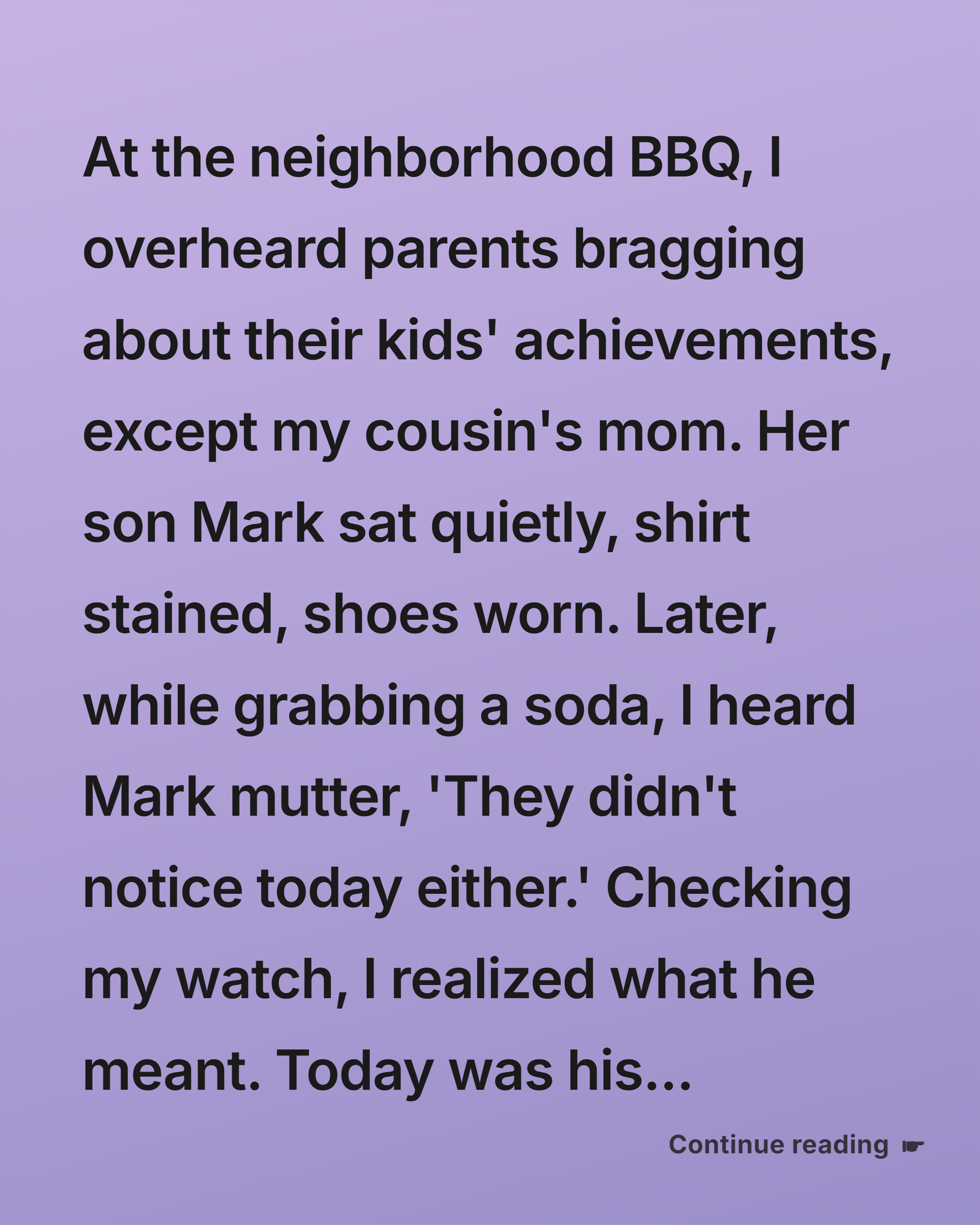
At the neighborhood BBQ, I overheard parents bragging about their kids’ achievements, comparing trophies, grades, sports records, and college dreams as though the afternoon were an unofficial competition. Everyone seemed to have someone to celebrate—except my cousin’s mom. Her son Mark sat quietly near the edge of the yard, his shirt stained, his shoes worn, and his hands folded tightly in his lap. He barely touched his food. Later, while I was grabbing a soda from the cooler, I heard him mutter under his breath, almost as though he were afraid someone might hear him, “They didn’t notice today either.” I froze. Checking my watch, I suddenly understood what he meant. Today was his birthday.
I felt a pang of guilt because Mark had quietly turned 12 while everyone around him was busy celebrating themselves and their children. Last year, his family had been too busy moving to celebrate, and apparently this year had slipped away just as easily. I looked across the yard and saw him sitting alone, watching other children laugh as their parents praised them. He seemed resigned to being ignored, yet there was a quiet dignity about him that resonated with me. What bothered me most was the realization that he hadn’t seemed surprised. He had expected nobody to remember.
Caught in reflection, I remembered Mark’s shy smile from years earlier. Unlike the boisterous crowd around us, Mark was different, someone who pondered in silence, wise beyond his years. He noticed things other people missed and rarely interrupted anyone, even when he clearly had something to say. Suddenly, I wondered how long he had been learning to disappear whenever a room became too loud. I decided there and then that, whatever happened next, I would make sure at least one person noticed him.
I approached Mark. “Hey, buddy,” I said, ruffling his hair affectionately. “Wanna grab a soda with me?” His face lit up momentarily, and he nodded, leaving his lonely spot near the fence. As we walked away from the crowd, I glanced back and noticed that his mother hadn’t even looked up. For some reason, that small detail stayed with me.
As we walked, I mentioned, “I heard you whisper back there. I think today’s a special day for you, isn’t it?” Mark looked at me, his eyes holding a mixture of surprise, embarrassment, and something that looked almost like relief. For several seconds, he said nothing. Then he shrugged and stared at the ground.
“It’s just another day,” he replied softly. His response broke my heart, because every child deserved to feel celebrated, even if the celebration was nothing more than a cupcake and someone saying, “I’m glad you were born.” Even if he’d grown used to feeling invisible, I hoped I could change that. But as I studied his face, I had the strange feeling that there was something else he wasn’t telling me.
We found a quiet spot under a large oak tree where the branches swayed gently with the breeze. The commotion of the barbecue faded into the background as we talked about everything from dreams to loaves of bread. I asked him what he wanted for his birthday, expecting him to name a toy, a game, or something every twelve-year-old might want. Instead, he thought for a long moment and said, “I don’t really need anything.” Then he added quietly, “I just wanted somebody to remember.”
Mark shared stories of school days and said, “Sometimes I feel like a shadow. No one sees me at all.” I realized he had built walls to shield himself, but he let those walls down for our brief moment together. Then he told me something that made me wonder how much of his life I had completely misunderstood. He said he spent most afternoons in his room making things from scraps because “things that people throw away still have uses.” He smiled faintly when he said it, as if he were talking about objects rather than himself.
I promised to spend time with him, not as a burden but genuinely. “How about we make this a tradition? You and me, hanging out no matter what?” His smile was worth more than all the fireworks in the world. Before we left the tree, I asked him what he had been doing in his room lately. He hesitated, then said, “I’ll show you someday.” The way he said it made me curious. It sounded less like an invitation and more like a secret he had been protecting.
Summer ended, and soon enough, the leaves turned crimson as golden September rolled in. Mark and I made good on our promise, meeting every so often to chat, play catch, or share a comic book over milkshakes. Each time we met, I noticed another little change in him. He laughed more easily. He spoke without apologizing for taking up space. Yet whenever I asked about the things he built in his room, he changed the subject.
Mark wasn’t just a shadow in my life anymore. He was a vibrant part of it, and I realized he had always been naturally brilliant, thriving on his own terms. He could remember complicated details after hearing them once and could look at broken objects and immediately imagine what they might become. Still, he never bragged. In fact, praise seemed to make him uncomfortable, as though he had spent so many years without it that he didn’t quite know what to do when it finally arrived.
Through Mark, I saw the world in a softer light, where the small gestures mattered just as much as grand displays of affection. He taught me to find beauty in modesty, courage in the quiet exchange of words. More importantly, he reminded me that people can be struggling right beside us while appearing perfectly ordinary. Sometimes the loudest pain is the one that never makes a sound.
One fall afternoon, Mark invited me to his room to show me his collection of handmade models. His mother was downstairs, busy with something, and Mark led me quietly down the hallway before pushing open his bedroom door. Meticulously crafted from old wood scraps, cardboard, wire, bottle caps, and glue, the models covered nearly every shelf. There were tiny houses, bridges, ships, animals, machines, and even a miniature town with working lights. He had built them with the same tenacity as a growing oak.
Noticing my wide-eyed appreciation, Mark said, “They aren’t perfect, but they’re mine.” I stepped closer and noticed something strange. Each model had a tiny symbol carved or painted somewhere on it—a small star beside a number. When I asked what the numbers meant, Mark quickly covered one of the models with his hand. “Nothing,” he said. I knew immediately that it wasn’t nothing. These models represented more than creativity; they symbolized the resilience of often unseen strength. I felt lucky to witness this side of Mark, but I also wondered what he was afraid someone might discover.
Within weeks, Mark’s models drew the attention of teachers and classmates alike after his science teacher happened to see photographs of them. His teacher encouraged him to enter a regional art and design competition, and for the first time, Mark had to place his work where strangers could judge it. He nearly withdrew the night before the deadline. “What if they laugh?” he asked me. I reminded him that the models had already survived something much harder than criticism—they had survived years of being unseen. Eventually, he entered, earning himself a place in the regional competition.
Time flew by, and our bond grew stronger. Eventually, news of Mark’s work spread through whispers in our community, reaching folks who had missed seeing the glow he always possessed. People who had once walked past him at gatherings began asking questions about his models. But Mark didn’t seem interested in becoming famous. Instead, he kept looking toward the same quiet places, as though he remembered exactly what it felt like to stand there unnoticed.
When we celebrated his triumph, Mark discovered pride from being accepted not as a prodigy, but as his genuine, unique self. The silence that had cocooned him seemed to crack open into the harmonious sounds of clapping hands. His teacher praised his imagination, his classmates congratulated him, and even some adults who had once ignored him suddenly wanted to know more about him. Mark smiled through it all, but afterward he whispered to me, “It feels strange when people suddenly know your name.”
Mark’s journey taught us all an enduring lesson on empathy. True brilliance rarely parades itself; it quietly emerges and waits for others to see its glow behind closed doors. Sometimes, talent isn’t missing at all. Sometimes, the world simply hasn’t bothered to look closely enough.
Mark continued making models, his mind brimming with ideas that turned boredom into innovation, like sunlight casting a spectrum of colors through a prism. One evening, however, he showed me something different. It was a small wooden box hidden beneath his bed. Inside were dozens of folded pieces of paper, each containing an idea, a drawing, or a question. Some were dated years earlier. “I write them down when nobody is around,” he explained. I realized then that while the rest of us had assumed Mark was simply quiet, he had been building an entire world inside his head.
One cold winter’s evening we found ourselves by the fireplace, sharing tales of wonder and imagining adventures to distant lands. Mark looked at me, his eyes wise and deep, and said, “Thank you for seeing me.” Then he reached into his pocket and handed me a folded piece of paper. It was a sketch of the oak tree where we’d first talked. Beneath it he had written the date of his birthday. I stared at the drawing, suddenly realizing that our conversation under that tree had become one of the moments he had chosen to remember forever.
I realized then that my understanding of Mark had shaped my path. He taught me to see people truly, and in doing so, transformed my perspective. I had once thought kindness meant doing something big for someone. Mark showed me that sometimes kindness was simply noticing the person standing quietly at the edge of the room and asking, “Are you okay?”
At school, he stood up for himself and became an advocate for others like him, quietly lifting their spirits and showing them how to find the light within their own shadows. He noticed the student who always ate lunch alone, the girl who never raised her hand despite knowing every answer, and the boy whose drawings were always hidden inside his notebook. Mark didn’t force anyone to speak. He simply made room for them.
With newfound strength, Mark began organizing community events, showcasing talents from those whose voices often went unheard. A quiet revolution, rooted in empathy, started taking form in our neighborhood. At the first event, only a handful of people came. At the second, there were dozens. Mark refused to call it a talent show. He called it “The Things We Almost Missed.”
The place once buzzing with competitive voices now echoed with contrasts of gentle recognition. It was a space where diversity of talents was welcomed and embraced, celebrating authenticity rather than comparison. Parents stopped asking whose child had won and started asking what their children had discovered about themselves. It wasn’t perfect, and old habits occasionally returned, but something had changed. People were looking twice.
Mark’s journey was about discovering the true measure of worth, not in accolades alone, but in how deeply you see others and see yourself. His regional award mattered, but it wasn’t the moment that changed him. The real turning point had happened beneath an oak tree when someone finally remembered his birthday.
As we sat together, Mark gave me a small model plane he had made. “It’s you,” he said with a smile, reminding me of many flights of imagination we’d shared. I turned it over in my hands and noticed the familiar little star carved beneath one wing. This time, Mark didn’t try to hide it.
It was a gesture so simple yet profound, and it filled me with immense gratitude for the lessons imbibed by simple yet strong souls like Mark. I asked him what the star meant. He smiled and said, “It’s for the people who help you remember where you came from.” I didn’t know what to say, so I simply thanked him and held the little plane carefully in both hands.
The plane wasn’t just a gift; it symbolized the dreams that can soar when empathy propels them through skies vast and limitless. It also reminded me that the smallest acts can travel farther than we ever imagine. A single conversation had changed Mark’s life, but Mark had spent years afterward changing the lives of others.
In the years that passed, Mark became a bright, kind-hearted young man. I continued to champion his brilliance beyond appearances because his strength lay in the silence he harnessed. He never became the loudest person in the room, and he never wanted to. His confidence came from knowing that he no longer needed to disappear to make everyone else comfortable.
At every gathering, I watched him greet others with genuine interest, creating ripples of positivity that would reverberate long after conversations ended. I sometimes caught him scanning a room before sitting down, looking for the person standing alone. Whenever he found one, he would walk over without hesitation. I knew exactly why.
One day, Mark approached me, his eyes filled with resolution, declaring his intent to pursue a path where he could help others become the best versions of themselves. He told me he wanted to work with young people who felt overlooked, because he understood what it was like to believe that nobody was watching. His voice was steady when he said it. There was no trace of the boy who once whispered beneath his breath that nobody had noticed his birthday.
He saw the world as his canvas and realized being a beacon for others was as fulfilling as his own success. I felt immense pride watching him live with purpose. Yet there was something else that made me proud: he never treated his past as something shameful. He carried it with him, not as a wound to display, but as a reminder of what he never wanted another child to experience.
The years had turned, and prowess wasn’t always about first place; sometimes, it came from kind intentions, transforming lives unseen by ordinary eyes. Mark’s greatest accomplishments were no longer certificates hanging on walls. They were the people who began speaking up because he had listened first.
Reflecting on our journey, I found immense value in each lesson, learning the importance of listening and seeing beyond what is superficial and obvious. I thought back to that BBQ, to the stained shirt and worn shoes, to the boy sitting alone while everyone else celebrated. If I hadn’t gone for that soda, if I hadn’t happened to hear those few quiet words, I sometimes wondered whether anyone would have discovered what Mark had been carrying inside him.
Understanding that a life enriched through quiet observation often offers comforts not spoken but felt deeply was transformative. Mark had taught me that attention is a form of love. Remembering someone’s small details, noticing when their voice changes, or simply sitting beside them can sometimes mean more than any expensive gift.
One autumn afternoon, Mark stood before a room of folks, now confident as he shared his story. He spoke about being overlooked, about building models in a quiet bedroom, and about the birthday he believed nobody remembered. Then he paused and looked directly at me. “Someone noticed,” he said. “That was enough to make me believe I was worth noticing.” The room became completely silent.
Mark’s words lingered in the air like soft whispers captured by each heart present, each one a seed planted for future compassion to thrive. Nobody moved for several seconds. Then a woman in the back began clapping, followed by another person, and then another. Soon the entire room was filled with applause, but Mark didn’t look at the crowd. He looked at me and smiled.
As we all applauded Mark’s journey, the true moral unfurled in its simplicity: every act of genuine kindness leaves an imprint that echoes infinitely. We may never know what someone is carrying when we pass them in a hallway, see them sitting alone, or watch them quietly leave a gathering. But we can choose to notice.
I felt invincible. Our little community had flourished into something bound by appreciation for the nuances of life and quiet victories of introspective souls. The same people who once competed over trophies now celebrated children who painted, built, wrote, repaired, listened, helped, and dreamed. Somehow, the neighborhood had learned what Mark had known all along.
Mark didn’t just grow up; he left a legacy that taught us that passion and understanding can change the world one thoughtful moment at a time. The boy who once believed he was invisible had become someone who made other people feel seen.
In the end, the neighborhood BBQ taught many truths, but highlighting Mark’s brilliance was greater than any accomplishment celebrated that day. The most important thing that happened wasn’t a trophy, a competition, or a speech. It was one forgotten birthday and one person who decided that forgetting wasn’t acceptable.
Whenever new families moved in, we shared the story of Mark and how he became the heart of our neighborhood—a reminder of enduring empathy. We didn’t tell it to make ourselves feel proud. We told it because somewhere nearby, there might always be another child sitting quietly, wondering whether anyone would notice.
Mark, who had once sat quietly, became the voice encouraging others to be proud—even if the world sometimes wears blinders. He never promised that life would suddenly become easy. Instead, he taught people that being unseen for a while didn’t mean they were insignificant.
His quiet glow taught us all that unseen triumphs often unfold into the loudest symphonies of generous hearts connecting and uplifting each other. And whenever I saw the little wooden plane sitting on my shelf, I remembered that the greatest journeys sometimes begin with something as ordinary as sharing a soda beneath an old tree.
As the chapter closed, each of us embraced Mark’s ethos: To see and be seen is not always with eyes but with open hearts ready to hear whispers. Sometimes the whisper is a birthday wish. Sometimes it’s a frightened confession. Sometimes it’s simply a quiet “I’m okay” that isn’t true. The important thing is to listen closely enough to hear what comes after it.
One final sunset signaled the day’s end, but the moral of the story lived on, radiant in each act that nurtures humanity through understanding. Somewhere in the neighborhood, children were laughing, parents were listening, and people who might once have walked past one another were stopping to ask questions. The change wasn’t loud. It didn’t need to be.
Your story, like Mark’s, has power and potential—so never let it dim beneath superficial shadows. May kindness illuminate your every step. Because sometimes, the person who seems to need the least attention is the person silently hoping someone will finally notice.
If you enjoyed this journey, share Mark’s legacy with others, extracting light even from the darkest corners, illuminating paths untraveled. Remember the boy at the BBQ who wasn’t asking for applause, a trophy, or a grand celebration. He only wanted someone to remember that he existed.
Let’s strive to inspire others with stories, little or large, and mold lives with empathy as the glue that binds us. A few minutes of genuine attention can become a memory someone carries for decades. We may never fully understand the impact of the moments we almost dismiss.
Mark’s tale isn’t just a memory but a message, an experience resonating for all with the courage to see the world anew. Share it boldly. And the next time you notice someone standing quietly at the edge of a crowd, don’t assume they want to be alone. Walk over. Say hello. Ask their name. You never know what remarkable story might be waiting for someone to finally see it.