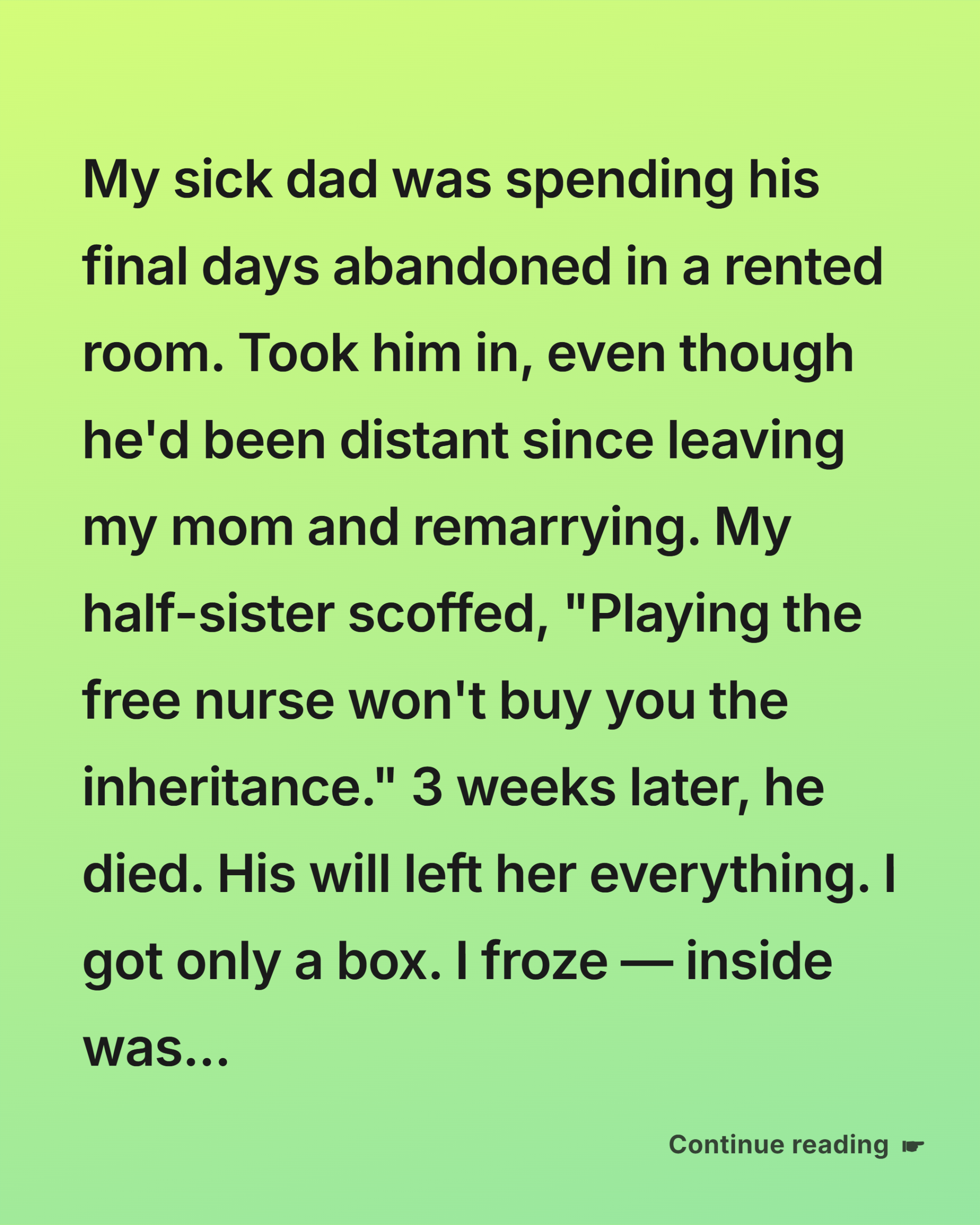
My sick dad was spending his final days abandoned in a rented room. I found him in a cramped, drafty apartment on the outskirts of Manchester, a place that smelled of stale tea and old newspapers, with curtains that barely kept out the grey daylight as if even the sun had given up on him. It was a far cry from the life he’d built after leaving my mom twenty years ago. He had remarried a woman with expensive tastes and had a daughter, my half-sister Bianca, who lived a life of luxury I only saw in magazines. When his health finally failed and his money started to dry up, that second family seemed to vanish like smoke, leaving behind only silence where there had once been promises.
I took him in, even though he’d been distant since leaving my mom and remarrying. My small spare bedroom became a makeshift hospice, filled with the hum of an oxygen machine, the faint antiseptic smell of medicine, and the soft glow of a nightlight that never fully chased away the shadows. My husband, Arthur, helped me lift him, feed him, and keep him comfortable during those long, quiet nights when even sleep felt guilty. We weren’t wealthy, and our house was modest, but it was warm and it was full of the grace he hadn’t shown us when I was a child, as if time had finally forced us into roles we never expected.
My half-sister Bianca scoffed when she heard the news, visiting once just to look down her nose at my mismatched furniture and the worn edges of everything I owned. “Playing the free nurse won’t buy you the inheritance, Silas,” she said, her voice dripping with a cold, polished disdain that didn’t belong in a room where a dying man was breathing his last days. She was convinced I was performing some long-con to get back into Dad’s good graces for the sake of his estate. I didn’t tell her that there was no estate left to speak of—just a tired old man who was afraid of the dark and kept asking if anyone was still there when the machines beeped.
Three weeks later, he died. He went peacefully in his sleep, his hand resting in mine, just as the sun was beginning to peek over the rooftops, casting a fragile gold light across his face as if hesitating to reveal what had just been taken. The funeral was a small, somber affair, mostly attended by his old work colleagues and my mother, who came out of respect for the man he used to be rather than the man he became. Bianca showed up in a designer black dress, looking more like she was at a fashion show than a burial, her heels clicking like impatience against the church floor. She didn’t shed a single tear, her eyes darting around as if looking for the lawyer the moment the dirt hit the casket, as though grief had a price tag she was waiting to calculate.
The will reading was held the following Monday in a sterile office in the city center, where even the air felt expensive and indifferent. Bianca sat across from me, smirking as she tapped her manicured nails on the mahogany table, already rehearsing victory in her mind. The lawyer cleared his throat and began to read the cold, legal sentences that summarized a man’s life as if he had been nothing more than numbers on paper. His will left her everything—the remaining cash in his offshore accounts, the deeds to a small property in Spain, and all his personal investments. I sat there in silence, not surprised, but feeling a familiar sting of being the “forgotten” child once again, as though I had been erased in advance.
I got only a box. It was a small, wooden chest with a tarnished brass latch, looking like something that had been tucked away in an attic for decades and forgotten by time itself. The lawyer handed it to me with a sympathetic look that almost made me step back, as if he already knew it carried more weight than it should. Bianca let out a sharp, mocking laugh as she stood up to sign her papers. “Enjoy your dusty memories, Silas,” she said, sweeping out of the room with the grace of someone who had just won a lottery she didn’t deserve, not noticing the way the lawyer briefly avoided her gaze.
I took the box home and sat with it at my kitchen table for a long time. I was angry, I’ll admit it, but it was a quiet anger, the kind that doesn’t know where to go. I had spent my savings, my sleep, and my emotional energy caring for a man who, in the end, still chose the daughter who abandoned him. Arthur sat across from me, placing a hand on mine without speaking, as if words would only disturb whatever was about to break open. “Open it when you’re ready,” he said softly. I finally flipped the latch, expecting to find old photos or maybe his military medals, something meaningless enough to match what I thought he had left me.
I froze—inside was not a stack of cash or a hidden deed. Instead, there was a thick pile of yellowed envelopes, all addressed to me, spanning over twenty years, their edges worn as if they had been opened in someone’s mind a thousand times before being sealed. I opened the first one, dated six months after he had left my mother. In it, he poured out his heart, explaining that he had made the biggest mistake of his life. He wrote about how my stepmother had threatened to keep him from ever seeing me if he didn’t cut ties and provide for her exclusively, and how every day after that decision felt like drowning in silence.
As I read through the letters, I discovered that he hadn’t been distant by choice; he had been a victim of a relentless emotional blackmail that I was too young to understand, and too far away to ever see. He had sent these letters to a private PO box, hoping one day he would be brave enough to give them to me. But the real shock came when I reached the bottom of the box and found a small, silver key and a folded piece of parchment that looked much newer than the others, as if it had been placed there in a hurry.
The parchment was a letter from a private vault facility in London. It explained that Dad had been quietly siphoning off a portion of his income for twenty years into a private account that Bianca and her mother knew nothing about. He knew they would come for his visible assets, so he had made himself look “poor” in his final years to protect this secret, disappearing into that rented room like a ghost hiding in plain sight. The “everything” he had left Bianca was actually a mountain of debt hidden behind a thin veil of luxury assets that were about to be repossessed, waiting like a trap that had already snapped shut.
I traveled to the vault in London the next day, my heart hammering against my ribs so hard I could barely focus on the road ahead. When the attendant opened the safety deposit box, I didn’t find diamonds or gold bars. I found the original manuscripts and the copyright deeds to a series of children’s books my father had written under a pen name—a series that had become a global phenomenon over the last decade without anyone knowing his name. He had never told anyone he was the author, using the royalties to build a foundation for underprivileged children in silence, as if recognition would ruin the purpose.
He had left the entire intellectual property and the future royalties to me, but with a specific condition. I wasn’t allowed to use the money for myself; I was to be the head of the foundation he had started. He had seen my heart while I cared for him in that small room, the way I stayed when others didn’t even call, and he knew I was the only person he could trust to carry on his real legacy. The “nothing” I was left was actually a multi-million pound charitable empire that would change thousands of lives, built quietly in the background of a life everyone thought had failed.
A month later, I received a frantic call from Bianca. She was screaming about lawyers and frozen accounts, her voice cracking in a way I had never heard before. It turned out that the “inheritance” she had bragged about was tied up in lawsuits and back taxes that far exceeded the value of the property in Spain. She had inherited a hollow shell, a fitting reflection of the relationship she had with our father, who she only valued when there was something left to take. She asked me for money, of course, but I told her the truth: I didn’t have any money for her, only a box of memories she had never bothered to make.
I spent the next year traveling for the foundation, setting up libraries and art programs in neighborhoods just like the one where I found Dad, places where hope felt like a borrowed thing. Every time I saw a child pick up one of his books, I felt a connection to him that was stronger than anything we’d had while he was alive, as if he was still quietly directing it all. I realized that he hadn’t left me a box of junk; he had left me a purpose. He had spent his final days watching me, making sure I was the man he hoped I would be, even when I thought I was simply saying goodbye.
The money from the royalties eventually allowed me to pay off our mortgage and ensure our own children had everything they needed. But we didn’t change our lifestyle much. We still live in the same house, and I still keep that spare bedroom exactly as it was when he stayed there, untouched except for time. It reminds me that the most valuable things in life are often hidden in the places we least expect to find them, waiting quietly until we’re ready to understand them.
Loyalty and love aren’t about what you can get out of a person; they are about what you are willing to give when there is nothing left to gain, when no one is watching or rewarding you for it. My father taught me that even a broken life can leave behind a beautiful map for someone else to follow, if you’re willing to read it. We spend so much time worrying about “fairness” and “inheritance,” forgetting that the greatest legacy is the character we build through our own actions, not the things we leave behind. I’m proud to be my father’s son, not because of the vault in London, but because I stayed when everyone else left.
Life has a funny way of balancing the scales in the end. Those who chase the gold often end up with lead, while those who offer a hand in the dark find themselves walking into the light. I learned that kindness is never a waste of time, even when the person receiving it doesn’t seem to deserve it. It’s not about them; it’s about who you choose to be.