Blending families is rarely straightforward—it’s a careful dance between setting boundaries, showing love, and learning how to live together.
When a stepchild joins the household, it’s natural to set ground rules.
But what happens when those intentions unintentionally push the child away instead of fostering connection?
One stepmother believed she was creating a smoother transition, but her stepdaughter felt judged rather than embraced.
Now, emotions are flaring, and the family bond is under pressure.
Hi,
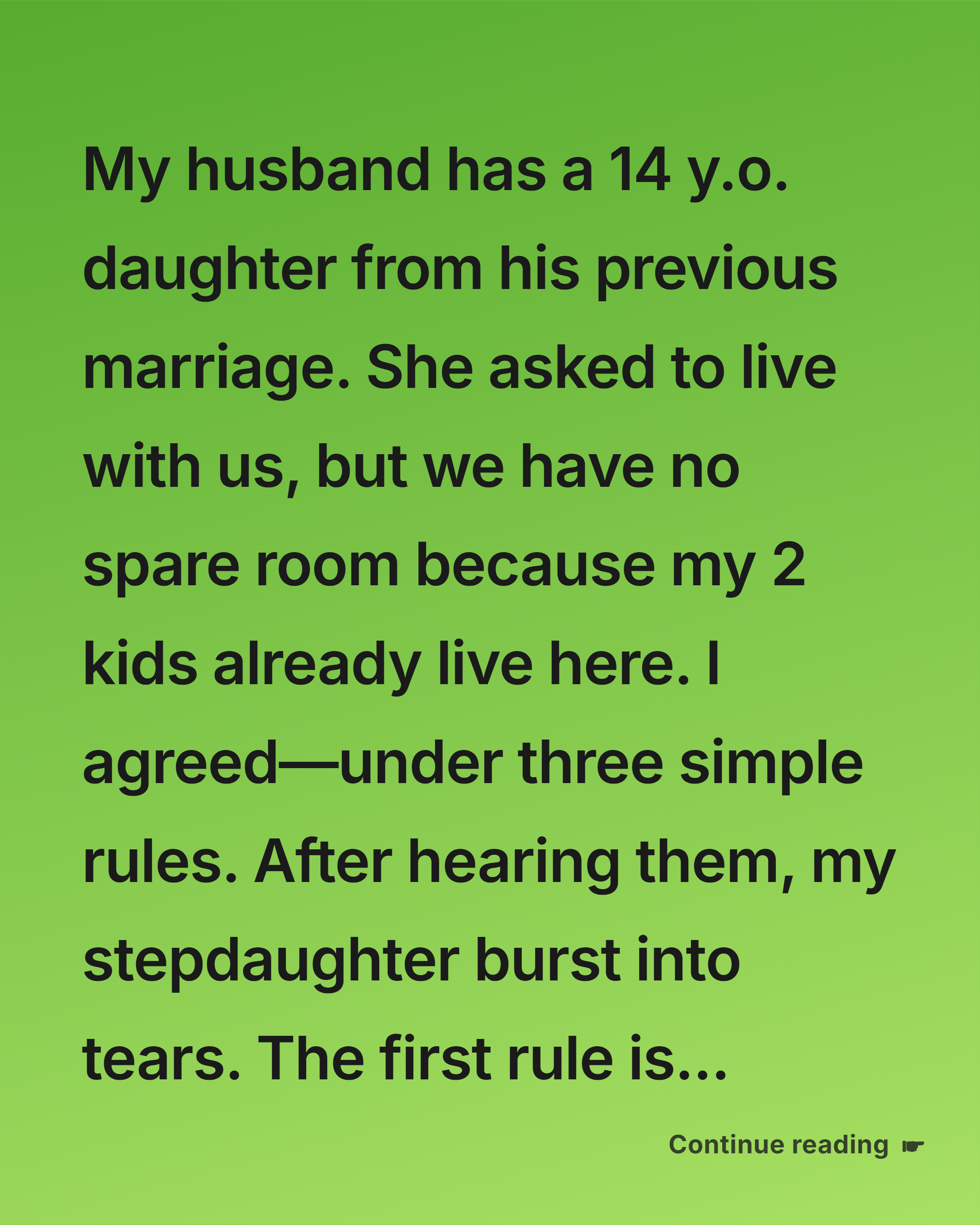
My husband has a 14-year-old daughter from a previous relationship. Her name is Lily, and until recently, she had only spent weekends and school holidays with us.
She had always been polite toward me, but there was a distance between us that I never quite knew how to cross.
I told myself it was normal. I was her stepmother, not her mother, and I never wanted to force a relationship she wasn’t ready for.
Then, about three weeks ago, everything changed.
Lily asked her father if she could come live with us permanently.
Her mother had been going through some difficult personal circumstances, and Lily said she no longer felt comfortable staying there. She wanted stability. She wanted to be near her father. Most importantly, she said she wanted a home where she felt safe.
When my husband told me, I immediately said yes.
I meant it.
But there was a practical problem I couldn’t ignore.
My two children already live with us, my daughter is thirteen, my son is eleven, and we don’t have an extra bedroom.
Our house is already crowded, and everyone has learned to make the limited space work.
Still, I didn’t want Lily to hear “there isn’t enough room” and interpret it as “there isn’t enough room for you.”
So I started thinking about ways we could make the arrangement work.
That’s where I made what may have been the biggest mistake of my life.
I agreed to Lily moving in, but I came up with three basic conditions.
At the time, I honestly believed I was being thoughtful.
I had no idea that each one would land like a rejection.
The first rule was that she would write me a short note every Sunday.
Nothing too long—just a few lines about her week, her highs and lows, something funny that happened, or even something she was worried about.
I thought this could be a gentle way for us to connect without putting her on the spot during awkward face-to-face conversations.
I imagined us leaving little notes for each other on the kitchen counter.
Maybe, eventually, she’d tell me things she wasn’t comfortable saying aloud.
I thought I was building a bridge.
Lily heard it differently.
She asked me, “Why do I have to report my feelings to you every week?”
I laughed nervously and told her she didn’t have to make it formal.
“It’s not homework,” I said. “It’s just something between us.”
She didn’t laugh.
She stared at me for several seconds before quietly saying, “But why do I have to do something to make you like me?”
I immediately told her that wasn’t what I meant.
But I could already see something changing in her face.
The second rule involved where she would sleep.
With no spare room, I suggested that she rotate monthly between my daughter’s room, my son’s room, and the couch.
I felt this shared compromise was the fairest approach.
Nobody would have to permanently give up their bedroom, and Lily wouldn’t feel like she was being singled out.
At least, that was how I saw it.
Lily saw something completely different.
She asked, “So where is my room?”
I told her we didn’t have one.
She looked toward my husband.
Then she looked back at me.
“So I’m supposed to move around the house?”
I tried to explain that it was temporary and that everyone would have to make sacrifices.
But she shook her head.
“You have two kids and they both have rooms.”
I reminded her that my daughter and son had shared rooms before and that we’d rearrange things when necessary.
She whispered, “But they belong here.”
That sentence stayed with me.
I didn’t know how to answer it.
Because suddenly I realized that, in her mind, this wasn’t a discussion about square footage.
It was a question of whether she belonged in the family at all.
The third rule was the one that finally broke her.
I asked her to bring something personal into the household once a week.
Maybe she could cook dinner one night.
Maybe she could introduce us to a game she loved.
Maybe she could teach us a hobby or choose a movie for everyone.
My goal was to help her feel like a contributing member of the family rather than a guest.
But when I explained it, she stared at me in disbelief.
Then she started crying.
Not quietly.
She sobbed so hard that she could barely speak.
She finally said, “Why do I have to earn my place here?”
I froze.
“That isn’t what I’m saying.”
“Yes, it is.”
“No, Lily. I swear it isn’t.”
She wiped her face with her sleeve.
“You already have your family. I’m the one who has to prove I belong.”
My husband had been standing nearby, listening.
That was the moment his expression changed.
He looked at me and said, “Nicole, stop.”
I tried to explain myself.
I told him I wasn’t trying to reject her.
I was trying to make the transition easier for everyone.
But he said something I wasn’t prepared to hear.
“You’re treating her like a problem that needs to be managed.”
I felt my stomach drop.
“That isn’t fair.”
“Maybe not,” he said. “But that’s how she’s hearing it.”
Lily left the room.
A few minutes later, I heard the front door slam.
I assumed she’d gone outside to calm down.
Then my husband walked into our bedroom and shut the door behind him.
“She thinks you don’t want her here.”
I told him that wasn’t true.
He said, “Then why did you make her agree to three conditions before she’d even moved in?”
I didn’t have an answer that sounded good anymore.
Because the truth was, I had been so focused on making the household function that I had forgotten something far more important.
She wasn’t a new roommate.
She was a fourteen-year-old girl asking her father if she could come home.
And somehow, I had turned that request into an arrangement with terms and conditions.
That night, Lily wouldn’t speak to me.
The next morning, she barely came downstairs.
My daughter told me Lily had been crying in the bathroom.
My son asked me whether Lily was still moving in.
I said I hoped so.
He looked at me and asked, “Does that mean she doesn’t want to be our sister anymore?”
I had no idea what to say.
Later that afternoon, I found something on the kitchen table.
It was a folded piece of paper.
For a moment, I thought Lily had finally written her first Sunday note.
But when I opened it, my heart sank.
It wasn’t a weekly note.
It was a list.
At the top, she had written:
**“Things I think I need to do so I can stay.”**
Underneath were three bullet points.
Write a note every Sunday.
Move wherever I’m told.
Do something to prove I’m part of the family.
Then, at the bottom, she’d written one sentence.
“I don’t think I can do this.”
I sat at the kitchen table staring at those words for what felt like an hour.
I’d spent days thinking about how Lily could adapt to our family.
I hadn’t once stopped to ask what it felt like for her to leave one home, walk into another, and discover that she had no room of her own.
No drawer that was permanently hers.
No place at the table that felt unquestionable.
And now, apparently, no certainty that she was wanted.
That evening, I went to her bedroom—or rather, the room she was temporarily using.
I knocked.
There was no answer.
I knocked again.
“Lily, it’s me.”
Silence.
I sat down outside the door.
I didn’t try to explain the rules.
I didn’t defend myself.
I simply told her the truth.
“I got this wrong.”
After a long silence, she finally said, “You don’t have to pretend.”
“I’m not pretending.”
“You don’t want me here.”
I felt tears fill my eyes.
“I do.”
“Then why did you make me prove it?”
I had no good answer.
So I gave her the only honest one.
“I thought I was helping you feel like part of the family. I didn’t realize I was making you feel like you had to earn your place in it.”
There was silence again.
Then the door opened a few inches.
Lily’s eyes were red.
She didn’t invite me inside.
But she didn’t close the door either.
I told her the three rules were gone.
All of them.
She looked at me suspiciously.
“Just like that?”
“Just like that.”
“What if you change your mind?”
“I won’t.”
“What if your kids don’t want me here?”
I told her that wasn’t her burden to carry.
Then I said something I wish I had said on the very first day.
“You don’t have to prove that you belong here, Lily. If you’re coming here, you’re coming home.”
She started crying again.
This time, I cried too.
But there was still one problem I couldn’t solve with an apology.
The bedroom.
The next morning, I sat down with my husband and the kids.
We talked about the space honestly.
There was no magical extra bedroom waiting to appear.
Someone would have to compromise.
But this time, we didn’t make Lily responsible for solving the problem.
My daughter volunteered first.
She said she could share her room permanently if we rearranged the furniture and gave them separate storage areas.
My son offered to move his desk into the hallway so there would be more room.
My husband suggested converting part of our downstairs office into a small private bedroom for Lily.
It wouldn’t be luxurious.
It wouldn’t be perfect.
But it would have a door.
A bed.
A dresser.
And, most importantly, it would be hers.
When we showed Lily the space, she stood in the doorway for a long time.
She didn’t say anything.
Then she walked inside and ran her hand across the empty wall.
“This can really be mine?”
I nodded.
She looked at me.
“You’re not going to make me write anything every Sunday?”
I smiled through my tears.
“No.”
“Or cook?”
“No.”
“Or move every month?”
“No.”
She hesitated.
“Then how do I become part of the family?”
I told her, “You don’t have to. You already are.”
She didn’t hug me.
Not immediately.
Instead, she sat on the floor and began talking.
About school.
About her friends.
About how scared she’d been about moving.
About how she had spent weeks wondering whether her father really wanted her or was simply agreeing because he felt guilty.
And then she told me something that broke my heart.
She said she’d been rehearsing what she would say if we told her no.
She had already packed a small bag.
Just in case.
I asked her where she thought she would go.
She shrugged.
“I didn’t know.”
That was when I realized how close we had come to losing something that had barely begun.
I had thought the challenge was finding enough space for another person.
It wasn’t.
The real challenge was making sure that person never felt like they were taking up space that didn’t belong to them.
A few days later, Lily moved in.
There were still awkward moments.
There were arguments.
There were slammed doors and tears and disagreements over bathrooms, television, food, and privacy.
Blending a family didn’t suddenly become easy.
But something changed.
One Sunday morning, I found a folded piece of paper on the kitchen counter.
For a second, my heart stopped.
I picked it up.
It was from Lily.
There was no rule anymore.
She didn’t have to write it.
She had chosen to.
The note said:
“I think I’m starting to feel like this is my home. Also, your pancakes are terrible.”
I laughed so hard I cried.
And underneath that, in smaller handwriting, she’d added:
“But I think I like it here.”
I kept that note.
Not because it proved that I’d fixed everything.
It didn’t.
I kept it because it reminded me of something I should have understood from the beginning:
You cannot make someone feel that they belong by giving them requirements for belonging.
Sometimes the most important thing a child needs isn’t another rule, another routine, or another test.
Sometimes they simply need to hear, without conditions:
You are wanted here. You are safe here. You don’t have to earn your place.
And for Lily, that was the first real rule our family ever needed.