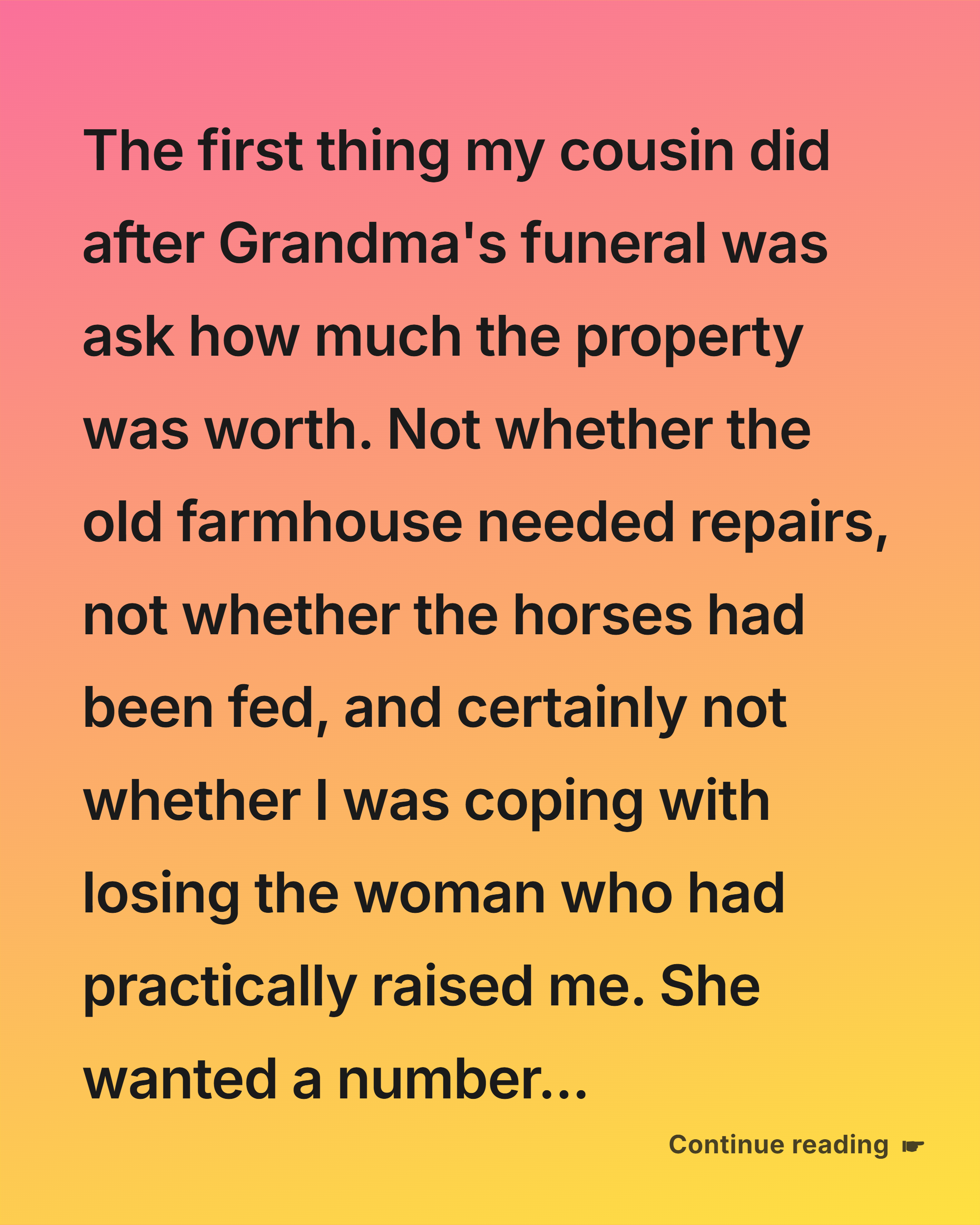
The first thing my cousin did after Grandma’s funeral was ask how much the property was worth. Not whether the old farmhouse needed repairs, not whether the horses had been fed, and certainly not whether I was coping with losing the woman who had practically raised me.
She wanted a number.
I should have known then that the reading of the will would become a battle neither of us had anticipated.
When Grandma’s attorney finished reading the document, I sat motionless, struggling to understand what I’d just heard. The sprawling family farm, with its apple orchards, grazing fields, weathered barns, and little pond, had been left entirely to my cousin, Vanessa.
Not me.
I had spent nearly every summer of my childhood there. After my parents separated, Grandma had given me a place where I felt safe and loved. As an adult, I’d continued visiting whenever work allowed, helping her maintain the property and taking care of the animals when her arthritis made ordinary chores difficult.
Vanessa, meanwhile, treated the farm like an occasional holiday destination. She usually arrived with expensive luggage, complained about the unreliable internet, took photographs of the countryside, and disappeared before anyone asked her to help.
Yet she was now the legal owner.
“There’s another provision,” Mr. Whitaker, Grandma’s attorney, said, noticing my expression.
He slid a cream-colored envelope across the desk.
My name was written across it in Grandma’s familiar handwriting.
I opened it carefully.
“My beloved Eleanor,
I know you may be disappointed by the decisions I’ve made. Please don’t mistake them for a lack of faith in you.
The farm has been placed in Vanessa’s name, but your right to occupy the main residence and manage the working property is protected for six months. During that period, neither the land nor its buildings may be transferred or developed without your written agreement.
There is something about this place that I have never explained. I need you to discover it for yourself.
Don’t make any permanent decisions until you have spoken to Arthur Bell, the man who has worked these fields longer than either of you have been alive.
On the first day of spring, another document will be opened.
Until then, trust what the land tells you.
All my love,
Grandma.”
I read the letter twice.
Why had she given Vanessa ownership if she wanted me to stay? What was I supposed to discover? And why had she specifically mentioned Arthur?
Across the room, Vanessa was already celebrating.
“Well, this is certainly unexpected,” she said, examining the property papers. “I suppose Grandma finally realized I was the one who could do something useful with this place.”
Her husband, Marcus, leaned toward her and whispered something about property values and commercial development.
I caught enough to understand.
They wanted to turn the farm into a luxury residential development.
“You’re not seriously considering selling it, are you?” I asked.
Vanessa looked at me as though I’d interrupted an important business meeting.
“Why wouldn’t I? Do you have any idea what this land is worth?”
“It’s our grandmother’s home.”
“Exactly. And homes are meant to be sold when they’re no longer useful.”
I clenched my hands beneath the table.
“Some things are worth more than their market price.”
She laughed.
“That’s a lovely sentiment, Eleanor, but sentiment doesn’t pay property taxes.”
Outside the attorney’s office, Vanessa approached me with an offer.
“Marcus and I discussed it. We’ll give you enough money to rent a decent apartment for a year. Consider it a generous goodbye.”
“I don’t want your money.”
“Then you’re making this unnecessarily difficult.”
“No. I’m simply not interested in watching you destroy everything Grandma worked for.”
Her expression hardened.
“Don’t confuse nostalgia with ownership, Eleanor. The farm belongs to me now.”
She walked away before I could respond.
That evening, I called my employer and requested an extended leave of absence from my administrative position at a medical supply company. I had savings, although not enough to live comfortably without working indefinitely.
Still, I couldn’t abandon the farm.
The following morning, Vanessa handed me a ring of keys.
“Here. The responsibility is yours until I find someone to manage the property.”
She said it as though she were doing me a favor.
Then she climbed into Marcus’s new SUV and drove away.
—
The first week nearly broke me.
Grandma had always made farm life look effortless. I was beginning to suspect she’d possessed some secret ability to make twenty hours of work fit into an ordinary day.
My mornings began at five. I checked the water troughs, fed the horses, collected eggs, and inspected the vegetable garden. Afterward came the machinery, the fences, the leaking irrigation pipes, and the endless collection of small problems that seemed to multiply whenever I turned my back.
One morning, I found a young goat standing on top of a feed container, looking remarkably pleased with herself.
“Get down, troublemaker,” I ordered.
She stared at me.
“Don’t give me that innocent expression. I know exactly what you did to the vegetable patch yesterday.”
The goat bleated.
I laughed despite myself.
Her name was Pepper, and she had been Grandma’s favorite. Looking after her made the house feel a little less empty.
Arthur Bell appeared around midday, carrying a battered toolbox.
At seventy-two, he was lean, weather-beaten, and permanently suspicious of anything with an electronic display. He had worked for Grandma since before I was born.
“Your grandmother would have had something to say about that gate,” he remarked, inspecting my repair.
“She probably would have had several things to say about it.”
“At least you’re learning.”
He tightened a hinge and examined the surrounding fence.
“You’re trying to do everything yourself. That’s not how she ran this place.”
“I don’t have much choice. Vanessa isn’t exactly interested in helping.”
Arthur gave a dry laugh.
“Your cousin wouldn’t know the difference between a hay bale and a garden ornament.”
I smiled.
Then he grew serious.
“Listen, Eleanor. Your grandmother was particular about certain things. She didn’t leave instructions without a reason. Whatever happens over the next few months, don’t let anyone rush you into signing anything.”
“Did she tell you what the letter meant?”
He wiped his hands on an old cloth.
“She told me to make sure you checked the north orchard before the spring inspection.”
“What am I looking for?”
“If I knew that, I’d have told you already.”
He picked up his toolbox and headed toward his truck.
Before leaving, he turned around.
“One more thing. Your grandmother didn’t keep that old place running for sixty years because she enjoyed making money. She believed it was supposed to serve a purpose.”
I watched him drive away, wondering what he knew that I didn’t.
—
Three days later, I discovered the first real problem.
While checking the northern irrigation system, I noticed that several rows of apple trees were receiving almost no water. The soil beneath them was dry, and some of the older trees had begun to deteriorate.
I followed the pipes toward an abandoned storage shed.
Inside, beneath a pile of rusted gardening equipment, I found a metal box secured with a small padlock.
The lock was old and already damaged. After a few minutes of struggling, I managed to open it.
There were photographs, handwritten notebooks, and a collection of faded property maps.
One photograph showed Grandma standing beside a group of children, none older than twelve. Behind them was a wooden building I didn’t recognize.
On the back, she’d written:
“First summer at the orchard school, 1998. The children planted the first trees.”
I stared at the photograph.
Grandma had never mentioned an orchard school.
The notebooks contained lists of names, harvest records, and detailed notes about something called the Bellweather Community Project. Several pages described agreements with local schools and families who had been struggling financially.
I was still examining them when Arthur arrived.
He stopped in the doorway.
“Where did you find those?”
“In the shed. What is the orchard school?”
He sighed and sat on an overturned bucket.
“Your grandmother started it after the old primary school closed. She let children from the surrounding villages come here on weekends. They learned gardening, animal care, and practical skills. Some families couldn’t afford proper school supplies, so she helped with those too.”
“Why didn’t she tell me?”
“She didn’t like advertising her kindness.”
He picked up one of the photographs.
“Your grandmother believed children should have somewhere to go where they weren’t judged by how much money their parents had.”
I turned another page.
There were records of small grants, donated equipment, and food distributed to families during difficult winters.
The farm wasn’t simply a business.
It had quietly become an important part of the community.
And Vanessa wanted to sell it.
—
My discovery made me more determined than ever, but it also created a problem.
Maintaining the farm while protecting the community project required money I didn’t have.
I sold some unused machinery, negotiated better prices with local produce buyers, and began advertising Grandma’s homemade preserves at the weekly farmers’ market.
Arthur helped whenever he could.
A retired teacher named Mrs. Collins, who had volunteered with Grandma for years, also offered assistance.
“You have no idea how many people owe that woman their gratitude,” she told me one afternoon.
She handed me a folder containing old letters from families who had received help.
One letter described how Grandma had paid for a young boy’s agricultural college fees. Another came from a woman whose family had received food and temporary accommodation after a house fire.
I read them all.
By the time I finished, I understood why Grandma had been so protective of the farm.
It wasn’t just a piece of property. It was a promise she’d made to people who depended on it.
Then, two weeks before the spring deadline, Vanessa returned.
She arrived with Marcus and a sharply dressed man carrying a leather portfolio.
“We need to discuss something,” she announced.
The man introduced himself as Mr. Reynolds, a representative of a property investment company.
He spread several documents across the kitchen table.
“They’ve made an excellent offer,” Vanessa explained. “The developers want the entire property, including the orchard. We’ll both receive compensation if we settle quickly.”
I looked at the figures.
The amount was enormous.
For a moment, I imagined what I could do with that money. I could buy an apartment, return to the city, and never worry about repairing another broken fence.
Then I noticed a paragraph near the bottom of the proposal.
The buyers intended to clear the northern orchard and demolish the old educational building.
“What happens to the children who use this place?” I asked.
Vanessa shrugged.
“They’ll find somewhere else.”
“Some of them have nowhere else.”
“That’s not our responsibility.”
I pushed the documents away.
“I’m not signing.”
Her smile disappeared.
“You don’t own this farm, Eleanor.”
“I know. But Grandma’s agreement gives me a protected occupancy right, and you can’t proceed with the sale without resolving it.”
“That arrangement expires soon.”
“Then I suppose we’ll discuss it when the time comes.”
Vanessa stood abruptly.
“You are making a terrible mistake.”
“No,” I replied. “I’m finally understanding why Grandma made hers.”
She gathered the papers and stormed outside.
As Marcus followed her, Mr. Reynolds remained behind for a moment.
“I would advise you to examine the land records carefully,” he said quietly. “There are some unusual entries involving the northern boundary.”
Before I could ask what he meant, he left.
That night, I barely slept.
—
The following morning, I visited the county records office.
After several hours of searching through archived documents, I found something remarkable.
The northern orchard and the educational building weren’t entirely part of the farm’s private estate.
Years earlier, Grandma had placed that section of land into a separate charitable trust. The arrangement protected it from commercial development and required it to remain available for agricultural education and community use.
Vanessa had inherited the rest of the property, but the developers couldn’t simply purchase everything.
The old building and orchard were protected.
I returned to the farm with copies of the documents.
Arthur examined them carefully.
“Well,” he said, smiling, “your grandmother certainly knew how to plan ahead.”
“But why didn’t she tell me?”
“Perhaps she wanted you to discover what mattered before you discovered what you could inherit.”
I looked toward the orchard.
For the first time, I felt that I was beginning to understand her intentions.
But one question remained.
Why had she given Vanessa the rest of the farm?
—
On the first day of spring, I returned to Mr. Whitaker’s office.
Vanessa was already there, looking irritated. Marcus sat beside her, checking his watch.
“I hope this doesn’t take long,” she muttered. “We have another appointment.”
Mr. Whitaker placed a sealed document on his desk.
“Your grandmother left specific instructions that this final declaration be read in the presence of both beneficiaries.”
He broke the seal.
“My dear Eleanor and Vanessa,
By now, I hope you have learned something about the difference between owning a property and understanding its purpose.
Vanessa, I gave you the farm because you have spent much of your life believing that financial security is the answer to every problem. I wanted you to confront a responsibility that cannot be measured by its selling price.
Eleanor, I gave you the right to remain because I knew you would ask questions, seek answers, and discover the history of the place rather than simply accept what you were told.
The northern orchard and educational buildings have already been placed in the Bellweather Community Trust. Their protection is permanent.
The remaining farm is subject to a final arrangement.
If Vanessa chooses to sell her interest to Eleanor at the independently assessed agricultural value, the transfer will be funded through the estate’s reserved inheritance account, provided Eleanor agrees to continue the community project for at least five years.
If she declines, the property will remain hers, but she must honor the existing agricultural access and preservation agreements.
I will not force either of you to become someone you are not.
I only hope you will both understand what I spent my life building.”
Silence filled the room.
Vanessa stared at the document.
“Wait. There’s money set aside to buy the farm?”
Mr. Whitaker nodded.
“Your grandmother established a fund specifically for that purpose. It is sufficient to purchase the remaining agricultural property at its independently determined value.”
Vanessa looked at Marcus.
He whispered something, then turned toward the attorney.
“How much is the farm worth?”
Mr. Whitaker gave him the valuation.
Vanessa’s expression changed immediately.
She had expected a fortune from the developers. Now she was being offered a guaranteed purchase at a fair price without the uncertainty of a lengthy commercial negotiation.
For several minutes, she said nothing.
Then she looked at me.
“You’d really spend your inheritance on this place?”
“I’d spend it on what Grandma spent her life protecting.”
“But you’d be responsible for everything. The buildings, the workers, the animals, the taxes…”
“I know.”
“And you’d have to maintain that ridiculous children’s program.”
I met her eyes.
“It’s not ridiculous to the children who depend on it.”
She leaned back.
“Fine. I accept the offer.”
Marcus looked surprised, but Vanessa had already begun discussing the payment arrangements.
I didn’t celebrate immediately.
I wanted to make sure every document was properly reviewed and every agreement legally completed.
A month later, the transfer was finalized.
The farm was mine.
—
The following months brought more work than I could have imagined.
I repaired the old educational building, reopened the weekend agricultural program, and partnered with two local schools. Arthur became the farm’s official operations manager, while Mrs. Collins organized the children’s activities.
The orchard flourished again.
We planted new trees, restored the irrigation system, and began selling fruit baskets to help cover operating costs.
Vanessa never returned to help.
For a while, I resented her indifference. Eventually, I realized I didn’t need her approval to honor Grandma’s wishes.
One afternoon, while sorting through the remaining papers in Grandma’s bedroom, I found a small envelope tucked inside an old gardening book.
It contained a final handwritten note.
“My dearest Eleanor,
If you have made it this far, I suspect your hands are covered in soil, your back is aching, and you’ve probably argued with at least one stubborn animal.
I wish I could have been there to see it.
Remember that a farm is never truly owned by one person. We borrow its seasons, care for its creatures, and leave something behind for those who come after us.
Don’t spend your life trying to preserve everything exactly as I left it. Let the place grow. Let it change. Just never forget why it mattered.
And don’t forget to make room for happiness, too.
With all my love,
Grandma.”
I pressed the letter against my chest.
For months, I’d believed Grandma had chosen Vanessa over me. Now I understood that she had trusted me with something far more meaningful than a piece of land.
She had trusted me to recognize its value.
That evening, Arthur found me sitting beneath the oldest apple tree, watching the children leave after their first spring gardening lesson.
“Your grandmother would be pleased,” he said.
I smiled.
“I hope so.”
He hesitated before adding, “There’s a little café opening in town next week. I was wondering whether you’d like to go with me.”
I raised an eyebrow.
“Are you asking me on a date, Arthur?”
He laughed, looking unusually embarrassed.
“Well, I thought I’d try something different from discussing irrigation pipes.”
I laughed too.
“All right. But you’re paying.”
“Naturally.”
As he walked away, I looked across the fields.
The farmhouse still needed work. The barns needed new roofs, and there were countless problems waiting for me the next morning.
But for the first time since Grandma died, I wasn’t afraid of what lay ahead.
I had a home, a purpose, and a community that had become my family.
And somewhere in the rustling branches above me, I could almost hear Grandma reminding me that the best things in life were never measured by what they could sell for.