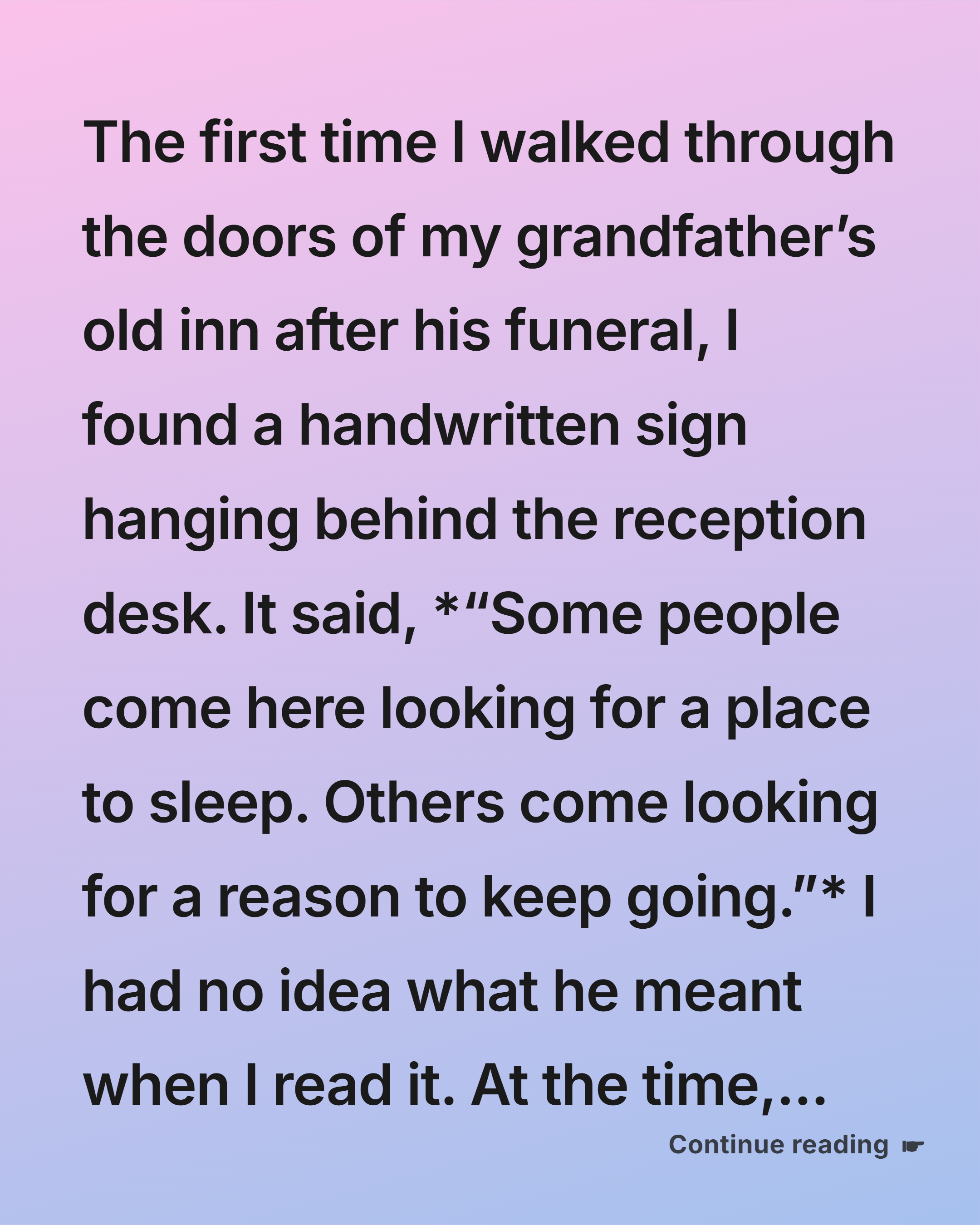
The first time I walked through the doors of my grandfather’s old inn after his funeral, I found a handwritten sign hanging behind the reception desk.
It said, *“Some people come here looking for a place to sleep. Others come looking for a reason to keep going.”*
I had no idea what he meant when I read it. At the time, I was too busy wondering why he had left me a crumbling building, a mountain of unpaid bills, and a family that suddenly seemed to remember I existed.
My name is Evelyn Brooks, and I was twenty-seven when my grandfather, Walter, passed away.
He had been the one constant in my life. My parents divorced when I was eight, and neither of them seemed particularly interested in raising a child. My father moved across the country with his new wife, while my mother struggled with addiction and spent years drifting between jobs and relationships.
Grandpa never complained about taking me in. He simply cleared out the spare bedroom, bought me a secondhand desk, and told me I could stay as long as I needed.
He wasn’t a wealthy man. He owned a small inn called Willow Creek House in a quiet town in Pennsylvania. It had twelve rooms, an aging wooden staircase, a kitchen that always smelled of cinnamon, and a porch where he spent nearly every evening reading the newspaper.
I grew up helping him change bedsheets, carry groceries, and polish the brass numbers outside the guest rooms. He taught me how to repair a leaking faucet, balance a checkbook, and recognize when someone was pretending to be happy.
But there was one part of his life he never explained.
Every Thursday afternoon, he closed the inn to visitors for two hours. He would disappear into the basement with a folder, lock the door, and refuse to answer questions.
When I was younger, I assumed he was working on taxes or dealing with something boring. Eventually, I stopped asking.
After college, I moved to Philadelphia and found a job as an administrative assistant at a small publishing company. I visited Grandpa whenever I could, usually bringing groceries and staying for dinner.
He always asked when I was coming home.
I would laugh and tell him I wasn’t planning to spend my entire life in a little Pennsylvania town.
He would nod, stir his tea, and say, “That’s fine, sweetheart. Just make sure you always have somewhere you can come back to.”
I didn’t understand how much those words would matter until he was gone.
His death came unexpectedly. He suffered a stroke one morning while preparing breakfast for two guests. By the time the ambulance arrived, he had lost consciousness. He died three days later.
At the funeral, I noticed something strange.
My father’s side of the family, most of whom hadn’t visited Grandpa in years, suddenly appeared in expensive clothes and stood together near the front. My father, Richard, even brought his wife and two adult children from his second marriage.
They barely acknowledged me.
I wasn’t surprised. My relationship with them had always been distant, especially with my half-brother, Mason, who seemed to think I had somehow stolen the family attention simply by being raised by Grandpa.
After the funeral, the lawyer asked everyone to attend a meeting.
I expected a few sentimental belongings, perhaps his old watch or the photographs that covered his living room walls.
Instead, the lawyer announced that Grandpa had left Willow Creek House, the surrounding property, and his remaining financial assets entirely to me.
The room went silent.
My father leaned forward.
“Excuse me?” he asked.
The lawyer calmly repeated the instructions.
My grandfather had written the will six years earlier and had updated it twice. There was no ambiguity about his intentions.
Mason immediately shook his head.
“That’s ridiculous. Dad, you’re his son. How can he leave everything to her?”
My father didn’t answer.
My stepmother, Diane, folded her arms and looked directly at me.
“Surely you understand that this property belongs to the family. It would be reasonable to divide the proceeds.”
I stared at her.
“Grandpa left it to me.”
“Because you were living with him,” she replied. “That doesn’t mean you deserve more than everyone else.”
I wanted to remind her that I had spent years helping him keep that place running while they visited only on holidays, if at all.
But I said nothing.
The lawyer explained that Grandpa had made his decision voluntarily and that the will had been properly witnessed. There was nothing to negotiate.
That should have ended the discussion.
Instead, it started weeks of arguments.
My father called repeatedly, insisting I should sell the property and distribute the money. Mason sent messages accusing me of manipulating Grandpa during his final years. My stepsister, Chloe, posted vague comments online about relatives who cared more about money than family.
I eventually stopped responding.
I had no intention of selling the inn.
Even if I couldn’t afford to maintain it forever, I couldn’t bring myself to erase the place where I had grown up.
Three weeks after the funeral, I returned to Willow Creek House with two suitcases and a plan to spend the weekend sorting through Grandpa’s belongings.
The building felt strangely empty.
His slippers were still beside the fireplace. His glasses rested on the kitchen counter. A half-finished crossword puzzle lay on the table.
I spent the first evening cleaning his office.
Behind a row of old accounting books, I found a small wooden drawer that I had never noticed before. It contained receipts, photographs, and a thick envelope marked with my name.
Inside was a short letter.
*Evelyn,*
*If you’re reading this, I’ve probably left you with more questions than answers. I hope you’ll forgive me for that.*
*Before you decide what to do with this building, I want you to visit the basement. The key is inside the blue tin behind my desk.*
*Please don’t let anyone convince you that everything I owned was meant to be sold.*
*Some things are worth more than their price.*
I read it twice.
Then I found the tin.
The key opened a narrow door at the bottom of the basement stairs. Behind it was a room I had never seen.
It wasn’t a storage room, as I had imagined. It looked more like a small office. There were filing cabinets, a desk, a coffee machine, and several shelves filled with neatly labeled folders.
On the wall hung photographs of people I didn’t recognize.
Some were children. Others were elderly couples, single parents, and young adults.
Every photograph had a handwritten date beneath it.
I opened the first folder.
Inside were records of rent payments, grocery expenses, medical bills, and school supplies. There were also letters from people thanking Grandpa for helping them during difficult periods.
One woman wrote that he had paid for her daughter’s winter coat when she couldn’t afford one.
Another described how he had allowed her and her two children to stay in one of the rooms for four months after her husband had thrown them out.
There were dozens of stories.
Then I found the document that explained everything.
For nearly twenty years, Grandpa had quietly operated a temporary housing program through Willow Creek House. He had used the inn’s income to provide free accommodation to people escaping difficult situations or struggling to rebuild their lives.
The Thursday afternoon closures weren’t about taxes.
They were private meetings with people who needed help.
I sat on the basement floor for a long time, surrounded by papers.
I had always thought of Grandpa as a kind, hardworking hotel owner. I had never realized how many lives he had touched without telling anyone.
The following morning, I called his lawyer.
He listened patiently as I explained what I had discovered.
“Your grandfather specifically instructed me not to disclose the program unless you chose to investigate the basement yourself,” he said.
“Why?”
There was a pause.
“Because he didn’t want you to feel obligated to continue something you hadn’t chosen. He wanted you to understand what the property meant before making your decision.”
Then he told me something else.
Grandpa had left a separate account containing money specifically reserved for the housing program. It wasn’t part of the inheritance available for distribution. He had also established a legal arrangement allowing the inn to continue providing temporary accommodation.
I suddenly understood why my father had been so determined to sell the property.
He didn’t know about the program, but he knew the land had become valuable. A developer had approached Grandpa the previous year with an offer to purchase the building and turn it into luxury apartments.
Grandpa had refused.
My father had apparently been furious when he learned about it.
I thought that was the end of the mystery.
I was wrong.
A week later, my father arrived without warning.
He parked his car outside the inn and walked in carrying a folder. He looked uncomfortable, as though he had rehearsed several different conversations during the drive.
“We need to talk,” he said.
I didn’t offer him coffee.
“What about?”
“The property.”
I almost laughed.
“Of course.”
He ignored my tone and placed the folder on the reception desk.
Inside were documents from a property development company. They included an offer to purchase the inn for considerably more than I had imagined it was worth.
“Your grandfather was making a mistake refusing this,” Dad said. “You could sell it, pay off everything, and have enough money to start a proper life.”
“I already have a life.”
“Don’t be childish, Evelyn.”
I closed the folder.
“Did you know what Grandpa was doing in the basement?”
His expression changed.
For a moment, he didn’t answer.
Then he said, “I knew he was helping people. I didn’t know the details.”
“Then why are you trying so hard to sell the place?”
He sighed.
“Because he spent his entire life worrying about strangers while neglecting his own family.”
That sentence angered me more than anything else he had said.
“He raised me,” I replied. “He didn’t neglect me.”
My father looked away.
I thought he would argue, but instead he sat down.
“Your grandfather and I had a terrible argument several years ago,” he said quietly. “I asked him for money to invest in a business. He refused. I told him he cared more about people who weren’t related to him than his own son.”
“And?”
“He told me that being related to someone didn’t automatically make them deserving of everything they owned.”
I stared at him.
For the first time, I understood that the conflict wasn’t simply about the money. My father had spent years feeling that Grandpa’s generosity toward others was an accusation against him.
He wanted the inheritance partly because he believed it would finally prove that he mattered.
But I wasn’t ready to make his feelings my responsibility.
“I won’t sell it,” I said.
He stood up.
“Then don’t expect this family to support you.”
I watched him leave.
For several days, I considered giving up. I had a full-time job, bills, and no experience managing a charitable housing program. Grandpa had made it look easy because he had spent decades building relationships and earning people’s trust.
I couldn’t simply replace him.
Then, one afternoon, a woman arrived carrying a small boy.
She introduced herself as Hannah. She had stayed at the inn for three months the previous winter, when she had been trying to leave an abusive relationship.
“I heard Walter passed away,” she said. “I’m so sorry.”
She looked around the reception area.
“Is everything going to close now?”
I didn’t know what to say.
The little boy tugged at her coat.
“Mom, is this the place where Mr. Walter gave me the dinosaur?”
Hannah smiled sadly.
“Yes, sweetheart.”
She explained that Grandpa had helped her find permanent housing and had paid for the first month of childcare so she could return to work.
Before leaving, she handed me a photograph.
It showed her son standing on the porch with Grandpa, holding a bright green toy dinosaur.
On the back, Grandpa had written:
*For the little man who never gives up.*
I cried after they left.
That evening, I made a decision.
I would keep the inn open.
Not because I felt guilty, and not because my father demanded anything. I wanted to do it because I finally understood what Grandpa had built.
But I needed help.
I contacted a local nonprofit organization and explained the situation. They agreed to help with applications, background checks, and referrals. I also spoke to a retired social worker named Margaret Ellis, who had worked with Grandpa for years.
She was skeptical when we first met.
“Do you understand how much work this is?” she asked.
“Not entirely,” I admitted.
“Good. At least you’re honest.”
She laughed.
Over the next several months, we repaired the building, updated the safety systems, and converted three unused rooms into family accommodation. I continued working remotely for the publishing company, while Margaret helped manage the program.
The first family arrived in October.
They were a mother and her teenage daughter who had lost their apartment after the mother’s employer suddenly closed its business.
When I handed them the room keys, the mother started crying.
“I’m sorry,” she whispered. “I don’t usually cry in front of strangers.”
I smiled.
“You’re not a stranger here.”
For the first time since Grandpa’s death, the inn felt alive again.
Meanwhile, my family continued pressuring me.
Mason eventually threatened to challenge the will. The lawyer responded with the necessary documents, and the matter went no further. My father stopped calling, although I occasionally received messages from Diane suggesting that I was destroying family relationships over an old building.
I tried not to let it bother me.
Then, nearly six months after Grandpa’s funeral, something unexpected happened.
I received a letter from my father.
It wasn’t a demand for money or another argument about the property.
It was an apology.
He wrote that he had spent years resenting Grandpa for refusing to rescue him from the consequences of his own decisions. He had changed jobs repeatedly, accumulated debt, and blamed everyone around him whenever something went wrong.
He admitted that when Grandpa became ill, he had visited only twice because he couldn’t stand seeing the man who had always refused to give him what he wanted.
The final paragraph was the hardest to read.
*I think I wanted the inheritance because I believed it would finally make me important to him. I never understood that he had already spent his life showing me what mattered. I just wasn’t paying attention.*
I folded the letter and put it in my desk.
I didn’t forgive him immediately.
But I called him a few days later.
We met at a small diner halfway between our towns. The conversation was awkward, and there were several long silences.
Eventually, he asked whether the inn was doing well.
“It’s getting there,” I replied.
He nodded.
Then he said something I never expected.
“Would you let me help?”
I studied his face.
“With what?”
“Repairs. Painting. Whatever needs doing. I’m not asking for anything.”
I didn’t trust him completely. One apology couldn’t erase years of disappointment.
But I agreed to let him come on Saturdays.
At first, he worked quietly. He repaired broken window frames, replaced damaged floorboards, and fixed the heating system in the upstairs hallway.
He never mentioned the inheritance again.
One afternoon, while we were painting the kitchen, he told me about his childhood.
Grandpa had been strict with him. He had expected him to take responsibility, keep his promises, and work for what he wanted. My father had interpreted those expectations as rejection.
“I spent years thinking he loved you more,” he admitted.
I put down my paintbrush.
“He didn’t love me instead of you, Dad. He just showed up when I needed him.”
My father stared at the wall for a moment.
“I know that now.”
It wasn’t a perfect reconciliation, but it was a beginning.
Then came the biggest surprise.
About a year after Grandpa’s death, Margaret and I were reviewing old financial records when we discovered a second set of documents tucked inside a filing cabinet.
They concerned the land behind the inn.
Apparently, Grandpa had purchased a small adjoining property nearly fifteen years earlier. It contained an old cottage and several acres of wooded land.
I had never known he owned it.
The documents revealed that he had intended to turn the cottage into a permanent residence for women who had completed the temporary housing program but still needed a stable place to live.
He had even drawn up architectural plans.
The project had never been completed because his health had deteriorated.
Margaret examined the drawings carefully.
“Your grandfather wasn’t just running an inn,” she said. “He was building a way for people to start over.”
I looked at the plans for a long time.
Then I contacted the nonprofit organization again.
Together, we applied for grants and approached local businesses for support. It took almost a year, but eventually we secured enough funding to renovate the cottage.
We named it Walter’s Place.
My father helped with the construction, and Mason even volunteered one weekend after hearing about the project from a mutual relative.
I was surprised to see him.
He looked around the property and said, “I used to think you got everything.”
I didn’t respond.
He kicked a small stone across the driveway.
“Turns out, I didn’t even know what everything was.”
For the first time, we had a conversation without arguing about money.
I didn’t suddenly become close to my half-siblings, and we didn’t pretend the past hadn’t happened. But the hostility slowly disappeared.
Chloe began visiting occasionally. She even donated furniture for the cottage after hearing that one of the families needed a proper dining table.
It wasn’t a perfect family reunion.
It was something more realistic: people gradually learning to treat one another better.
Two years after Grandpa died, we held a small opening ceremony for Walter’s Place.
The first resident was a thirty-two-year-old woman named Rachel, who had escaped an unsafe home with her six-year-old daughter.
She stood in the doorway holding a box of belongings and looked at the freshly painted walls.
“How long can we stay?” she asked.
“As long as you need while we help you find somewhere permanent,” I replied.
She looked at me as though she wasn’t sure she had heard correctly.
Then she hugged her daughter and began crying.
My father stood beside me during the ceremony.
He had spent the morning repairing a loose railing and was wearing an old work shirt covered in paint.
“You know,” he said, watching Rachel walk inside, “I think your grandfather would have liked this.”
I smiled.
“I think he would have told us we were taking too long.”
We both laughed.
Later that evening, I returned to the inn and sat in Grandpa’s old office.
I found his photograph on the desk, the one where he was standing on the porch with his sleeves rolled up and a ridiculous grin on his face.
For a long time, I wondered whether I had made the right decision.
I had inherited a property that could have given me financial freedom. Instead, I had chosen a life full of responsibilities, paperwork, repairs, and problems that didn’t always have easy solutions.
But then I remembered the little boy with the dinosaur, Hannah’s tears, and the families who had found a safe place when they needed one most.
I finally understood Grandpa’s Thursday afternoons.
He hadn’t been hiding something shameful.
He had been protecting something precious.
Today, Willow Creek House still has its twelve guest rooms. Some are rented to travelers, and the income helps maintain the building. Others are reserved for people who need temporary accommodation.
Walter’s Place has become a permanent part of the program, and Margaret still insists that I make better coffee before important meetings.
My father visits regularly. We aren’t suddenly the perfect father and daughter, but he has become someone I can call when a pipe bursts or when I need help moving furniture.
Mason and I occasionally exchange messages. We may never become particularly close, but we no longer treat each other like enemies.
And every Thursday afternoon, I close the reception desk for two hours.
I sit in the little basement office with a cup of coffee, read applications, and make sure the people who need help aren’t overlooked.
I also keep Grandpa’s handwritten sign behind the desk.
Sometimes visitors ask about it.
I tell them it belonged to the man who taught me that a building is only worth something because of what happens inside it.
I used to believe inheritance was about what someone left behind.
A house. A bank account. Land. Possessions that could be divided, sold, or argued over.
Now I understand that the most valuable things people leave us are often the ones that cannot be written into a will.
Grandpa left me a responsibility, but he also left me a purpose. And somewhere along the way, he helped me rebuild a relationship with a father who had spent years believing love was something that had to be earned through money.
I can’t change the years we lost, and I can’t make every member of my family understand why I chose to keep the inn.
But I can decide what happens next.
And whenever I see someone arrive at Willow Creek House carrying everything they own in a couple of bags, I remember Grandpa’s words.
*Always make sure you have somewhere you can come back to.*
He gave me that place.
Now, I’m making sure other people have one too.