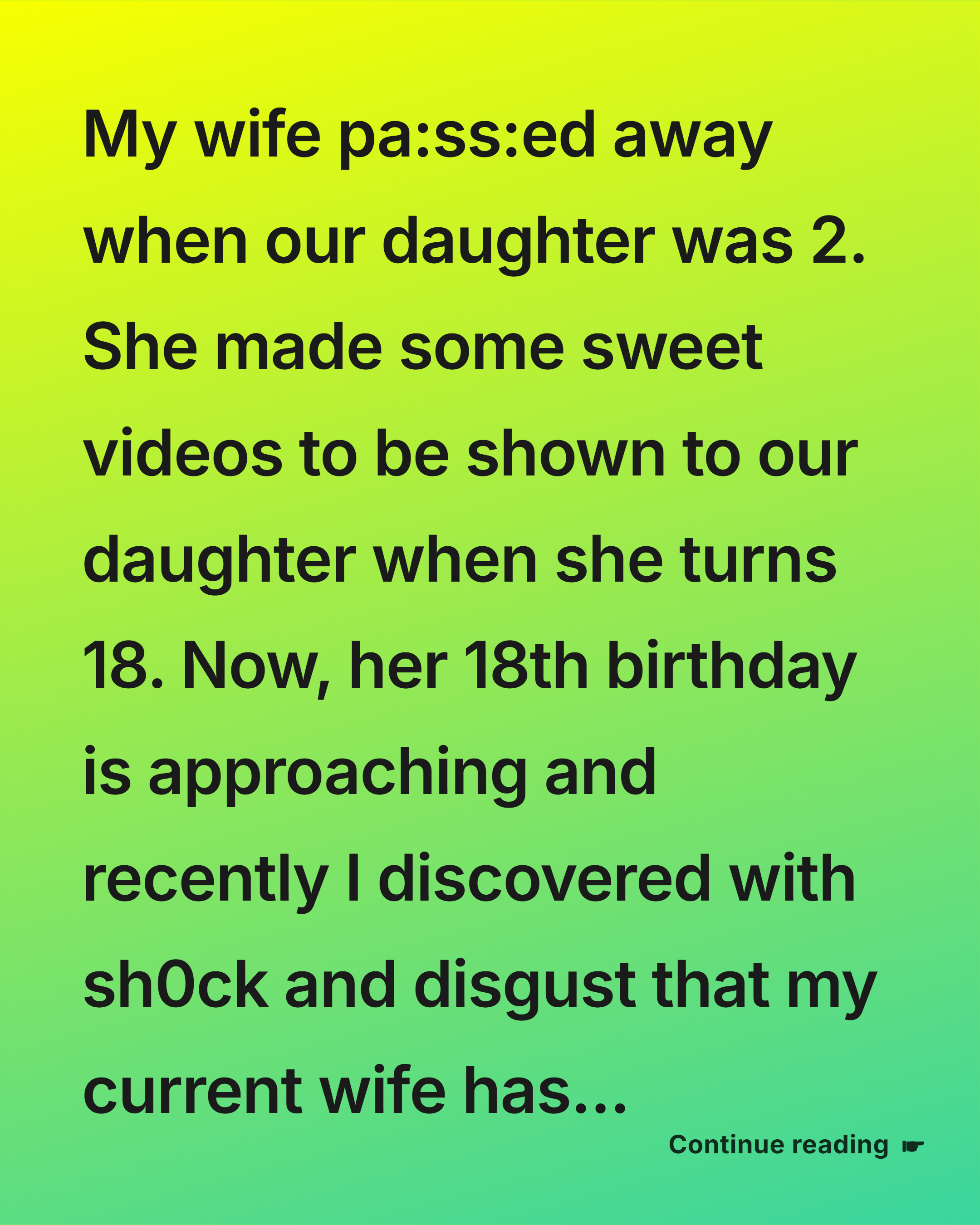
A grieving father recently shared a deeply emotional and painful story on Reddit, revealing how one shocking act of betrayal shattered his trust in the woman he had married and reopened wounds he had spent years trying to heal. What began as a loving plan to give his daughter an unforgettable 18th birthday present soon became a heartbreaking nightmare that threatened to destroy his family.
Still mourning the loss of his first wife, Cloé, he had carefully preserved a collection of video recordings she had made before her tragic death. These recordings were more than old family videos; they were precious pieces of a life that had ended far too soon, capturing a mother’s laughter, her dreams, and her love for the daughter who would grow up with only the faintest memories of her.
He had been waiting for the perfect moment to share them with Eleanore, hoping the recordings would help her finally connect with the mother she had lost as a toddler. But when that long-awaited birthday approached, he discovered that someone he trusted had made a decision that could never easily be undone. His current wife had destroyed the tapes, and her explanation left him questioning whether their marriage could survive such a devastating betrayal.
Preserving Memories for a Daughter Who Never Knew Her Mother
The man began by explaining that his first wife, Cloé, had died in a car accident when their daughter, Eleanore, was only two years old. In an instant, he lost the woman he loved, while his little girl lost the chance to grow up with a mother who could hold her hand, comfort her fears, celebrate her achievements, and tell her stories about the world.
Before the tragedy, the couple had recorded countless moments together using a video camera. Some clips showed them laughing over ordinary things, sharing meals, and talking about their hopes for the future. Others captured the excitement of Cloé’s pregnancy, when the two of them would speak to their unborn daughter, imagining what she would be like and the wonderful life they hoped to give her.
They had made the recordings with the intention of showing them to Eleanore when she turned 18. They wanted her to see the faces, hear the voices, and experience the affection that had surrounded her before she was old enough to remember it. Neither parent could have imagined how precious those simple recordings would become—or how desperately her father would one day wish he could preserve every second of them.
After Cloé’s death, the man was devastated. The house felt painfully empty, and ordinary routines became difficult reminders of everything he had lost. He tried to remain strong for his daughter, but grief followed him through the quiet evenings, the family celebrations, and the milestones Cloé should have been there to witness.
Raising Eleanore alone, he eventually sank into a deep depression. Friends encouraged him to begin dating again, insisting that he deserved another chance at happiness. Yet he struggled with the idea, feeling as though moving forward might somehow dishonor the woman he had loved and the life they had planned together.
Over time, he learned that continuing to love Cloé and building a future for himself did not necessarily have to be opposing choices. Still, he could never bring himself to discard the memories they had created. The videos became a private treasure, a bridge between the past and the future, and a promise he intended to keep for his daughter no matter how many years passed.
A New Marriage and Lingering Insecurities
Years later, when Eleanore was 13, the man met Wendy at his sister’s birthday party. Their connection developed quickly, and Wendy, who had two children of her own, initially appeared understanding of his circumstances. She seemed willing to accept that his late wife would always occupy a meaningful place in his life, and he believed he had finally found someone with whom he could begin a new chapter.
They married two years later, hoping to build a blended family together. For a while, he believed their relationship could provide the stability and companionship they all needed. He had no intention of replacing Cloé, nor did he expect Wendy to become someone she was not. He simply wanted a partner who could understand that his past was part of him.
However, from the beginning, Wendy seemed uncomfortable whenever he mentioned Cloé. Even when he spoke about his first wife in a fond but matter-of-fact way, Wendy sometimes became withdrawn or changed the subject. He never deliberately compared the two women, but he occasionally shared memories because he wanted Eleanore to know more about her mother’s personality, interests, and dreams.
To him, these stories were a natural part of raising a child who had lost a parent. To Wendy, however, they increasingly seemed to represent a shadow she could never escape.
Eventually, Wendy admitted that she felt she could never measure up to Cloé, who had once been a model. Her insecurity was not limited to their differences in personality or life experiences; it extended to her appearance, too. She often expressed sadness about feeling less attractive than the woman whose memory still occupied such an important place in her husband’s heart.
The man insisted that he loved Wendy for who she was and had never expected her to compete with his late wife. He tried to reassure her that loving someone who had died did not mean he was incapable of loving someone who was still alive. In his mind, there was room for both the memories of his first marriage and the happiness he hoped to build in his second.
He believed Wendy’s distress stemmed largely from her own self-doubt rather than anything he had intentionally done to hurt her. Whenever she appeared upset, he tried to be patient, hoping that with time she would feel secure enough to understand that Cloé’s memory was not a threat to their relationship.
What he failed to realize was how deeply that insecurity might have taken root. The tension surrounding Cloé’s memory never truly disappeared, and the man had no reason to suspect that the very recordings he had protected for years would eventually become the target of his wife’s resentment.
A Cruel Betrayal
As Eleanore’s 18th birthday approached, the man grew increasingly excited about finally sharing the videos Cloé had made. He imagined his daughter sitting beside him, watching her mother smile and speak, perhaps hearing her voice clearly for the first time in years. He hoped the recordings would answer questions Eleanore had carried throughout her childhood and give her a sense of connection that photographs alone could never provide.
The gift was especially meaningful because it represented something he had promised himself long ago: that his daughter would one day have the opportunity to know her mother beyond the stories other people told her. He had protected the recordings through years of grief, changes in his life, and the challenges of raising a child alone. Now, the moment he had been waiting for was finally within reach.
When he mentioned his plans to Wendy, he noticed that she seemed uneasy. Her expression changed, and there was a tension in her reaction that he could not quite explain. Still, he did not immediately suspect anything sinister. Perhaps she was uncomfortable with the subject, he thought, or perhaps she simply did not understand how important the gift was to him and Eleanore.
He tried not to overthink it. After all, the recordings had been kept safely for years, and he had no reason to believe that anyone would deliberately interfere with his plans.
Then, just days later, he went to retrieve the tapes so he could place them in a special box for Eleanore’s birthday. He expected to find them exactly where he had left them. Instead, the place where he had carefully stored them was empty.
At first, he assumed he had misplaced them. He searched through cupboards, drawers, storage boxes, and other places where he might have put them during an earlier cleanup. The longer he searched, the more unsettled he became. These were not ordinary belongings that could be replaced with a quick trip to a store. They contained moments from a life that had ended, and there was no way to recreate the originals.
Finally, with his anxiety mounting, he asked Wendy whether she had seen the tapes.
Her response left him stunned. With a cold, almost neutral expression, she admitted that she had thrown them away.
For a moment, he struggled to process what she had said. Surely there had to be some misunderstanding. Surely she had moved them somewhere else, or perhaps she meant she had discarded something different. He pressed her for an explanation, desperately hoping she would reveal that the recordings were still recoverable.
Instead, Wendy explained that he talked about Cloé too much and needed to move on. She claimed she thought getting rid of the tapes would help him finally let go of the past and begin focusing on the life they had together.
The revelation was devastating. Wendy had not merely discarded a box of old belongings; she had deliberately destroyed something she knew was emotionally significant. Worse, the recordings were not hers to dispose of. They belonged to a family history that included Eleanore, a daughter who had already lost more than any child should have to lose.
His grief quickly turned to anger. He could not understand how Wendy could have convinced herself that destroying another person’s irreplaceable memories was an act of kindness. Even if she genuinely believed he was struggling to move forward, how could she justify making such a permanent decision without his permission?
The argument that followed was intense. He tried to explain that the videos were meant for Eleanore, not simply for him. They were a chance for her to see her mother as a living, breathing person rather than a tragic absence in her childhood. Wendy’s decision had taken away something that could never be replaced by an apology or a promise to do better.
Overwhelmed by the betrayal, he eventually withdrew to the bedroom and locked the door. He could barely stand to look at Wendy, let alone continue arguing with her. His mind kept returning to the same unbearable thought: his daughter’s 18th birthday was approaching, and the gift he had spent years protecting might be gone forever.
Yet beneath his anger lay another, even more painful realization. If Wendy had been willing to destroy something so precious behind his back, what else might she have been capable of doing when her insecurities became overwhelming? And if she had understood how much those recordings meant to him, had she truly believed she was helping him—or had she simply wanted Cloé’s presence erased from their lives?
He did not know the answers. All he knew was that the woman he had trusted had crossed a boundary he had never imagined she would cross.
Searching for Fragments, Seeking Peace
The following morning, the man began searching his computer for any digital traces of Cloé that might have survived. He combed through old folders, photographs, archived files, and anything that might contain a copy of the recordings. Every possible lead offered a small flicker of hope, followed by the fear that he might discover nothing at all.
He knew how much the videos would have meant to Eleanore. Even as she grew older, she sometimes cried over the fact that she had never truly known her mother. She had photographs and family stories, but neither could fully capture the sound of Cloé’s voice, the way she laughed, or the warmth in her expression when she spoke about the child she was waiting to meet.
The recordings had promised something extraordinary: a chance for Eleanore to witness her mother’s love directly, preserved in her own words and gestures. Now, with her birthday only days away, her father faced the possibility that this gift had been taken from her before she even knew it existed.
Meanwhile, Wendy continued apologizing. She sent him repeated messages, attempting to explain herself and express regret. Perhaps she was beginning to understand the magnitude of what she had done, or perhaps she was frightened by the possibility that her actions had permanently damaged their marriage. Whatever her motivation, he admitted that he could not bring himself even to look at her messages without feeling the betrayal all over again.
He was caught between the desire to recover the videos and the realization that recovering them would not automatically repair the trust he had lost. Even if he found a backup, the knowledge that Wendy had knowingly discarded the originals would remain. The recordings might be saved, but the question of whether their marriage could survive her decision would still be waiting for him.
The situation became even more painful when mutual friends began pressuring him to forgive Wendy. Some argued that Cloé had been gone for more than a decade and that he needed to stop allowing the past to interfere with his present. Others suggested that Wendy had made a terrible mistake but deserved another chance because she was now apologizing.
Their words only deepened his sense of isolation. He understood that people might struggle to comprehend the lasting effects of grief, especially when the loss had occurred years earlier. But time had not made Cloé less important to Eleanore, nor had it transformed the videos into meaningless objects.
He wondered how those friends would feel if someone destroyed the last surviving recordings of a person they loved, particularly recordings intended for a child who had never been given the chance to know that person. Would they still describe the act as a mistake that should be forgotten? Would they still insist that an apology was enough?
To him, the issue was not whether he should remain trapped in the past. It was whether his wife had the right to decide which parts of his history deserved to survive. He had built a new life with Wendy, but he had never agreed to erase the life that came before it.
And with every passing hour, the pressure surrounding Eleanore’s birthday grew more intense. He needed to find something he could give his daughter, something that would help her feel connected to her mother despite what had happened. He also needed to decide what to tell her if the recordings could not be recovered—and whether concealing Wendy’s role in their disappearance would only create another painful secret.
A Man Torn Between Grief, Anger, and Confusion
Now, overwhelmed by grief, anger, and uncertainty, the father is questioning whether his reaction is too extreme or entirely justified. He recognizes that Wendy may have acted out of insecurity and that her discomfort with Cloé’s memory had been building for years. But understanding the emotions behind her decision does not make the decision itself any less damaging.
The betrayal has forced him to confront difficult questions about the future of his marriage. Can he trust someone who deliberately destroyed irreplaceable memories without consulting him? Can Wendy genuinely understand the harm she has caused, or will she continue to view his connection to Cloé as an obstacle to their happiness? And if he chooses to forgive her, what would forgiveness look like when the consequences of her actions cannot simply be undone?
There is also Eleanore to consider. Her birthday should be a celebration of adulthood and a milestone she can remember with happiness. Instead, her father is struggling to salvage the gift he had envisioned for years, knowing that revealing what happened could cause her enormous pain and permanently alter her relationship with Wendy.
He has not forgotten that Wendy is part of his present, and he does not pretend that their marriage has been without love or meaningful moments. But he is beginning to understand that love alone cannot resolve every conflict, particularly when one person’s insecurity leads them to violate another person’s boundaries.
For now, his attention remains fixed on the search for the recordings. He is hoping that somewhere, on an old computer, an overlooked storage device, or a forgotten backup, a fragment of Cloé’s voice might still exist. Even a few minutes of footage could make a difference to a daughter who has spent most of her life wishing she could know her mother better.
Yet the search has become about more than recovering lost videos. It is also about discovering whether the trust in his marriage can ever be restored and whether Wendy can acknowledge that her attempt to force him to move on has only reopened wounds she never had the right to close.
As Eleanore’s 18th birthday draws closer, the father faces an agonizing choice: how to honor the promise he made to his daughter, how to confront the woman who shattered it, and how to protect what remains of his family without sacrificing his own emotional well-being.
He once believed that time would make the pain of losing Cloé easier to carry. He never imagined that, years later, he would be fighting to preserve the final pieces of her memory against someone who had promised to share his future.
And perhaps the most heartbreaking question is not whether Wendy deserves forgiveness, but whether she truly understands what she destroyed—and whether the love they once shared can survive the consequences of that choice.