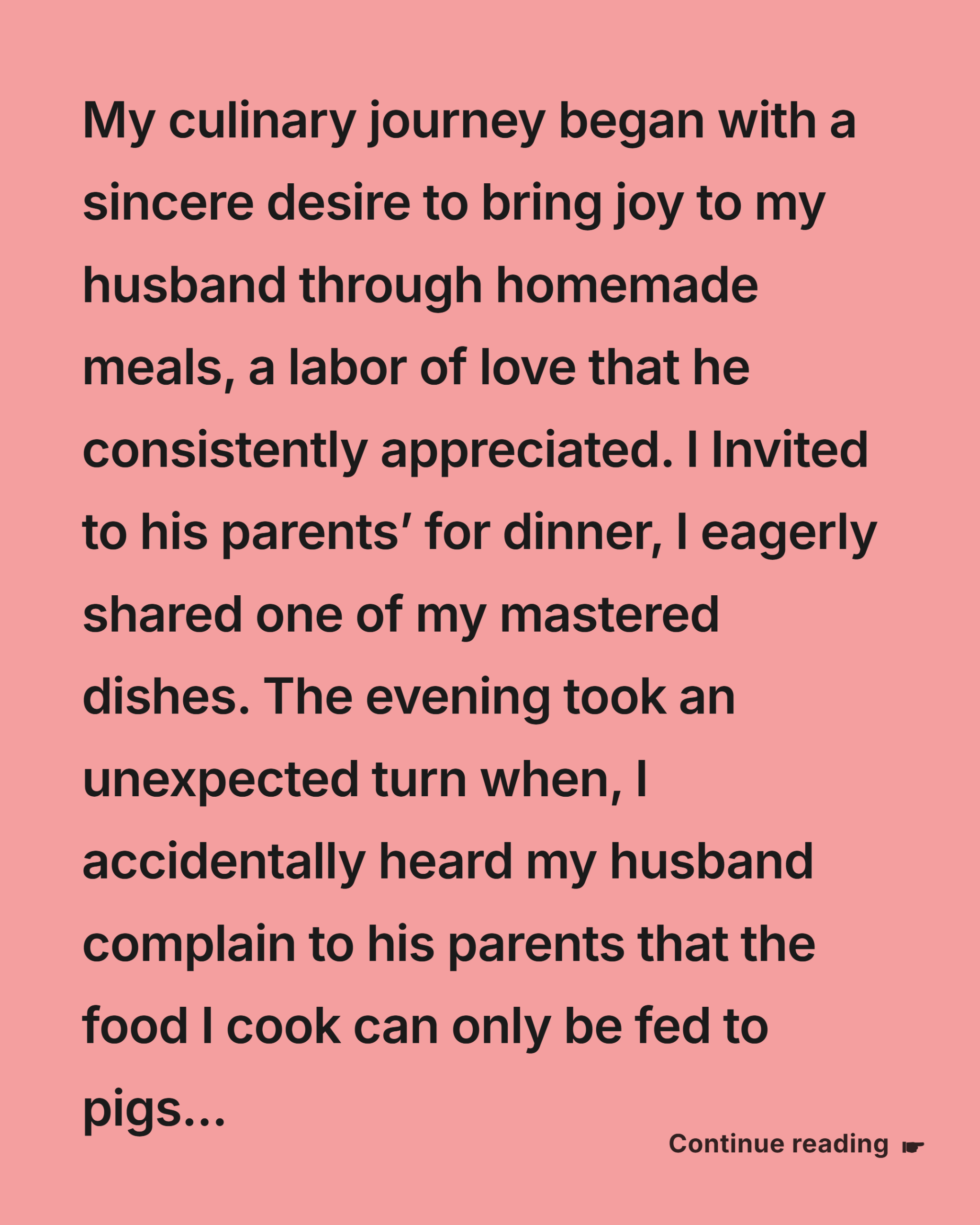
My culinary journey began with a simple, sincere desire: to bring joy to my husband through the meals I placed on our table each night. Cooking became my quiet love language. After long days, I would tie on my apron and lose myself in the comforting rhythm of chopping vegetables, simmering sauces, and tasting spices until everything felt just right. Over time, I mastered the dishes he loved most—creamy pastas, fragrant roasts, delicate desserts. Our kitchen filled with warmth, laughter, and the comforting clatter of plates. When he praised my food, his eyes bright with approval, I felt a small but powerful sense of pride. In those moments, our dining table felt like the center of our world, a place where love was served alongside every meal.
So when my husband suggested we visit his parents for dinner one Saturday evening, I felt excited—almost honored—when he encouraged me to bring one of the dishes I had perfected. I chose the one he claimed was his favorite, a recipe I had refined over countless evenings. I spent the entire afternoon preparing it carefully, tasting and adjusting until the flavors felt perfect. As we arrived at his parents’ home carrying the dish, I felt hopeful, even a little nervous. Sharing something you’ve poured your heart into always carries a quiet vulnerability.
The evening began pleasantly enough. His parents greeted us warmly, the house filled with the familiar smells of home and old family memories. When my dish was placed on the table, everyone complimented the aroma. My husband smiled at me across the table, and for a moment, I felt reassured that the effort had been worth it.
Then, midway through dinner preparations, I stepped away to the kitchen to fetch an extra serving spoon.
That small moment—barely a minute—changed everything.
As I passed the hallway on my way back, I heard my husband’s voice drifting from the living room where he had stepped aside with his father. I wasn’t trying to listen. In fact, I slowed instinctively because something in his tone felt… different. Casual. Slightly mocking.
And then I heard the words.
He laughed softly and said, “Honestly, Dad, you’d think after all this time she’d get better at cooking. I just pretend it’s great so she won’t feel bad.”
The words struck like ice water poured straight into my chest.
For a moment, I couldn’t move. My hands tightened around the spoon I was holding as the hallway suddenly felt too narrow, the walls too close. My mind raced, trying to convince me I had misunderstood. Maybe I’d misheard. Maybe there was some context I didn’t catch.
But his father chuckled quietly in response.
And my husband continued, almost casually, “It’s easier this way. She tries so hard.”
My heart cracked open in that instant.
All those nights spent perfecting recipes. All those proud smiles across the dinner table. All those compliments I had believed.
Were they just… kindness? Or worse—pity?
I stood there in the dim hallway for several long seconds, feeling something fragile inside me collapse.
Then I walked back to the dining room.
When I reentered, the table looked exactly the same—the plates, the warm lights, the dish I had spent hours preparing sitting proudly in the center. But something fundamental had shifted inside me. The room felt colder now, the laughter forced.
I took my seat quietly, but the weight of what I had heard pressed heavily on my chest. My husband glanced at me, smiling as if nothing had happened.
That smile hurt more than the words.
I tried to swallow the lump in my throat, but tears began to sting behind my eyes. Finally, unable to carry the silence any longer, I placed my fork down.
“I heard what you said,” I whispered.
The words cut through the room like a blade.
My husband froze.
His father shifted uncomfortably in his chair, suddenly fascinated by his plate.
I looked directly at my husband, my voice trembling despite my effort to stay calm.
“I spend hours cooking because you told me it made you happy,” I said. “Because every time you complimented a dish, I believed you. I believed that those little moments meant something to you the way they meant something to me.”
The room fell into a deep, uneasy silence.
My husband’s expression slowly changed from confusion to realization as the meaning of my words settled in.
“I heard everything,” I continued softly. “The pretending. The jokes.”
For a moment, no one spoke.
Then my husband pushed his chair back slightly, his face pale. The easy confidence he’d worn all evening vanished.
“That’s not what I meant,” he said quickly, his voice suddenly strained.
But the damage had already been done.
Dinner ended early that night. The food sat half-eaten, the warmth of the evening replaced by a heavy quiet none of us could escape.
The drive home passed in near silence.
In the days that followed, the truth between us refused to fade. My husband tried to explain that he had exaggerated to impress his father, that he had been careless with his words, that he never meant to hurt me. But trust, once cracked, does not mend overnight.
We talked—sometimes calmly, sometimes through tears.
For the first time, we spoke honestly about the small things we had always ignored: the pressure to please, the fear of disappointing one another, the careless words that linger longer than we realize.
Slowly, painfully, we began rebuilding something stronger than the polite smiles we had once relied on.
And one evening, weeks later, as I stood once again in our kitchen preparing dinner, my husband walked in quietly and stood beside me.
“I used to think those compliments were just about the food,” he said softly. “But I realize now they were really about the love you put into it.”
He paused before adding, almost like a confession:
“I should never have treated that like a joke.”
Our story didn’t end with that dinner. In many ways, it truly began there.
Because sometimes the most painful words we overhear are the ones that force us to confront the truth—and decide whether love is strong enough to grow from it.

ZafMalik is a journalist an storyteller who turns everyday moments into unforgettable, viral narratives. With a sharp eye for emotion and twists, he brings real-life stories to life in ways that stay with you long after they’re told.