The envelope arrived on a Tuesday, tucked between a water bill and a flyer advertising replacement windows.
My wife, Mara, opened it at the kitchen table while I searched the refrigerator for something that might become dinner.
“Apparently,” she said, “I’m eating in the library.”
I turned around.
She held up the printed schedule for my younger sister’s wedding. Beneath the reception arrangements, someone had written a note in blue ink:
Mara: private dining space arranged. Ben can join after photographs.
My name is Ben. Mara is my wife of eight years. And until that moment, neither of us had known she needed to be separated from the other guests.
“Maybe it’s a mistake,” I said.
Mara looked at me over her glasses.
“Then call and ask.”
Mara had used a wheelchair since a spinal cord injury at eleven. She worked as an architectural illustrator, possessed a devastatingly dry sense of humor, and could identify a badly designed building before I found its front door.
We met when she rejected a proposal I’d submitted for a community theater renovation.
I was the carpenter responsible for a stage entrance with an awkward turn.
“You’ve designed a lovely obstacle course,” she told me.
I corrected it. Then I asked her to dinner.
For years, my sister, Celia, seemed to adore her. She borrowed Mara’s earrings, sent her photographs of questionable paint colors, and called whenever she needed someone to tell her the truth.
But after Celia became engaged to Owen, everything acquired an audience.
The flowers needed to photograph well. The guests needed to match the setting. Even our mother, Ruth, received instructions about which shade of silver to wear.
Celia had booked Bellweather House, an old estate overlooking the river. Mara had asked once about access.
Celia said it was handled.
Now there was a handwritten seating arrangement suggesting otherwise.
When I called, Celia sounded distracted.
“The library is beautiful, Ben. It has a fireplace.”
“Why would Mara eat there?”
A pause.
“The dining room is down three steps.”
“Then why book it?”
“Because I’ve wanted this venue since I was sixteen.”
I watched Mara fold the schedule along its original crease.
“And the photographs?” I asked.
“The terrace has stairs too. We thought Mara could stay inside while we did the formal family pictures. Owen’s uncle has a bad knee. He probably won’t be in all of them either.”
“You sent my wife instructions to eat alone.”
“She won’t be alone. There’ll be a staff member.”
I shut my eyes.
Celia lowered her voice.
“Please don’t turn this into something ugly. I’m trying to find a solution.”
“Did you ask Mara what would work?”
“I knew she’d want everything changed.”
Mara extended her hand for the phone.
“Celia,” she said evenly, “I asked whether I could enter the building and sit with my family. That was the entire request.”
“I can’t rebuild a historic house for one person.”
“No,” Mara replied. “But you can decide whether that person belongs at your wedding.”
She handed the phone back and rolled away from the table.
I told Celia we wouldn’t be attending under those arrangements.
For the first time in my life, my sister hung up on me.
Our mother called the following morning.
“She’s under a great deal of pressure.”
“So is Mara.”
“Couldn’t you go for the ceremony, at least?”
“And leave my wife at home?”
“I’m asking you not to lose your sister over a building.”
Across the kitchen, Mara stopped stirring her coffee.
I realized then how easily everyone could make the building the problem. Buildings couldn’t answer back. Nobody had to apologize to them.
“We’ll talk later, Mom.”
After I ended the call, Mara said, “You can go if you want.”
“I don’t want.”
“I mean it. I won’t make you choose.”
I pulled out the chair beside her.
“You didn’t make this choice necessary.”
She nodded, but her mouth tightened.
“I keep thinking about all those times she asked my opinion. Dresses. Invitations. Her speech.”
“I know.”
“She wanted me involved until it meant making room.”
For the next several days, we behaved like people avoiding a broken window in winter.
We went to work. We discussed groceries. We watched half an episode of a detective series and couldn’t remember who had been murdered.
Then I made things worse.
Without telling Mara, I wrote a long message in the family group explaining exactly why we were staying away.
By lunchtime, three cousins had called her. An aunt sent a prayer. Someone suggested she offer to be carried down the steps.
Mara shut her laptop.
“Did you ask me before giving everyone my afternoon?”
“I was defending you.”
“I needed my husband to listen to me. Now I have twelve people waiting for me to tell them how upset I am.”
I wanted to explain my intentions. Instead, I looked at the unfinished drawing on her screen.
“You’re right.”
“Please don’t turn me into a family campaign.”
I apologized and posted one final message asking everyone to stop contacting her about the wedding.
Then I left the group.
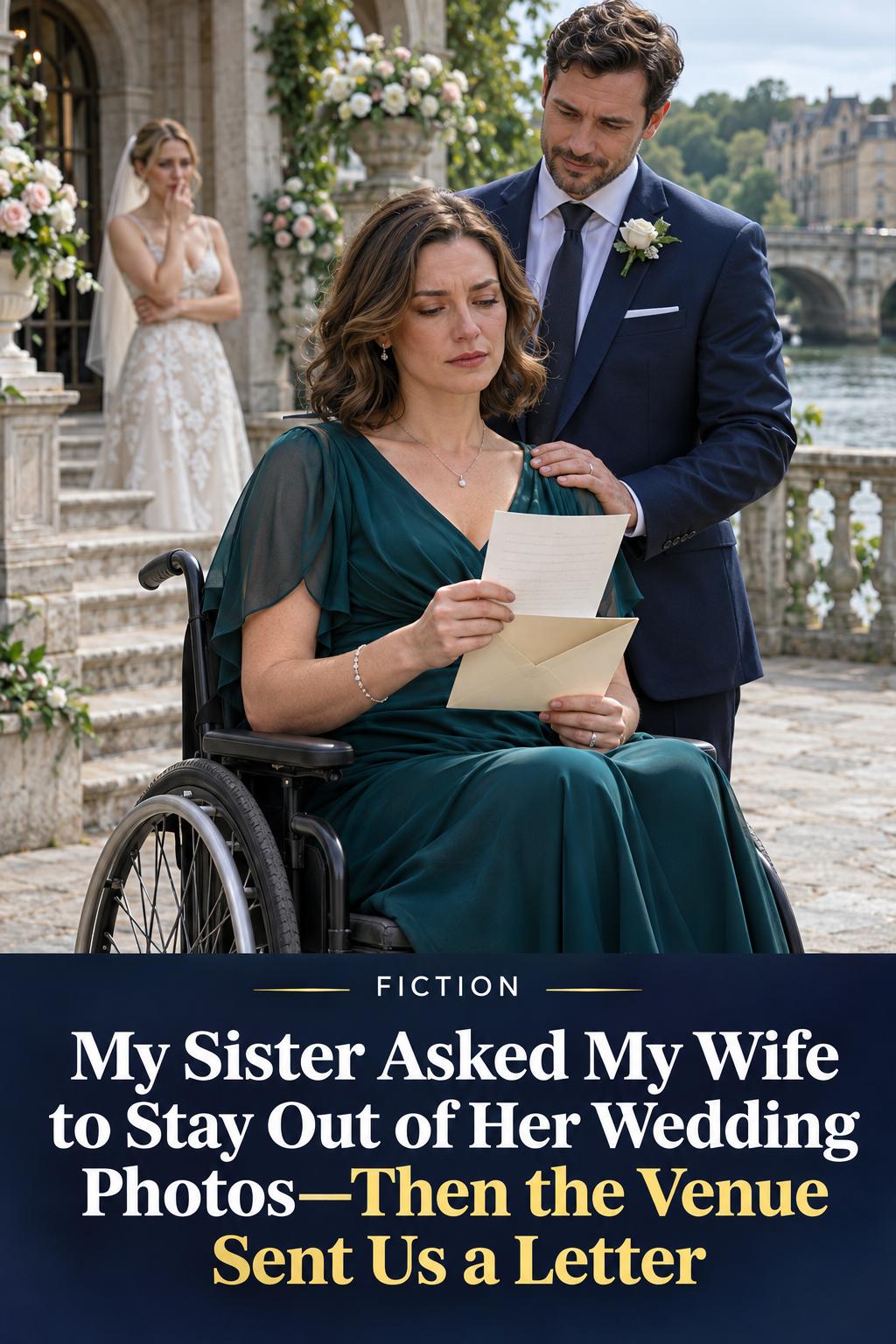
The letter arrived four days later.
This time, it came from Bellweather House.
Mara slit the envelope, read the first paragraph, and frowned.
“What?”
She passed it across.
The letter thanked her for agreeing to the private dining arrangement and requested confirmation that she could transfer from her wheelchair so venue staff could carry her between floors.
At the bottom was a box marked Guest Approval, with Mara’s name typed beneath it.
She hadn’t approved anything.
I reached for my phone.
Mara laid her hand on mine.
“I’ll make this call.”
She asked for the events manager, introduced herself, and requested a copy of every message concerning her attendance.
The manager, Helena, sounded increasingly uncomfortable.
Within an hour, the emails arrived.
Celia had told the venue that Mara preferred privacy during meals.
She had also written that Mara was “comfortable receiving assistance on stairs.”
There was something else.
Three weeks earlier, Helena had offered to move the entire reception into the accessible garden pavilion at no additional hire charge. It seated fewer people, but it would accommodate Celia’s confirmed guest list.
Celia had declined.
The house dining room is essential to the look we’re creating, she had written.
Mara read that sentence twice.
Then she closed the laptop.
“Now I know.”
We didn’t send the emails around.
Mara forwarded them to Celia and Owen with a short note:
Please correct the information you provided in my name. I have agreed to none of these arrangements. We will not attend under the current plan.
Owen called that evening.
He worked offshore and had left most of the planning to Celia. I expected excuses.
Instead, he asked whether Mara wanted to speak to him.
She did.
“I was told the pavilion wasn’t available,” he said.
“It was.”
“I’ve seen the emails.”
Mara waited.
“I’m sorry,” he continued. “I should have checked when you asked about access.”
“Yes,” she said. “You should have.”
He accepted that without trying to soften it.
Two days later, Celia asked to visit.
Mara suggested the public gardens instead.
“Forty minutes,” she told me. “Then we have somewhere else to be.”
We didn’t. I understood.
Celia arrived without her wedding binder.
She sat opposite us beside a pond, twisting a loose thread on her sleeve.
“I’ve corrected the forms,” she said.
“Thank you,” Mara replied.
“And we’re moving dinner to the pavilion.”
Mara’s expression barely changed.
Celia looked at me, perhaps hoping I would help.
I kept quiet.
“I know that doesn’t fix what I said.”
“No,” Mara answered. “It fixes dinner.”
Celia’s eyes filled.
“I got so caught up in how everything would look.”
“Was it embarrassing to have me there?”
“No.”
“Then why leave me out of the photographs?”
Celia stared at her hands for a long time.
Finally, she said, “Because I pictured something years ago, and I treated everyone like they had to fit it.”
Mara looked toward the water.
“You could have called me. We could have looked at the venue together.”
“I know.”
“You made decisions about what I could tolerate. Then you put my name on them.”
“I’m sorry.”
This time, she didn’t add anything.
Before we left, Mara told her we needed time. Celia nodded.
For once, she didn’t ask for a deadline.
Over the next month, the changes became practical.
Helena sent Mara the revised route between the ceremony lawn, pavilion, and accessible bathroom. Mara answered the questions relevant to her and declined Celia’s invitation to supervise the rest.
“I’m still a guest,” she reminded her.
Celia hired a coordinator.
My mother came over one afternoon carrying an apple cake and an apology that seemed to have cost her some sleep.
“I asked you to make yourself smaller so nobody else would be uncomfortable,” she told Mara. “I’m ashamed of that.”
Mara invited her in.
They ate cake. They talked about other things too.
When Mara finally told me she wanted to attend, I asked whether she was sure.
“I want to see what happens next,” she said.
On the wedding morning, rain swept across the river.
By noon, the ceremony lawn was flooded.
I felt my stomach drop when Celia called. The house had a covered entrance hall. I could already imagine the hurried explanations.
Instead, she said, “Tell Mara we’re moving the ceremony into the pavilion. Dinner tables will go around the edges until afterward.”
“What about the photographs?”
“We’ll work it out.”
Her voice shook, but she wasn’t asking us to solve anything.
When we arrived, staff were moving flowers beneath the pavilion roof. Owen’s grandmother sat near a heater. Two children chased each other between stacks of spare chairs.
Celia stood at the entrance in her wedding dress, holding a roll of tape.
For a moment, she and Mara simply looked at each other.
Then Celia stepped aside.
“Your seats are with Mom.”
Mara smiled.
“Good. She promised to save me something to eat.”
The family photographs were taken beneath the pavilion’s wide awning.
The photographer started arranging everyone in a standing row, then paused to consider the crowded space.
Celia pointed to a collection of garden chairs.
“Could we use those?”
He brought them over.
Some of us sat. Others leaned behind us. Owen’s grandmother pulled Celia close by the wrist, laughing as the veil caught on her bracelet.
Nobody needed to disappear to make the picture work.
Later, Celia asked Mara to join her near the edge of the dance floor.
They talked for several minutes. I stayed at our table.
When Mara returned, I asked what they’d discussed.
“Her honeymoon. My deadline. Whether she can borrow my green suitcase.”
“Can she?”
“I told her she has to return the earrings first.”
That autumn, the framed wedding photograph arrived at our house.
In it, Mara was laughing at something Owen had said. My mother’s eyes were closed. I was looking in the wrong direction.
Celia had included a note.
This is my favorite one.
Mara set it on the hallway shelf.
Beside it stood a small photograph from our own wedding, taken eight years earlier in a registry office with dreadful lighting.
I asked whether she was happy with where she’d put it.
She moved it an inch to the left, considered both pictures, and nodded.
“Everyone fits.”