The recording lasted forty-three seconds.
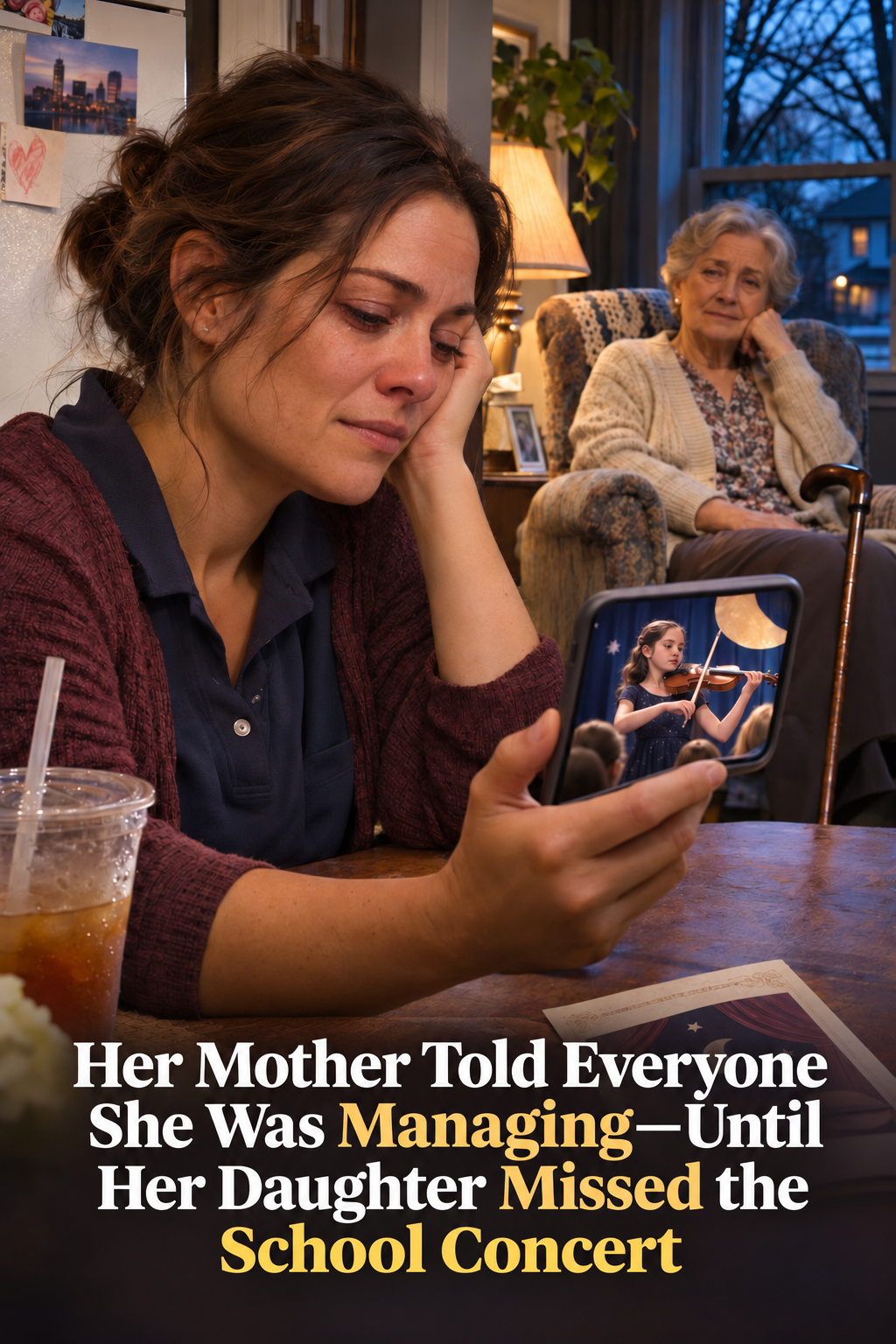
In it, eleven-year-old Iris stood beneath a paper moon, searching the school auditorium before beginning her violin solo.
Mara watched it in the hospital parking lot, still wearing her supermarket uniform. Upstairs, her mother was waiting for an X-ray after attempting to carry a laundry basket down the stairs.
“You played beautifully,” Mara whispered to the phone.
Then she turned off the screen before the applause.
At thirty-eight, Mara was raising Iris and her younger brother, Ben, in a rented duplex outside Dayton. Her mother, Celia, had moved in eight months earlier after a stroke weakened her left side.
Before the stroke, Celia had managed a school cafeteria. She remembered everyone’s allergies and disliked being thanked for things she considered ordinary.
Now she disliked needing help even more.
She contributed money for groceries and insisted on paying the water bill. But Mara handled the bathing, appointments, prescriptions, cooking, and the cautious journey between bed and bathroom.
Her older brother, Graham, lived forty minutes away.
Whenever Mara mentioned help, he replied, “Mom says she’s doing fine.”
That night, after bringing Celia home, Mara found Iris’s concert program beside a plate of cold toast.
“You don’t have to watch the video again,” Iris said. “I know you were busy.”
The kindness hurt worse than an accusation.
The following morning, Mara called Graham.
“I need you here Saturday. Six hours.”
There was a pause.
“Couldn’t you get someone?”
“I’m asking someone.”
He sighed. “Mara, I have a life too.”
She ended the call before saying something she couldn’t retrieve.
Two days later, Celia announced that Graham would be coming Sunday for lunch.
“I told him you’ve been tired,” she said.
Mara gripped the edge of the counter.
“Tired?”
“What should I have said?”
“That I haven’t slept through the night since September.”
Celia’s expression closed.
“I never asked you to make me feel like a burden.”
Mara nearly apologized. The words rose automatically.
Instead, she said, “I’m asking you to stop telling people there’s nothing to do.”
Sunday arrived with rain and a bakery cake. Graham kissed his mother, checked his phone, and asked whether lunch was ready.
Mara put on her coat.
“Where are you going?”
“To take my children swimming. Your number is beside the medication list. We’ll be back at five.”
“Mara—”
“Mom’s lunch is in the fridge.”
For the first hour, she checked her phone constantly.
Then Ben jumped into the shallow end without holding her hand, and she nearly missed that too.
When they returned, the cake remained untouched.
Graham sat beside Celia with a notebook open. His shirt sleeve was damp from helping her wash.
“I didn’t know getting dressed took that long,” he said.
Mara set down the swimming bag.
“I tried to tell you.”
“I know.”
Celia stared toward the window.
“Your brother asked why I kept saying I managed everything myself.”
Neither of her children spoke.
“At work, people came to me when something went wrong,” she continued. “Now someone has to wait outside the bathroom.”
Her voice shook.
“I liked hearing him say how well I was doing.”
Mara sat opposite her.
“You can be doing well and still need help.”
Celia nodded, then looked at Graham.
“I let you believe your sister was exaggerating.”
The arrangements they made were imperfect but specific. Graham took Tuesday evenings and alternate Saturdays. He paid for an aide one additional morning each week. Celia agreed to discuss her care honestly with both children.
Mara kept Thursday evenings free.
Three weeks later, Iris practiced her violin in the living room while Celia sorted socks one-handed. Graham stood at the stove, reading the instructions on a packet of rice.
From the doorway, Mara watched her mother drop a sock and reach for it.
Then Celia stopped.
“Graham,” she called, “would you get that for me?”
He put down the packet.
Mara hung up her coat and took a seat beside her daughter.