My mother-in-law hated me from the moment Adam brought me home. She never tried to hide it. Her smiles were sharp, her compliments backhanded, her silence heavy with judgment. I learned quickly that whenever she entered a room, I could feel myself shrinking without even knowing why.
To her, I was never enough—too quiet, too sensitive, too “weak” for her precious son. Adam noticed. He just never intervened. Whenever she criticized me, he would lower his eyes, change the subject, or disappear behind some excuse about not wanting to get involved. At the time, I told myself he was simply avoiding conflict. I would later realize that his silence had been a choice.
When I was pregnant with twins, I thought—foolishly—that things might change. That the promise of grandchildren would soften her. For a while, she pretended. I remember the first time I showed her the ultrasound pictures. I was smiling so hard my cheeks hurt, waiting for even a little warmth from her. She glanced at the image, handed it back, and simply said, “Let’s hope everything works out.”
She touched my belly once, stiffly, like it offended her. She asked no questions. She never said their names. I had already chosen them, quietly, with Adam. I imagined her one day holding them, maybe finally seeing me as part of the family. Looking back, I wonder if she had already decided that my place in that family would never be permanent.
At thirty-seven weeks, everything ended. No warning. No mercy. One moment I was planning cribs and folding tiny clothes. The next, I was lying in a hospital bed staring at a ceiling that felt miles away, listening to words that didn’t make sense. There was no heartbeat. The doctor kept speaking gently, but I couldn’t understand how something could be so wrong when only hours earlier I had felt them moving.
Then no second one either. The world went silent. The funeral was small. There were two tiny coffins, two arrangements of flowers, and a grief so enormous that I could barely comprehend how my body was still breathing.
I barely remember it. I remember Adam standing beside me, unmoving, like grief had turned him to stone. And I remember his mother leaning close enough that only I could hear her. Her face looked almost calm, as if the funeral were an inconvenience rather than the burial of two babies.
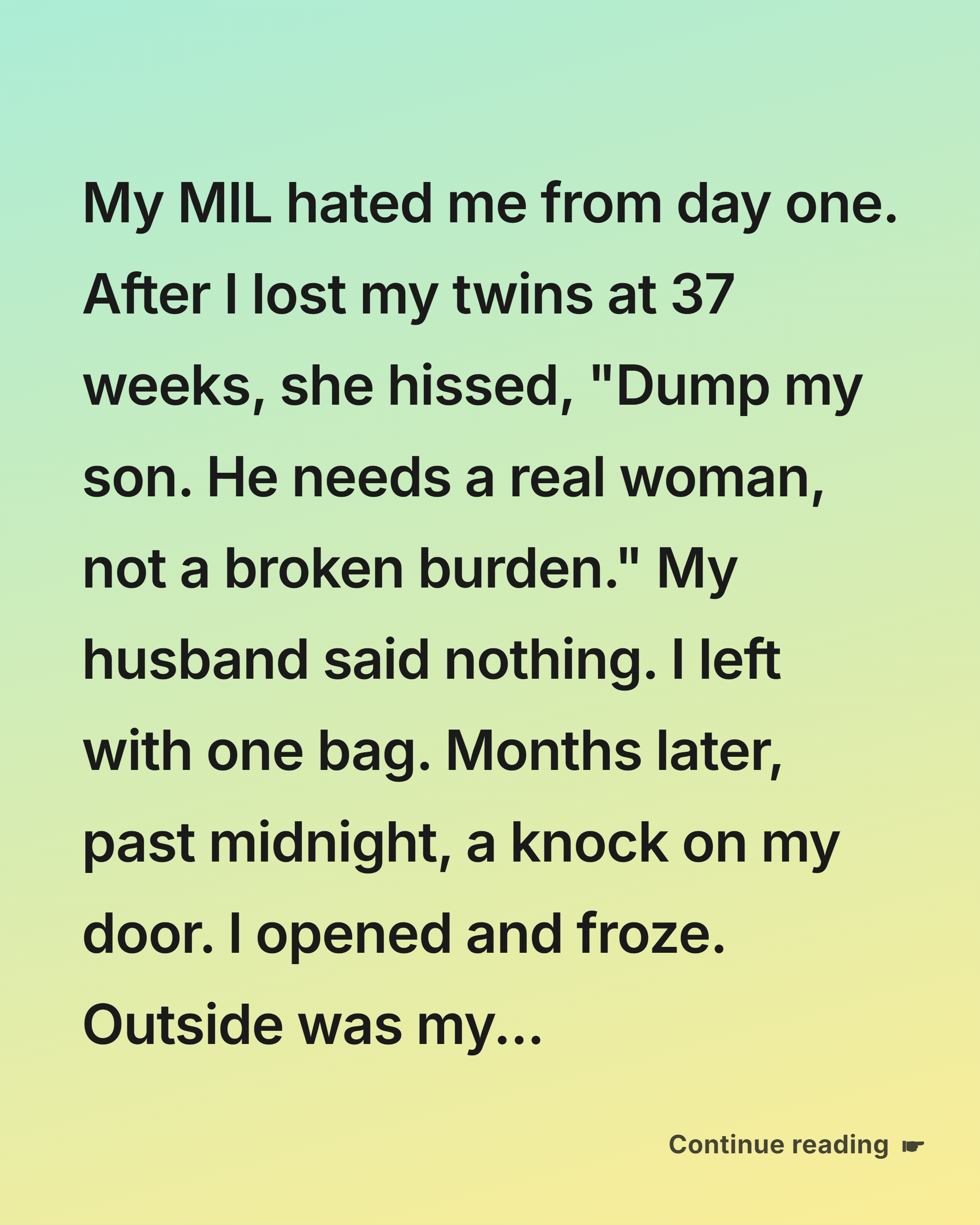
“Dump my son,” she hissed. “He needs a real woman. Not a broken burden.” The words struck harder than anything anyone had said to me that day. I looked at Adam, waiting—begging—for him to say something. Anything. I wanted him to defend me. I wanted him to tell her she was wrong. Instead, he stared at the graves.
That night, I packed one bag. I didn’t take the nursery decorations. I didn’t take the framed ultrasound pictures. I didn’t even take most of my clothes. I left the house with the strange feeling that if I stayed another minute, something inside me would break permanently.
I didn’t cry. I didn’t scream. I just left. Adam didn’t stop me. He didn’t follow me to the car. He didn’t call after me. As I drove away, I kept waiting for my phone to ring. It never did.
For months, I lived in survival mode. A small apartment. Sleepless nights. I learned how to wake up at three in the morning and stare at the ceiling until sunrise. Some days I forgot to eat. Other days I would stand in a grocery store aisle and suddenly realize I had been staring at baby formula for several minutes, even though I had no reason to buy it.
Therapy appointments I could barely afford. Adam didn’t fight for me. He didn’t explain. He didn’t ask how I was surviving. The man who had once promised he would protect me had somehow become a stranger who communicated through lawyers.
His lawyer sent papers instead. Dense, cold documents I signed because I didn’t have the strength to read every line. I trusted that, after everything, he wouldn’t destroy me completely. There were pages about property, finances, accounts, and something described as a “final settlement.” I remember asking the lawyer’s office whether I needed to understand every clause. They told me the documents were routine and that I should have my own counsel if I had concerns.
I was too exhausted to fight. I signed what was put in front of me. I thought the worst thing that could happen had already happened.
I was wrong. Close to midnight one evening, there was a knock at my door. I wasn’t expecting anyone. I froze before reaching for the handle. Nobody came to my apartment that late unless something was wrong.
My heart jumped as I opened it—and then stopped. It was her. Adam’s colleague. The woman whose name had always hovered between us like smoke. The one I’d suspected was more than a coworker. The woman I had secretly blamed for all the distance between Adam and me. She looked pale. Nervous. Not triumphant. Not smug. Her hands were trembling so badly that she had to clasp them together.
“We need to talk,” she said quietly. I almost shut the door. Instead, something in her expression stopped me. She looked frightened, as if she had come to my apartment knowing there was no safe way to tell me what she had discovered.
Inside, she didn’t waste time. “Adam and I have been lovers for over two years,” she said. The confession landed with a strange dullness. I had suspected it for so long that hearing it aloud almost felt less painful than the uncertainty had been.
“He told me you were basically roommates. That a divorce was coming. I believed him.” She swallowed hard. “He told me the marriage was already dead. He said you didn’t love him anymore and that you were staying because you wanted his money.”
Her voice cracked. “I didn’t know you were pregnant. I didn’t know you lost your babies.” She pressed a hand to her mouth, fighting tears. “I am so sorry.” For the first time, I saw something I hadn’t expected to see in her face—not guilt for taking my husband, but horror at discovering the story he’d told her had been a lie.
Then she dropped the real bomb. “I’m here to warn you. He’s planning to leave you with nothing after the divorce. He bragged about it yesterday. Said you signed papers without reading them. That he’ll take your inheritance fund—everything. He said we’d own it.” She stopped and looked at me. “But I never agreed to that. I didn’t even know what he was talking about until I saw the documents.”
I felt sick. My inheritance had been established long before I met Adam. It was money my grandfather had left me, protected through a separate fund. Adam had always known about it, but I had never imagined he could legally reach it.
“I found the documents in his safe,” she continued, pulling out a thick folder. “These are the originals. Please destroy them. Or take them to a lawyer. Just don’t let him ruin you.” I stared at the folder without touching it. My first thought was that this had to be another trap. Maybe Adam had sent her. Maybe he wanted me to expose something. Maybe she was trying to scare me into making a mistake.
She seemed to read my mind. “I know you don’t trust me,” she whispered. “You shouldn’t. Not after what I’ve done. But please trust the documents.”
She looked at me, eyes steady despite the fear. “I’ll help you. I’ll testify. I won’t be part of this.” Then she told me something that made my blood run cold: Adam had apparently been telling people that I would sign anything because grief had made me incapable of thinking clearly. He had been laughing about it. He believed the divorce would leave me financially helpless and that I would never have the strength to challenge him.
I stood there, shaking, stunned beyond words. The woman I thought was my enemy had chosen truth. But there was something else inside that folder—something that made the situation far more serious than a cheating husband trying to take advantage of a grieving wife. There were emails, financial transfers, drafts of agreements, and notes that appeared to show someone had been helping Adam plan everything long before he filed for divorce.
Chosen solidarity. Chosen decency. I still believe she was a pawn in Adam’s game. But now I began wondering whether Adam had been the mastermind at all. Some of the notes contained phrases I had heard before—phrases that sounded exactly like my mother-in-law. Warnings about my “weakness.” Comments about my inheritance. Even suggestions about how quickly I could be pushed out of the family.
I suspect my mother-in-law helped pull the strings—her voice, her cruelty, her hunger for control woven into everything he did. But now the truth is on my side. Legal action is already underway. My attorney immediately challenged the documents I had signed and began examining the financial records. What Adam thought was an airtight plan began falling apart piece by piece.
The documents are safe. The lies are unraveling. And thanks to the one person I never expected—the mistress—I finally watched betrayal collapse under its own weight. She became a witness, not because she suddenly became innocent, but because she finally refused to let Adam’s lies destroy another person.
Adam tried to contact me once the lawyers became involved. First came apologies. Then anger. Then threats disguised as concern. His mother called too, demanding that I meet her “for the sake of the family.” I never answered either of them. For the first time since I had married Adam, I didn’t feel obligated to explain myself.
I don’t know what will happen in court. I don’t know whether Adam or his mother will ever admit what they did. But I know something I didn’t know on the night I walked away: losing my children did not make me weak, and surviving betrayal did not make me broken.
Sometimes, justice doesn’t come from where you hope. It comes from where you least expect. Sometimes the person you believed was your enemy is the one who finally tells you the truth. And sometimes the people who think your grief has made you powerless make one fatal mistake—they forget that grief can eventually turn into strength.
I thought I had lost everything that night. My babies. My marriage. My home. My future. But I hadn’t lost myself.
And in the end, that was the one thing Adam could never take from me.