What keeps people kind when life gives them every reason not to be? These 12 stories of real compassion, love, and human connection will remind you that empathy still exists in the world, and that choosing kindness, even on the worst days, is the most powerful thing we can do. Sometimes the smallest gesture becomes the thing a person remembers forever. Sometimes a stranger changes a life without ever realizing it. And sometimes, long after the moment has passed, kindness echoes back in ways nobody could have predicted.
1.
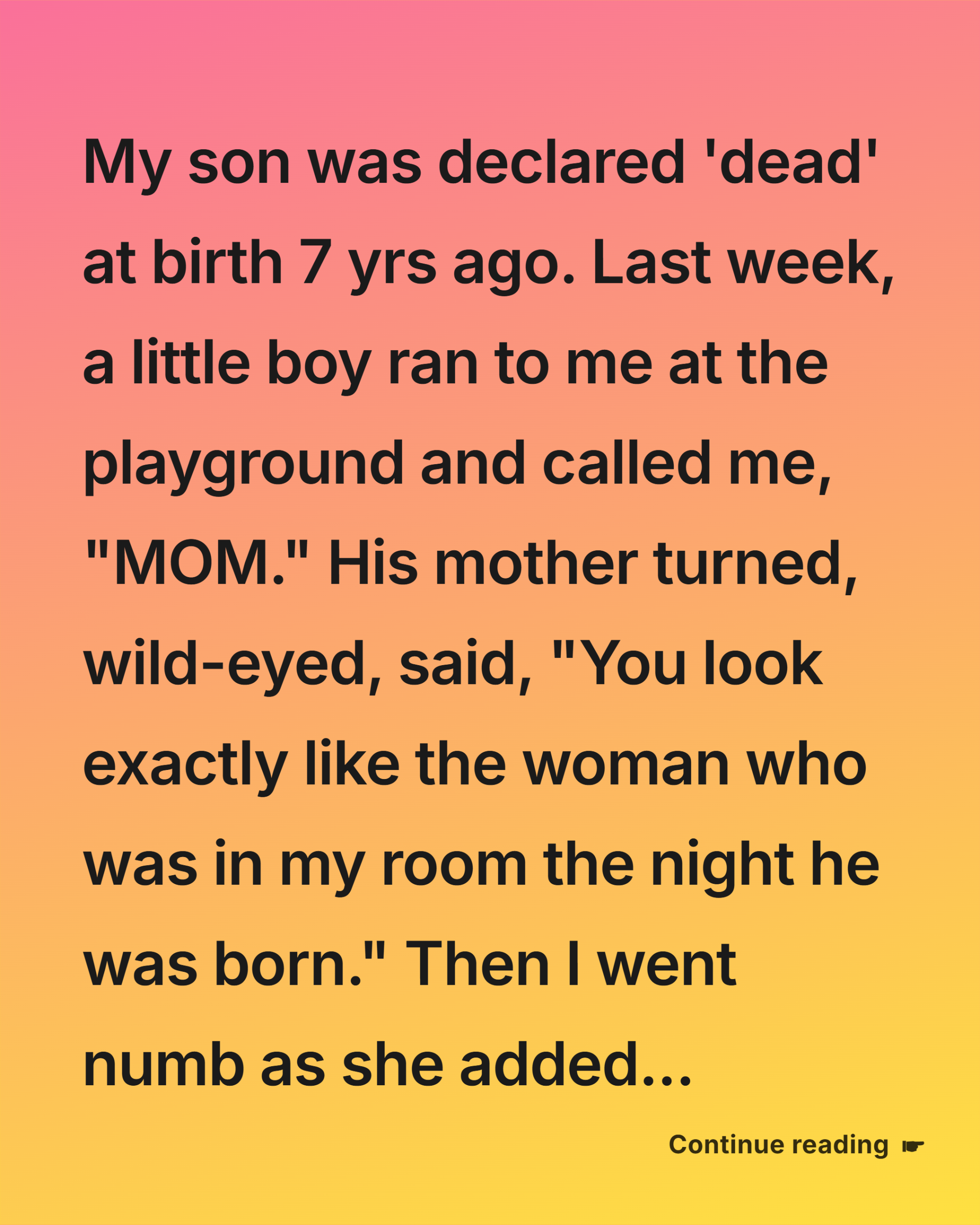
My son was declared dead at birth 7 years ago. Last week, a little boy ran to me at the playground and called me, “MOM.” His mother turned, wild-eyed, said, “You look exactly like the woman who was in my room the night he was born.” Then I went numb as she added, “…she wasn’t staff. I had no idea who she was. But she stayed!”
I didn’t remember… but something inside me shifted. The boy clung to me like he knew me, like something unseen had tied us together.
Later, the memory returned in fragments. That night, after they told me my son was gone, I wandered out, hollow and shaking. I heard a woman crying in the next room, no husband, no family, no one beside her. Just fear.
I went in without thinking. Sat beside her. Held her hand through every contraction, every scream, every moment she thought she couldn’t go on… I didn’t save my own child. But somehow, in that unbearable night, I helped bring hers into the world.
The woman told me afterward that the nurses kept assuming I was family because I refused to leave her side. She said when her son was old enough to ask about the day he was born, she always told him there had been “another mother” in the room who carried sadness in her eyes but still chose to help a stranger.
Standing there years later, I understood something I hadn’t before… kindness doesn’t erase pain, but it transforms it. And sometimes, without even knowing, it lives on in someone else’s story.
2.
I was getting fired. I knew it before I sat down. Eight months of declining numbers, a merger, the whole thing. My manager could barely look at me.
When it was over I walked out and stood at the elevator for a full minute just staring at the button. The receptionist (a woman I’d said maybe twelve words to total) walked over and handed me a granola bar. She said, “I always keep one for when this happens.” She meant it practically, not cruelly. Turns out she kept a whole drawer.
I ate it in the parking lot. Best granola bar of my life.
Not because I was hungry, although I was. Because in that moment, when I felt disposable and embarrassed and completely alone, someone had quietly prepared for another person’s bad day. She’d seen enough people walk out of those offices shattered that she decided nobody should do it on an empty stomach.
I never forgot that.
Three years later, when layoffs hit my next company, I bought a box of granola bars and kept them in my desk drawer. Nobody ever asked why.
3.
I teach piano to kids in a low-income neighborhood. I charge what families can afford, which sometimes means nothing.
One student, a ten-year-old named Daniel, practiced on a paper keyboard he’d drawn himself because there was no piano at home. Traced the keys with a ruler, labeled every note in pencil, and practiced finger placement on paper for three months before I found out.
I didn’t make it a big moment. I just started leaving the studio unlocked an hour early so he could use the real piano before his lesson. He thought it was a schedule change.
Sometimes I’d arrive early and hear him inside, slowly working through scales in the dark before turning on the lights. Careful. Determined. Like he was afraid the opportunity might disappear if he made too much noise.
Six months later, Daniel performed at our recital and got a standing ovation from people who had no idea they were watching a kid who’d learned half of it on paper. I didn’t tell them. He doesn’t know I know about the paper keyboard.
Some things land harder when they stay quiet. He’s thirteen now and teaching younger kids on Saturday mornings. He still arrives early. Old habits.
A few months ago, I found one of the old paper keyboards folded neatly in the trash after class. He’d finally worn it out.
4.
My son failed his driving test four times. Fourth time he came home and went straight to his room. Didn’t eat dinner. I didn’t knock or lecture him.
I just slid a piece of paper under the door — it was my own driving test fail receipt from 1987. Three fails before I passed. I’d kept it without ever knowing why. He came out an hour later and ate two plates of food.
Later that night he sat at the kitchen counter turning the old receipt over in his hands like it was proof of something bigger than driving. Maybe proof that failing repeatedly didn’t make him incapable. Just human.
He passed the fifth time. He still has that receipt in his car.
Last year he admitted that after the fourth failure he’d already decided he was “the kind of person who never gets things right.” A faded piece of paper changed his mind before the thought could settle permanently.
5.
I was a flight attendant for eleven years. You see a lot. People at their worst, mostly — exhausted, rude, frightened, entitled.
But one flight I won’t forget: a man in 14B was visibly terrified of turbulence. Full white-knuckle, eyes shut, completely rigid every time we hit a bump. I’d seen it a thousand times. What I hadn’t seen was the woman across the aisle — a complete stranger — who noticed before I did.
She didn’t say anything dramatic. She just started narrating the clouds out her window in this calm, steady voice. Describing shapes. Making it sound like a nature documentary.
“The long one looks like a crocodile,” she said once, smiling faintly.
A few minutes later the man in 14B opened his eyes and actually started responding, calling out shapes he could see from his side. By the time we landed they were laughing about a cloud that looked like a riding lawnmower. She never introduced herself.
He never asked her name. I watched the whole thing from the galley and I thought: that’s it. That’s the whole thing right there. You just narrate the clouds for someone who’s scared.
You don’t always fix the fear. Sometimes you simply sit beside it until it becomes bearable.
6.
I’m a cashier. A woman bought one birthday balloon and a single cupcake with one candle. Paid in quarters and dimes. She didn’t make eye contact. I didn’t say anything until she reached the door, and then I called after her.
She turned around looking nervous like she’d done something wrong. I just said, “Happy birthday.” She stood there for a second. Then she said, “How did you know it was mine?” I told her I guessed. She smiled the whole way out.
But what stayed with me was the expression on her face before she smiled — pure surprise. Like nobody had expected her birthday to matter that year.
After she left, the customer behind her quietly paid for the cupcake and balloon and asked me to put the money back in the register.
I think about her every birthday I have now. And every year, without fail, I say happy birthday to at least one stranger.
7.
My dad lost his speech after a stroke when I was 15. Not fully — he could get words out — but slowly, and with effort, and he knew it frustrated people, so he mostly stopped trying. Restaurants were the worst. He’d point at the menu and the servers would look at me to translate and he’d go very still in that way I hated.
One night a young waiter (couldn’t have been older than nineteen) crouched down next to my dad’s chair, put his finger on the menu, and said “just blink when I hit the right one” and went through the specials one by one.
My dad blinked at the salmon. The waiter said “excellent choice” like it was the most natural transaction in the world. He came back three more times during the meal to check in, always addressing my dad directly, never me.
At one point my father struggled through half a sentence trying to thank him. The waiter waited through every painful second without interrupting or pretending to understand before he did.
My dad talked about that waiter for months. He’d lost so much by then. Being spoken to like a full person, and not a problem to be managed around, gave him something back that night.
I still don’t know that waiter’s name. I hope someone’s been kind to him too.
8.
My grandmother never learned to read. She hid it her entire life — menus, forms, labels — seventy years of workarounds so quiet nobody knew. After she died I found a notebook.
My grandfather had spent years writing down the logos of her favorite products in colored pencil so she could shop alone. Every label. Every brand. Hundreds of them. He never told anyone either.
There were tiny notes beside some of them. “This one is the soup you like.” “Blue cap, not red.” “Don’t buy the other rice.”
The pages were worn soft at the corners from being carried so often.
She’d been gone six years when I found it. He’d been gone nine. I sat on her kitchen floor for a long time.
And I realized that some of the greatest love stories aren’t loud at all. Sometimes they look like a man quietly drawing grocery labels so the woman he loves never has to feel ashamed.
9.
I almost quit medical school in my second year. Not because of the workload — I’d expected that. Because I couldn’t shake the feeling that I didn’t belong there, that everyone else had something I was missing, that it was only a matter of time before someone confirmed it out loud.
I was in the library at midnight, seriously considering emailing the dean, when a professor I barely knew sat down across from me. She didn’t ask what was wrong. She opened her laptop, turned it to face me, and showed me her own second-year transcript. It was covered in grades I would have been ashamed of.
She said nothing else for a moment. Then: “The ones who think they don’t belong are almost always the ones who do.” She packed up and left. I sat there another hour. I did not send the email.
Years later I asked her why she showed me that transcript. She laughed and said another doctor had shown her his own failing grades twenty years earlier when she’d been ready to quit too.
I graduated four years later and I have repeated those exact words to at least a dozen students since, sitting in libraries at midnight, looking exactly how I looked that night. The transcript move is now mine too. It works every time.
Kindness survives because people pass it forward before it disappears.
10.
I used to run a small bakery. One winter we had a regular customer, an older man, coffee and one roll every Thursday, exact change, very quiet. He missed four Thursdays in a row and I genuinely worried.
Fifth week he came back thinner. He said he’d been in the hospital and the first thing he’d wanted when he got out was to come here. I hadn’t done anything except make his roll and not rush him. He said that was the thing. That I never rushed him.
Then he told me something I still think about: after his wife died, ours was sometimes the only conversation he had all week.
I started keeping a Thursday roll aside after that. Just in case.
For the next three years, every Thursday at exactly 8:15, I’d see him walking toward the bakery window before the sun was fully up. And every single time, he’d smile when he saw the roll already waiting.
11.
My neighbor is seventy-three and was widowed two years ago after fifty-one years of marriage. I didn’t know her well, we waved, occasionally talked about the weather, that kind of thing.
After her husband died I noticed her lights were off by 6PM every night and her car didn’t move for weeks. I didn’t want to intrude so I did the smallest possible thing: I started leaving my porch light on later. Just so her side of the street wasn’t completely dark.
A few weeks later she knocked on my door and asked if my light was on a timer. I said yes, something like that. She said she’d started timing her evening walks by it, that she liked knowing when it came on. I never told her I was doing it on purpose. I just kept doing it.
One snowy evening the power went out on our entire block. I looked outside and saw her standing on her porch looking strangely lost in the dark.
So I lit a lantern in my front window.
A minute later, her porch light came on too — battery powered. Then another neighbor’s.
She walks every evening now, sometimes waves at the window when she passes. She got a dog in the spring. She doesn’t need the light the same way anymore. I still leave it on.
Some habits you keep not because they’re needed, but because the intention behind them still feels true.
12.
I was in a waiting room when a little girl, maybe four, walked over and handed me a sticker. A purple star. Completely unprompted. Her mom looked mortified and started apologizing.
I put the sticker on my jacket. The girl looked at me like I’d just done something very correct. I was there for a biopsy result I’d been dreading for two weeks. The result was fine.
But before the doctor came in, before I knew everything would be okay, I remember sitting there touching that tiny sticker with my thumb like it was an anchor.
I still have that sticker. I moved it from jacket to jacket for three years. I don’t think I’m being dramatic when I say it helped.
Sometimes hope doesn’t arrive in grand speeches or life-changing revelations. Sometimes it’s handed to you silently by a child holding a purple star.