Jack and I had only been in our temporary rental for a single night when we met Lindsey, the neighbor who introduced herself with a cheerful smile and a plate of perfectly arranged cookies. Her friendliness felt slightly rehearsed, especially as her eyes constantly drifted past us, scanning the inside of our home as if she were taking inventory. Before leaving, she slipped in a warning about the neighborhood rule: only one vehicle allowed in each driveway, no exceptions.
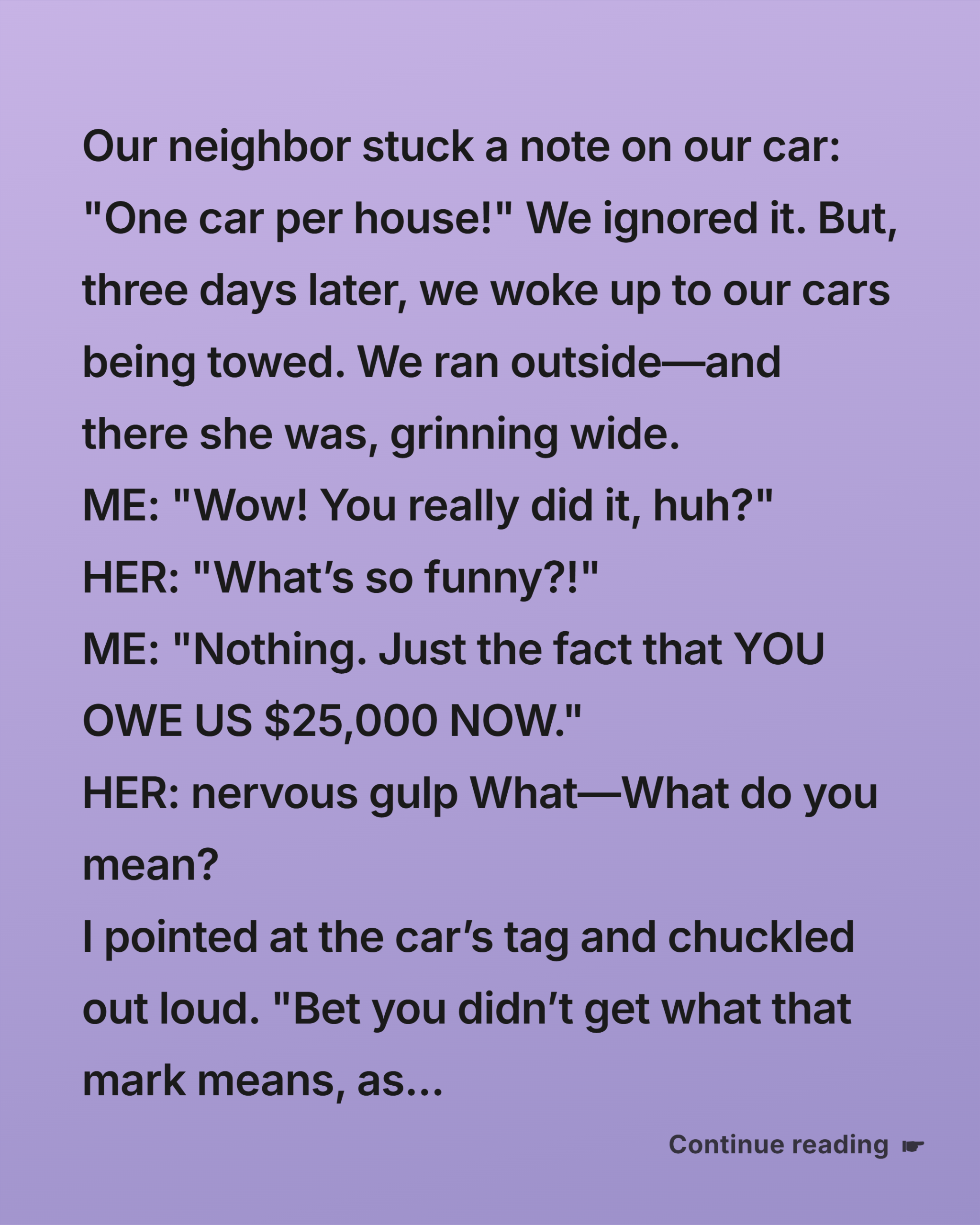
We didn’t think much of it—both of our cars fit neatly on the property, and we weren’t planning to stay long. Her tone suggested she believed she was delivering helpful guidance, but something in her manner felt more like surveillance than hospitality. Still, we thanked her and assumed that would be the end of it. We had no idea she had already decided that the rule was hers to enforce. Three days later, just before sunrise, we woke to the unmistakable metallic clanking of tow trucks.
At first, I thought I was dreaming. Then came the grinding sound of machinery, followed by the sharp hiss of hydraulic equipment. Jack and I rushed outside, still half-dressed, and stopped dead when we saw both our cars already halfway lifted off the ground. A tow operator was securing the second vehicle while another stood beside the first truck, checking paperwork.
Standing across the street, Lindsey sipped her coffee, watching the scene unfold with a smile that made it clear she hadn’t been surprised by any of it. When Jack demanded to know what was happening, the tow truck driver explained that the request had come through the HOA that very morning. There had been no warning, no written notice, no knock on our door, and apparently no attempt to contact us.
I looked at Jack. Jack looked at me. Then we both looked back at Lindsey.
She simply raised her coffee cup.
When we told her that her assumption would be costing her a great deal, her confident expression shifted instantly. The small sticker on one car—designating it as part of a sensitive work contract—meant towing it without verification triggered substantial fines and penalties for procedural interference. What Lindsey had apparently believed was a harmless enforcement action suddenly involved contractual obligations, documented procedures, and people far above the level of an irritated neighborhood resident.
The tow driver, suddenly much less confident, lowered the vehicle back toward the pavement. He started making phone calls. Jack contacted our employer, while I began documenting everything: the trucks, the license plates, the time, the HOA paperwork, and Lindsey standing across the street with her coffee.
That was when Lindsey finally crossed the road.
She no longer looked amused.
She insisted there had been a rule and that she had merely reported a violation. But when Jack asked her who had authorized the tow, she hesitated. When I asked why neither of us had received a notice, she had no answer. And when the tow company confirmed that the request had been submitted that morning, Lindsey suddenly became very interested in changing the subject.
By the next morning, representatives from the management company arrived to sort out the situation, requesting statements and clarifying how the misunderstanding had snowballed. They explained to Lindsey, calmly but firmly, that by unilaterally ordering the tow of vehicles she didn’t own, she had created a liability for herself and the HOA. What had started as an overzealous attempt to enforce a neighborhood rule had now become an official incident requiring documentation, investigation, and legal review.
The costs associated with reversing the tow, compensating for delays, and breaching protocol totaled nearly twenty-five thousand dollars—an amount she had not expected and certainly had not intended to shoulder. Watching her reaction, it was clear she had never imagined a simple “rule reminder” becoming such an expensive lesson. She stood speechless on her porch, her morning coffee cooling in her hands as she tried to make sense of it all.
For several minutes, nobody said anything.
Then one of the management representatives looked directly at Lindsey and asked the question that seemed to drain whatever confidence she had left.
“Did you personally authorize the tow?”
Lindsey stared at the ground.
That silence answered more than any explanation could have.
Fortunately, the matter was resolved through the proper channels, and Jack and I were able to continue our assignment without further disruption. The HOA also issued a clarification reminding residents that rules had to be enforced through established procedures, not personal assumptions or private vendettas. For us, the ordeal was frustrating, expensive, and completely unnecessary—but at least it ended without the situation becoming something even uglier.
In the days that followed, Lindsey withdrew from her usual outdoor routines. Her blinds stayed shut; her famously maintained rose bushes wilted from neglect. She stopped lingering outside whenever we left for work, and the cheerful neighbor who had arrived with cookies on our first night seemed to disappear entirely.
Jack joked that we should probably send her a thank-you card for teaching us the neighborhood rules so thoroughly.
I laughed, but I also understood something I hadn’t before. The most unsettling part of the whole experience wasn’t the tow trucks or the money. It was how quickly someone could turn a minor rule into a personal mission simply because they believed they had the authority to do so.
Sometimes, when I saw her curtains shift slightly as we walked to the car, I wondered if she regretted her eagerness to enforce rules that didn’t require her involvement. Neighborhoods thrive on consideration, not surveillance, and perhaps she now understood the difference. In the end, the whole incident became an unexpected reminder: sometimes the greatest peace comes not from winning a battle, but from choosing not to create one in the first place.