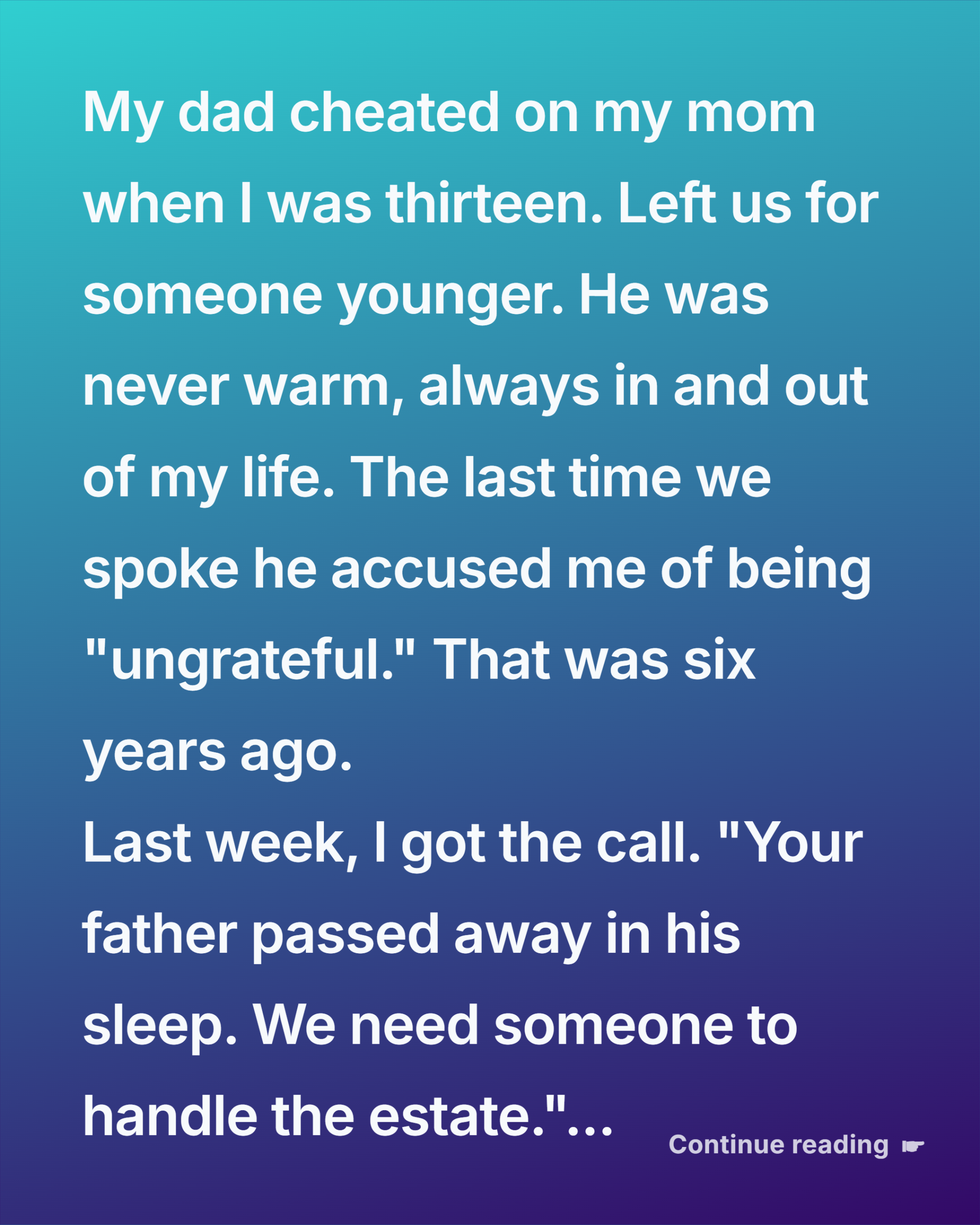
When Cara returned to her late father Philip’s house, she expected only dust and old memories. Their relationship had been fractured for years—he was distant, present in name but never truly close. He left her mother when Cara was 13, and though he wasn’t cruel, he never offered the warmth she craved. The key turned in the lock with a reluctant click, as if even the house resisted letting her in. The air inside felt stale, heavy, like it had been waiting too long for someone who never came back.
Their last conversation, six years earlier, ended in anger and silence. Walking into his empty house now felt less like homecoming and more like trespassing in a stranger’s unfinished life. As she moved through the rooms, everything seemed frozen: his shoes by the door, a cracked coffee mug in the sink, a half-read novel by the bed. Even the silence felt deliberate, like it was holding something back. She half-expected to hear footsteps upstairs, then hated herself for the thought.
Sorting through his belongings felt mechanical—until she reached the attic. There, inside a dusty box, she found fragments of her childhood: medals, yearbooks, and at the bottom, her teenage diary. The attic stairs creaked under her weight as though warning her to turn back. Dust floated in the weak beam of light like suspended secrets. Flipping the box open, her hands paused before touching the diary, as if it might burn. She finally opened it, cringing at her old insecurities—until she noticed something impossible.
In the margins, in his unmistakable handwriting, were his replies. Unlike the father she remembered, his notes were tender, filled with reassurance: “You are not unlovable, Cara.” “I’m proud of you.” “One test doesn’t define you.” The ink varied in pressure, as though written in moments of guilt and urgency. Deeper in the diary, she found his most painful confession: “I was a bad father. You didn’t deserve the silence. I read your words when I couldn’t speak mine. I sat outside your door more times than you knew.”
“This was the only way I could talk to you. I hope someday, you’ll forgive me.”
Cara broke down. For the first time, she felt him reaching out, far too late but sincere. Her fingers trembled as she traced his handwriting, as if trying to feel his presence through the paper. The house outside the attic suddenly felt smaller, as if it had been holding its breath for years just like her.
She left a sticky note on his desk: “I read every word. I heard you.” She hesitated before placing it down, staring at the empty room as though expecting an answer that would never come.
Weeks later, standing at his grave, she placed wildflowers and whispered goodbye. This time, it wasn’t bitter. The wind pressed softly against her face, almost like a response, though she knew it wasn’t.
It was release.