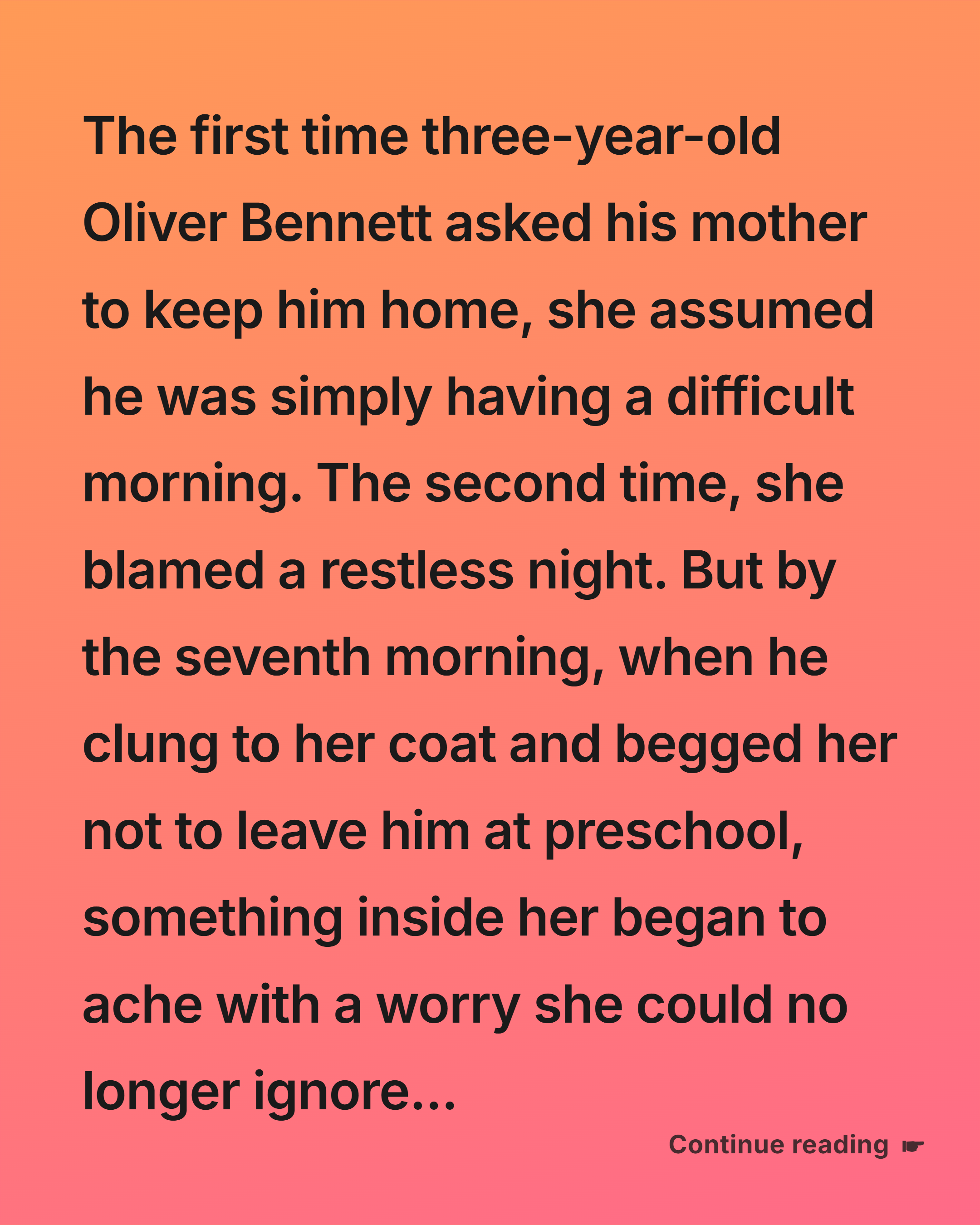
The first time three-year-old Oliver Bennett asked his mother to keep him home, she assumed he was simply having a difficult morning. The second time, she blamed a restless night. But by the seventh morning, when he clung to her coat and begged her not to leave him at preschool, something inside her began to ache with a worry she could no longer ignore.
It was a rainy Tuesday when everything finally came to a head.
“Please, Mommy! I don’t want to go! Please don’t make me!” Oliver cried, wrapping both arms around his mother’s legs.
Rachel Bennett glanced at the clock above the kitchen counter. She was already running fifteen minutes behind schedule, and an important presentation awaited her at the office.
“Oh, sweetheart, we talked about this,” she said, trying to sound patient. “Your friends are waiting for you. You’ll have fun once you get there.”
But Oliver shook his head so violently that his little curls bounced around his forehead.
“No! I don’t want to see Miss Denise!”
Rachel froze.
Miss Denise?
Denise Harper was one of the senior caregivers at Little Pines Early Learning Center, the preschool Oliver had attended since he was barely a year old. He had always adored the place. He used to wake up excitedly on school mornings, asking whether his favorite building blocks would still be waiting for him.
Yet something had changed during the past week.
At first, Rachel had dismissed his reluctance as an ordinary childhood phase. Children developed new fears, became attached to routines, and occasionally resisted separation from their parents. She had even mentioned it during Oliver’s recent pediatric appointment.
The doctor had reassured her that such behavior was common among toddlers, especially during periods of emotional development.
But now Oliver was trembling.
Rachel knelt in front of him and gently took his hands.
“Sweetheart, look at Mommy. Did something happen at school?”
Oliver’s lower lip quivered. He glanced toward the hallway as though someone might be listening.
“Miss Denise gets mad,” he whispered.
Rachel felt a knot tighten in her stomach.
“What does she get mad about?”
Oliver didn’t answer. Instead, he buried his face against her shoulder and began crying.
Rachel hugged him, suddenly ashamed of how impatient she had been moments earlier.
“I’m sorry I raised my voice, darling. Mommy isn’t angry with you. I just want to understand.”
She rocked him gently until his breathing settled.
Then she tried another question.
“Is someone taking your toys? Are the other children bothering you?”
Oliver shook his head.
“Do you not like playing outside anymore?”
Another shake.
Finally, after a long silence, he whispered something that made Rachel pull back.
“Don’t make me eat there.”
Rachel stared at him.
“Eat what, sweetheart?”
Oliver pressed his face into her sweater.
“Lunch. I don’t want lunch.”
Rachel had always known her son was a picky eater. He preferred small portions and often needed encouragement to try unfamiliar foods. But she had never worried about it because his pediatrician considered his growth and development perfectly normal.
“Does Miss Denise make you eat things you don’t like?” she asked.
Oliver nodded faintly.
“Does she get upset if you don’t?”
He nodded again.
Rachel wanted to ask a dozen more questions, but she stopped herself. Oliver was already frightened, and she didn’t want to turn the morning into an interrogation.
Instead, she made him a promise.
“How about this? I’ll take you to school, but I’ll come back before lunchtime. You won’t have to stay for lunch today. All right?”
Oliver immediately lifted his head.
“Before lunch?”
“Before lunch. I promise.”
His expression softened, although the fear hadn’t completely disappeared.
Rachel dressed him, packed his little backpack, and drove to Little Pines.
The moment they arrived, Oliver’s cheerful demeanor vanished. He walked through the entrance slowly, clutching his stuffed rabbit.
At the classroom door, he turned around.
“Mommy?”
Rachel crouched to his height.
“Yes, baby?”
“Come back fast.”
“I will.”
He hesitated before releasing her hand.
Rachel watched him disappear into the classroom, carrying an uncomfortable feeling all the way back to her car.
She couldn’t shake the thought that something was happening at school that her little boy was too frightened to explain.
At the office, Rachel struggled to concentrate. She worked as an accountant for a small architectural firm, and that morning she had several financial reports to finish before an afternoon meeting.
But every time she looked at the clock, she thought about Oliver.
At eleven, she finally approached her supervisor, Martin.
“Martin, I know this is short notice, but I need to take the rest of the day off. Something is going on with my son, and I need to look into it.”
Martin, who had two children of his own, immediately noticed her worried expression.
“Is everything all right?”
“I’m not sure,” Rachel admitted. “He’s suddenly terrified of going to preschool.”
Martin closed the folder on his desk.
“Go take care of him. We’ll manage here.”
Rachel thanked him and left.
She had originally intended to collect Oliver before lunch, just as she had promised. But as she drove toward the preschool, a different thought occurred to her.
What if the problem happened during lunchtime?
What if that was precisely the part of the day he was afraid of?
She parked across the street and sat for a moment, watching the children play in the fenced outdoor area.
Little Pines had strict visitor rules. Parents were not permitted to enter classrooms or the dining hall without authorization. The administration claimed the restrictions protected the children’s routines and privacy.
However, the building had large interior windows, allowing visitors in the hallway to see into several common areas.
Rachel decided she would take a look before announcing herself.
When she entered the reception area, the receptionist greeted her with a smile.
“Good afternoon, Mrs. Bennett. Are you here to collect Oliver?”
“Not quite,” Rachel replied, keeping her voice casual. “I wanted to check something with his teacher.”
“Oh, they’re having lunch at the moment. You can wait here if you’d like.”
Rachel nodded and walked slowly toward the dining hall.
She could hear the cheerful chatter of children before she reached the door. Little voices mixed with the clatter of plastic plates and cups.
For a moment, everything appeared perfectly normal.
Several children were seated around small tables, eating their meals. Caregivers moved between them, helping with drinks and cleaning up spills.
Then Rachel spotted Oliver.
He was sitting at the far end of a table, looking unusually small in his oversized blue sweater.
Beside him sat a woman Rachel had never seen before.
It wasn’t Oliver’s usual classroom assistant. The woman appeared to be in her late forties, with tightly pulled-back hair and a stern expression.
Rachel moved closer to the glass.
A plate sat in front of Oliver. It contained a serving of chicken casserole, mashed potatoes, and green beans.
Most of the food was untouched.
The woman leaned toward him.
“Come on, Oliver. Three more bites.”
Oliver shook his head.
“I don’t want it.”
The woman sighed dramatically.
“That’s what you said ten minutes ago. Pick up your spoon.”
Oliver looked down.
“I don’t like it.”
The caregiver’s expression hardened.
“You don’t get to decide what you like. Your mother sends you here to learn good habits, and eating properly is one of them.”
Rachel felt her stomach tighten.
Oliver pushed his plate away slightly.
The woman immediately pulled it back.
“Don’t you dare push that plate away.”
Then she did something that made Rachel’s blood run cold.
She picked up Oliver’s spoon, scooped up a large portion of mashed potatoes mixed with casserole, and brought it toward his mouth.
“Open up.”
Oliver turned his head.
“I don’t want it!”
“Oliver, I am not asking you again.”
The little boy began crying.
The caregiver glanced around to see whether anyone was watching before gripping his chin and attempting to force the spoon between his tightly closed lips.
Oliver jerked backward.
The spoon struck his cheek, spilling food across his sweater.
Rachel could barely believe what she was seeing.
Her son wasn’t simply being encouraged to finish his meal. He was frightened, humiliated, and being physically restrained by someone who was supposed to protect him.
Then the caregiver leaned closer and whispered something that Rachel could only partly hear.
“If you tell your mommy, she’ll be disappointed in you. Good boys don’t make trouble.”
Rachel’s hands began shaking.
That was enough.
She pushed open the dining hall door and stepped inside.
“Take your hands off my child!”
Her voice cut through the room.
The caregiver immediately released Oliver and stood up, looking startled.
“Excuse me? You cannot come into the dining hall like that!”
Rachel barely looked at her.
She went straight to Oliver, who had begun crying harder.
“Mommy’s here, sweetheart. You’re safe.”
Oliver threw his arms around her neck and clung to her as though he was afraid someone might pull him away.
Rachel held him close, rubbing his back.
The caregiver cleared her throat.
“Mrs. Bennett, I think there’s been a misunderstanding. Oliver has been refusing his meals, and we have a responsibility to make sure the children receive proper nutrition.”
Rachel slowly turned toward her.
“Proper nutrition? Is that what you call grabbing a three-year-old by the chin and forcing food into his mouth?”
The woman folded her arms.
“We have a routine here. Children need boundaries. If we allow everyone to eat only what they want, they’ll never develop discipline.”
Rachel looked at the untouched plate.
“There’s a difference between encouraging a child to try something new and physically forcing food into his mouth. You know that, don’t you?”
The caregiver’s cheeks reddened.
“I wasn’t hurting him.”
“Then why is he crying? Why does he look terrified every time you approach him?”
The woman glanced toward the other children.
“Please lower your voice. You’re upsetting everyone.”
Rachel took a deep breath. She was furious, but she knew the children didn’t need another adult shouting in front of them.
“I’m taking my son home. And before I leave, I want to speak with the director.”
At that moment, another caregiver approached.
“Is everything okay?”
Rachel looked at her.
“No. It isn’t. I’d like you to tell me how long this has been happening.”
The second caregiver hesitated.
“Mrs. Bennett, perhaps we should discuss this privately.”
“Absolutely. But first, I want to know why my son has been coming home from school frightened of lunchtime.”
The senior caregiver interrupted.
“Oliver has always been difficult at meals. I’ve explained this to his mother before.”
Rachel frowned.
“No, you haven’t. Nobody has ever contacted me about a problem with his eating.”
The woman looked away.
A few minutes later, the center’s director, Patricia Wells, arrived after being called by the receptionist.
Patricia was a composed woman in her fifties who had managed Little Pines for nearly a decade. She listened as Rachel explained what she had witnessed.
At first, Patricia seemed uncomfortable.
“Mrs. Bennett, I assure you that we have policies regarding mealtimes. Our staff are instructed to encourage children to eat balanced meals, but physical force is never acceptable.”
“Then I suggest you investigate why one of your employees thinks it’s acceptable,” Rachel replied.
Patricia turned toward Denise.
“Is what Mrs. Bennett described accurate?”
Denise shook her head.
“She misunderstood the situation. Oliver has been refusing nearly everything we serve. I was simply trying to help him finish his lunch.”
Rachel looked at the director.
“My son has been begging me not to bring him here. He has been crying every morning. Today I finally understand why.”
Patricia’s expression changed.
“Has he been saying anything specific at home?”
“He told me he was afraid of lunchtime. And I just heard your employee threaten him with disappointment if he told me what was happening.”
For the first time, Patricia looked genuinely alarmed.
She asked Denise to step outside while she spoke with Rachel.
Then she requested that the other caregiver remain with the children and called the center’s safeguarding coordinator.
Rachel was relieved that someone was finally taking the situation seriously, but she wasn’t prepared for what happened next.
When Patricia returned, she brought a thin folder containing several incident reports.
“Mrs. Bennett,” she said carefully, “I need to show you something.”
Rachel glanced at the papers.
The reports contained notes about Oliver’s mealtime behavior. According to the records, he had supposedly been refusing meals for several weeks.
But that wasn’t all.
Several entries mentioned that he had been moved to a separate table after becoming upset. One report even described him as having an emotional outburst because he wouldn’t finish his food.
Rachel felt her anger return.
“Why wasn’t I informed about any of this?”
Patricia looked troubled.
“I’m trying to understand that myself. These reports were entered under Denise’s name, but there is no record of any parent notification.”
Rachel stared at the paperwork.
Then she noticed something else.
The dates didn’t match.
Some reports had been entered on days when Oliver had been absent from school.
“Patricia, look at these dates. Oliver wasn’t even here on those days.”
The director examined the folder more closely.
Her expression changed.
“That’s impossible.”
But it wasn’t.
After reviewing the attendance records, Patricia discovered that several reports had been copied from another child’s file and altered. Denise had been documenting supposed mealtime incidents without following the center’s reporting procedures.
The discovery changed the entire conversation.
This was no longer simply a disagreement about how a caregiver handled lunch. There were serious questions about her judgment, honesty, and treatment of the children.
Patricia immediately removed Denise from direct childcare duties while the center conducted a formal investigation. She also arranged for the relevant records to be preserved and contacted the appropriate safeguarding authorities.
Rachel was asked whether she would be willing to provide a statement about what she had witnessed.
She agreed without hesitation.
Before leaving, she picked up Oliver’s little backpack and helped him put on his jacket.
He was unusually quiet.
“Are you going to take me somewhere else tomorrow?” he asked.
Rachel knelt and kissed his forehead.
“You don’t have to go back there, sweetheart. Not until Mommy knows you’re safe.”
Oliver considered this for a moment.
Then he whispered, “Will you sit with me at lunch?”
Rachel’s heart broke.
“Every day if you want me to.”
She carried him out of the building, determined that he would never again feel that he had to endure something frightening just to avoid disappointing an adult.
That evening, Rachel didn’t pressure Oliver to explain everything. Instead, she allowed him to play with his toys while she prepared his favorite dinner.
Later, when they were sitting together on the sofa, he finally began talking.
He explained that Denise often became angry when children didn’t finish their food. She would threaten to take away their playtime, move them away from their friends, or make them sit alone until their plates were empty.
Oliver also revealed that she had told him not to tell his mother because Rachel would think he was being naughty.
Rachel listened carefully, resisting the urge to interrupt.
She reassured him repeatedly that he had done nothing wrong.
“Sweetheart, you can always tell Mommy when something makes you uncomfortable. Even if someone tells you to keep it a secret.”
Oliver nodded.
“Even if they’re a teacher?”
“Especially then.”
The following morning, Rachel arranged an appointment with Oliver’s pediatrician and explained what had happened. The doctor reassured her that she had been right to take his distress seriously and advised her to keep mealtimes relaxed, without pressure or punishment.
Rachel also contacted another early learning center recommended by a colleague.
The transition wasn’t immediate. Oliver needed time to regain his confidence, and Rachel wanted to make sure the new environment was genuinely safe and welcoming.
At the new preschool, the caregivers took a different approach.
They allowed children to explore unfamiliar foods, offered small portions, and encouraged them without turning meals into battles.
Oliver was initially hesitant.
During his first lunch, he sat quietly, watching the other children.
A young caregiver named Hannah noticed his uncertainty and pulled up a chair.
“You don’t have to eat everything today,” she told him warmly. “You can try a little if you feel like it. And if you don’t like something, that’s okay too.”
Oliver studied her face.
“Are you going to be mad?”
Hannah looked surprised.
“Why would I be mad?”
“Because I don’t finish.”
Hannah smiled gently.
“Food isn’t a test, Oliver. You’re here to learn and play, not to make an empty plate.”
For the first time in weeks, Oliver relaxed.
He picked up his spoon, tasted a little mashed potato, and then reached for his water.
Nobody scolded him.
Nobody threatened him.
And nobody tried to force another bite.
Over the following weeks, Rachel noticed a remarkable difference. Oliver began talking excitedly about his new friends, asking whether he could go to school even on weekends.
He started trying different foods at his own pace, although he still had his favorite meals.
Rachel also received updates from the investigation at Little Pines. The center confirmed that Denise’s conduct had violated its childcare policies. The falsified records and reports of inappropriate treatment led to further disciplinary action, and the relevant authorities were notified.
Patricia also introduced additional staff training, clearer incident-reporting procedures, and more transparent communication with parents about children’s daily care.
Rachel was glad the center had finally taken action, but she knew something important: policies were only meaningful when the people responsible for protecting children actually followed them.
One Saturday morning, several weeks later, Rachel was preparing pancakes when Oliver wandered into the kitchen carrying his stuffed rabbit.
“Mommy?”
“Yes, sweetheart?”
“Can I have school lunch today?”
Rachel smiled.
“School lunch? You mean you want pancakes?”
Oliver shook his head.
“No. I want to eat lunch with Hannah and my friends.”
Rachel laughed softly and lifted him into her arms.
“Then I think you’ll have a wonderful time on Monday.”
As she held him, she remembered those miserable mornings when he had clung to her legs, desperately begging her not to leave.
She had nearly dismissed his fear as another childhood phase. She had almost allowed the demands of work and everyday life to convince her that everything was normal.
But something about his trembling voice had made her stop and listen.
And that small decision had changed everything.
Rachel understood that children don’t always have the words to explain what is frightening them. Sometimes they communicate through tears, sudden changes in behavior, sleepless nights, or an unexpected fear of places they once loved.
They depend on adults to notice those changes and take them seriously.
Most importantly, she learned that a child’s silence should never be mistaken for proof that everything is all right.
What can we learn from this story?
Children deserve to be treated with patience, dignity, and respect, even when their behavior challenges the adults caring for them. Encouraging healthy habits should never become an excuse for intimidation, humiliation, or physical force.
Parents should trust their instincts when something about their child’s behavior changes unexpectedly. Ask gentle questions, listen without judgment, and investigate concerns rather than dismissing them.
And perhaps the most important lesson is this: children need to know that they can always tell their parents when something feels wrong. They should never be made to believe that protecting an adult’s reputation is more important than their own safety.
A child may not always know how to explain what is happening, but a loving parent should never stop listening.