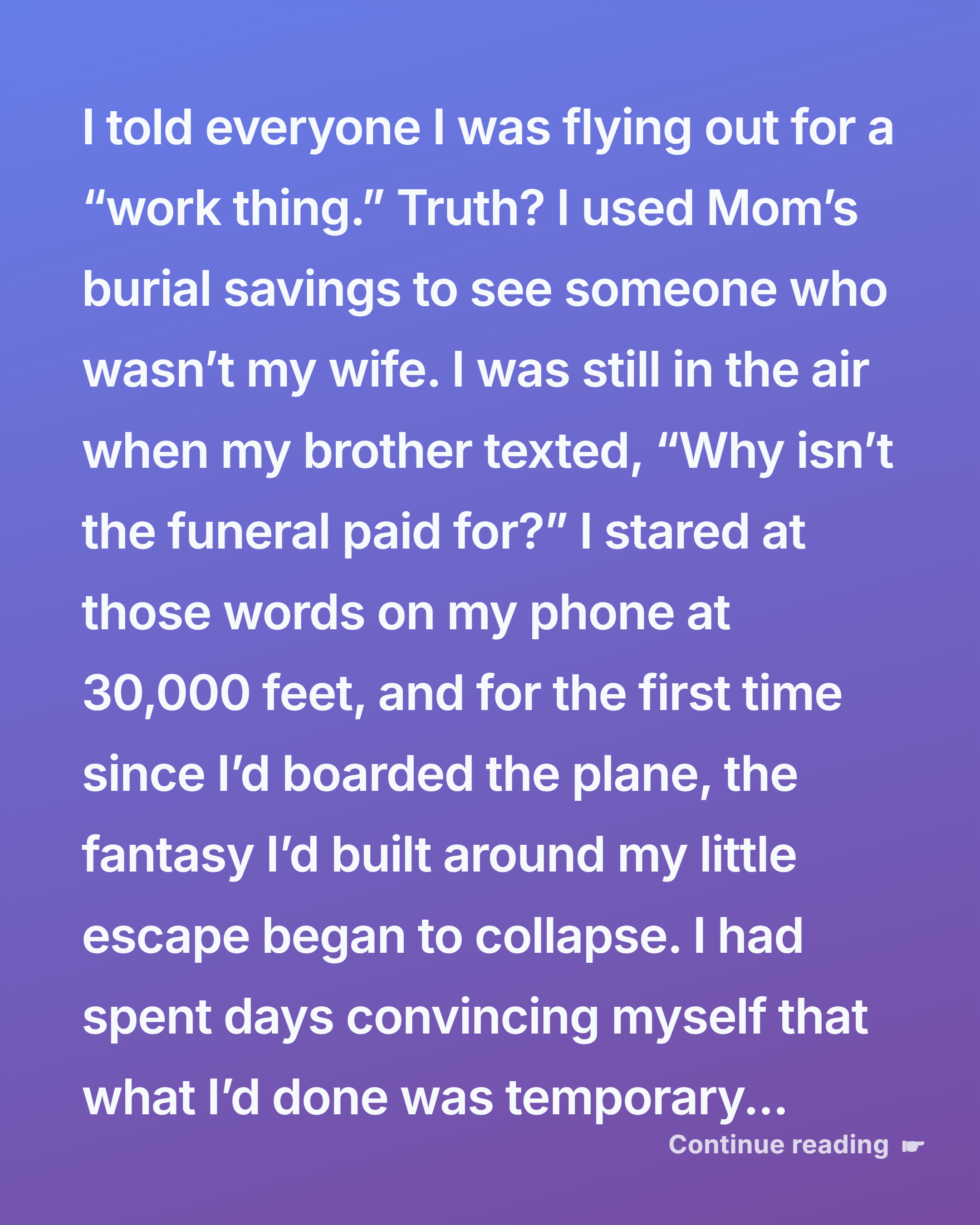
I told everyone I was flying out for a “work thing.” Truth? I used Mom’s burial savings to see someone who wasn’t my wife. I was still in the air when my brother texted, “Why isn’t the funeral paid for?” I stared at those words on my phone at 30,000 feet, and for the first time since I’d boarded the plane, the fantasy I’d built around my little escape began to collapse. I had spent days convincing myself that what I’d done was temporary, private, and fixable. That one message made it clear that none of those things were true.
Mom had been gone six days. Cremation was scheduled, flowers ordered, the service arranged, and every remaining expense was riding on that one joint account she had made me executor of. I didn’t plan on using it. I really didn’t. But after the memorial planning calls, the sleepless nights, the relatives asking questions I didn’t want to answer, I cracked. I booked a flight to Oaxaca. To see Lina. I told myself I needed to breathe. I told myself Mom was already gone and the money would still be there when I returned. The lie was so convenient that, for a few hours, I almost believed it.
Lina, who didn’t know I was married. Who thought I was a widower. Who held my face like I was something salvageable. She believed the story I had fed her—that my wife had died years ago and that my life had simply become complicated afterward. I had never intended to tell her the truth. It was supposed to be a weekend. I stayed eight days. Eight. While my siblings were making phone calls, checking arrangements, answering questions from the funeral home, and grieving their mother, I was sitting across from another woman at a little restaurant thousands of miles away, pretending I was somebody else. I wasn’t answering calls. I told myself my siblings would handle it. But they didn’t have the access. Only I did. And somewhere between the third and fourth day, I stopped thinking of the money as something I had borrowed and started treating it like money I could replace later.
When I landed back in Baltimore, my phone blew up before I even reached baggage claim. Missed calls from Ari, my wife, from Meena, my sister, even from my uncle. Dozens of them. Messages stacked one after another, some marked urgent. I didn’t answer any. Just Ubered home, telling myself I’d fix everything before anyone could understand how badly I had screwed up. I kept rehearsing explanations in my head. A banking error. A delayed transfer. Anything that might buy me time. But when I got to the house—our house—the locks had been changed. My duffel bag buzzed in my hand. Another text had arrived.
It was from Meena. Just one line: “You’re about to lose more than Mom.” I read it three times. The words seemed strangely calm, and somehow that frightened me more than if she had screamed at me. Meena was the kind of person who yelled when she was angry. Silence meant she had already made up her mind.
I stood there for a few seconds, hoping maybe it was some mistake. Maybe Ari had locked up for safety while I was gone. Maybe the locksmith had changed the locks because of some plumbing emergency. I was grasping at anything. But no. The porch light was off, which never happened. Mail had piled up by the door. And my key didn’t just not work—it didn’t even fit anymore. I tried it twice, then stood there staring at the little piece of metal as if it had somehow betrayed me. It was absurd, but I suddenly understood that the key was the last physical proof I had that I still belonged there.
I knocked. Nothing. I called Ari, straight to voicemail. Tried again. Same. The fourth time, I heard my own voice say, “The person you’re calling is unavailable.” She’d blocked me. I stood on that porch with my phone against my ear, listening to the automated message, and realized she had probably been waiting for me to come home. Not to forgive me. Not to argue. To make sure I understood there was no home left to come back to.
I sat on the porch with my bag, in the same jeans I’d worn through three flights, wondering if there was any world where I could make this look okay. There wasn’t. And when my brother, Naveen, finally called me back, he made that clear. I almost didn’t answer because I knew I had no defense left. But I did. His first breath sounded like he had been crying or screaming. Maybe both.
“You absolute piece of shit,” he said. “You stole Mom’s funeral money to go get laid? While we were all here trying to do right by her?” His voice cracked on the last sentence, and that somehow hurt more than the insult. I could hear people moving around behind him. Family. The same family I had abandoned while pretending I was dealing with grief.
I didn’t deny it. I didn’t even have the energy to lie. I just said, “I messed up.” It was the smallest sentence I could find for the biggest thing I had ever done.
He laughed—this bitter, dry sound that I knew I would remember for the rest of my life. “No, Makar. You didn’t mess up. You bailed on your dying mother and your living wife. That’s not a mess-up. That’s a whole demolition.” Then he hung up. I sat there staring at the dead screen, realizing there was nobody left to blame. Not stress. Not grief. Not temptation. Me.
The next day, I checked into a cheap motel in Dundalk and tried to get ahead of the damage. The room smelled faintly of bleach and old cigarettes, and the air conditioner rattled all night. I called the funeral home and wired the rest of the money. Most of it was still there. I hadn’t spent everything—just enough to hurt. Just enough to create a hole everyone else had been forced to stand around and stare into. When the funeral director thanked me for settling the balance, I had to mute the phone because I suddenly couldn’t breathe. He had no idea that the person paying for his services had been the reason the bill had ever become a crisis.
I sent Ari an email, then another. Long, rambling things full of apologies and promises and late realizations. I wrote until sunrise. I told her I loved her. I told her I was ashamed. I told her Lina didn’t matter. I told her I had been confused, grieving, weak, selfish—anything that might make what I had done sound less deliberate. She never replied. Meena sent one message: “Don’t contact her again. You’ve done enough.” I read it over and over until I finally understood that apologies weren’t supposed to be a tool for getting someone back. They were supposed to be the beginning of accepting what you had done.
The day of the funeral, I sat in the parking lot across the street from the crematorium. I watched through the windshield as people I hadn’t seen in years shuffled in—cousins, neighbors, old coworkers of Mom’s. Some carried flowers. Some hugged each other. Some stood alone with their hands in their pockets, staring at the doors. I saw Meena arrive. Then Naveen. I watched them walk inside without looking toward my car. I wasn’t welcome. That was clear.
And I didn’t go in. My hand touched the door handle several times, but I never opened it. I could have walked across the street. I could have begged. I could have apologized in person. But I knew that if I walked through those doors, I would be making Mom’s funeral about me, and I had already taken enough from everyone.
The shame was physical. Like wearing a too-heavy coat soaked in rain. Even when I finally dragged myself to a grief group a few weeks later, I couldn’t speak. I just sat there while others cried about their mothers and fathers and dogs and sons. One woman talked about losing her mother after forty-seven years of marriage. Another man described sitting beside his father in hospice. I felt like an intruder among people who had actually shown up when someone they loved needed them. I kept thinking about the empty chair at the crematorium and wondering whether Mom had somehow known I wouldn’t be there.
I lasted ten minutes. Then I walked out into the parking lot and sat in my car until dark. For the first time, I admitted something I had been avoiding: I wasn’t just grieving my mother. I was grieving the person I had convinced myself I was.
I didn’t hear from Ari for months. Not on my birthday. Not on what would’ve been our tenth anniversary. She changed her number. Took me off the lease. I found out from her cousin’s Instagram that she moved to D.C. Started over. The picture showed her standing beside a window in a new apartment, smiling in a way I hadn’t seen in years. I stared at it longer than I should have. There was no caption about me. No accusation. No explanation. Just her, alive and moving forward, while I was still sitting in the wreckage I had created.
Part of me hoped Lina might be a weird sort of escape again. Maybe if I could get back to the version of myself I had been in Oaxaca, I wouldn’t feel so broken. So I texted her. I expected anger. Maybe curiosity. Instead, she responded with one word: “Who?” I read it until the screen blurred.
She’d blocked my number, too. I guess she pieced things together after I ghosted her that last morning. I had told her my mom died, but not much else. I think she saw through me. Maybe someone had told her. Maybe she had found Ari online. Maybe she had simply noticed the contradictions I had spent months ignoring. Whatever happened, Lina didn’t owe me an explanation. I had lied to her about my marriage, lied about my life, and disappeared when things became inconvenient. I had managed to lose two women in the same week, and neither one had been responsible for that loss.
It took me five months to get an apartment. I was crashing on a friend’s couch for a while, doing side jobs and deliveries, paying back the family fund from savings I should’ve had years ago. I sent my siblings a check every month. Meena cashed them but never replied. Naveen returned the first one with a note that said, “Pay the debt. Don’t expect a thank-you.” So I did. Every month. No matter how little I had left afterward. I stopped waiting for forgiveness and started treating repayment like what it was: an obligation.
Then one night, just before winter, I saw Meena at a grocery store near my building. She was in line ahead of me with her daughter. I almost turned around. My heart started pounding so hard I could hear it. I hesitated, but she saw me. She looked exhausted. Not angry—just done. Her daughter whispered something to her and glanced back at me. Meena said something quietly to her, then turned around again.
I nodded. She didn’t smile, but she didn’t walk away either. That was the first sliver of grace I’d gotten in half a year. I left the store without approaching her. For once, I understood that giving someone space could be an act of respect.
A week later, she emailed. One line. “Come by the house Saturday. We’ll talk.” I stared at the message for nearly an hour. I wondered if she wanted to confront me. I wondered if there was some legal issue. I even wondered if the family had decided to cut me off completely. Whatever the reason, I knew I couldn’t hide anymore.
I showed up early, dressed like a kid meeting the principal. My palms were sweating. I half-thought it was a trick. But when I knocked, Meena opened the door and stepped aside without a word. The house smelled like coffee and Mom’s old lavender cleaner. For a second, I forgot why I was there. Then I saw the framed photograph of Mom on the hallway table, and everything came rushing back.
We sat at the dining table. She poured coffee. No sugar, no milk—just like Mom used to do. Neither of us spoke for several minutes. The ticking wall clock seemed unbearably loud. Finally, Meena put her cup down and looked directly at me.
“You’re not getting forgiven,” she said. “That’s not what this is.” Her voice wasn’t cruel. That almost made it worse.
I nodded. “I know.” I had finally learned that forgiveness wasn’t something I could negotiate for, earn through tears, or demand because I was sorry.
“But I figured… Mom loved you. Even when you didn’t deserve it. She’d want us to try. Bare minimum.” She looked down at her hands. “I don’t know if I can ever trust you again, Makar. But I don’t want Mom’s last memory of our family to be that you were completely lost.”
I didn’t know what to say. I just kept my eyes on the coffee and listened. For once, I didn’t defend myself. I didn’t explain. I didn’t tell her how bad I felt. I simply let her say everything I deserved to hear.
She told me the funeral had nearly been canceled. That Naveen had put the whole thing on a credit card. That they’d been humiliated, explaining to the priest why the account had been drained. She told me Meena had spent hours on the phone trying to reassure relatives that the service would still happen. Every detail I had dismissed as something that could be “handled” had landed on someone else’s shoulders.
But then she said something that knocked the wind out of me.
“She wrote you a letter,” Meena said. “Before she died. I wasn’t going to give it to you. But… I think you should read it.” Her eyes flicked toward the hallway. “I found it in her bedroom after the funeral. It was tucked inside the drawer where she kept old birthday cards. Your name was on it.”
She went to the back room and came out with a pale blue envelope. My name, in Mom’s handwriting. I hadn’t seen it in over a year. My throat closed. I reached for it, but my hand was shaking so badly that Meena had to slide it across the table.
I opened it slowly. The ink was faded in spots. But the message was clear.
“Makar, my boy, you always carry too many secrets. I see them in your face. Let them go. Life’s too short to live double. Be good. Not perfect—just good. That’s enough for me.” There were only a few more lines, but one sentence at the bottom nearly broke me: “If you ever get lost, come home before pride keeps you away.” I had spent months thinking I had abandoned Mom. Reading that letter, I realized she had been trying to find me long before she died.
I cried harder than I had in years. Not loud. Just this steady, leaky kind of crying that doesn’t stop. I bent over the letter and covered my face with both hands. Meena didn’t say anything. She just sat there. She let me cry without comforting me, and somehow that was exactly what I needed. There are some tears that aren’t asking anyone to save you. They’re simply what happens when the truth finally becomes heavier than the lie.
That letter changed me. Not overnight. But it planted something. I started going back to that grief group. This time, I spoke. Told them what I’d done. I told them about the money. About Lina. About Ari. About sitting outside my mother’s funeral because I was too ashamed to walk inside. Nobody clapped. Nobody told me I was brave. But nobody left either. For the first time, I learned that accountability didn’t mean announcing how sorry you were. It meant telling the truth even when the truth made you look terrible.
I started volunteering Sundays at a hospice nearby. Just sitting with people. Reading to them. Sometimes just holding their hand. I don’t know. It felt like a way to return something I’d stolen. I never told the patients why I was there. They didn’t need my story. They needed someone willing to sit beside them when the room became quiet. Sometimes I would leave after a shift and sit in my car for ten minutes, thinking about Mom and wondering how many times she had needed someone to sit with her while I was too busy pretending everything was fine.
One day, maybe a year later, I was helping a nurse move a patient when I looked up and saw Ari.
She was walking down the hallway with her aunt, who was in a wheelchair. Our eyes locked. I froze. For one terrible second, I thought about turning around and pretending I hadn’t seen her. Then I realized I had spent too much of my life running from consequences.
She didn’t yell. Didn’t cry. She just stared for a second and then gave me this tiny nod. Not forgiveness. Not love. But something like recognition. Like maybe, just maybe, I wasn’t the same man she’d shut the door on. I wanted to say a hundred things. I wanted to apologize again. I wanted to tell her about Mom’s letter. But I knew those words belonged to me, not her. She hadn’t come there to hear them.
I didn’t follow her. I let her go. Watching her disappear around the corner hurt more than I expected, but it was a clean kind of pain. There was no bargaining. No chasing. No attempt to turn one moment of kindness into an invitation.
A few weeks later, she emailed. I stared at her name in my inbox for nearly a minute before opening it.
“I heard you’ve been helping at St. Raymond’s. That’s good. I’m glad you’re finding something.” It was short. But it meant everything. Not because it meant she wanted me back. It didn’t. It meant she had noticed that I was finally doing something without demanding anything in return.
People think the worst thing you can do is cheat. Lie. Steal. And yeah, those things are terrible. But the real damage comes when you keep going like nothing happened. When you never say, “I wrecked something, and I want to own it.” The worst part of what I did wasn’t just the money or the affair or the lies. It was the fact that I kept telling myself I deserved another chance before I had done anything to become worthy of one.
That’s the part I finally got right. I stopped asking people to forget. I stopped trying to control how they remembered me. I stopped calling guilt “regret” and expecting that to count as change. I learned that you can be sorry every day and still have to live with what you did.
Meena and I talk now. Not often, but enough. Naveen forgave me after I paid off the funeral debt and helped renovate our uncle’s house. He said, “You’re still a moron. But at least now you’re a useful one.” I laughed when he said it, but afterward I went outside and cried in my car. It was the closest thing to the old family feeling I had experienced in years.
As for Mom, I think about her every day. Her silly stories. Her quiet strength. The way she used to leave the kitchen light on when she knew one of us would be coming home late. That letter is framed now, hanging by my door. Sometimes I touch the glass before I leave for work. Not because I think it somehow brings her back, but because I need the reminder that the people we love often see more of us than we think they do.
Ari? She’s engaged to someone new. I know because she told me. I wished her the best. She wished me peace. There was no dramatic reconciliation. No secret confession that she had always loved me. No second chance waiting around the corner. Just two people acknowledging that the life we once shared had ended and that neither of us needed to destroy the other to move forward.
And honestly? That’s more than I ever deserved. For a long time, I thought redemption meant getting my old life back. My wife. My house. My family. My reputation. Eventually I realized redemption doesn’t restore what you destroyed. Sometimes it simply teaches you not to destroy the next thing placed in your hands.
So yeah. I lost almost everything. I lost my marriage. I lost the trust of my siblings. I lost a woman who had believed a version of me that never really existed. I lost my mother’s funeral, a moment I can never get back. And I will carry that last one for the rest of my life.
But in losing it, I found something I never had before: accountability. Not the performative kind. Not the kind where you make a grand speech and wait for everyone to applaud. The real kind. The kind where you sit with your own mess and stay long enough to clean it up. The kind where you understand that sometimes the person you hurt never comes back, and you still have to become better anyway.
If you’ve hurt someone, don’t wait for them to forgive you. Start being someone worth forgiving. Pay what you owe. Tell the truth. Accept the doors that close. Stop demanding that your apology become someone else’s healing. And if the people you hurt never trust you again, understand that their choice belongs to them.
And if you’re carrying secrets? Let them go. Before they become heavier than the people you’re trying to protect. Before one selfish decision becomes ten. Before you’re sitting in a parking lot across from your own mother’s funeral, staring at a locked door and realizing you were the one who threw away the key.
You’d be amazed what shows up in their place.