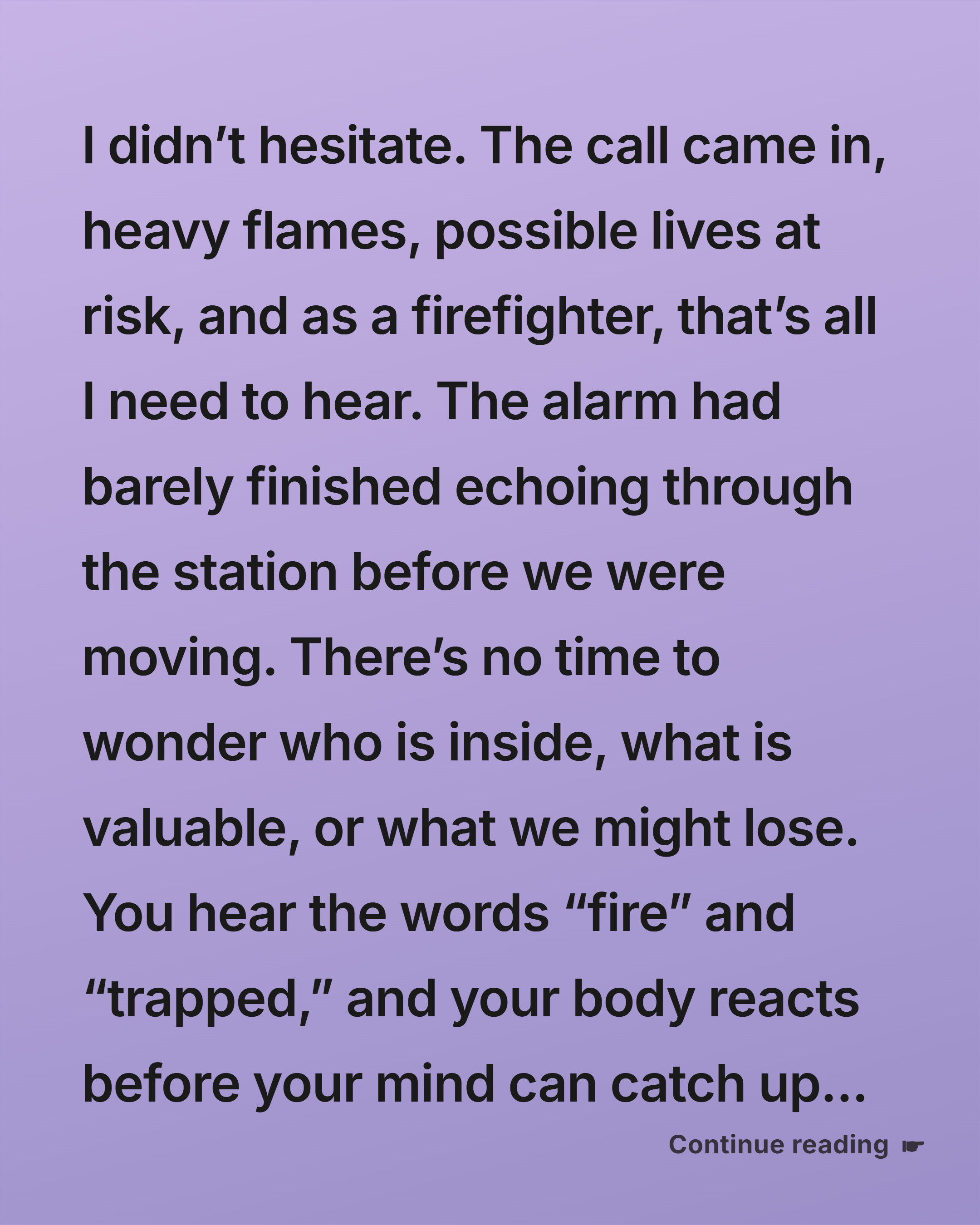
I didn’t hesitate. The call came in, heavy flames, possible lives at risk, and as a firefighter, that’s all I need to hear. The alarm had barely finished echoing through the station before we were moving. There’s no time to wonder who is inside, what is valuable, or what we might lose. You hear the words “fire” and “trapped,” and your body reacts before your mind can catch up.
We arrived to a scene that looked like something out of a nightmare. Smoke poured into the sky like a black storm. Flames ripped through the windows, neighbors screamed from the sidewalk, and the structure groaned under the pressure of the fire consuming it from within. Every second mattered. The house was nearly gone.
And then I heard it.
A sound so small it almost disappeared beneath the roar of the flames.
A desperate, high-pitched yowl.
Not a person.
A cat.
Trapped inside.
I didn’t think. I just ran.
Gear on, lungs burning, heat pressing against every inch of my body, I kicked the door open and crawled into hell. The smoke was so thick I could barely see my own hands. Every breath felt like swallowing fire. Pieces of the ceiling cracked above me, falling like warnings that the building was running out of time.
But then I heard her again.
A weak cry.
I followed the sound.
Behind a collapsed piece of furniture, trembling and covered in ash, was a small cat frozen with fear. I reached out, wrapped her in my jacket, shielded her from the falling debris, and held her close as I crawled back through the flames.
When I finally stepped outside, carrying her into the cold night air, I expected relief.
I expected cheers.
I expected people to understand.
But the second I stepped outside, I knew something was off. No applause. No thank yous. No sighs of relief.
Just… silence.
Then a voice cut through the crowd.
“You saved a damn cat and left everything else in there?”
The words hit harder than I expected.
That’s when it hit me. The house was a total loss. The owners weren’t home. But their neighbors had begged us to go next door—to try saving furniture, photos, whatever wasn’t already ash. They had watched years of memories disappear behind those flames.
But protocol said otherwise.
The cat was alive.
The rest was gone.
For a firefighter, rules aren’t just suggestions. They are written in experience, in tragedy, and in the lessons learned from people who didn’t come back because they took one unnecessary risk. We don’t run into burning homes to save couches, paintings, or possessions.
We save lives.
But standing there, with the cat trembling in my arms, the crowd’s eyes pierced me like I had chosen wrong.
And maybe, in their eyes, I had.
The woman who had yelled pushed through the crowd. She was middle-aged, her hair pulled back hastily, her face streaked with smoke, her eyes red from irritation, exhaustion, and maybe tears she refused to let fall.
She pointed at me.
“You could have tried!” she shouted. “There were pictures… wedding albums… things that can’t be replaced. Things people spend their whole lives protecting. But no, you risked your life for a stupid animal.”
Her words stung sharper than the heat had.
I wanted to argue.
I wanted to explain.
I wanted to tell her that every living creature inside a burning building matters.
But my throat was tight.
Before I could answer, another voice came from behind the crowd.
An older man, leaning heavily on a cane, stepped forward. His hands shook slightly as he looked at the woman.
“That ‘stupid animal’ was my daughter’s cat.”
The crowd went quiet.
The old man swallowed hard.
“My daughter passed away last year. Daisy was the last thing she left behind. The only living piece of her that I still had.”
The woman’s expression changed.
The anger disappeared.
The old man looked at the cat in my arms.
“So don’t call her stupid.”
The crowd murmured. Some looked away. Some lowered their heads.
My chest eased, but only a little.
The truth is, I hadn’t known that story.
I hadn’t known who owned the cat.
I hadn’t known what memories were attached to her.
To me, in that moment, she was simply a life.
Any life.
A life worth saving.
But suddenly, she was more than that.
She was a connection to someone who was gone.
A piece of a family that grief had already taken from him.
The old man reached out, and I placed the cat carefully into his arms. He held her like she was made of glass, then kissed her head as tears rolled down his face.
That moment should have been enough.
It should have been the end of the story.
A firefighter saves a cat. An old man gets his companion back. Everyone goes home.
But it wasn’t.
Because what happened after that fire turned my life upside down in ways I never could have imagined.
Two days later, I was off duty, grabbing groceries when a teenager approached me. He looked nervous, clutching his phone tightly in his hand.
“Hey, you’re the firefighter who saved the cat, right?”
I nodded cautiously.
He handed me his phone.
A video was playing.
It was me.
Walking out of the burning house.
Carrying Daisy.
The woman yelling.
The old man defending me.
Someone had recorded everything.
And somehow, it had spread everywhere.
The video had gone viral.
Thousands of views.
Then hundreds of thousands.
Comments.
Shares.
Arguments.
And not all of it was kind.
Some people praised me.
Others mocked me.
“Hero to cats.”
“Should’ve saved the photo albums.”
“Wasted effort.”
“Firefighters have better things to do.”
The internet, in its usual way, had split into two sides, and somehow, I had become the center of a debate I never asked to join.
I was just doing my job.
But suddenly, strangers who had never seen the inside of a burning building were judging the choices I made while standing in one.
By the time I got home, reporters were calling the station.
Some wanted interviews.
Others wanted “the firefighter who risked his life for a cat.”
My captain warned me to stay quiet and let the attention fade.
“It’ll blow over,” he said.
But it didn’t.
It grew.
Every day, there was another article, another comment, another opinion from someone who wasn’t there.
One morning, a package arrived at the station addressed to me.
Inside was a photo frame.
It was damaged by fire.
The edges were blackened.
The glass was cracked.
But inside was a picture.
A young woman smiling while holding the very same cat I had carried out of the flames.
A note was attached.
“You didn’t just save a cat. You saved a piece of her. Thank you.”
It was signed by Robert.
That letter broke me in the best way.
I had replayed that woman’s accusations over and over.
I had wondered if I had made the right choice.
If people were right to question me.
But Robert’s words reminded me why we do what we do.
Still, the story didn’t end there.
A week later, Robert showed up at the firehouse.
He brought cookies—burnt a little, uneven, but somehow perfect.
He asked if we could talk.
We sat outside on the curb, him with his cane and Daisy’s carrier beside him.
“Her name’s Daisy,” he said, smiling softly.
“My daughter, Claire, loved that cat more than anything. She used to say Daisy wasn’t just her pet. She was family.”
He looked down.
“When Claire passed, Daisy stopped eating. She stopped moving. I thought I was going to lose her too.”
He paused.
“But now she’s alive because of you.”
His voice became quieter.
“And maybe because of that, so am I.”
I didn’t know how to respond.
I’m trained to fight fires.
To break through walls.
To carry people out of danger.
I’m not trained to carry someone’s grief.
But Robert didn’t need me to fix anything.
He just needed someone to listen.
We started meeting for coffee after that.
Strange, maybe.
But it felt right.
He told me stories about Claire.
How she was stubborn.
How she challenged everyone.
How she brought home injured animals and refused to leave them behind.
“She wanted to be a vet,” he told me one day, staring into his coffee.
“She wanted to build a place where no animal would be forgotten.”
He smiled sadly.
“Life had other plans.”
Listening to him, I realized saving Daisy had created a chain reaction I never saw coming.
I had saved a cat.
But that cat helped save Robert from a deeper loneliness.
And somehow, knowing that helped save something inside me too.
But life has a way of testing you.
A month later, another fire broke out.
This time, a small apartment building.
We rushed in.
Followed protocol.
Evacuated residents.
Checked every room.
Everyone got out safely.
No fatalities.
But as I stepped outside, exhausted and covered in soot, I heard a familiar voice from the crowd.
“Hey, that’s the cat guy!”
People laughed.
Some took pictures.
Some called me a hero again.
Others laughed like I was nothing more than an internet joke.
And somehow, that hurt.
That night, I sat alone in my apartment scrolling through comments.
Some people supported me.
Others didn’t.
“Firefighters are supposed to save people, not pets.”
“He’s lucky the cat belonged to someone important.”
“Otherwise, pointless.”
My chest tightened.
I tossed my phone across the room.
The next day, Robert called.
He knew something was wrong before I even said anything.
“You’re letting strangers decide your worth,” he said.
His voice was calm.
“But strangers don’t know you. They don’t know what it’s like to crawl through fire. They don’t know what it means to carry someone’s entire world in your arms.”
I wanted to believe him.
But doubt is sticky.
It stays long after the flames are gone.
Then something unexpected happened.
One afternoon, I was at the grocery store again when the same teenager from before spotted me.
He rushed over, almost out of breath.
“Hey—I don’t know if you know this, but because of your video, my sister started volunteering at the animal shelter.”
I looked at him.
“She said if someone like you cared enough to risk everything for a life that small, then she should care too.”
He smiled.
“She goes there every day after school now. It changed her.”
It hit me like a second wave.
The internet could laugh.
It could judge.
It could tear people apart.
But it could also inspire.
Without realizing it, my choice had pushed someone else to do good.
Maybe more than one person.
Weeks passed.
The jokes slowed.
The attention faded.
Life returned to normal.
But the lesson stayed.
I started noticing how often people dismissed small acts of kindness.
How quickly they called something meaningless because they didn’t understand its value.
But for the right person, those small things could be everything.
One evening, Robert invited me to his house.
Daisy was stretched across the couch, purring like she owned the entire place.
He handed me a folder.
Inside were Claire’s journals.
“She would’ve wanted you to have these,” he said.
I hesitated.
But he insisted.
Later that night, I read every page.
I saw Claire in her own words.
Her dreams.
Her sketches of animals.
Her plans for a future clinic.
Her love for Daisy.
But one sentence stopped me.
“The world tells you to save big things. But maybe the small things are just as important. Maybe they’re what keep us human.”
I closed the journal.
I sat there quietly.
Because that sentence felt impossible.
Like it had been written for me years before we ever met.
From then on, whenever I doubted myself, I remembered Claire’s words.
I remembered Robert’s gratitude.
I remembered the teenager’s sister.
And I realized the fire hadn’t just changed Daisy’s fate.
It had changed mine.
The irony?
Months later, the same woman who had shouted at me that night came to the station.
She looked different.
Quieter.
Humbled.
She carried a box of cookies.
“I was wrong,” she admitted.
“I didn’t understand then. But I do now.”
She looked down.
“I’m sorry.”
I accepted her apology.
Not because I needed it.
But because it felt like another thread in the impossible web of lives connected by that single night.
Looking back now, I see it clearly.
The fire wasn’t what tested me most.
It wasn’t the flames.
It wasn’t the danger.
It wasn’t even the weight of the cat in my arms.
It was everything afterward.
The judgment.
The criticism.
The doubt.
The unexpected consequences.
But through it all, I learned this:
Sometimes the world won’t understand your choices.
Sometimes people will call them pointless.
Sometimes the smallest act of courage will look meaningless to those who don’t know the story behind it.
But if your choice saves one life—human or not—it matters.
And if that choice inspires another person to do good, it matters even more.
So no, I don’t regret running into that house for Daisy.
Because that night, I didn’t just save a cat.
I saved a connection.
A memory.
A piece of someone’s heart.
A future ripple of kindness.
And maybe, in some way, I saved myself too.
Life has a funny way of testing our instincts, of making us question the good we’ve done.
But here’s the truth I carry with me:
The right thing doesn’t always look like the biggest thing.
Sometimes it’s small.
Sometimes it’s fragile.
Sometimes it meows.
And sometimes, it’s the very thing that keeps someone alive for another day.
So if you ever wonder whether your actions matter, remember this story.
Because even the smallest rescue can echo in ways you will never see coming.
And sometimes, that echo can change the world—including your own.