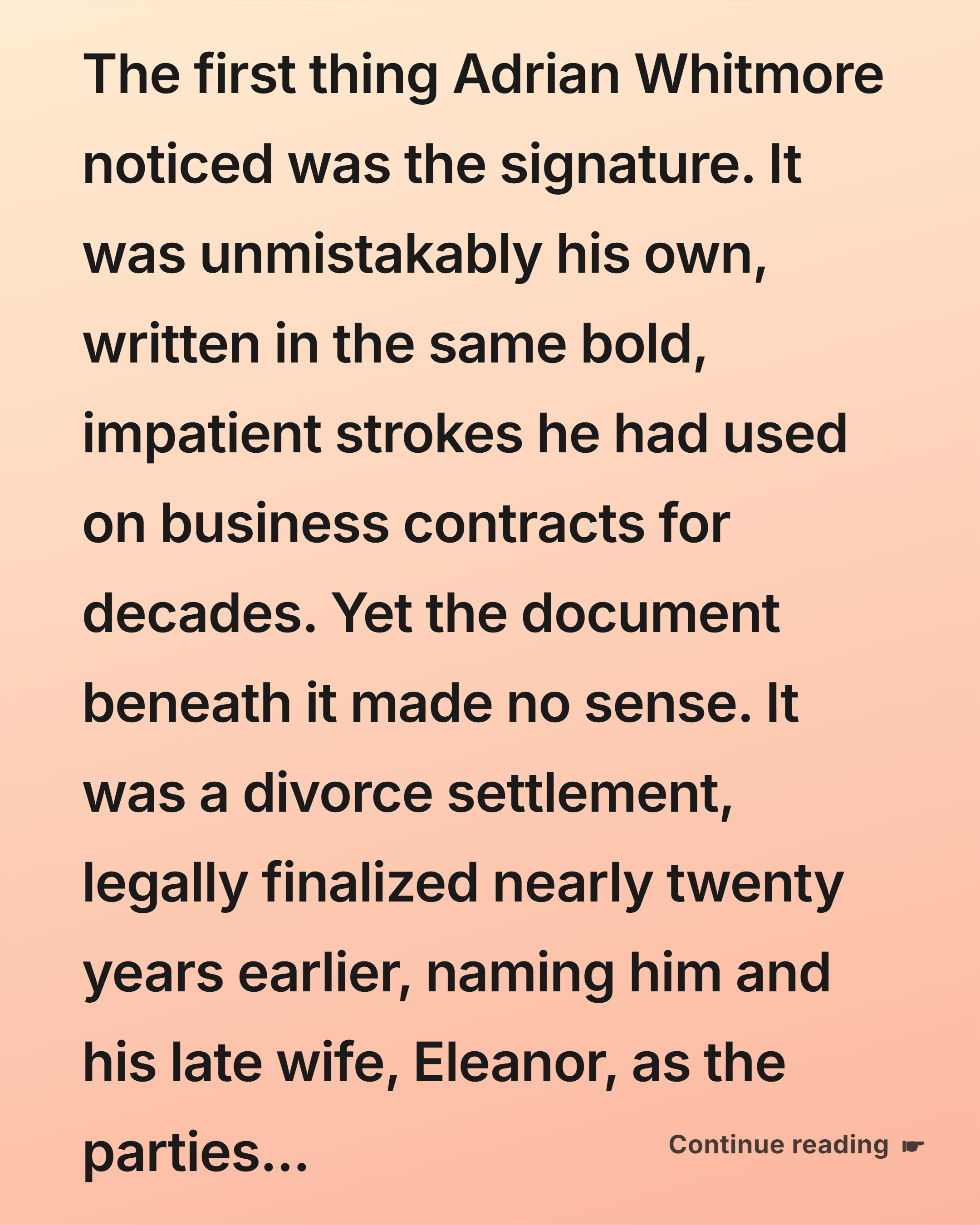
The first thing Adrian Whitmore noticed was the signature.
It was unmistakably his own, written in the same bold, impatient strokes he had used on business contracts for decades. Yet the document beneath it made no sense. It was a divorce settlement, legally finalized nearly twenty years earlier, naming him and his late wife, Eleanor, as the parties.
Adrian sat motionless in the study of his sprawling Malibu home, the ocean visible through the floor-to-ceiling windows. His wife had been buried only eight days earlier, and he was still struggling to accept that he would never hear her voice calling him down for breakfast or complaining about the newspapers he left scattered around the house.
Now, among the personal papers she had kept in a locked wooden cabinet, he had discovered something that seemed to challenge the entire history of their marriage.
He and Eleanor had apparently been divorced.
He read the document again, searching for an explanation. The date was particularly disturbing. It had been signed in July, almost twenty years ago, during the period of his life that remained a blank space in his memory.
Adrian remembered the accident that had changed everything. A fall from a hotel balcony had left him with severe head trauma, and afterward, he had struggled with memory loss. Almost six months of his life had disappeared. His doctors had warned that some memories might never return.
He knew what Eleanor had told him about those months, but he had never thought to question her version of events. She had said he was recovering, that they had needed to leave New York, and that the move to California had given them an opportunity to rebuild their lives.
Apparently, there was considerably more to the story.
Before the accident, Adrian had lived extravagantly. He was the only son of a wealthy industrialist and had inherited a substantial fortune at a relatively young age. Although he occasionally involved himself in investment ventures, he preferred delegating the complicated work to financial advisers.
New York had been his playground. He attended exclusive parties, socialized with musicians and filmmakers, and surrounded himself with people who enjoyed spending money as much as he did. Alcohol had gradually become part of his daily routine, and his increasingly unpredictable behavior had placed enormous pressure on his marriage.
Eleanor had been patient for years, but Adrian now wondered how much she had endured without telling him. He remembered her trying to persuade him to slow down, particularly when his drinking became excessive. He had always interpreted her concerns as nagging rather than genuine fear.
Despite everything, he had never knowingly been unfaithful. He had loved his wife, or at least believed he had understood what loving her meant.
He picked up his phone and called the law firm printed on the divorce paperwork. After several minutes of waiting, a receptionist informed him that the firm had relocated and provided its new address. When he asked for the current telephone number, she suggested searching for it online.
Adrian ended the call and returned to the documents.
The financial settlement was another shock. Eleanor had been entitled to half of their marital assets, which meant she had walked away with a fortune even by the standards of wealthy New Yorkers. Adrian had possessed considerable wealth before their marriage, largely inherited from his father, so the settlement represented an extraordinary amount of money.
He had always considered himself generous with his wealth. He regularly supported charities, funded educational programs, and contributed to organizations helping disadvantaged families. Eleanor had managed most of their charitable activities, and he had trusted her judgment completely.
That trust was now colliding with a growing list of unanswered questions.
He continued searching through the cabinet, hoping to find an explanation for the divorce. Instead, he discovered a document that made him forget about everything else.
It was a birth certificate.
The child was named Vivian Grace Mercer, and the date of birth was three years before Adrian and Eleanor had married. The mother’s name was Eleanor Mercer, her maiden name.
Adrian stared at the certificate.
He had never heard of Vivian. Not once in thirty years of marriage had Eleanor mentioned having a daughter before their relationship. He had known about her childhood, her parents, and the difficult years following her father’s death. He had even visited the town where she grew up.
Yet somehow, an entire child had been erased from the story.
He leaned back, feeling an uncomfortable mixture of confusion and betrayal. Had Eleanor given the child up for adoption? Had someone forced her to do it? And why had she kept the birth certificate all these years?
The questions became even harder to bear when he remembered how bravely Eleanor had fought her cancer. The disease had initially responded to treatment, but complications developed, and within months, her condition deteriorated beyond what the doctors could control.
He had spent her final weeks beside her hospital bed, holding her hand and promising that he would always keep her memory alive.
He had never imagined that he would spend the days following her funeral investigating a life she had apparently kept hidden from him.
He decided to involve his children. His twins, Lucas and Natalie, were twenty-three and had always been close to their mother. Both had returned home for the funeral, and neither had any idea that their mother might have had another child.
That evening, Adrian invited them into his study. He placed the divorce decree and birth certificate on the coffee table and explained what he had discovered.
Natalie picked up the birth certificate first. Her expression changed as she read it.
“You’re telling me Mom had a daughter before she married you?”
“That’s what the document says,” Adrian replied.
Lucas looked at the divorce papers. “And you apparently divorced her? Dad, how can you not remember something like that?”
“I’ve asked myself the same question all afternoon. The accident left me with a significant memory gap. Apparently, this happened during that period.”
Natalie looked genuinely hurt. “But why wouldn’t she tell us? We were her children. She could have trusted us.”
“Maybe she was afraid of what we would think,” Adrian suggested. “Or perhaps there was something about her past she couldn’t bring herself to discuss.”
Lucas examined the lawyer’s name printed at the bottom of the settlement.
“Have you tried contacting him?”
“I called the original firm, but they’ve moved.”
“Find him online. Most lawyers have professional profiles these days. If he’s still practicing, we might be able to get some answers.”
Adrian nodded. For the moment, however, he wanted to put the matter aside. They had only just buried Eleanor, and he didn’t want their mother’s funeral to become overshadowed by a legal investigation.
Still, as he watched his children leave the room, he knew that whatever he had discovered was only the beginning.
Several days after the funeral, Adrian finally contacted the attorney whose signature appeared on the divorce decree.
The lawyer, a man named Malcolm Reeves, was now a senior partner at a respected Manhattan firm. When Adrian introduced himself, Malcolm immediately recognized his name.
There was an awkward silence before the lawyer spoke.
“Adrian Whitmore? I can’t believe it’s you. How have you been?”
“I’m managing,” Adrian replied cautiously. “My wife passed away recently.”
“Oh, Eleanor. I’m terribly sorry. She was a remarkable woman.”
Adrian was surprised by the familiarity in his voice.
“You knew her well?”
“Well enough to understand what she was going through. It was a difficult period for both of you.”
Adrian tightened his grip on the phone.
“That’s actually why I’m calling. I found a divorce decree among her belongings. Apparently, you handled the proceedings.”
Malcolm paused.
“Yes, I did.”
“And I don’t remember any of it.”
Another silence followed.
“You’re serious?”
“Completely. According to this document, I divorced my wife twenty years ago. I have no recollection of signing it, discussing it, or even considering it.”
“Adrian, I think we need to speak in person. There are several matters that you may not fully understand.”
“Then tell me what happened.”
“I would rather not discuss something this sensitive over the telephone. I still have the relevant files. Can you come to New York?”
Adrian agreed to make the trip.
Two days later, he arrived at Malcolm’s office in Manhattan. The lawyer greeted him warmly before leading him into a private conference room. Several thick folders were already waiting on the table.
Malcolm began by asking Adrian about the accident.
“What do you remember about the night you fell?”
“Almost nothing. Eleanor told me we had argued about my drinking. Apparently, I lost my balance near the balcony railing and fell. I was lucky to survive.”
“And did she explain what happened immediately afterward?”
“She said she called for help, stayed at the hospital, and arranged everything with the doctors. When I regained consciousness, I was confused and couldn’t remember much. She eventually moved us to California because she believed I needed a quieter environment.”
“Did you ever investigate the circumstances surrounding the fall?”
“No. I trusted her. Besides, I was struggling just to remember my own life. She found an excellent neurologist, and I concentrated on getting better.”
Malcolm listened carefully before opening one of the folders.
“Did you ever see the newspaper coverage from that period?”
Adrian shook his head.
“No. Eleanor discouraged me from reading anything about the accident. She said the publicity would only make my recovery harder. I didn’t argue. I wanted to leave that entire chapter behind.”
Malcolm took a moment before continuing.
“Adrian, there’s something else you should know. You and Eleanor had a substantial life insurance policy. She was the named beneficiary.”
Adrian frowned.
“I remember buying that policy shortly after we married. It was supposed to protect her financially if something happened to me.”
“Correct. The policy was still active when you fell.”
Adrian stared at him.
“Are you suggesting she had a financial reason to want me dead?”
“I’m not suggesting anything. But at the time, several newspapers questioned whether the accident had been entirely accidental. There was considerable speculation about Eleanor’s involvement.”
Adrian felt his stomach tighten.
“Why wasn’t I told?”
“Your wife insisted that you needed to be protected from the publicity while you recovered. The investigation never established wrongdoing, and she never collected the insurance money. But there were other developments.”
Malcolm opened another folder and placed a set of papers in front of him.
“Eleanor changed her will shortly after the accident.”
“Why?”
“That’s something you’ll need to understand by reading the documents. Look at the beneficiary listed here.”
Adrian glanced down.
The name was Vivian Grace Mercer.
For several seconds, he couldn’t speak.
It was the same name on the birth certificate he had found at home.
Malcolm watched his reaction.
“Now you understand why I wanted you to come here.”
Adrian reached into his briefcase and retrieved the birth certificate.
“Here. I found this among her personal belongings. Is this the same person?”
Malcolm examined it carefully before nodding.
“Yes. The dates and identifying details match the records in Eleanor’s file.”
Adrian rubbed his forehead.
“So my wife had a daughter, secretly arranged her financial future, and changed her will to benefit her. All without telling me?”
“There is one more thing,” Malcolm said.
He opened a separate drawer and removed a sealed envelope. Eleanor’s handwriting appeared across the front, followed by Adrian’s full name.
“She left this with specific instructions that it should only be opened after her death. She also asked that it be delivered to you through me.”
Adrian looked at the envelope for a long moment.
“Did she explain what was inside?”
“No. She simply said you deserved to hear the truth from her, not through a stranger.”
Malcolm stood.
“I’ll give you some privacy. Take as long as you need.”
When the door closed, Adrian carefully broke the seal.
The letter was several pages long.
My dearest Adrian,
If you’re reading this, it means I am no longer there to explain the decisions I made. I have spent many years wondering whether I would ever find the courage to tell you everything. Unfortunately, I kept waiting for the perfect moment, and eventually, time ran out.
There is something about my life that I never told you. Before I met you, I had a daughter named Vivian. I was barely twenty when she was born. Her father was a young musician who disappeared when I told him I was pregnant. My parents were deeply religious and believed an unmarried mother would bring shame upon the family. They pressured me to surrender my baby for adoption.
I was young, frightened, and financially helpless. I convinced myself that another family could give her the security I couldn’t provide. I signed the papers, but I never stopped thinking about her.
Years later, when you and I were married, I wanted to tell you. Every time I tried, I became afraid that you would see me differently. I was terrified that you would reject me because of something I had done before we met.
Eventually, I hired someone to find her. I learned that she had grown up in several foster homes and had never enjoyed the stable childhood I had hoped for her. I also learned that she had been struggling financially. I wanted to help, but I didn’t know how to approach her without exposing the secret.
Then came the accident.
Adrian, I need you to know that I did not push you. We argued that evening because I was frightened by your drinking. You had been behaving recklessly, and I was worried that one day you would hurt yourself. During the argument, you stumbled near the balcony and fell. I called for help immediately. I thought I had lost you.
When you survived but couldn’t remember those months, I was relieved. However, I also knew that the marriage we had been living was no longer sustainable. You were angry, frightened, and sometimes impossible to reach. You needed a new beginning, and I needed to make decisions about my own life.
The divorce was real. We discussed it during your recovery, and you signed the papers after telling me you wanted to separate. I didn’t fight you. I believed that forcing you to remain married to me would only make your recovery harder. But when your memories failed you, I made a terrible decision. I allowed you to believe that we had simply continued our marriage without interruption.
We eventually found our way back to each other. We rebuilt our relationship, and I fell in love with you all over again. I know that doesn’t excuse the deception. I should have told you the truth.
I changed my will because I wanted Vivian to have the security I had failed to give her as a child. I hope you won’t see this as a betrayal. I wasn’t trying to take anything away from you. I was trying to make sure my daughter would never again have to depend on people who could abandon her.
There is one more thing I want you to understand. I never stopped loving you, even during the years when we were no longer legally married. You gave me a beautiful family, and I will always be grateful for that.
Please don’t punish Vivian for my mistakes. She has already lost enough time without knowing where she came from.
With all my love,
Eleanor.
Adrian lowered the letter.
He sat motionless, reading the final paragraph again. The woman he had mourned as his devoted wife had apparently lived with a secret that had shaped nearly every major decision of her adult life.
But the most painful realization was not that she had hidden a daughter.
It was that she had hidden an entire chapter of their marriage from him, and he had never known enough to ask questions.
When Malcolm returned, Adrian folded the letter carefully.
“Her will leaves everything to Vivian?”
“Essentially, yes. Eleanor established a trust for her daughter. The assets are to be transferred according to the terms of that trust following her death.”
“And what about the divorce? Can we challenge it?”
Malcolm leaned back.
“We could examine the circumstances under which it was signed. Your memory loss may raise questions about your capacity at the time. However, the records indicate that the agreement was properly executed. Contesting it would be difficult, particularly after so many years.”
Adrian’s expression hardened.
“What about the inheritance? Can I claim that the money belongs to me?”
“That would depend on the legal ownership of the assets and the terms of Eleanor’s will. We could pursue a challenge, but it would be expensive and emotionally complicated.”
“How much was she worth?”
Malcolm checked the financial statement.
“Approximately four hundred and thirty million dollars, including her investments, property interests, and other holdings.”
Adrian let out a slow breath.
“Four hundred and thirty million?”
“That’s correct.”
“And all of it goes to a woman I’ve never met?”
“According to the trust documents, yes.”
Adrian looked down at Eleanor’s letter again. For a moment, he imagined the headlines if he decided to challenge the will. A wealthy widower fighting his dead wife’s daughter over a fortune.
It would be an ugly spectacle.
He closed the folder.
“Do you have an address for Vivian?”
Malcolm nodded and pulled out another document.
“We have a last known professional address in Los Angeles. However, I should warn you that the information may be outdated.”
“Write it down.”
Malcolm handed him a piece of paper.
Adrian slipped it into his jacket pocket.
“I want to meet her before I make any decisions.”
The address led Adrian to a modest commercial building in an industrial section of Los Angeles. He had expected an office, perhaps a small production company, but the building looked neglected. The paint was peeling, and a broken sign hung above the entrance.
Inside, he found a narrow reception area and a man with tattoos covering both arms. The man was busy sorting through paperwork and barely glanced up when Adrian entered.
“Can I help you?” Adrian asked.
The man gave him an amused look.
“Depends. Are you selling something?”
“I’m looking for a woman named Vivian Mercer. I was told she worked here.”
The man stopped sorting the papers.
“Vivian Mercer? Never heard of her.”
Adrian pulled out a photograph attached to one of Eleanor’s old documents.
The man examined it briefly.
“That doesn’t help much. We get dozens of women through here. Most don’t use their real names anyway.”
“What kind of business is this?”
The man laughed.
“Seriously? You walked into an adult entertainment studio and didn’t notice the signs?”
Adrian glanced around the room. Suddenly, several details made sense.
“I see.”
“Well, now that we’ve established that, are you looking for somebody specific or just wasting my afternoon?”
“I’m trying to find my wife’s daughter. Her mother recently died, and I have something important to tell her.”
The man’s expression changed slightly.
“Your wife’s daughter?”
“Her name is Vivian Mercer.”
The man studied the photograph again.
“Wait a minute. You mean Vee?”
“Possibly. Does she go by another name?”
“She used to work under the name Raven Vale. Some people called her Vee. She left this place months ago.”
“Do you know where she went?”
The man hesitated.
“Look, I don’t usually give out information about former employees.”
Adrian took out his wallet.
“I’m not trying to cause trouble. I’ll give you a thousand dollars if you can point me in the right direction.”
The man’s eyebrows rose.
“That’s a pretty generous offer.”
He leaned back in his chair.
“She used to work with a production outfit called Silverline Media, a few streets from here. I heard she was trying to get into legitimate commercial work. Whether she’s still there, I couldn’t tell you.”
Adrian placed the money on the desk.
“Thank you.”
The man pocketed it.
“And one piece of advice? Don’t tell her I sent you. We didn’t exactly part on friendly terms.”
Adrian didn’t ask for details. He had enough information to continue.
Silverline Media turned out to be a small independent production company operating from a converted warehouse. The receptionist was polite but cautious when he mentioned Vivian’s name.
“Are you a relative?” she asked.
“Something like that.”
“I’m afraid I can’t give you her personal information.”
“I understand. Would you be willing to pass along my number?”
The woman considered it before accepting his business card.
“I can’t promise she’ll call.”
“That’s all I’m asking.”
Adrian left, uncertain whether he would ever hear from her.
For the next three days, he checked his phone more often than he cared to admit. He tried not to become impatient, reminding himself that a stranger had no obligation to respond to an unexpected message.
On the fourth evening, his phone vibrated.
Unknown Number: You said you knew Eleanor Mercer. Who are you?
Adrian stared at the message before replying.
Adrian: My name is Adrian Whitmore. Eleanor was my wife. She passed away recently. I believe you may be her daughter.
Several minutes passed.
Then another message arrived.
Unknown Number: That’s a pretty strange thing to tell someone. What do you want from me?
Adrian: I don’t want anything from you. I have a letter from your mother and some information about your past. I would appreciate the opportunity to explain.
The response came almost immediately.
Unknown Number: Where?
They arranged to meet at a quiet restaurant the following afternoon.
Vivian arrived twenty minutes late, wearing jeans, a black jacket, and a baseball cap pulled low over her forehead. She was thirty-two, with dark hair and an expression that suggested she had learned not to trust people easily.
She looked at Adrian for several seconds before sitting down.
“You don’t look like the kind of man who would normally come looking for someone like me,” she said.
Adrian gave a small, uncomfortable smile.
“I suppose I don’t.”
“Let’s skip the small talk. What do you want?”
He took a breath.
“Your mother died recently. She had cancer. Before she passed away, she left a letter explaining that she had given birth to a daughter before she married me. That daughter was you.”
Vivian’s expression remained guarded.
“You’re saying Eleanor was my biological mother?”
“Yes.”
“Do you have proof?”
Adrian took out the birth certificate and a copy of the adoption records. He also showed her a photograph of Eleanor holding a newborn baby.
Vivian stared at the photograph.
For the first time, her expression softened.
“Where did you get this?”
“From her belongings. She kept it all these years.”
Vivian looked away.
“Did she ever try to find me?”
“She did. She hired someone to locate you, and she followed your life from a distance. She was afraid to approach you.”
Vivian gave a bitter laugh.
“That’s convenient. She watched from a distance while I spent my childhood wondering why nobody wanted me.”
Adrian had no answer.
She continued.
“I went through five foster placements before I turned eighteen. My last foster mother was particularly charming. She liked collecting government payments for taking care of children, but she wasn’t especially interested in actually taking care of us.”
“I’m sorry.”
“Don’t be. You didn’t do it.”
Vivian explained that after aging out of the foster system, she had struggled to find stable work. A series of bad decisions and financial pressures had eventually pushed her toward the adult entertainment industry. At first, she had convinced herself it was temporary. Later, she discovered how difficult it could be to leave.
“I hated it,” she admitted. “But rent doesn’t care whether you hate your job. Neither do the people who promise you opportunities and then make sure you’re dependent on them.”
Adrian listened without interrupting.
“Why are you telling me all this?” she asked.
“Because I want you to understand that your mother cared about you. She made mistakes, serious ones, but she never stopped thinking about you.”
Vivian folded her arms.
“Did she leave me money?”
Adrian nodded.
“She established a trust. The estate is worth approximately four hundred and thirty million dollars.”
Vivian blinked.
“You’re joking.”
“I’m afraid not.”
“Why would she leave that to me?”
“Because she wanted you to have the security she couldn’t give you when you were born.”
Vivian looked toward the window.
“And what do you get out of this? Surely you’re not here because you suddenly developed a charitable interest in strangers.”
Adrian appreciated her suspicion.
“I’ve spent most of my life managing investments and overseeing businesses. I can help you understand the estate and make sure you have independent advisers. But I won’t control your money. It’s yours, and you should have your own legal and financial representation.”
“Good. Because I’m not handing four hundred million dollars to a man I’ve met once.”
“Nor should you.”
For the first time, Vivian smiled.
Adrian hesitated before continuing.
“There is something else. Your mother left me a letter. Would you like to read it?”
Vivian nodded.
He handed her the pages.
She read slowly, occasionally stopping to wipe her eyes. When she reached the final paragraph, she lowered the letter and sat quietly.
“She really wrote this?”
“Every word.”
“She remembered me.”
“She never forgot you.”
Vivian pressed the letter against the table.
“I don’t know what I’m supposed to feel.”
“You don’t have to decide today.”
After a moment, Adrian reached into his jacket and handed her another card.
“I also own a production company. We finance independent films, documentaries, and television projects. If you’re interested in getting away from the industry you’re in, I would be happy to introduce you to people who can help you build a different career.”
Vivian examined the card.
“You’re a film producer?”
“Executive producer. I’ve been involved in the business for several years.”
“That’s not what I expected.”
“What did you expect?”
“Someone in an expensive suit telling me I should be grateful for a fortune I never asked for.”
Adrian laughed softly.
“I’ll try not to disappoint you.”
Vivian looked at the card again.
“I’ve always wanted to work on real films. Not the kind I’ve been doing. I wanted to write stories, maybe produce something about women who have been through what I have.”
“Then perhaps we have something worth discussing.”
He didn’t promise her that everything would suddenly become easy. He knew that money could remove certain obstacles, but it couldn’t erase years of pain or rebuild trust overnight.
Still, he could offer her a beginning.
Before they parted, Adrian asked whether she would consider meeting his children.
Vivian hesitated.
“They know about me?”
“They do. They were shocked, but they want to meet you. They’re good people, and I think your mother would have wanted you to know them.”
“I’ll think about it.”
“That’s all I ask.”
A week later, Vivian visited Adrian’s production office in Santa Monica.
Lucas and Natalie were waiting when she arrived. Neither knew quite what to say, so Natalie broke the awkward silence by offering her a cup of coffee.
“Mom always made terrible coffee,” she said with a nervous smile. “She insisted it was perfect, though.”
Vivian laughed.
“She sounds like someone I might have liked.”
Lucas joined the conversation.
“She was stubborn about almost everything. Especially charity work. Once she decided an organization needed help, there was no changing her mind.”
Vivian’s expression grew thoughtful.
“She liked helping people?”
“More than anything,” Natalie replied. “Sometimes she spent more time worrying about strangers than she did about herself.”
The conversation gradually became easier. They exchanged stories about Eleanor, comparing the woman they had known with the fragments Vivian had learned from the letter.
There were similarities. They all noticed her determination, her generosity, and her tendency to hide her own worries behind a reassuring smile.
For the first time, Vivian began to feel that she wasn’t simply an outsider being introduced to an established family. She was discovering pieces of a woman who belonged to all of them.
Later that afternoon, Adrian proposed traveling to New York together to complete the inheritance arrangements.
Vivian agreed, provided she could have an independent attorney and financial adviser review everything.
“Absolutely,” Adrian said. “Your mother left you the money. You should have complete control over how it’s handled.”
Before they finalized the travel arrangements, Vivian raised another idea.
“I’ve been thinking about something,” she said. “I don’t want to spend the rest of my life pretending my past never happened. There are women trapped in the same industry I was in, and some of them have children who are suffering because of it. I’d like to create a foundation that helps them leave safely.”
Natalie leaned forward.
“That sounds like something Mom would have supported.”
“I want it to be more than a place that hands out emergency checks. Women need legal assistance, counseling, job training, safe accommodation, and people who won’t judge them.”
Lucas nodded enthusiastically.
“We could build a proper business plan and establish partnerships with organizations already doing this work.”
“Count me in,” Adrian said.
Vivian looked around the room.
“I’d like to name it after Eleanor. Even though I didn’t get to know her, she gave me something I never thought I’d have: the chance to start again.”
They agreed on the name Eleanor’s Promise.
The following months were busy. With the inheritance secured in a professionally managed trust, Vivian began working with her own team of financial advisers. Adrian provided introductions and business guidance, but he made a conscious effort not to interfere with decisions that belonged to her.
Lucas helped develop the foundation’s financial structure, while Natalie used her connections in the film industry to organize fundraising events and recruit volunteers.
They established partnerships with legal aid organizations, shelters, employment programs, and specialists experienced in supporting women leaving exploitative situations.
The foundation did not promise instant solutions. Its work focused on practical support, confidentiality, and giving women the resources to make independent decisions about their futures.
Vivian eventually became its public director. She spoke at conferences, participated in documentaries, and worked with advocacy groups to improve protections for vulnerable women and children.
Her own experiences gave her a perspective that no amount of money could have purchased. She understood how difficult it was to ask for help when the people offering it had previously been the ones taking advantage of you.
One afternoon, nearly a year after Eleanor’s death, Adrian attended the opening of the foundation’s first residential support center.
A young woman approached Vivian after the ceremony. She was nervous and kept glancing toward the exit, as though she expected someone to appear and drag her away.
Vivian spoke to her quietly, listened to her concerns, and arranged for one of the counselors to help.
Adrian watched from a distance.
When the woman finally relaxed enough to smile, he felt something shift inside him. He had spent years measuring success through investments, properties, and the size of his portfolio. Yet the most meaningful thing he had witnessed in a long time was a frightened stranger beginning to believe that her life could change.
Later, Vivian joined him outside.
“Do you think Mom would have been proud?” she asked.
Adrian looked through the glass doors at the people working inside.
“I think she would have been overwhelmed by what you’ve built.”
Vivian smiled faintly.
“I wish I could have met her.”
“So do I,” he replied. “But perhaps the best way to understand her is to look at what you’ve chosen to do with the life she gave you.”
They stood together for a moment, watching the evening sunlight settle over the building.
Adrian still had questions about the past. He sometimes wondered what Eleanor had endured during the years he couldn’t remember and whether he could ever fully understand the decisions she had made.
He had also accepted that some questions would never receive answers.
He could have spent the remainder of his life fighting over the fortune, challenging the will, and trying to prove that Eleanor had wronged him. Instead, he chose to honor the part of her story that mattered most: her desire to protect a daughter she had never stopped loving.
His relationship with Vivian did not become perfect overnight. They had awkward conversations, disagreements, and moments when the weight of lost years became impossible to ignore. But they kept showing up for one another.
Lucas and Natalie gradually stopped thinking of Vivian as the mysterious sister they had discovered after their mother’s death. She became simply their sister, someone they could call, argue with, and laugh alongside.
Adrian, meanwhile, began devoting more of his time to charitable work. He reduced his involvement in unnecessary business ventures and used his experience to support organizations that created lasting opportunities for vulnerable families.
Sometimes, when he visited Eleanor’s grave, he brought flowers and sat quietly for a while. He no longer went there to ask why she had kept so many secrets.
Instead, he talked about the children, the foundation, and the lives being changed because of her final decision.
He had once believed that love meant knowing everything about another person. Eleanor’s secret had taught him something different: people could make terrible mistakes, carry unbearable regrets, and still spend their lives trying to do something good.
He couldn’t recover the years Vivian had lost, and he couldn’t rewrite the past he no longer remembered. But he could help make sure that the future was kinder.
And perhaps that was the greatest inheritance Eleanor had left behind—not the hundreds of millions of dollars, but the opportunity for a broken family to become whole in a way none of them had expected.