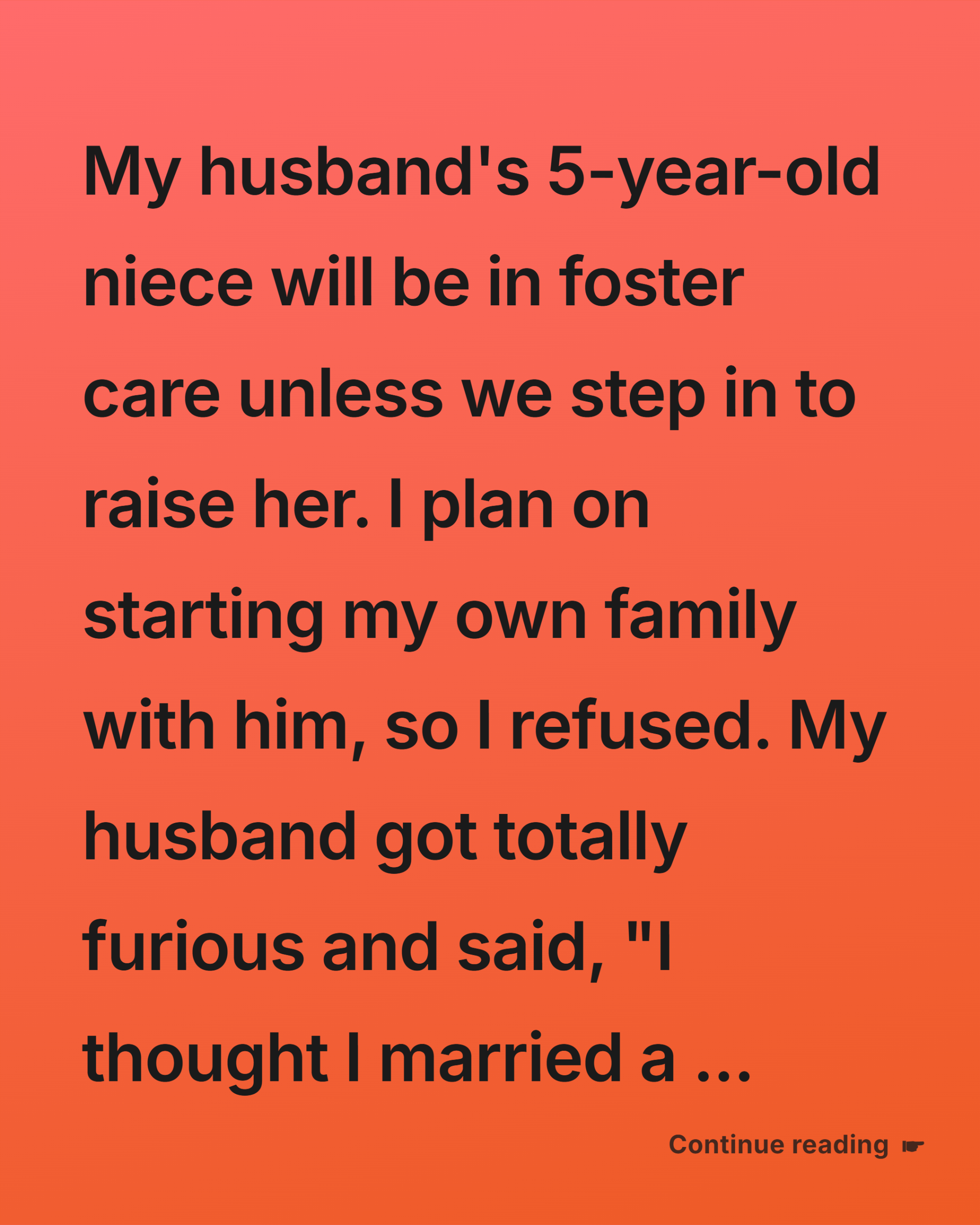
My husband’s 5-year-old niece will be in foster care unless we step in to raise her. I plan on starting my own family with him, so I refused. My husband got totally furious and said, ‘I thought I married a woman who actually cared about people.’ And the way he said it wasn’t just anger—it was disbelief, like he was suddenly seeing a stranger in front of him.
That line cut deeper than I expected. I stood there in our tiny kitchen, the kettle still whistling, and my hands frozen mid-stir in my coffee. For a second, I forgot to breathe, as if the air itself had turned heavy and unwilling to come in.
We had only been married eight months. I was 29, and finally starting to feel like I had things figured out—career on track, a decent apartment, and plans to start trying for a baby later that year. I had envisioned us decorating a nursery together, laughing as we built a crib with one too many screws leftover, joking about how neither of us really knew what we were doing.
Now he was talking about raising someone else’s child. A child who came from a whole mess of problems. His sister, Mindy, had been in and out of rehab, and this wasn’t her first run-in with CPS. But this time, it was serious. Permanent. And for the first time, I saw panic behind his anger.
And suddenly, it felt like I was being asked to throw our whole life off course, to derail everything we had quietly promised each other without ever saying it out loud.
“I’m sorry,” I told him. “But we didn’t plan for this.” My voice sounded smaller than I intended, like it didn’t belong to me anymore.
He looked at me like I’d grown horns, like the person he married had shifted into something unfamiliar overnight. “You think life asks for your permission?” he said, almost shaking.
I stayed quiet. He walked out, the door shutting with a finality that echoed longer than it should have in a small apartment.
The next few days were tense. He started sleeping on the couch, which felt like punishment, like silence was now part of the household. Every morning, we’d avoid eye contact like strangers in an elevator that kept stopping on the same floor.
On the fourth day, he told me he was going to visit his niece, Olivia, at the temporary shelter. His voice was flat, but his eyes were sharp, watching me carefully.
“Do you want to come?” he asked, not expecting me to say yes, already halfway prepared for rejection.
I almost said no again, out of pride or stubbornness—I’m still not sure. But something in me softened, uncomfortable and reluctant. Maybe it was guilt. Maybe it was curiosity. Maybe I just wanted to understand what he already seemed ready to sacrifice everything for.
So I went.
The shelter was a dull, gray building on the outskirts of town. Not dangerous, but sterile in a way that made it feel like time had stopped inside. The air smelled faintly of disinfectant and forgotten toys.
Olivia was sitting at a small table coloring when we walked in. Her hair was tangled, and she had on a sweatshirt two sizes too big, slipping off one shoulder like she’d grown into sadness too quickly.
But when she looked up and saw my husband, her eyes lit up like he was Santa Claus, like he was the only safe thing she recognized in a world that had already changed too much.
“Uncle Rob!” she shouted, running over to him without hesitation, like fear didn’t know her yet.
He scooped her up like she weighed nothing, hugging her close in a way that made his decision feel already made. Then he looked over at me.
“This is my wife, June.”
Olivia gave me a shy wave, her tiny fingers covered in blue marker, like she had been coloring her way through waiting.
I smiled, and to my own surprise, I meant it. It didn’t feel forced. It felt like something fragile trying to form.
We sat with her for an hour. She showed me her drawing—a house with crooked windows and stick-figure people, one of which had hair that looked like mine, drawn carefully like she had noticed me more than I realized.
I didn’t say anything on the drive home. But my mind was spinning, looping through possibilities I wasn’t ready to name.
That night, Rob told me he was seriously considering taking Olivia in. With or without me. His voice wasn’t threatening, but it wasn’t asking either.
It felt like an ultimatum. It probably was, even if he didn’t say it out loud.
I told him I needed a few days to think, though I already knew this wasn’t something that could be solved neatly.
Over the next week, I tried to talk myself out of it. We’d never even discussed fostering, never imagined this kind of responsibility landing in our laps, and now I was supposed to be someone’s mother overnight?
Still, I couldn’t stop thinking about the way Olivia clung to him, like he was a lifeline she refused to let go of. The way she’d looked at me like I was already someone in her life, even if I hadn’t decided to be yet.
The following weekend, I went with him again. This time, I brought Olivia a stuffed dog. Nothing fancy, just something soft and huggable, as if softness could fix anything.
Her face lit up, and she squeezed it so tight I thought the seams might pop, like she was afraid it might disappear if she loosened her grip.
I don’t know when it happened exactly, but I started to care. Genuinely care. It wasn’t logical. It was gradual, like something slipping past my defenses without permission.
It wasn’t dramatic or like a movie. It was small things—the way she said “thank you” without being told, the way she whispered to the stuffed dog like it was her only friend in a room full of unknowns.
By the end of the visit, she was holding both our hands, as if she had already chosen her safety.
When we left, I turned to Rob in the parking lot and said, “Let’s bring her home.” My voice shook, but it didn’t hesitate.
I expected relief or joy, but he just nodded, like he didn’t quite trust it yet, like he was afraid I might take it back.
It took about three weeks for the paperwork. During that time, we tried to baby-proof our small apartment, suddenly measuring every corner of our lives against a child’s presence. Bought a little bed. Picked out curtains with rainbows. I spent my evenings watching YouTube videos on how to make kids feel safe, like love could be learned step by step.
When Olivia finally came to stay, she was quiet. Barely spoke at dinner. Slept with the stuffed dog pressed tight to her chest like it was the only thing holding her together. But every day, she came out of her shell a little more, testing the world carefully.
And every day, I felt a little more like her mom, even if I hadn’t fully accepted the title yet.
I won’t pretend it was easy. She had nightmares. She wet the bed a few times. She once screamed at me when I cut her sandwich the “wrong way,” like that mistake meant something bigger.
But she also started laughing in the mornings, real laughter that didn’t feel cautious. She drew us pictures. She started calling me “Junie” instead of “the wife,” as if rewriting what I meant in her world.
A few months later, she slipped and called me “Mom.”
She froze. I froze.
Then she burst into tears.
“I’m sorry. I didn’t mean—my real mommy…”
I held her and said, “You can call me whatever you want. I’m not here to replace anyone. I’m just here to love you.” And I meant every word, even the complicated ones.
From that moment, something changed. Not everything—but enough to matter.
We began to feel like a family. A messy, makeshift family. But a real one, held together by effort more than certainty.
One night, Rob and I were in bed, and he said, “I was scared I’d lose you over this.” His voice was softer than I had heard in weeks.
I smiled. “You almost did.”
We both laughed, but quietly. It wasn’t funny, really. But it was true in a way neither of us could ignore.
Things were good. Better than I imagined they’d be. So much so that we started talking again about having our own baby. We agreed to wait until Olivia was fully settled, as if stability was something we could schedule.
About six months after Olivia moved in, I took her to the park. She was playing on the swings when a woman approached me.
She was thin, with sunken cheeks and dark circles. But there was something familiar about her eyes, something that made my stomach tighten before my mind caught up.
“I’m Mindy,” she said.
My chest tightened. The air felt heavier again, like it had that first day in the kitchen.
“I just got out. From rehab. Six months clean.”
I didn’t know what to say. She didn’t ask to take Olivia. She just wanted to see her from a distance, like she wasn’t sure she had the right to stand any closer.
We talked for a few minutes. I could tell she was nervous, ashamed, trying to hold herself together with whatever dignity she had left.
“I messed up. I know that. I don’t expect anything. I just needed to see that she’s okay.”
I looked over at Olivia, laughing on the swings, and nodded. “She’s okay.” And I realized I meant it more than I expected.
Mindy didn’t stay long. Before she left, she asked, “Can I give you my number? In case… someday?”
I took it. I didn’t promise anything. But I kept the slip of paper in my wallet like something unfinished.
I didn’t tell Rob about the meeting that day. Not because I was hiding something, but because I needed time to make sense of what it meant.
Two months later, Mindy wrote us a letter.
She didn’t ask for custody. She said she was working full-time at a diner, living in a women’s sober home, going to meetings, rebuilding pieces of a life that didn’t exist anymore.
She said she was grateful Olivia had us.
It wasn’t what I expected. It was quieter. More human than I had prepared for.
Rob was hesitant, but I suggested we allow Olivia to send her mom a card. Just a drawing. Something simple that didn’t reopen wounds too fast.
He agreed.
It became a monthly thing. Small steps. Olivia didn’t understand everything, but she liked sending her drawings. Mindy never pushed. She stayed consistent. Clean. Respectful. Present in the only way she knew how to be.
A year passed.
We adopted Olivia officially that winter. She wore a blue dress and asked if she could wear sparkly shoes. We said yes, because suddenly, it mattered more than rules.
That night, she told us, “This is the happiest day of my life.”
Rob cried in the car, unable to hide it anymore.
I think I did too, quietly, like something inside me finally settled.
A few more years passed, and we finally had our own baby. A boy, Milo.
Olivia was nine when he was born. She made a big sister card and insisted on helping with everything—even diaper changes, even when she got frustrated.
She was fiercely protective. “He’s our baby,” she’d say, like she was making sure the world understood.
We never expected what came next.
One afternoon, we got a call from Mindy. She had been sober for four years, working at the same diner, living on her own now, steady in a way we never thought possible.
“I’m getting married,” she said. “And I was wondering if Olivia would come. Just as a guest. No pressure.”
We didn’t know what to do at first. The past still had weight, even if it had softened.
But we talked to Olivia.
“I’d like to go,” she said. “I want to see her. And I want you both there.”
So we went.
It wasn’t awkward like I thought it might be. Mindy looked healthy. Calm. Her fiancé seemed kind, grounded. Olivia gave her a hug and called her “Mom,” but then turned to me and said, “You’re still my Junie.”
I squeezed her hand, holding onto that sentence like it was enough.
That night, on the drive home, Rob looked over and said, “Thank you.”
“For what?” I asked.
“For saying yes. Back then. When it wasn’t easy.”
I nodded. I didn’t say anything. I didn’t have to, because everything important had already been decided years ago.
The truth is, that decision changed everything.
It taught me that love doesn’t always arrive the way you planned it. Sometimes, it shows up messy, unexpected, and wrapped in responsibility that scares you before it saves you.
But it’s still love.
Olivia is fifteen now. She just got her learner’s permit. And when people ask how many kids we have, I say, “Two.” No hesitation, no explanation needed.
Looking back, I almost can’t believe I said no at first.
But I did.
And I’m not proud of it, but I’m honest about it. Because that’s how most life-changing things start—not with certainty, but with fear, doubt, and a choice to lean in anyway.
Sometimes, the most beautiful families are the ones you build from the pieces life hands you when you weren’t ready to choose them.
So if you’re ever on the fence about opening your heart to someone who needs you—don’t wait for it to feel convenient. Just ask yourself if you’re willing.
That’s usually enough.