I remember the first time it happened like it was yesterday. We were standing in line at the little deli across from our office in downtown Manchester, the smell of toasted sourdough and roasted coffee filling the air. The lunchtime crowd buzzed around us, everyone rushing back before the afternoon meetings began. My coworker, Vanessa, patted her pockets with a look of practiced distress and sighed. “Oh no, I think I left my purse at my desk again,” she said, her eyes wide and pleading. Being the person I am, I just tapped my card and told her not to worry about it.
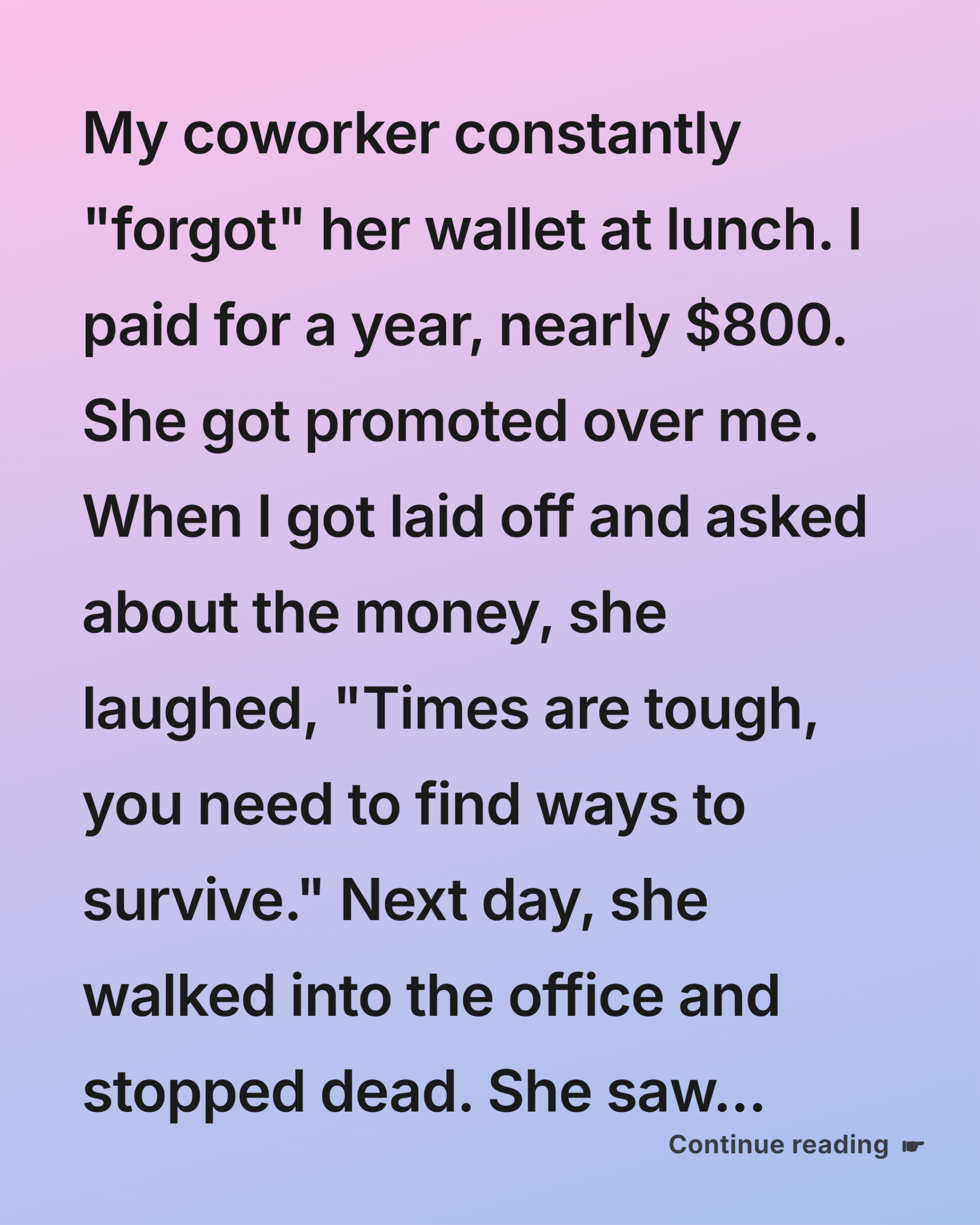
That was the beginning of a pattern that would last for an entire year. Every Tuesday and Thursday, like clockwork, Vanessa would “forget” her wallet, claim her banking app had stopped working, or suddenly realize her card was “somewhere at home.” At first, I laughed it off. It seemed harmless, like the kind of small mistake anyone could make once or twice. But after a few weeks, I started noticing something strange—she never seemed embarrassed. She never offered to pay me back without being asked. She simply smiled, thanked me, and moved on as if my money was just another office resource she had access to.
I was a junior analyst at the time, and I really couldn’t afford to be the office benefactor. My salary barely covered my expenses, and I was trying to save whatever I could. But Vanessa was charismatic, the kind of person who made you feel like part of the “in-crowd” just by standing near her. She knew everyone, laughed loudly in meetings, remembered people’s birthdays, and always seemed to know exactly what to say to make others feel important. I kept convincing myself that maybe she was just going through a difficult period.
Still, I kept track. Not because I wanted to hold it over her head, but because I had a feeling I needed to remember the details. I started with simple notes, then eventually created a messy spreadsheet on my phone. Date. Meal. Amount. Reason she gave. I told myself it was just for my own records, but deep down, I think part of me already knew I might never see that money again.
By the end of twelve months, I had spent nearly $800 on her salads, paninis, coffees, and afternoon snacks. The exact total was $784.50. I kept telling myself she’d pay me back when she got her bonus or when things settled down for her. I figured we were friends, or at least close enough that the debt meant something. We worked in a high-pressure marketing firm where everyone was fighting for recognition and looking for an edge. I thought my generosity was building a bridge that would help both of us as we climbed the ladder.
What I didn’t realize was that Vanessa wasn’t building a friendship with me. She was building a habit.
Then came the day of the annual performance reviews. I had hit every target, stayed late almost every night, and taken on responsibilities far beyond my position. I had even covered Vanessa’s shifts when she had “family emergencies” that always seemed to happen at the most convenient times. I had prepared myself for the announcement because I was certain the senior associate position was mine.
Instead, the director called us into the boardroom and announced that Vanessa had been promoted over me.
I remember sitting there in silence, staring at the presentation screen while everyone applauded. Vanessa stood up with a confident smile and gave a polished speech about perseverance, teamwork, and dedication. She talked about “going above and beyond” and “helping the company succeed,” while I sat there knowing exactly how much of her workload I had quietly carried on my shoulders.
The sting of the promotion was bad enough, but the real blow came a week later.
The company announced a “restructuring” phase, which is just corporate language for removing people they no longer want to invest in. Employees were called into private meetings one by one. When my turn came, I already had a terrible feeling in my stomach.
I was handed a cardboard box and a two-week severance package that wouldn’t even cover my rent. My position was eliminated.
Vanessa’s was not.
She didn’t even look up from her new corner office as I packed my stapler, my notebooks, and the framed photo of my dog that had sat beside my computer for years. She was too busy laughing on a conference call, surrounded by the very success she had built partly on my effort.
I could have walked away quietly. Part of me wanted to. But as I stood in that office hallway, carrying a box filled with reminders of everything I had lost, I realized there was one thing I still had control over.
The truth.
I decided to stop by her office on my way out, not to cause a scene, but to settle the score. I pulled up the spreadsheet on my phone and showed her the total: $784.50.
“Vanessa, since I’m leaving and money is going to be tight, I really need you to settle this lunch debt,” I said, trying to keep my voice steady. “I helped you because I thought we were friends. I think it’s only fair that you pay it back.”
For a moment, I thought maybe she would finally understand.
She didn’t.
She leaned back in her expensive leather chair, looked at the spreadsheet, and then let out a sharp, mocking laugh.
“Times are tough, darling,” she said, casually brushing a piece of lint off her designer blazer. “You need to find ways to survive, just like I did.”
She paused, then smiled.
“Consider it a lesson in the cost of being too soft.”
Those words stayed with me.
I walked out of that building feeling smaller than I had ever felt in my life. I spent the evening staring at my bank account, wondering how I had let someone treat me like a human ATM for so long. I questioned my judgment, my kindness, and even my ability to succeed in a workplace where people like Vanessa seemed to win.
But the thing about survival is that you never know who is watching the way you play the game.
The next morning, I got a call from a number I didn’t recognize.
It was the CEO’s personal assistant.
She asked me to come back into the office for a “follow-up exit interview.”
I was confused and honestly a bit annoyed. What was the point? My job was already gone. My desk was cleared. My access card probably didn’t even work anymore. But something about her tone made me curious, so I agreed.
I returned to the office and sat in the lobby for twenty minutes, watching my former coworkers hurry past me. Some looked surprised to see me. Others avoided eye contact, unsure what to say.
Then the elevator doors opened.
Vanessa stepped out.
She was dressed perfectly, carrying the same expensive handbag she always showed off. She walked into the lobby with the confidence of someone who believed she owned the building.
Then she saw me.
Her smile disappeared.
Her face went from confident amusement to a pale, frozen mask of fear within seconds.
I didn’t understand why until I looked behind her.
The CEO, Mr. Sterling, stepped out of the elevator.
He wasn’t looking at me.
He was looking directly at Vanessa.
His expression was cold enough to silence the entire reception area.
“Vanessa,” he said, his voice low and serious, “please join us in the conference room.”
For the first time in a year, Vanessa looked like she had no idea what was coming next.
It turned out the deli across the street wasn’t just a random sandwich shop.
It was owned by Mr. Sterling’s sister.
She had been working behind the counter almost every day for the past year. She had watched Vanessa “forget” her wallet dozens of times. She had watched me quietly pay the bill again and again without ever embarrassing her.
But what really caught her attention was something that happened one afternoon.
Vanessa had been sitting at a corner table with a friend, laughing about how she had “found a sucker” at work who kept paying for everything.
Mr. Sterling’s sister had heard every word.
She remembered my name because she had seen me there so often. She remembered Vanessa because she had seen the pattern.
And when she found out I had been laid off while Vanessa had been promoted, she knew something was wrong.
She told her brother everything.
Mr. Sterling immediately ordered a review of Vanessa’s performance records, expense reports, and project history.
What they discovered was worse than anyone expected.
Many of the accomplishments Vanessa had presented as her own were actually projects I had completed. Emails, drafts, and document histories showed that she had repeatedly taken credit for my work while presenting herself as the driving force behind the team’s success.
The “restructuring” suddenly looked very different.
It wasn’t just about cutting costs.
Mr. Sterling had been evaluating who truly represented the company’s values.
And Vanessa had failed spectacularly.
As we sat in the conference room, another person entered—a man I had never seen before. He introduced himself as a representative from a much larger rival firm that had been in discussions about acquiring our company.
Then he said something that completely changed the room.
“We have been observing this company for months,” he explained. “Not just the numbers. The people.”
It turned out the man had been the “delivery guy” who brought coffee to our office twice a week.
He had been watching how employees treated each other when nobody thought anyone important was paying attention.
He looked at me and smiled.
Then he looked at Vanessa.
His expression changed instantly.
“We value integrity above everything else,” he said. “We noticed how you handled yourself even when you were being taken advantage of. And we noticed how Vanessa handled situations when she thought there would be no consequences.”
Vanessa immediately started explaining.
She talked about “business decisions,” “workplace dynamics,” and “doing what was necessary to succeed.”
But Mr. Sterling raised his hand.
The room went silent.
He placed a folder in front of me.
I expected another document explaining my termination.
Instead, it was an offer.
A leadership position with the newly merged company.
A director-level role.
I stared at the paper, convinced there had to be some mistake.
There wasn’t.
While Vanessa had spent a year trying to climb higher by stepping on others, I had unknowingly been proving exactly the kind of person they wanted leading people.
Vanessa, meanwhile, was handed a termination letter. Her promotion was revoked, and she was escorted from the building she had been so proud to sit in.
Her final paycheck was adjusted to reimburse me the $784.50 she owed.
As she walked out, she carried the same designer bag she had carried every day.
But she no longer carried the confidence.
I stood there holding the folder, feeling a strange mix of relief, disbelief, and profound vindication.
The rewarding part of this journey wasn’t just the higher salary or the impressive title.
It was realizing that my kindness had never been the weakness Vanessa believed it was.
My “softness” had been evidence of something much stronger.
Character.
I had spent a year feeling foolish for helping someone who took advantage of me. But that kindness had become a silent witness to who I really was. Vanessa thought survival meant using people before they could use her.
She was wrong.
Real survival is about building a reputation that people trust.
I spent my first day as a director ordering lunch for the entire floor—and this time, I paid for it happily. But I also made one announcement before everyone ate.
“In this office, nobody should feel like they have to compete by tearing someone else down. We succeed by lifting each other up.”
The culture changed almost immediately.
The fear and competition faded.
People started collaborating instead of protecting themselves.
It was amazing how quickly a workplace could transform when the people at the top actually valued the people at the bottom.
I learned that life has a strange way of balancing the scales when you least expect it.
You might feel like you’re losing because you’re playing fair while others are cheating. You might wonder whether kindness is worth anything in a world that rewards selfishness.
But the game is usually much longer than you think.
Honesty and generosity aren’t weaknesses. They are investments in the kind of person you become—and the kind of reputation you leave behind.
Never let someone else’s lack of character convince you to abandon your own.
The truth is, you never really know who is sitting in the corner of the room, who is standing behind the counter, or who is quietly watching how you treat people when you think nobody important is paying attention.
Integrity is what you do when no one is looking.
But the reality is, someone is always looking.
Being called a “sucker” by a person who measures success by what they can take from others is often just another way of being recognized as a leader by those who understand what real success means.
I’m glad I kept my spreadsheet.
But I’m even more grateful that I kept my heart.