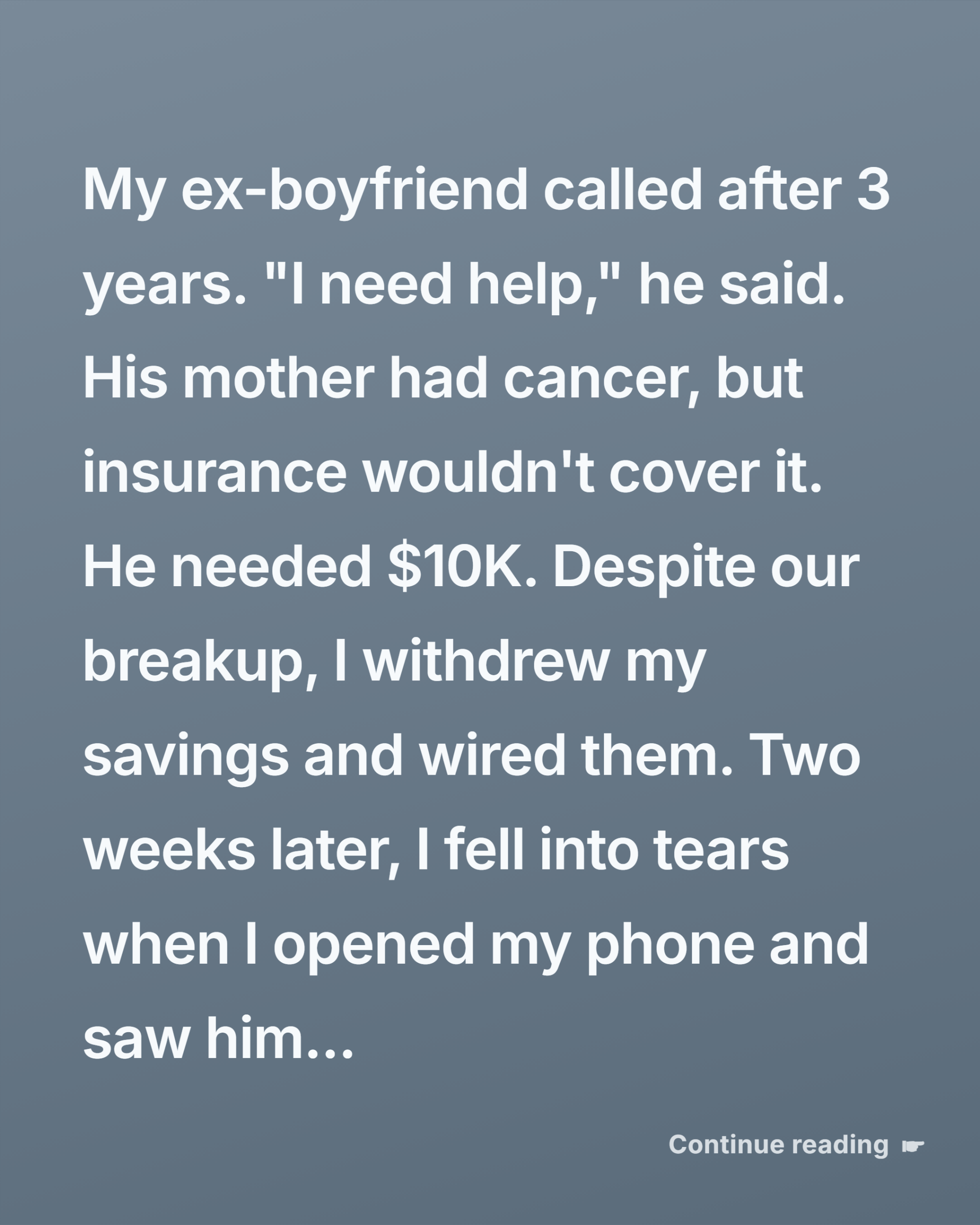
My ex-boyfriend called after 3 years. “I need help,” he said. His voice was a jagged rasp, stripped of the arrogance I remembered from our final argument in that rain-slicked parking lot in Manchester. He sounded like a man who had been running for a long time and finally hit a wall he couldn’t climb over. He told me his mother, Evelyn, had been diagnosed with aggressive Stage III cancer, and the private insurance they had been paying into for decades was finding every loophole possible to deny the claim. He needed $10k for a specialized treatment that had to begin immediately, or she wouldn’t make it through the winter.
Despite our messy breakup and the three years of silence that followed, I felt a familiar pull in my chest. Evelyn had been the only person in that family who truly looked at me with kindness. She was the woman who would quietly slip extra containers of her homemade shepherd’s pie into my hands when she knew I was struggling with rent, pretending she had “made too much again” so I wouldn’t feel embarrassed accepting it. She had always treated me like I mattered, even when her own son made me feel like I didn’t.
I couldn’t just sit there and let a woman like that fade away because of corporate paperwork and an insurance company looking for excuses. I didn’t even consult my friends, knowing they would probably call me reckless for answering Arthur’s call in the first place. They would remind me of how badly he had hurt me, how he had walked away without looking back, and how dangerous it was to reopen a door I had worked so hard to close.
But all I could think about was Evelyn.
The very next morning, I went to the bank, withdrew nearly every cent of my hard-earned savings, and wired the money to the account number Arthur gave me. Ten thousand dollars. Almost everything I had.
At the time, I told myself I wasn’t helping Arthur.
I was helping Evelyn.
The two weeks that followed were a strange mixture of anxiety and quiet pride. I was living on ramen noodles, walking miles to work to save on bus fare, and ignoring the little voice in my head asking whether I had made a terrible mistake. Still, I felt like I had done something noble. Something human.
I kept waiting for an update. A message saying the treatment had started. A photo of Evelyn smiling. A simple “thank you” from Arthur would have been enough.
Every time my phone buzzed, my heart skipped.
I wanted proof that my sacrifice had mattered.
Then, two weeks later, everything collapsed.
I opened my phone and saw him.
It wasn’t a text message.
It wasn’t a private photo.
It was a public post on the social media page of a local high-end car dealership.
There he was.
Arthur.
Standing beside a sleek, midnight-blue sports car with a grin stretched across his face like he had just won the lottery.
The caption read:
“Big thanks to Arthur for finally getting his dream ride today! Hard work pays off!”
My stomach twisted.
At first, my brain refused to accept what I was seeing. I zoomed in on the picture, studying his face, looking for some explanation. Maybe it was a misunderstanding. Maybe the car belonged to someone else. Maybe there was some detail I wasn’t seeing.
But there wasn’t.
The same man who had begged me for money to save his dying mother was standing beside a luxury vehicle that probably cost more than my yearly salary.
The $10k I had sent wasn’t for a hospital bed.
It wasn’t for chemotherapy.
It wasn’t for medicine.
It was a down payment for a status symbol.
I sat on my kitchen floor, the cold linoleum pressing against my legs, and cried until my throat burned. I felt like the biggest fool on earth. Not because I had wanted to help, but because I had trusted someone who knew exactly which parts of my heart to manipulate.
My savings were gone.
My trust was shattered.
And the woman I thought I was saving probably didn’t even know I existed anymore.
That entire night, I typed angry messages to Arthur and deleted every single one. I wanted to scream at him. I wanted to demand an explanation. I wanted him to feel even a fraction of the pain he had caused me.
But eventually, I realized something.
No message could undo what he had done.
No insult could return my money.
No argument could make him become the person I once believed he was.
So I blocked him, deleted the apps, and sat at my kitchen table trying to figure out how I was going to pay my electricity bill the following month.
For the first time in years, I regretted trusting someone.
A month passed, and I slowly began crawling out of the hole I had fallen into. I picked up extra shifts at the café, started selling old furniture, and cut every unnecessary expense I could. I avoided my mother’s calls because I couldn’t bring myself to admit what had happened. I didn’t want to hear the disappointment in her voice.
I was embarrassed.
Not because I had been generous.
Because I had been deceived.
Then, on a quiet Tuesday afternoon, a heavy envelope arrived in the mail.
There was no return address.
No sender name.
Just my name written neatly across the front.
I stared at it for several seconds before opening it. My first thought was that it was more trouble. Maybe a debt notice. Maybe some legal document connected to the money I had lost.
Instead, I found a thick stack of papers and a handwritten note on floral stationery.
The moment I saw the handwriting, my hands started shaking.
I knew it immediately.
Evelyn.
Her elegant, looping script covered the page.
She thanked me for the “anonymous donation” that had arrived at exactly the right time and explained that the money had helped clear urgent medical debts. She wrote that she had no idea the person behind the transfer was me until she found a bank receipt Arthur had accidentally left on her kitchen counter.
I had to read that sentence twice.
Arthur had made a mistake.
A tiny mistake.
And that mistake had exposed everything.
But then I reached the next part of the letter.
And my heart sank.
Evelyn explained that while recovering from treatment, she had discovered something devastating about her son. Arthur had not simply lied to me.
He had been lying to everyone.
He had used her illness as a personal fundraising campaign, telling different versions of the same heartbreaking story to old friends, distant relatives, former coworkers, and anyone else who might feel sympathy.
He had collected almost $50,000.
My $10,000 was only one piece of the deception.
The money that was supposed to save his mother’s life had been sitting in his account while he lived like nothing was wrong.
He hadn’t used the extra money for her care.
Not a single cent.
He had used his own mother’s suffering as a way to finance the life he wanted.
The letter shook in my hands as I continued reading.
Evelyn had confronted him.
At first, Arthur denied everything.
Then the evidence became impossible to ignore.
Bank statements.
Messages.
Receipts.
Everything.
The son she had raised had turned her pain into a business opportunity.
The letter contained one more thing.
A check.
For $12,000.
My original $10,000 returned, plus an additional amount she called “interest on a broken heart.”
She explained that she had sold her small countryside cottage and moved into a managed care facility. With the money from the sale, she wanted to repay everyone Arthur had deceived.
She didn’t just want to fix the financial damage.
She wanted to restore the faith people had lost.
I held the check against my chest, feeling relief and sadness at the same time.
I was grateful to get my money back.
But I was heartbroken for Evelyn.
No parent deserves to discover that their own child is capable of something like that.
A few days later, I visited Evelyn at the care home.
She looked fragile.
Her hair was gone from chemotherapy, and her body seemed smaller than I remembered.
But her eyes were exactly the same.
Warm.
Sharp.
Full of kindness.
We sat together in the garden for hours, drinking tea and watching the leaves move in the wind. Neither of us mentioned Arthur’s name.
Eventually, she reached over and squeezed my hand.
She told me she was proud of me.
Not because I had given her money.
But because after everything Arthur had done, I still had the ability to care about another person.
That stayed with me.
Because she was right.
My money had not saved her life in the way I thought it would.
But my willingness to help had given her the courage to uncover the truth.
As I was leaving the care home, something unexpected happened.
A familiar sound echoed across the parking lot.
An engine.
A powerful one.
I turned around.
A midnight-blue sports car had just pulled in.
My heart immediately knew who it was before I even saw the driver.
Arthur stepped out.
He looked polished, expensive, and confident.
Until he saw me.
Then he saw his mother standing behind me.
The color drained from his face.
For a moment, none of us moved.
Three years of history.
Ten thousand dollars.
A lifetime of betrayal.
All standing silently between us.
He opened his mouth, but no words came out.
And I didn’t give him the satisfaction of asking for an explanation.
I simply walked past him, got into my battered old hatchback, and drove away.
For the first time since he called me, I felt completely free.
I didn’t need an apology.
I didn’t need revenge.
The shame on his face had already said everything.
The strangest thing happened over the next few months.
Because I had spent so long working extra shifts and living carefully, I realized I didn’t actually need to cash Evelyn’s check immediately.
I kept it in a drawer.
Not as a reminder of being fooled.
As a reminder of something else.
That kindness itself was never the mistake.
Eventually, I used the money to start a small foundation that helps families navigate medical insurance appeals and understand their rights when companies try to deny necessary treatment.
It felt like the only way to honor Evelyn.
She had lost trust in her own son, but she had restored my faith in humanity.
Months later, I heard that Arthur had been forced to sell the sports car to repay some of the people he had deceived. His reputation was destroyed, and eventually he left town to start over somewhere else.
I didn’t celebrate his downfall.
I didn’t feel joy watching him lose everything.
I simply felt that life had corrected something that I never could.
He had tried to use tragedy to buy a lifestyle.
But eventually, the truth collected its debt.
My bank account recovered.
But my understanding of people changed forever.
Looking back now, I don’t regret sending that money.
For a while, I thought I had been the victim of my own kindness.
But I see things differently now.
If I hadn’t helped Evelyn, she might never have discovered what Arthur was doing. He might have continued manipulating people for years, using her illness as a weapon.
My mistake became the thing that exposed him.
I learned that you cannot control what people do with the kindness you give them.
You can only control whether their cruelty changes the kind of person you choose to be.
I’m still someone who wants to help.
I just help now with my heart open and my eyes open too.
This experience taught me that the most valuable things in life are not luxury cars, expensive possessions, or appearances of success.
They are the people who stand beside you when there is nothing to gain.
I lost my savings for a moment.
But I gained something far more valuable.
A lifelong friendship with a woman who showed me what true integrity looks like.
Forgiveness isn’t about pretending someone didn’t hurt you.
It is about refusing to let their actions keep control over your future.
The greatest lesson I carried from all of this is that your character is revealed by what you do when you believe nobody is watching.
Arthur had the sports car.
He had the smile.
He had the appearance of success.
But underneath it all, he had nothing.
I had an empty bank account.
I had tears.
I had been deceived.
But I also had something he never did.
A heart that remained honest.
And in the end, the truth always finds its way to the surface.
Usually at the exact moment when the person hiding it feels safest.
Always trust your instincts.
But never be ashamed of having a heart that wants to help.