Three weeks ago, my ex-wife died in a car accident, and the world tilted on its axis. Even though we hadn’t been together for years, she was still Jake’s mom—his anchor, his safe place. Jake is fourteen, tall for his age, his voice already changing, but since the funeral he’s seemed smaller somehow, like grief had pressed him inward and taken up all the space where his confidence used to be.
At first, he tried to be “fine.” He went to school, nodded when teachers offered condolences, shrugged when I asked how he was holding up, and even forced himself to laugh when one of his friends made a joke. But I could see through it. Then the nightmares started. The first night, I heard him screaming my name like he was drowning.
I ran into his room and found him curled into a tight ball, shaking so hard the bed rattled. He couldn’t breathe. His eyes were open but unfocused, like he was still trapped somewhere terrible. He kept saying, “Mom… Mom…” between gasps, and every time I tried to wake him fully, he flinched like he didn’t know where he was.
I sat with him until sunrise, just being there. I didn’t lecture him or tell him it would get better. I didn’t tell him to be strong. I just held his hand and reminded him that he was home and that I was right there. The next night, it happened again. And the next. Each time, he woke terrified, sweating through his shirt, searching the room as though expecting his mother to somehow walk through the door.
By the fourth night, I stopped pretending this was temporary. I dragged a blanket and pillow into his room and slept on the floor beside his bed. When he woke up screaming, all he had to do was look down and see me there. I wanted him to know that whatever his dreams showed him, he would never have to wake up alone.
It helped. He’d calm faster. Sometimes he’d just whisper, “You’re here,” and fall back asleep. Those three words broke my heart every time. He was fourteen, but in those moments he sounded like the little boy who used to run into my room after a thunderstorm and climb under my blankets.
My wife, Sarah—who I’ve been married to for two years—didn’t say anything at first. She watched, quiet, tight-lipped. I thought maybe she understood. I thought perhaps she was giving us space because she knew this wasn’t about her. Looking back, I realize I had mistaken her silence for compassion.
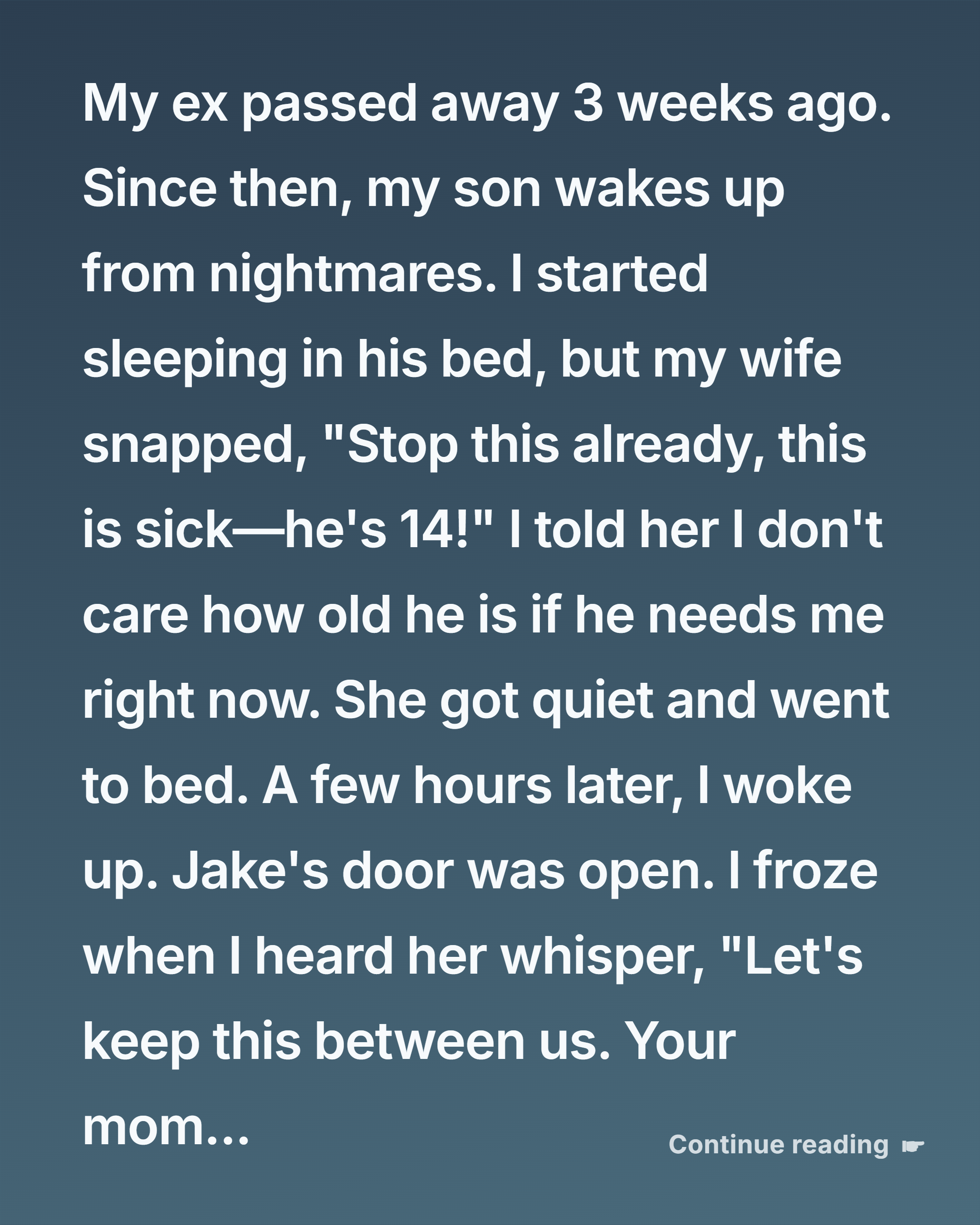
On the fifth night, she snapped. “This has to stop,” she said sharply when she saw me picking up my pillow. “This is sick—he’s fourteen.” She said it with such disgust that for a moment I actually wondered if I had somehow crossed a line simply by comforting my own son.
I told her I didn’t care if Jake was four or forty. He was my son, he had just lost his mother, and if sleeping on a floor beside him helped him survive the night, then I would sleep there every night for as long as he needed me. Sarah stared at me like I’d said something offensive, then went to bed without another word. A few hours later, something woke me.
The house was too quiet. Jake’s door was open. I heard Sarah’s voice. At first, I couldn’t make out the words, but there was something about her tone that made every instinct in me tense. It wasn’t comforting. It was low, controlled, almost rehearsed.
I walked closer, my heart pounding. She was sitting on Jake’s bed in the dark, holding his hand. Her voice was low and deliberate. I stopped just outside the doorway, unseen, listening.
“Let’s keep this between us,” she said. “Your mom wasn’t even around that much anyway. And now you’re making your dad choose.” There was a pause. I heard Jake sniffle, but he said nothing.
“You’re not six anymore,” she continued. “Men your age don’t act like this. You need to stop.” Her words seemed to hang in the darkness. Then she added something that made my stomach turn. “If you keep doing this, your dad is going to get tired of it. You don’t want him choosing you over his marriage, do you?”
I couldn’t move. For a few seconds, I just stood there, staring into the room, trying to process what I was hearing. This wasn’t tough love. This wasn’t someone trying to help a grieving teenager. She was making my son feel responsible for the future of our marriage.
Jake’s shoulders were hunched. He wasn’t crying—just staring at the wall like he was bracing for impact. His hand was still trapped beneath hers, and his face looked completely defeated. Something in me cracked. Sarah turned and saw me standing there.
Her face flashed with surprise, then annoyance. “I was helping him,” she said quickly. “You’re making it worse by coddling him. He needs to grow up.” She pulled her hand away from Jake as if she had suddenly remembered I was watching.
I told her—quietly, because Jake was right there—that she had no right. Not now. Not ever. I told her that grief wasn’t something she got to police, and she certainly wasn’t going to make my son feel guilty for loving the mother he had just lost.
She scoffed. “You’re being emotionally manipulated by a teenager. He’s playing it up for attention.” I looked at Jake, and the expression on his face told me everything. He wasn’t manipulating anyone. If anything, he had been trying desperately not to burden us.
That was it. I told her she was wrong. That grief doesn’t have an age limit. That there is no expiration date on missing your mother. That fourteen-year-old boys are allowed to cry, have nightmares, need comfort, and fall apart when someone they love dies. And most importantly, I told her that my son lost his mother and I would choose him every single time.
She crossed her arms and said, “Then you’re choosing him over our marriage.” The words came out like a threat, but by then, something inside me had gone strangely calm. I realized I had already made my choice long before she gave me the ultimatum.
She packed a bag that night and said she was going to stay with her sister “until this whole weird thing is over.” Before leaving, she stood by the front door and looked at me as though she expected me to stop her. I didn’t. She waited another few seconds, then walked out. The door clicked shut behind her, and for the first time in days, the house felt strangely peaceful.
After she left, I sat on Jake’s bed. He didn’t say anything. He just leaned into me like he used to when he was little, and I held him. After several minutes, he finally whispered, “Dad, am I the reason she left?”
My heart nearly broke.
I told him, “No. Absolutely not. Adults make their own choices. You didn’t do anything wrong.” He nodded, but I could feel him trembling against me. Then he whispered something else that I will never forget.
“I heard her talking about Mom before.”
I pulled back and looked at him.
“What do you mean?”
He hesitated before telling me that Sarah had made comments about his mother before the funeral. Small comments at first. Things about how his mom had been “dramatic,” how she “always needed attention,” how Jake should stop putting her on a pedestal now that she was gone. He had kept those things to himself because he was afraid telling me would make me angry.
I felt sick.
I asked him why he hadn’t told me sooner.
He looked down at his hands and said, “Because I thought you might leave too.”
That sentence hurt more than anything Sarah had said.
I realized then that my son hadn’t just been grieving his mother. He had been silently worrying that grief itself might cost him his father. Sarah hadn’t simply misunderstood what he needed. She had made him believe that loving his mother too much might make me abandon him.
The next morning, I called Sarah. She answered after several rings.
She expected me to ask when she was coming home.
Instead, I told her she didn’t need to come back.
There was silence on the other end.
She asked if I was serious.
I told her I had never been more serious about anything in my life.
She tried to explain. She said she had been frustrated, that she felt ignored, that she thought I was allowing Jake to become dependent on me in an unhealthy way. She said she had only been trying to “protect our marriage.”
I told her a marriage worth protecting would never require me to make my grieving child feel guilty for needing his father.
Then I ended the call.
And now, in the quiet aftermath, I’m realizing something I didn’t expect. I don’t miss her. I’m not sure I want her back. What surprises me most is how peaceful the house feels without the constant tension, as though everyone can finally breathe again.
Jake still has nightmares sometimes. He still wakes up looking frightened, and some mornings he barely speaks. But now, when he comes downstairs, he knows he won’t be judged for it. If he needs to talk about his mother, we talk about her. If he wants to look at old pictures, we look at them. If he needs to cry, I sit beside him. And if he needs me to sleep on the floor beside his bed, then that’s exactly where I’ll be.
Because anyone who sees a grieving child as competition isn’t someone I trust in my home—or in my son’s life.
And sometimes, losing someone you thought you needed is how you finally realize who you were never supposed to lose.