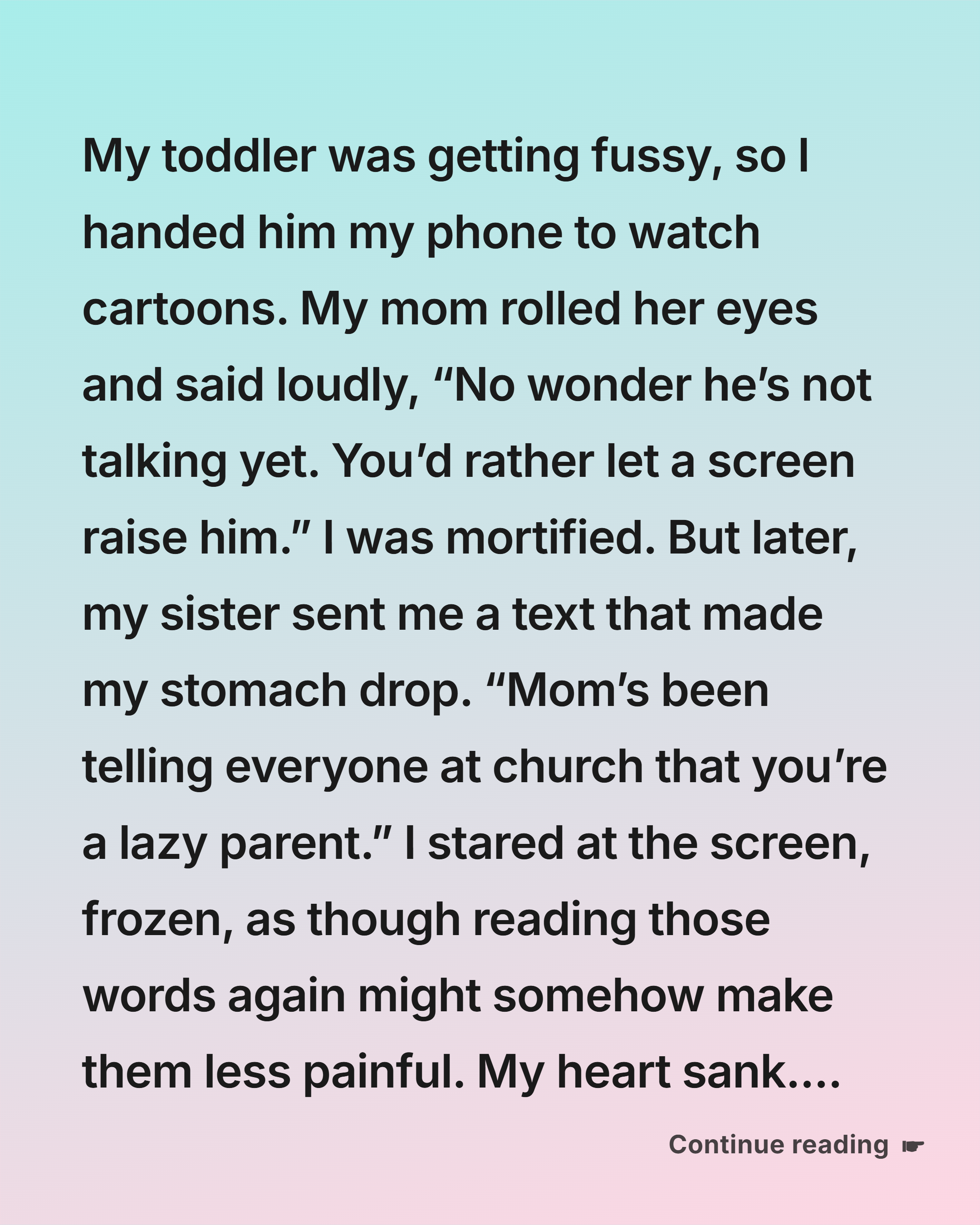
My toddler was getting fussy, so I handed him my phone to watch cartoons. My mom rolled her eyes and said loudly, “No wonder he’s not talking yet. You’d rather let a screen raise him.” I was mortified. But later, my sister sent me a text that made my stomach drop. “Mom’s been telling everyone at church that you’re a lazy parent.”
I stared at the screen, frozen, as though reading those words again might somehow make them less painful. My heart sank. It wasn’t just that my mom had criticized my parenting; it was the realization that she had been talking about me behind my back, turning my struggles into gossip for other people to discuss.
I had always known my mom could be harsh. She had a way of making even the smallest mistake feel like a personal failure. But knowing she was dragging my name through the mud among people who barely knew me was something else entirely. My eyes burned with tears, and my hands trembled as I set my phone down. I couldn’t understand how someone who was supposed to support me could make an already difficult season of my life feel even harder.
That night, I couldn’t sleep. My son, Micah, had finally fallen asleep after a long day of tantrums, teething, and the usual exhaustion that came with caring for a toddler. I lay in bed staring at the ceiling, replaying my mom’s words and questioning every decision I had made. Was I doing enough? Was I somehow holding my son back? I kept going over everything I might be doing wrong—or, more painfully, everything other people had decided I was doing wrong without knowing the first thing about my life.
What they didn’t see was that I had been raising Micah mostly on my own. My husband worked out of state for three weeks out of every month, leaving me to manage nearly everything at home. I had left my job to care for our baby, and although I loved being his mother, the isolation was real. Some days, getting dressed and brushing my teeth felt like accomplishments worth celebrating. There were mornings when I barely had time to finish a cup of coffee before Micah needed something else. Sometimes, putting a cartoon on my phone for a few minutes was the only way I could catch my breath.
The next morning, I made breakfast while Micah sat nearby, stacking blocks and knocking them over again. He was babbling to himself, making soft, jumbled sounds that didn’t quite resemble words, but he was trying. He was curious, engaged, and determined to communicate in his own way. I smiled at him, praised his efforts, and encouraged him to keep going. For a few minutes, I let myself enjoy the simple happiness of being his mom without questioning whether I was doing it well enough.
Then my mom called.
“I heard from Donna that Micah still isn’t saying real words,” she said before I could even finish saying hello. “You need to be stricter. More books, fewer screens. You spoil him, and then you wonder why he’s behind.”
I swallowed hard, trying to keep my voice steady. “I appreciate your advice, Mom, but I’m doing my best.”
“You need to do better than your best,” she snapped before hanging up, leaving me staring at my phone with a familiar heaviness in my chest. It was as though nothing I did could ever be enough for her. Even when I tried to defend myself calmly, she found a way to make me feel small.
For the rest of the day, I felt completely drained. Every time I looked at Micah, my mom’s words crept back into my mind. I watched him play, listened to his little babbles, and wondered whether I had missed something important. Was I failing him without realizing it? Was my reliance on cartoons hurting him? I hated that a few cruel comments had turned ordinary moments with my son into opportunities to doubt myself.
That night, I fell down an internet rabbit hole, reading every article I could find about toddler speech development, watching videos from speech therapists, and joining parenting forums where other mothers shared their worries. The more I read, the more I realized that children develop at different rates, but I also knew I didn’t want to dismiss a concern simply because I was afraid of being judged. I scheduled a speech evaluation for Micah. Not because my mom had shamed me into it, but because I loved my son and wanted to make sure he was getting whatever support he needed.
Two weeks later, we sat in a small, welcoming room with a warm, patient therapist named Clara. She encouraged Micah to play, showed him picture cards, and gently invited him to imitate different sounds. I watched closely, my nerves making every little movement feel significant. Part of me worried that Clara would confirm all the fears my mom had planted in my mind. Another part desperately hoped she would tell me there was nothing to be afraid of. I wanted answers, but I also wanted someone to look at my child without immediately seeing something wrong with him.
When the evaluation was over, Clara smiled kindly at me. She explained that Micah’s expressive language was developing on the later side, but based on what she had observed, there were encouraging signs. He was curious, engaged, and affectionate, and she wasn’t suggesting that I should panic. She also explained that children develop at different rates and that the best next steps depended on his individual needs. Then she looked directly at me and said, “You’re doing fine. Keep encouraging him, talking with him, and giving him opportunities to communicate. You’re already taking a positive step by seeking guidance.”
For the first time in weeks, I felt as though I could breathe again. I hadn’t imagined my worries, and I hadn’t failed my son simply because I was concerned about his development. I had done what a parent was supposed to do: pay attention, ask questions, and seek help when something felt uncertain. Walking out of that appointment, I felt lighter than I had in a long time.
But the moment I got home, I saw three missed calls from my mom and a voicemail waiting on my phone. I hesitated before pressing play, already bracing myself for another lecture. Her voice filled the room, sharp and disapproving as ever. “I hope you’re not ignoring me out of guilt. I just want Micah to have the best start in life. Not everyone can afford to be so soft.” I stood there listening, feeling the relief from my appointment slowly give way to frustration. Even after I had taken steps to address my concerns, she still found a way to make me feel as though I wasn’t doing enough.
I didn’t call her back.
That night, I opened my Notes app and began writing everything I had been holding inside. I wrote about the exhaustion, the loneliness, the constant second-guessing, and the way her comments followed me long after our conversations ended. I wrote about how painful it was to hear that she had been calling me lazy behind my back. I wrote about all the times I had wanted encouragement but received criticism instead. I wasn’t planning to send the words to her or post them anywhere. I simply needed somewhere to put all the feelings I had been carrying around, because keeping them bottled up was beginning to hurt more than admitting they existed.
When I finished, I stared at the screen for a long time. Reading my own words, I realized something I hadn’t fully understood before: I didn’t have to keep proving myself to people who had already decided they knew better than I did. I could love my mother without accepting every judgment she made about me. I could listen to advice without allowing it to become a verdict on my worth as a parent. Most importantly, I could stop treating her approval as the final measure of whether I was doing a good job.
A few days later, my sister came over. She brought coffee and pastries, offering them almost like a peace offering. She seemed unsure how to begin the conversation, glancing at me before looking down at her cup. Finally, she said, “Mom’s always been like that, but I think this time she crossed a line.”
“She crossed several,” I replied, letting out a tired laugh that held more frustration than humor. I was relieved that someone else could see it, although I wished it hadn’t taken things getting this bad for someone to acknowledge it.
We sat in silence for a while, watching Micah giggle as he chased a toy car across the floor. He stumbled, caught himself, and immediately started laughing again, completely absorbed in his little world. He was bright. He was joyful. And he was mine. Watching him reminded me that my life wasn’t the disaster my mom’s comments had made it feel like. We were learning together, one ordinary, imperfect day at a time.
“You know,” my sister said slowly, “she always hated when we cried in public. Remember? She used to yank us by the arm and whisper, ‘Stop embarrassing me.’ Maybe that’s why she’s so quick to criticize you now. She doesn’t want anyone thinking our family is messy.”
I thought about that for a moment, remembering how often we had been expected to hide our feelings whenever they threatened to inconvenience her. Perhaps she had learned to see appearances as more important than honesty. Perhaps she was repeating what she had been taught, mistaking criticism for discipline and control for care. Whatever the reason, understanding where her behavior came from didn’t make it any less painful.
“Well,” I said, taking a sip of my coffee, “families *are* messy. Pretending otherwise doesn’t help anyone.” My sister nodded, and for the first time in a long while, I felt as though we were talking about something real instead of carefully avoiding the truth.
We didn’t fix everything that day, but it was the beginning of something better. I started setting firmer boundaries with my mom. I stopped feeling obligated to answer every call the moment it came in, and I no longer sent her daily updates about Micah just to reassure her that I was doing enough. When she made snide remarks, I began responding with calm, clear statements such as, “That doesn’t help,” or “Micah and I are fine.” I didn’t argue endlessly or try to convince her that my decisions were reasonable. I simply made it clear that I wasn’t going to participate in conversations that left me feeling ashamed of myself.
And the more I pulled back, the more I began to recognize how much power her criticism had held over me. It wasn’t only what she said; it was how desperately I had wanted her to approve of me. I had spent years trying to anticipate her disappointment and avoid giving her anything to criticize. Now, I was learning that I could make thoughtful decisions, accept that I wasn’t perfect, and still trust myself. I didn’t need her permission to be a good mother.
Three months later, Micah said his first clear word: “Ball.” It happened during an ordinary moment at home, when he was playing with one of his favorite toys. I heard the word, looked at him in surprise, and then watched his little face light up as he repeated it. I grabbed my phone and recorded him, laughing and crying at the same time. It was such a small word, just four letters, but to me it felt enormous. It was a moment I had worried about, hoped for, and imagined so many times that hearing it aloud left me almost unable to speak.
My first instinct was to send the video to my mom. For a moment, I pictured her reaction, imagined her finally acknowledging how much I had worried and how hard I had worked. I wanted her to share my happiness, and some part of me still wanted to hear her say that I had done a good job. But I paused, looked at the video again, and realized I didn’t have to offer her every precious moment of my life in the hope that she might finally understand me. So I didn’t send it to her.
Instead, I sent it to Clara, the speech therapist who had reassured me when I needed it most. I sent it to my sister, who responded with a flood of excited messages and more celebration than I could have asked for. I sent it to my husband, who called immediately, his voice thick with emotion as he listened to Micah say the word again. He was thrilled, and hearing his happiness made the moment feel even more special. For once, I wasn’t thinking about what my mom might say or whether someone would find a reason to criticize me.
And then I simply sat there, watching the video on repeat. I listened to Micah’s little voice, watched the pride on his face, and let myself enjoy the moment without turning it into proof of anything. He didn’t have to reach a milestone to make me a good mother, and I didn’t need anyone else to validate the love I had poured into raising him. But I was allowed to celebrate every new step, and that day, I celebrated with my whole heart.
A few days later, my mom showed up unannounced. I was home with Micah when I heard the knock at the door, and I felt a familiar tension rise in my shoulders. Part of me wondered whether she had come to apologize. Another part braced itself for another lecture disguised as concern. When I opened the door, she stood there with an expression that gave little away.
“I thought I’d stop by,” she said, as though nothing had happened between us.
Before I could respond, Micah ran toward the door, clutching his ball. He looked up at her with a bright smile and shouted, “Ball!” My mom’s eyes widened. For a moment, she seemed genuinely surprised, and I watched her take in the little boy she had spent so much time worrying about—and criticizing me over.
I smiled and said, “He says that all the time now.” I didn’t say it to prove her wrong or to remind her of everything she had said. I simply shared the truth. Micah was growing, learning, and finding his voice in his own time, and we were enjoying every step along the way.
She stepped inside and looked around the living room. The place wasn’t spotless. There were toys scattered across the floor, dishes waiting in the sink, and evidence of an ordinary day with a toddler everywhere she turned. But the house was warm, lived in, and full of love. I wondered whether she would notice the mess first, as she might have in the past, or whether she would finally see the life unfolding around it. For once, I didn’t rush to tidy anything up or apologize for the state of the house.
She sat down awkwardly, resting her hands in her lap. For a while, neither of us said much. Then she looked at me and said, “You know\… I just want what’s best for him.”
“I know,” I replied gently. “But sometimes it doesn’t feel like that.” My voice was calm, although the words carried the weight of months of hurt. I wasn’t trying to start an argument. I wanted her to understand that good intentions didn’t erase the damage her words had caused.
She looked at me, then lowered her eyes to her hands. The silence stretched between us, and for a moment, I wondered whether she would become defensive or find another way to blame me. Instead, she said quietly, “I didn’t know how to do this differently.”
I nodded. “Neither did I, at first. But I’m learning.” I meant it. I was learning to trust myself, to ask for help when I needed it, and to recognize that parenting wasn’t a performance for other people to judge. Perhaps my mom had things to learn, too. I couldn’t do that work for her, but I could give her room to try as long as she respected the boundaries I had set.
That was the first honest conversation we’d had in years. It wasn’t a dramatic apology, and it didn’t undo the hurt she had caused. There were still things we hadn’t discussed, and I knew one conversation couldn’t change a lifetime of habits. But for the first time, we were speaking honestly instead of hiding behind criticism, excuses, or the need to appear perfect. It was a small beginning, but it felt real.
Over the next few months, something shifted between us. My mom didn’t transform into a perfect grandmother overnight, and there were still moments when her old habits threatened to return. But she began trying more often. She started asking questions instead of issuing instructions, and she occasionally caught herself before making a judgmental remark. I met her halfway when it made sense, allowing her to be part of Micah’s life without giving up my right to make decisions for him. Our relationship wasn’t suddenly perfect, but it was becoming more honest, and that mattered.
More importantly, I started trusting myself. I stopped measuring my worth by how smoothly each day went or how many people approved of my choices. I learned that some days would be full of laughter, while others would involve tears, unfinished chores, and moments when I needed a little help getting through the afternoon. None of those things made me a failure. They made me a human being raising a small human being, and I finally began giving myself the same patience I was trying to give my son.
I joined a local mom group, not online but in real life. We met every Thursday at the park, bringing snacks, toys, strollers, and whatever else we needed to get through an afternoon with our children. Some days were chaotic, with crackers flying across the grass, juice spilling onto clothes, and tantrums erupting just when someone thought the afternoon was going smoothly. But we talked. We laughed. We shared stories about sleepless nights, difficult mornings, and the small victories that nobody else seemed to understand. For the first time in a long while, I felt connected to other women who knew that motherhood could be beautiful and exhausting in the very same moment.
One afternoon, I was sitting on the grass while Micah toddled around with a juice box when a new mom joined us. She had dark circles beneath her eyes and a newborn resting against her chest. She looked exhausted in a way I recognized immediately, as though she had been carrying more than she knew how to explain. We made small talk for a while, but eventually she looked down at her baby and muttered, “I’m probably doing everything wrong.”
I recognized that voice because I had heard it in my own head so many times. I turned toward her and smiled. “Every mom feels that way sometimes. But you’re showing up, and you’re trying. That matters more than you realize.” I didn’t offer her a lecture or a list of things she should be doing differently. I simply wanted her to know that she wasn’t alone and that she didn’t have to be perfect to be a good mother.
She nodded slowly, and her eyes filled with tears. She blinked them away, almost as if she were embarrassed to let anyone see them. “Thanks,” she whispered. “No one’s said that to me before.” Her words stayed with me long after we left the park. I knew how much a little kindness could mean when someone was already struggling to believe in herself. Sometimes, what a mother needs most isn’t another opinion about what she’s doing wrong. It’s someone willing to remind her that she’s doing something that matters.
Later that night, as I rocked Micah to sleep, I thought about everything that had happened since that awful day when my mom criticized me in front of everyone. I remembered the shame I had felt, the sleepless nights, the endless searching for answers, and the way I had slowly learned to stop treating every criticism as proof that I was failing. It had been a difficult journey, but it had changed me in ways I hadn’t expected. I was no longer the same mother who had sat frozen in humiliation, wondering whether someone else’s cruel opinion could define her.
Micah was speaking more now. He wasn’t forming full sentences yet, but his vocabulary was growing, and each new word felt like a little window opening into his world. He could point to a dog and say, “Doggy!” He could say “Mama” and mean it, looking straight at me with a smile that made my heart ache with happiness. He could even sing part of the alphabet song, stringing together a few familiar sounds with the kind of enthusiasm only a toddler could manage. I celebrated every new attempt, every sound, and every moment he tried to tell me something.
And I hadn’t gotten there by being a perfect mother. I had gotten there by being consistent, present, and patient. I had sought professional guidance when I had concerns, encouraged my son as he learned, and kept showing up even on the days when I felt completely overwhelmed. I had made mistakes, just as every parent does, but I had also learned to recognize that making a mistake wasn’t the same as failing my child. I could keep learning without living in a constant state of shame.
The judgment, the gossip, and the unsolicited advice never completely disappeared. There were still people who seemed to have an opinion about every parenting decision, from how much screen time a child should have to what a mother ought to be doing with her day. But something inside me had changed. My confidence had grown louder than the criticism, and I no longer felt compelled to defend every choice or explain every difficult day. I could listen when someone offered genuinely helpful advice and let the rest pass without allowing it to take root in my mind.
Then one day, I received a message from a woman in our community, someone I barely knew. I almost ignored it, assuming it was another bit of neighborhood gossip or an unsolicited opinion. But when I opened it, I found a message I hadn’t expected. She wrote, *“I used to think you were just letting the phone raise your kid. But I’ve been watching, and I see how much you do for him. You’re a good mom. I’m sorry for assuming.”* I read it once, then again, letting the words sink in.
I stared at the message for a long time. There was something bittersweet about receiving an apology from someone who had judged me without knowing my circumstances. I appreciated her honesty, but I also thought about how easily people could turn a brief glimpse of someone else’s life into a complete story in their minds. She had seen me hand my toddler a phone and assumed she understood my parenting. She hadn’t seen the sleepless nights, the constant care, the worry, or the effort I put into helping my son grow.
Because it wasn’t just about me. It was about how quickly we judge one another without knowing the whole story. We see a mother give her child a screen, lose patience in public, or arrive somewhere with messy hair and a tired expression, and we imagine we know what kind of parent she is. We don’t see what happened before that moment or what she might be carrying after it. We don’t know whether she’s exhausted, overwhelmed, struggling without support, or simply making a choice that works for her family. A few seconds of observation can never tell us everything about another person’s life.
The message also made me think about my own behavior. I remembered times when I had rolled my eyes at mothers who posted pictures of messy houses or let their children wear costumes to the grocery store. I had sometimes assumed that other parents were being careless or indulgent without stopping to consider what their days might look like. It was uncomfortable to admit, but I had done my share of judging, too. I had expected others to give me the understanding I hadn’t always been willing to extend to them.
Now, I saw things differently. I understood that compassion wasn’t something we should offer only after learning someone’s struggles. It was something we could choose before knowing the details. I couldn’t control what people assumed about me, but I could decide not to make the same mistake with someone else. And if my experience had taught me anything, it was that a little kindness could reach someone at exactly the moment they needed it most.
At Micah’s third birthday party, we filled the backyard with balloons, bubbles, and a generous pile of cupcakes. My mom was there, quieter than usual but present, and she seemed more interested in enjoying her grandson than commenting on how everything was being done. My sister helped set up, while our little group of mom friends filled the backyard with laughter, stories, and the cheerful chaos that comes with a gathering of young children. It wasn’t a picture-perfect celebration, but it was ours, and that made it special.
Micah, covered in frosting and beaming with excitement, came running toward me. He wrapped his little arms around my legs and shouted, “Mama! Happy!” I scooped him up, hugged him tightly, and kissed his frosting-covered cheek. “Me too, baby,” I whispered. And I meant it. I was happy not because everything in my life had become perfect, but because I had learned to appreciate the imperfect life I was building with my son. I had people who supported me, a child who filled my days with joy, and a growing belief that I could trust myself even when someone else disagreed.
Looking back, I’m grateful for the difficult parts, even though I wouldn’t wish that kind of hurt on anyone. Those experiences taught me how to advocate for my child and stand up for myself. They forced me to examine the way I responded to criticism, recognize the importance of boundaries, and stop chasing approval from people who weren’t willing to understand me. I learned that being a good mother didn’t mean getting everything right. It meant being willing to learn, seek help, and keep showing up for my child, even when the world seemed determined to tell me I wasn’t enough.
It’s easy to judge a mother in the grocery store who hands her child a tablet to keep him occupied. It’s easy to assume she’s lazy, distracted, or unwilling to put in the effort. But it’s much harder—and far more meaningful—to sit beside her and ask how she’s really doing. It’s harder to offer help without criticism, listen without immediately giving advice, and recognize that the moment we’re witnessing might be only a tiny piece of a much bigger story. Sometimes, the person we are tempted to judge is simply a parent doing whatever she can to get through the day.
So, if you’re reading this while feeling as though you’re failing, take a breath. You are not alone, and one difficult day doesn’t define the kind of parent you are. If your toddler is taking longer to talk, if your house is a mess, or if your own mother is making you feel as though you’ll never be enough, please remember that you don’t have to meet someone else’s expectations to deserve compassion. Every child develops differently, and when you have concerns, seeking appropriate professional guidance is an act of love, not an admission of failure. You can learn, adjust, and ask for help without questioning your worth.
You don’t have to prove anything to people who refuse to see your effort, and you don’t have to accept every criticism simply because it comes from someone you love. You can set boundaries, protect your peace, and make decisions based on what you believe is best for your child. You can be exhausted and still be loving, overwhelmed and still be attentive, uncertain and still be a good mother. Most of all, you can give yourself permission to be human while raising a child who is still learning how to navigate the world.
You just keep showing up, loving your child, learning along the way, and reaching out for support when you need it.
That’s what matters.