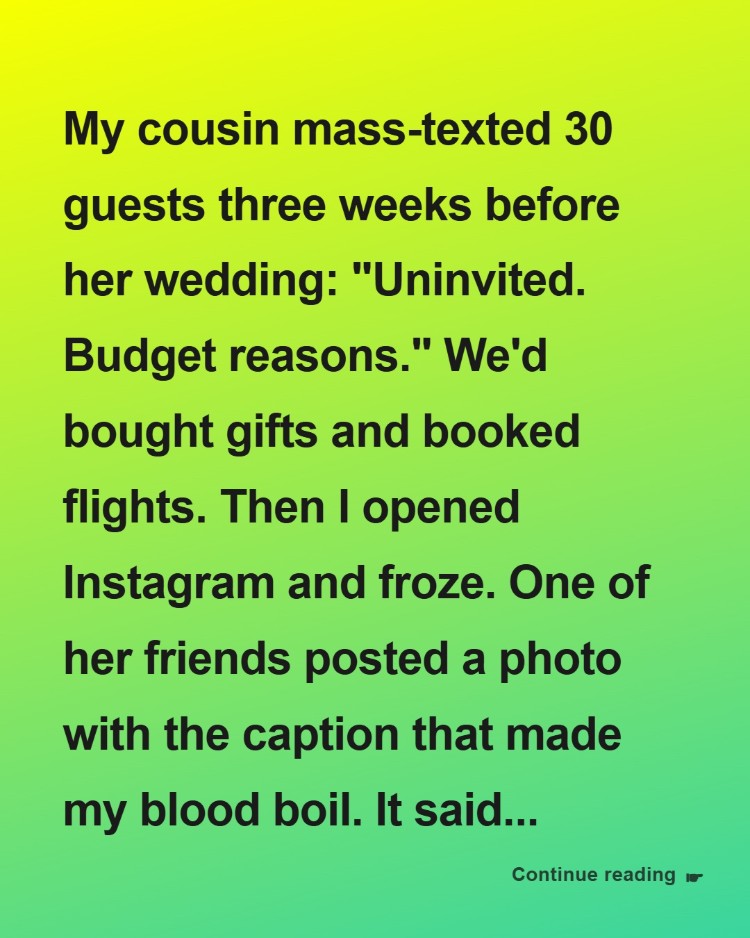
The text from my cousin Jessica was cold. A wall of words to thirty different people. “Due to unforeseen budget cuts, we have to shrink our guest list.
We are so, so sorry.” Sorry. My mom was out a $700 plane ticket. My uncle had already sent a thousand-dollar check.
We were all hurt, but mostly just confused. Jessica’s fiancé, Mark, came from money. Big money.
“Budget cuts” made no sense. Two weeks went by in a weird silence. No calls.
No other texts. I was on the couch, just scrolling through Instagram, trying to make my brain shut up. That’s when I saw it.
A post from Stacy, Jessica’s maid of honor. It was a picture of a new invitation. Sleek, black, gold font.
Nothing like the flowery one we got. Stacy’s caption was bubbly: “So PROUD of my girl for reaching Diamond Level! Your Wealth Wedding is going to be an inspiration to us all!
Can’t wait to celebrate and network! #LevelUp”
I zoomed in on the picture. Underneath a smiling photo of Jessica and Mark were three columns.
Bronze Partner: $500 Entry. Silver Partner: $2,000 Entry. Diamond Partner: $10,000 Entry.
My blood went cold. I stared at the screen so long that my phone eventually dimmed.
This wasn’t a wedding. It was a conference.
At the bottom of the invitation, in tiny letters, was a disclaimer. “Attendance confirms your buy-in to the Infinity Lifestyles starter package at your chosen Partner Level.”
My hands were shaking as I took a screenshot. I sent it to the family group chat we’d created after the mass un-invitation, a chat titled “What the Heck, Jessica?” The responses came in a flood.
My Aunt Carol was the first. “Is this a joke?”
My Uncle Robert, the one who sent the thousand-dollar check, was less delicate. “They’re charging people to come to their wedding?
What is Infinity Lifestyles?”
I didn’t know, but I was about to find out. A quick search sent me down a rabbit hole. Infinity Lifestyles was a multi-level marketing company.
It promised financial freedom through selling overpriced “wellness” products and, more importantly, recruiting others to do the same. The internet was littered with horror stories. People who had lost their homes, their life savings, their friends.
It was all there, hidden behind a glossy veneer of “empowerment” and “being your own boss.” Jessica hadn’t just uninvited us. She had disqualified us. We weren’t potential customers or recruits.
We were just family. We didn’t have an entry fee. My mom called me, her voice trembling.
“I don’t understand. Is this Mark’s doing? This doesn’t sound like Jessica.” But it did, a little.
Jessica had always been chasing something. A better job, a fancier car, a bigger apartment. She always seemed to believe that happiness was something you could buy if you just found the right price tag.
Mark had amplified that. He was slick, always dressed in designer clothes, talking about investments and portfolios. He’d once told my dad that a nine-to-five job was “a cage for people with no imagination.” Now it all made sense.
They weren’t just a couple; they were a “power couple,” a brand. And we, the normal, budget-conscious, non-investor family, didn’t fit their brand. The anger came next, hot and sharp.
Uncle Robert tried calling Mark’s parents, people he’d met a few times and seemed perfectly pleasant. He left a message asking about his “wedding gift” and if it could be reallocated to a “Silver Partner” ticket. He was being sarcastic, of course, but he never got a call back.
The check was cashed the next day. That was the last straw for him. For all of us.
This wasn’t just a tacky, greedy wedding plan. This was theft, wrapped in a betrayal. We had a family video call that night.
Thirty faces, all hurt and confused, stared back at me from the screen. Some wanted to crash the wedding. Others wanted to plaster the screenshot of the ticket prices all over Jessica’s social media.
There was a lot of yelling. I just listened, my mind racing. A public shaming would be satisfying for a moment, but it would just create more family drama.
It wouldn’t solve the real problem. It wouldn’t help Jessica, who, despite everything, was still my cousin. She was in deep, and I had a sickening feeling that she was more of a victim than a villain in this.
“Wait,” I said, cutting through the noise. “Everyone just stop for a second.” The faces on the screen turned to me. “What if this is bigger than just Mark?” I asked.
“What if his whole family is involved?”
That question changed everything. Until that moment, we had been looking at Jessica and Mark as two greedy people making an unbelievably bad decision.
But what if they weren’t the ones who had invented the scheme?
What if they had simply been the newest pieces on a much larger chessboard?
That’s when I started digging again, but this time, I wasn’t just looking at the MLM. I was looking at Mark’s family. His father, Arthur Vance, was a prominent figure in the city, known for his philanthropy.
He was on the board of charities and hospitals. His name was on buildings. His photographs appeared in newspapers beside politicians, celebrities, and CEOs. He was the kind of man people described as a “pillar of the community.”
But as I went further back, I found it.
An old article from a small business journal from twenty years ago. Arthur Vance was the founder of a company called “Vantage Marketing Group.”
It was the parent company of Infinity Lifestyles. It wasn’t just Mark’s little side hustle.
It was the family business. The entire fortune was built on this pyramid. Their philanthropy, their reputation, it was all funded by people like the ones I read about in those forums—people who had lost everything.
I sat there staring at my laptop, suddenly aware that the room around me had gone completely quiet.
The “Wealth Wedding” wasn’t just a recruitment event. It was a coronation. Mark was being officially welcomed into the family empire, and Jessica was his queen.
They weren’t just getting married; they were merging assets. I presented my findings to the family. The yelling stopped.
The anger was replaced by a cold, quiet resolve. This was a whole different level of deception. “So what do we do?” my mom asked, her voice barely a whisper.
“We can’t let them get away with this.”
Uncle Robert, a man who ran his own successful construction company, knew people. He didn’t know billionaires, but he knew people who held them accountable. “I know a journalist,” he said, his voice grim.
“An investigative reporter. A real one. The kind that brings people down.”
That was our new plan.
We weren’t going to crash the wedding. We were going to dismantle the stage it was built on. Over the next few weeks, we worked in secret.
We gathered everything. The original flowery invitation. The screenshot of the “Partner Level” invitation.
Uncle Robert’s bank statement showing the cashed check. My mom’s non-refundable flight confirmation. I found more people online, former Infinity Lifestyles members, and encouraged them to speak to the reporter, David.
We gave him a trove of evidence. He was floored. He told us this was the break he’d been looking for.
He’d heard whispers about Vantage Marketing Group for years but could never find a way in. We had just handed him the key. But before he published anything, David warned us that one mistake could destroy the investigation.
“If they find out what you’re doing,” he told us, “they’ll have time to bury the evidence.”
That sentence stayed with me.
For the first time, I wasn’t angry anymore.
I was afraid.
We stopped talking about the investigation in writing. We avoided names. We stopped forwarding screenshots. Every piece of evidence was backed up in multiple places.
And then, three days before the wedding, something happened that made my stomach drop.
Jessica called me.
I almost didn’t answer.
When I finally did, there was silence on the other end.
“Are you there?” I asked.
“Yes,” she whispered.
She sounded nothing like the confident woman from Instagram.
“Can you come see me?”
I hesitated. “Why?”
Another long silence.
Then she said, “Because I think I made a mistake.”
Before I could ask what she meant, the line went dead.
I immediately called her back.
No answer.
I called again.
Straight to voicemail.
I told David what happened. His response was immediate.
“Don’t tell her anything,” he said. “And don’t go alone.”
But there was no time. Jessica had vanished from social media that same night. Stacy stopped posting. Even Mark’s accounts went strangely quiet.
For forty-eight hours, we heard nothing.
Then the wedding day arrived.
It was a beautiful, sunny Saturday. On Instagram, Stacy was posting a storm of pictures from the lavish venue. Champagne towers, ice sculptures, a string quartet.
Jessica looked stunning in her dress, but her smile seemed tight, practiced. Mark was glued to her side, his arm possessively around her waist. The thirty of us who were uninvited gathered at my mom’s house.
We didn’t have champagne, just coffee and tea. We weren’t dressed in gowns and tuxedos, just our regular clothes. We ordered a few pizzas and sat around the living room, a strange mix of nervous and determined.
It felt like a wake. We were mourning the cousin, the niece, the family member we thought we knew. We were mourning the idea of a family that was supposed to be about love, not levels of investment.
At exactly 6 p.m., just as the reception was starting, Uncle Robert’s phone buzzed. It was a link from David. The headline was explosive: “The Pyramid at the Altar: How a City’s Most Prominent Family Built an Empire of Deception.”
For several seconds, nobody spoke.
Uncle Robert opened the article.
Then he looked up at us.
“It’s live.”
The article was a masterpiece.
It started with the wedding, our story. The two invitations, side by side. It laid out the whole scheme, connecting the dots from the “Wealth Wedding” all the way up to Arthur Vance and his philanthropic facade.
It featured anonymous, heartbreaking stories from people who had lost their life savings to Infinity Lifestyles. Our family’s story was the hook, the relatable, infuriating entry point into a much darker world. We sat in silence, reading it on our phones.
It was all there. Our pain, our confusion, validated and broadcast for the world to see. We imagined the scene at the wedding.
The phones of the “Diamond Partners” and “Silver Partners” would be buzzing. The whispers would start. The carefully curated “networking” event would curdle into a festival of panic.
The brand they were all there to celebrate was being systematically destroyed in real time. The wealth they were idolizing was being exposed as a sham. The first call came an hour later.
It was Jessica, and she was hysterical. “How could you?” she screamed at me through the phone. “You ruined my wedding!
You ruined my life!”
I stepped out onto the porch, the cool evening air a relief. “Your wedding?” I said, my voice calm, all the anger gone, replaced by a deep, hollow sadness. “Jessica, you were selling tickets to your own family.
You traded us for a ‘Diamond Level.’ This was never about a wedding.”
“You don’t understand!” she sobbed. “This was our future! Everything we worked for!”
“What did you work for, Jess?” I asked gently.
“A future built on my uncle’s thousand dollars? On the life savings of strangers you call ‘downlines’? We did this because we love you.
You are caught in something terrible, and we couldn’t just stand by and watch.”
There was a long silence.
Then Jessica whispered something that I almost didn’t hear.
“He told me you were going to destroy us.”
“Who?”
She didn’t answer.
“Jessica, who told you that?”
I heard a sharp breath on the other end.
Then the call ended.
I stood frozen on the porch, staring at the dark screen.
For the first time, I understood that the investigation hadn’t just exposed what Jessica had done.
It had exposed what someone had been willing to do to keep her obedient.
She hung up on me. The fallout was swift and brutal. The article went viral.
Other news outlets picked it up. A federal investigation was launched into Vantage Marketing Group and its subsidiaries. Arthur Vance’s name was quietly removed from charity boards.
The assets of the company, and the family, were frozen. The “Wealth Wedding” became a national punchline, a symbol of greed and deception. The “partners” who had paid thousands to attend were now desperately trying to distance themselves from the scandal, claiming they were victims too.
We learned through the grapevine that Mark’s family had turned on Jessica almost immediately. They blamed her, her “common” family, for bringing this scrutiny upon them. Mark, the golden boy, chose his father’s side without a second’s hesitation.
He filed for an annulment before the week was out. But there was something else.
David called me one evening and told me that investigators had discovered internal communications suggesting Jessica had been under enormous pressure to recruit relatives before the wedding.
The “guest list” had never really been a guest list.
It had been a target list.
Our names were apparently categorized according to how much money they believed we could bring into the organization.
My mother was marked as a “high-emotion prospect.”
Uncle Robert was labeled a “high-value prospect.”
And I was listed simply as “potential recruiter.”
I read those words three times.
Then I closed my laptop.
I had spent weeks wondering why Jessica had chosen money over family.
Now I realized that, somewhere along the way, the organization had taught her to stop seeing us as family at all.
The next few months were a blur of legal proceedings. Uncle Robert and several other family members joined a class-action lawsuit.
Thanks to our initial evidence, the case was strong. They eventually got their money back, and so did thousands of other people. The Vantage empire crumbled.
We heard nothing from Jessica. She disappeared completely. Her social media was deleted.
Her phone number was disconnected. My mom left her voicemails for weeks, full of love and worry, but they were never returned. Then, about a year after the wedding that never really was, a letter arrived at my mom’s house.
It was addressed to all of us. The handwriting was Jessica’s. It wasn’t an apology, not at first.
It was an explanation. She wrote about how lost she had felt, how seductive Mark’s world of endless ambition and easy money had been. She admitted she had been brainwashed, convinced that love and success were things you had to earn, things with a price tag.
She had been so desperate to “level up” that she had forgotten what it meant to just be. “I didn’t see you as family,” she wrote, the ink slightly smeared in places. “I saw you as people who didn’t ‘get it.’ I was told that anyone who questioned the path was a ‘dream stealer.’ It was only when I was left with nothing—no Mark, no money, no ‘partners’—that I realized my real dreams were the ones I had thrown away.
The ones that didn’t cost a thing.”
She was working as a waitress in a small town a few states away. She was slowly paying off the debts she had accumulated. She said she didn’t expect forgiveness, but she wanted us to know she was sorry.
Truly sorry. My mom cried as she read the letter aloud. They were not tears of sadness, but of relief.
The cousin we had lost was still in there somewhere, finding her way back. It wasn’t a fairy-tale ending. There was no big, tearful reunion right away.
Healing takes time. But the door was open. The lines of communication were restored, not with a text, but with honest, heartfelt words on a piece of paper.
I looked around at my family, gathered once more in my mom’s living room. We weren’t Diamond Level. We were just a messy, complicated, and imperfect family.
And I realized that true wealth is not measured in partner levels or entry fees. It’s measured in the people who will gather in a living room and order pizza for you when your world falls apart. It’s the richness of a bond that can’t be bought or sold, a support system that comes with no disclaimer in the fine print.
It’s the priceless investment of unconditional love.