HR departments should be the heart of a company, protecting both employees and the business itself. But when they prioritize exploitation over compassion, they become the company’s greatest liability. True workplace empathy means respecting boundaries, not disguising unpaid labor as “team bonding.” When leadership punishes employees for refusing to be exploited, they create a toxic culture where fear replaces trust—and sometimes the only thing powerful enough to expose it is a firm stand backed by an undeniable paper trail. Hey Bright Side,
I finally stopped playing their game, and the results changed my life forever.
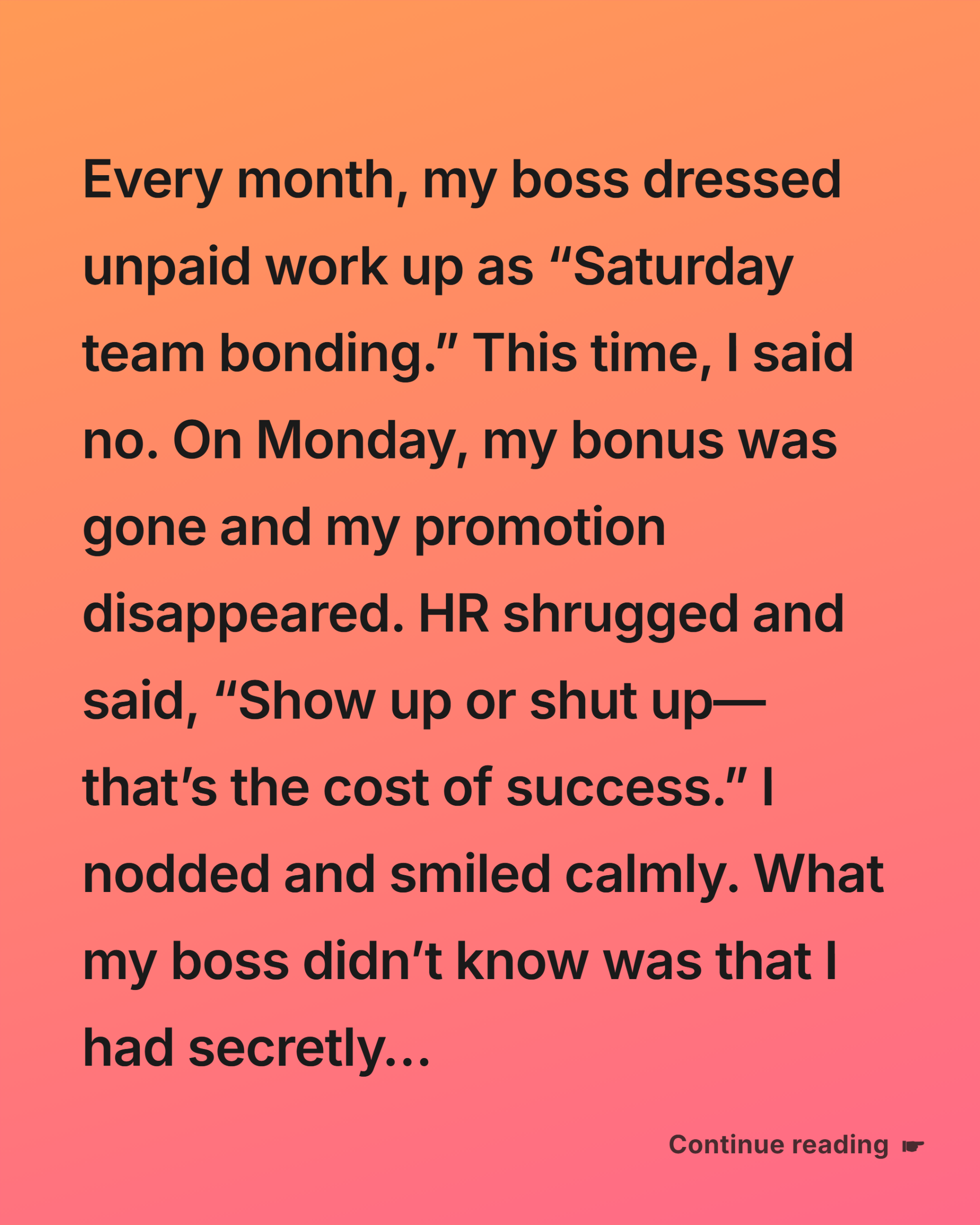
For the last year, my boss had been disguising mandatory unpaid work as “Saturday bonding.” It always followed the same predictable script. We’d receive cheerful messages about a “quick” client call, a “short” brainstorming session, or a “casual” deadline that somehow consumed the entire weekend. Saying no was never presented as an option, even if no one dared admit it aloud. Every Saturday I watched my personal life disappear while management smiled and called it company culture. This time, though, something inside me finally snapped. I already had family plans that meant too much to cancel, so I refused to log on.
When I walked into the office on Monday morning, the atmosphere felt strangely quiet. My boss called me into his office before I had even finished my coffee. Without hesitation, he informed me that my quarterly bonus had been revoked and that the promotion I’d spent months working toward had suddenly “gone in another direction.” The message was crystal clear: refusing unpaid work came with a price. I went straight to HR to report what had happened, hoping someone would recognize the retaliation for what it was. Instead, they barely looked up from their desks before one of them sneered, “Show up or shut up. That’s the price of being promoted here.”
I didn’t argue.
I simply nodded, thanked them for their time, and walked away with a calm smile that completely hid what I was thinking. They mistook my silence for surrender. What they didn’t know was that, for the previous six months, I had quietly become what I called a “silent archivist.” Every email. Every text message. Every calendar invitation labeled “bonding.” Every after-hours request disguised as voluntary participation. I had carefully preserved every piece of evidence proving that these weekends were not optional social events—they were mandatory work performed without pay. I had timestamps, attendance lists, meeting recordings, and detailed notes documenting every stolen hour.
Instead of confronting them again, I carried that digital mountain of evidence to an employment lawyer. They examined everything, smiled, and immediately knew what they were looking at. Within weeks, they filed a comprehensive unpaid wage claim supported by months of documentation. Suddenly, the company that had laughed off my complaint wasn’t laughing anymore. Executives who had ignored me were scrambling through internal emails, outside investigators became involved, and urgent meetings filled everyone’s calendars. The company eventually agreed to settle for $95,000, covering unpaid wages, damages, legal fees, and additional compensation rather than risk a far more public legal battle.
The consequences spread much farther than I ever expected. My boss was terminated almost immediately after the investigation concluded, and the entire HR department was replaced once leadership realized just how much legal exposure their negligence had created. Meanwhile, I accepted an offer from one of the company’s competitors—a place where work-life balance wasn’t just a slogan on the wall but an actual company value. Looking back, I sometimes wonder whether everything had to unfold this way. So, Bright Side, did I go too far by exposing the people responsible and watching an entire department lose their jobs, or was this truly the only path left to justice after every internal door had been slammed in my face?
I’d love some advice on how to move past the guilt of being labeled the “whistleblower.”
Best,
Andrew
Wage theft remains one of the largest forms of corporate misconduct in America, yet many organizations continue getting away with it because so few employees report it. Fortunately, as your experience demonstrates, state and federal labor agencies take these violations extremely seriously. Companies found engaging in unpaid wage practices can face severe financial penalties, government investigations, costly settlements, and judgments requiring them to pay employees two or even three times their lost wages. Your HR department absolutely deserved to be held accountable because protecting employees from exactly this kind of abuse is one of its primary responsibilities—not enabling it.
By dismissing your complaint and openly encouraging retaliation, they did far more than ignore an employee. They exposed their entire organization to enormous legal and financial risk, something responsible HR professionals are specifically hired to prevent. Your boss should probably consider himself fortunate that termination was the worst consequence he faced. Given the evidence you collected, the outcome could have been considerably more damaging. Andrew, what you accomplished wasn’t simply a legal victory—it was accountability finally catching up with people who believed they were untouchable.
You transformed a deeply toxic workplace into a powerful lesson that cost the company $95,000 and forced meaningful change. To answer your question directly: you didn’t “take down” an HR department—they dismantled themselves through their own decisions. Your actions simply brought those decisions into the light. Here is why your approach became a masterclass in professional self-defense:
Data Beats Gaslighting: Your former boss tried to disguise unpaid labor as “team bonding,” hoping friendly language would erase legal obligations. By carefully preserving every email, message, and meeting invitation, you stripped away the corporate spin and replaced it with undeniable facts. In workplace disputes, documentation often speaks louder than the loudest manager ever can.
The HR Reality Check: The moment HR told you to “show up or shut up,” they abandoned the very purpose of their department. HR exists to manage risk, ensure compliance, and protect both employees and the company from situations exactly like this. By refusing to act, they became active participants in the misconduct rather than safeguards against it. Holding them accountable ultimately protected future employees from suffering the same treatment.
Redefining Success: Your former workplace wanted you to believe that career advancement required sacrificing your weekends, your family, and your self-respect. You proved something much more valuable—that genuine success is built on integrity, healthy boundaries, and refusing to normalize exploitation. Promotions earned through fear are never worth the personal cost.
By refusing to let them devalue your time, you protected not only your own future but also sent a clear message that abusive workplace cultures can be challenged. As for your guilt about being called a “whistleblower,” remember this: you were never a snitch—you were a mirror. You simply reflected their own actions back to them through evidence and the law.
The guilt belongs to the people who knowingly stole your time, withheld your wages, retaliated against you for standing up for yourself, and mocked you when you sought help. They created the consequences—you merely revealed them. Your story proves that sometimes the most powerful response to workplace intimidation isn’t raising your voice at all. It’s quietly collecting the truth until it becomes impossible for anyone to ignore. Enjoy your settlement, embrace your new beginning, and most importantly, enjoy the weekends that finally belong to you again.