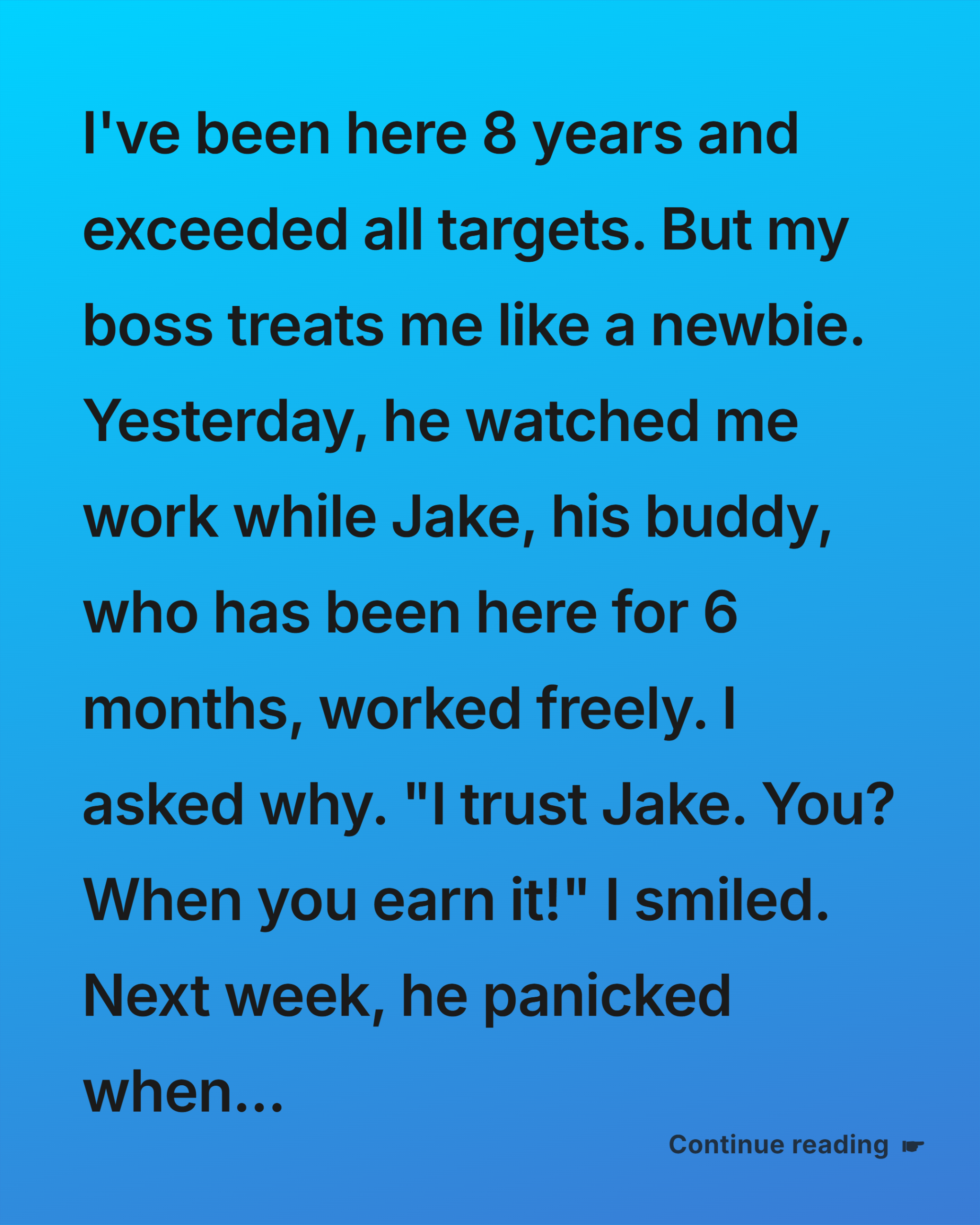
I’ve been here 8 years and exceeded all targets. I know every quirk of our data systems, every mood swing of our major clients, and exactly which printer on the third floor jams if you look at it sideways. But my boss, Mr. Sterling, treats me like a newbie who just walked in off the street yesterday. He’s the kind of manager who breathes down your neck while you’re typing an email, checking for typos before you’ve even hit the spacebar. Every success I delivered somehow became “team effort,” while every tiny delay—even those caused by other departments—was quietly placed at my feet. After years of swallowing my frustration, I had begun to realize something unsettling: Sterling didn’t want capable employees. He wanted people who made him feel important.
Yesterday, he spent nearly forty minutes standing behind my cubicle, watching me work on the quarterly projections. It was stifling, the kind of micro-management that makes you forget how to do a job you could perform in your sleep. Meanwhile, Callum—who everyone calls Jake for some reason because he looks like a “Jake” to Sterling—was sitting two rows over, laughing at a meme on his phone. Callum has been here for 6 months, mostly because he’s Sterling’s golfing buddy from the local club. The contrast was impossible to ignore. Every few minutes Sterling glanced over at Callum with an approving grin, then turned back to scrutinize every click of my mouse as though he expected me to sabotage the company I’d spent nearly a decade helping build.
I watched as Sterling patted Callum on the back and told him to “keep up the great hustle” without even glancing at Callum’s blank spreadsheet. I’d had enough of the double standard that was starting to rot the morale of our entire department. I stood up, walked into Sterling’s office, and asked why I was being hovered over while the new guy worked freely. He didn’t even look up from his desk, just smirked at his monitor. Outside his office, conversations went silent. A few coworkers pretended to organize paperwork while obviously listening through the glass walls.
“I trust Jake,” he said with a dismissive wave of his hand. “He’s got the right instincts, the right pedigree. You? Well, Arthur, when you earn it, maybe I’ll give you some space.” I smiled, a genuine, calm smile that seemed to confuse him for a second. I didn’t argue, didn’t plead my case, and didn’t mention my eight years of perfect performance reviews. His words hung in the air far longer than he realized. Something about them removed the last reason I had to stay. For the first time in years, I wasn’t angry—I was absolutely certain.
I walked back to my desk, finished my projections, and quietly started organizing my digital files. I spent the rest of the afternoon making sure every single one of my active projects was meticulously documented and updated. I wasn’t doing it for Sterling; I was doing it for my own peace of mind. I knew my worth, even if the man who signed my paychecks was blind to it. My coworkers assumed I was simply being unusually organized before another busy quarter. None of them noticed that I was also closing every loose end so no one could later accuse me of leaving chaos behind.
Next week, he panicked when he walked into the office on Monday morning and realized I wasn’t at my desk. Usually, I’m the one who unlocks the main suite and gets the coffee brewing before the sun is even fully up. But today, the doors were locked, the lights were off, and the inbox of our main client portal was overflowing with urgent requests. He called my cell phone eighteen times before 9 a.m., but I didn’t pick up. By then, people across the office were beginning to notice that dozens of routine tasks they had taken for granted only happened because I quietly handled them before anyone else arrived.
The panic reached a fever pitch when he tried to log into the master administrative account to approve a million-pound shipment for our biggest partner in Birmingham. He realized that the password—which I had told him to change for security reasons every month for years—was one he had never bothered to write down. He had always just yelled across the room for me to “fix it” whenever he needed access. Now, he was locked out of his own kingdom, and the gatekeeper was nowhere to be found. Worse still, no one else knew which security protocols had to be followed before the account could be accessed without triggering compliance alerts.
By noon, Sterling was reportedly seen pacing the lobby, sweating through his expensive silk shirt as the Board of Directors started calling. They wanted to know why the logistics chain had come to a screeching halt on the busiest day of the quarter. He finally reached me through my personal email, sending a message that was half-demand and half-plea. He told me to “stop playing games” and get back to work immediately. Around him, department heads were demanding updates, clients were threatening penalties, and every passing minute made it painfully obvious how much of the operation had quietly depended on the employee he had insisted was never quite good enough.
I replied with a very short, very polite attachment: my resignation letter, which I had actually filed with HR the previous Friday afternoon. I reminded him that since he didn’t trust my work enough to let me do it without supervision, I had decided to find a place where my eight years of expertise were valued. I also pointed out that I had spent the weekend finalizing a contract with our primary competitor, a firm that had been trying to headhunt me for years. I wished him and the company nothing but success, knowing full well they were about to discover how expensive it is to undervalue experience.
It wasn’t just about my departure; it was about what happened when they tried to have “Jake” fix the problem. Sterling had been so convinced of Callum’s “instincts” that he handed him the task of bypassing the security lockout. Callum, who had spent most of his six months learning the names of Sterling’s favorite golf clubs rather than the company’s software, accidentally triggered a total system wipe. He had followed a “shortcut” he found online that ended up deleting the last forty-eight hours of transaction data. The office reportedly fell silent as warning messages filled every screen. People stared at one another, realizing this was no longer a minor inconvenience—it was becoming a full-scale operational crisis.
Sterling was suddenly facing not just a delay, but a catastrophic loss of records that could lead to legal action from our partners. He called me again, his voice cracking over the voicemail, offering me a twenty percent raise and a “Senior Vice President” title if I’d just come back for one day to restore the backups. I listened to the message while sitting in my new office, which had a window that actually opened and a team that greeted me with respect. For the first time in years, my phone ringing didn’t fill me with dread. It simply confirmed everything I had already known.
I informed him that the backups weren’t actually missing; they were perfectly safe and encrypted. I had moved them to a secure cloud server months ago because I knew Sterling’s Buddy-System was a security risk waiting to happen. But there was a catch: per the company’s own security bylaws that Sterling had signed without reading, the encryption keys could only be released to a certified auditor. The policy had been created to protect the company from exactly the kind of reckless shortcut Callum had just attempted.
I wasn’t being petty; I was following the very rules he had used to try and “put me in my place.” Since he didn’t trust me, I told him it was only fair that a third party verify the data before it was reintegrated into the main system. This forced the Board of Directors to initiate a full-scale internal audit of Sterling’s entire department. They discovered that while I had been exceeding targets, Sterling and Callum had been “misallocating” travel expenses for their golf trips for months. The deeper the auditors looked, the more uncomfortable the findings became. What started as a search for missing data quickly uncovered years of poor oversight, favoritism, and financial misconduct.
By the time the audit was finished, Callum was gone, and Sterling was “invited” to take an early, unpaid retirement. The Board reached out to me, not to ask me to come back as a subordinate, but to offer me Sterling’s old job as the Head of Operations. I turned them down, though. I told them that a company that allows a culture of “pedigree over performance” to flourish for eight years isn’t a company I want to lead. An apology offered only after disaster isn’t a culture change—it’s damage control.
The rewarding conclusion came when I started my own consultancy firm, taking three of my most talented (and equally undervalued) former coworkers with me. We now handle the logistics for the very clients who used to call me at my old desk, but now they pay me three times the rate. Several of those clients later admitted they had assumed I had been running the department all along because every difficult problem somehow ended up on my desk. Sterling still calls me occasionally, asking for “advice” on his new hobby—which apparently involves a lot of time at the driving range and a lot less time in a boardroom.
I realized that for eight years, I had been waiting for someone else to validate my hard work, thinking that loyalty alone would eventually earn me respect. But trust isn’t a trophy you get handed after a decade of service; it’s a standard you set for yourself and demand from others. If you stay in a place where your excellence is treated as suspicion, you’re not building a career—you’re just building a cage. The hardest lesson wasn’t learning my value. It was accepting that some people benefit too much from undervaluing you to ever acknowledge it.
I learned that the most dangerous thing you can do is make yourself indispensable to someone who doesn’t appreciate you. You think it makes you safe, but it actually just makes you a target for their ego. The moment I stopped smiling and started acting on my own worth was the moment the cage door finally swung open. Now, I work in a place where the only “pedigree” that matters is the quality of the work we produce together—and where trust is earned through competence instead of golf scores or personal friendships.
Life is too short to spend your days earning the trust of people who aren’t even trustworthy themselves. You have to be the one to decide when you’ve “earned it,” and if the people around you can’t see that, it’s time to move the goalposts to a field that’s actually worth playing on. Looking back, I don’t remember the stress nearly as much as I remember the relief of finally walking away. The greatest promotion I ever received wasn’t a new title—it was reclaiming my self-respect. I’m just glad I finally found the courage to stop being a “newbie” in my own life.