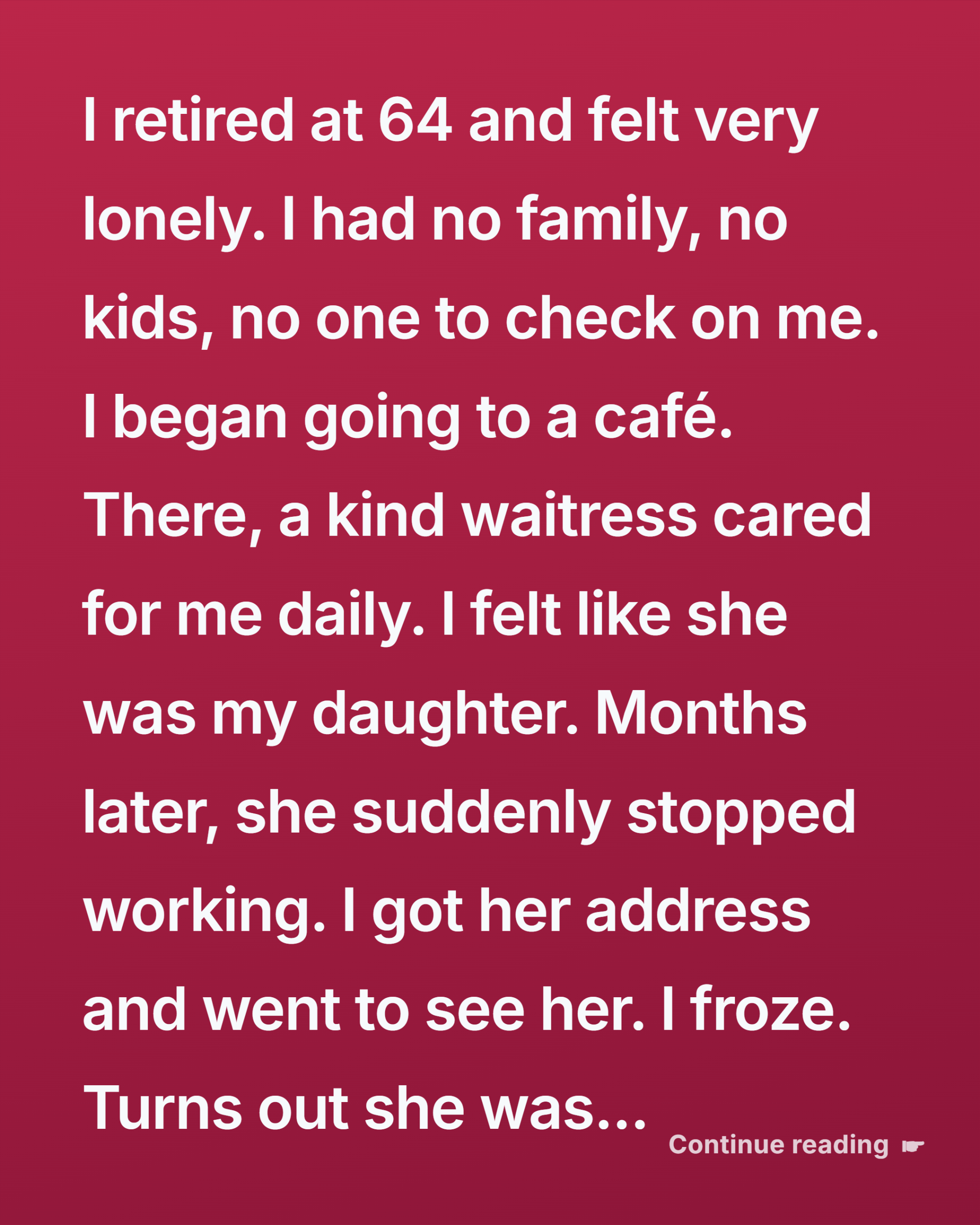
I retired at sixty-four and found the silence overwhelming. For the first few weeks, I told myself I was simply adjusting. I had worked most of my adult life, and I had imagined retirement would feel like freedom. Instead, the mornings stretched endlessly, the afternoons felt hollow, and the evenings were the worst. I had no family, no children, and no one checking in on me. Out of habit and need, I began visiting a small café each day.
A kind waitress greeted me warmly, remembered my coffee, and listened when I spoke. At first, our conversations were nothing more than small talk—weather, books, customers, the strange things people ordered before noon. But gradually, she began asking about me. She remembered stories I had told her weeks earlier and noticed when I seemed quieter than usual. Those brief conversations became the brightest part of my routine, and without realizing it, I began to think of her as the daughter I never had. Then one morning, she wasn’t there.
I waited through my entire coffee, expecting her to appear from the kitchen or walk through the front door wearing her familiar smile. She never did. The next morning, she was gone again. Then another day passed, and another. When I finally asked one of the other servers where she was, the answer was strangely vague. “She had to leave,” the woman said, before turning away as if she had already said too much.
Days passed, and worry replaced comfort. I told myself I was being foolish. She was a young woman with her own life, and I had no right to expect explanations from her. Still, something about the sudden disappearance bothered me. Eventually, after asking around and finding her address, I went to see her, unsure of what I would say. I almost turned around twice before knocking.
When she opened the door, I barely recognized her. She looked exhausted, her hair pulled back carelessly, dark circles beneath her eyes. Yet the moment she saw me, she smiled. It was the same warm smile she had given me across the café counter so many times. “You came,” she said softly, as though she had been expecting me. Then she stepped aside and invited me in, offering tea, just as she always had at the café.
That familiar kindness eased my nerves, but there was something else in her expression now—something guarded and frightened. I asked if everything was all right. For a moment, she simply stared into her cup. Then she finally explained that she’d left her job because her father was ill and needed full-time care. His condition had worsened suddenly, and long shifts were no longer possible.
As she spoke, I realized how much of her story I had imagined to fill my own loneliness. I had built a relationship in my mind that was much larger than the one we had actually shared. Her kindness had been genuine, but it was never meant to replace a family. She hadn’t been trying to rescue me from loneliness, and I hadn’t been meant to rescue her from her responsibilities. We were simply two people who had happened to find comfort in talking to each other.
We talked for hours. She shared her worries about her father, the bills piling up, and the fear that she might not be able to keep everything together. I admitted how frightening retirement had been, how I had spent months pretending I enjoyed my freedom when what I really missed was being needed by someone. At one point, she looked at me and said, “I think we both needed someone to listen.”
That sentence stayed with me.
By the time I stood to leave, I no longer felt abandoned. I felt understood. Before I stepped outside, she hugged me unexpectedly. It wasn’t the embrace of a daughter and father, and I no longer needed it to be. It was simply the embrace of one lonely person thanking another for showing up.
I still visit the café, though she no longer works there. Sometimes we meet for tea; sometimes weeks pass between visits because life gets busy. I occasionally ask about her father, and she asks how retirement is treating me. Our relationship is quieter now, less dependent on routine and far more honest. There is no expectation that either of us will fill a space that was never ours to fill.
What stayed with me was the lesson: loneliness doesn’t fade by forcing roles onto others. It doesn’t disappear because we convince ourselves that a stranger is a replacement for the family we never had. And sometimes, the people who matter most in our lives aren’t the ones who stay forever—they’re the ones who remind us, even briefly, that we are still capable of being seen.
It fades when we let connections be honest and real. I didn’t find a daughter—and she didn’t find someone who could solve all her problems—but I found something I had almost forgotten was possible: a meaningful connection that asked for nothing except honesty. Sometimes, late in life, that can be enough to make the silence feel a little less frightening.