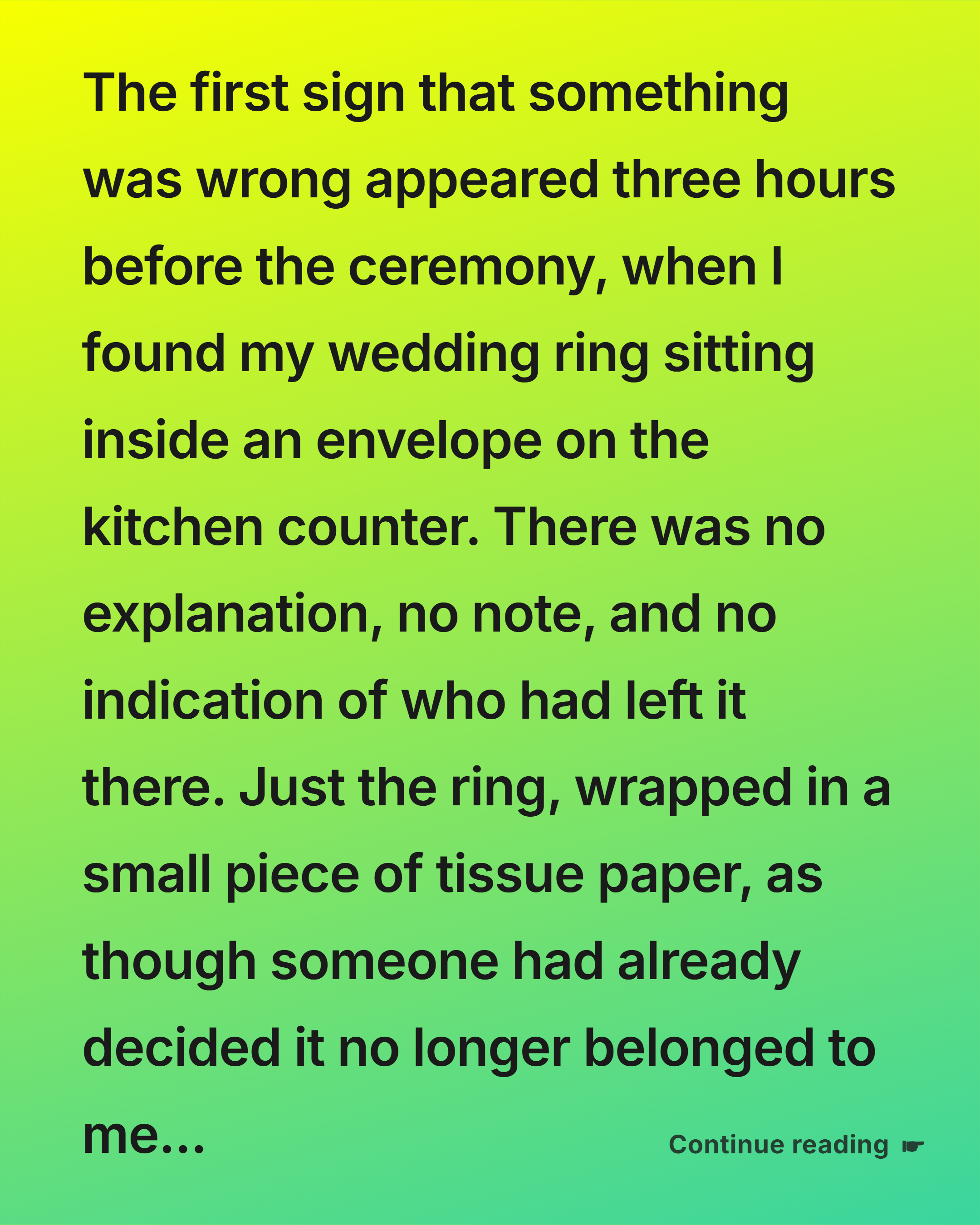
The first sign that something was wrong appeared three hours before the ceremony, when I found my wedding ring sitting inside an envelope on the kitchen counter.
There was no explanation, no note, and no indication of who had left it there. Just the ring, wrapped in a small piece of tissue paper, as though someone had already decided it no longer belonged to me.
I should have paid attention.
Instead, I slipped it into my pocket, straightened my tie, and told myself that wedding days were stressful. People forgot things. Plans changed. Emotions ran high. By that afternoon, I would be married to the woman I had loved for nearly four years, and none of those little inconveniences would matter.
My name is Adrian, and until that morning, I genuinely believed I had everything figured out.
My fiancée, Camille, and I had chosen an old countryside estate for our wedding. It had belonged to her grandparents, and she had always dreamed of getting married beneath its enormous oak trees. I had spent months restoring the neglected garden, arranging the lighting, and negotiating with vendors because I wanted the day to be everything she had imagined.
Camille was a woman who noticed details other people overlooked. She remembered birthdays, handwritten notes, and the exact way someone liked their coffee. She was also fiercely independent, sometimes to the point of making it difficult for anyone to help her.
I loved that about her.
We had our differences, of course. I was practical and preferred solving problems immediately. Camille needed time to think, sometimes disappearing into her thoughts for hours. But I believed we complemented each other.
Or at least, I believed we did.
The morning of the wedding, my best friend, Nathan, arrived at the estate carrying two coffees and wearing an expression I couldn’t quite understand.
“Have you spoken to Camille today?” he asked.
“Not since breakfast. Why?”
He hesitated before handing me my coffee.
“Nothing. Just making sure everything’s okay.”
I laughed. “You’re acting like you’re the one getting married.”
He forced a smile, but his eyes remained serious.
I should have asked more questions. Instead, I went back to checking the arrangements.
By noon, guests were arriving. The garden looked magnificent, the musicians were rehearsing, and the caterers were putting the finishing touches on dinner. My mother was already crying, my father was pretending not to be emotional, and my younger brother, Lucas, was running around making sure nobody touched the wedding cake before the photographs.
Everything appeared perfect.
Then the wedding coordinator approached me with a tablet in her hand.
“Adrian, there’s been a change to the ceremony schedule.”
“What kind of change?”
She glanced toward the main house.
“Camille has asked us to delay the ceremony by twenty minutes.”
“Why?”
“She hasn’t explained. She just asked me to tell you that she needs a little more time.”
I checked my watch. Twenty minutes wasn’t a disaster. I nodded and tried to remain calm.
But twenty minutes became forty.
Then an hour.
Guests began exchanging puzzled looks. The musicians stopped playing, and the coordinator kept disappearing into the house before returning with increasingly uncomfortable expressions.
Finally, I walked toward the bridal suite.
Before I could reach the staircase, Nathan stepped into my path.
“Adrian, wait.”
I stared at him.
“What’s happening? Where is she?”
He looked down at the floor.
“I think you need to sit down.”
Something in his voice made my stomach tighten.
“Don’t tell me to sit down. Tell me what’s going on.”
Nathan took a breath.
“Camille isn’t coming out.”
I felt my face grow hot.
“Is she sick? Did something happen?”
“No. She’s fine physically.”
“Then what?”
He rubbed his forehead, struggling to find the right words.
“She wants to speak to you. But she doesn’t want to do it in front of everyone.”
I pushed past him and climbed the stairs.
Camille was sitting alone in the bridal suite, still wearing her wedding dress. Her bouquet lay untouched on the dressing table. Her makeup was perfect, but her eyes were swollen from crying.
When she saw me, she immediately stood.
“Adrian, I’m sorry.”
I looked at her, waiting for an explanation that would somehow make sense of everything.
“What’s happened?”
She held out her phone.
On the screen was an email from a property management company. It contained a signed agreement concerning the estate where we were supposed to get married.
I recognized the address immediately.
It was Camille’s grandparents’ property.
“What am I looking at?”
She swallowed.
“I was going to tell you after the wedding.”
My confusion turned into something much worse.
“Tell me what?”
Camille sat down again.
“Six months ago, I found out that the estate was in serious financial trouble. My grandparents had left behind debts, and the maintenance costs were becoming impossible. I’ve been trying to save it, but I couldn’t do it alone.”
I stared at the document.
It was an agreement to transfer the property to a development company. The sale had been negotiated months earlier.
“You were selling the estate?”
She nodded.
“Yes.”
“Without telling me?”
“I didn’t know how to explain it. I thought I could find another solution.”
I scrolled through the email. There were meeting records, financial statements, and correspondence dating back nearly half a year.
Then I noticed something that made my hands go cold.
The agreement included a clause requiring the property to be vacated within thirty days. The development company intended to demolish the old house and replace it with luxury apartments.
I looked up.
“Camille, you know how much this place means to you.”
“That’s why I couldn’t bear to tell you.”
“Then why bring us here today? Why make this the place where we were supposed to start our marriage?”
She began crying again.
“Because I wanted one last happy day here.”
Those words hurt more than I expected.
I had spent months believing we were building a future together. Meanwhile, she had apparently been preparing to say goodbye to something she knew I would never have agreed to lose.
But there was another part of the agreement.
The development company had offered Camille a position managing its new residential project. She had already accepted.
It wasn’t simply a property sale. She had arranged a new life for herself without ever discussing it with me.
“Does this mean you’re moving?” I asked.
She didn’t answer immediately.
Finally, she whispered, “The company wants me in another state. I thought you might come with me.”
I felt as though the room had suddenly become much smaller.
“You thought I would leave my job, my family, and everything we’ve built here because you decided that was what our future should look like?”
“I was afraid you’d say no.”
“So you decided not to give me the choice.”
Camille covered her face.
“I know. I handled everything terribly.”
For a long moment, neither of us spoke.
Then I asked the question I had been avoiding.
“Do you still want to marry me?”
She looked at me, and I could see the answer before she said it.
“I love you, Adrian. But I don’t think I can give you the kind of marriage you want.”
I nodded slowly.
It was strange how a single sentence could make years of memories feel different.
I didn’t shout. I didn’t throw anything. I simply took the ring from my pocket and placed it on the dressing table.
“I wish you’d trusted me enough to tell me the truth.”
She reached for my hand, but I stepped back.
“I’m not angry because you want a different future. I’m hurt because you made plans for both of us without ever asking what I wanted.”
Then I walked out.
Downstairs, the guests were still waiting. My mother saw my expression and immediately understood that something terrible had happened.
She didn’t ask questions. She simply wrapped her arms around me.
I expected the afternoon to become a humiliating disaster. I imagined people whispering, relatives demanding explanations, and everyone rushing toward their cars.
But something unexpected happened.
My grandmother, who had traveled nearly six hours to attend the wedding, stood up from her chair and approached the microphone.
“Well,” she announced, looking around the garden, “I suppose we’re not having a wedding today.”
A few uncomfortable laughs followed.
She continued.
“But I refuse to let everyone go home without eating. The food is paid for, the music is here, and I’ve put on a ridiculous pair of shoes for this occasion. So somebody had better dance with me.”
The tension broke.
People laughed. My uncle started clapping. Lucas grabbed my hand and pulled me toward the dance floor, insisting that I couldn’t spend the entire afternoon looking like someone had stolen my dog.
For the first time that day, I smiled.
The ceremony never happened, but the celebration continued in a completely different way.
My mother danced with her brothers. My grandmother told embarrassing stories about my childhood. Nathan made an unnecessarily dramatic toast about how I had survived the most expensive date of my life.
And somehow, everyone stayed.
I went home that evening exhausted, heartbroken, and strangely grateful that I hadn’t made a lifelong commitment to someone who couldn’t be honest with me.
But the story didn’t end there.
Three days later, I received a call from Camille’s younger brother, Oliver.
He had been strangely quiet at the wedding, and I hadn’t spoken to him since everything happened.
“Adrian, there’s something you should know,” he said.
I almost told him I didn’t want to hear any more about Camille.
But his next words made me stop.
“She didn’t tell you the whole story about the estate.”
Apparently, the property wasn’t simply in debt. Camille’s grandfather had established a small charitable trust before his death. It was intended to preserve the grounds and provide temporary housing for families escaping domestic violence.
Camille had discovered the trust while sorting through old documents. The development company had offered her a substantial amount of money, but the agreement required her to transfer the property without disclosing the trust’s existence.
Oliver had been trying to persuade her to consult an independent attorney. She refused, insisting that the sale was the only way to escape the financial pressure.
“Why are you telling me this?” I asked.
“Because I think you should know that the agreement isn’t as straightforward as she made it sound. And because I don’t think she has told you what happened after you left.”
He explained that Camille had contacted the company the following morning, asking to withdraw from the agreement. They had refused, claiming that she had already committed herself legally.
I wasn’t sure what to believe, so I contacted a lawyer and asked him to review the documents Oliver had sent.
The investigation revealed that the estate’s financial situation was complicated, but not hopeless. The charitable trust had legal protections, and the development company had failed to disclose several obligations connected to the property.
The sale was eventually challenged.
I wasn’t involved in the legal battle, and I made it clear that I wouldn’t be returning to the relationship. But I did help Oliver connect with a local preservation organization that had experience managing historic properties.
Several months later, the estate was saved.
The old house remained standing. The gardens were restored, and the charitable trust continued its work with the help of volunteers and community donations.
Camille eventually moved away. We exchanged a few messages, but neither of us tried to rebuild what had fallen apart.
I don’t hate her. I understand that fear can make people do foolish things, especially when they feel trapped by responsibilities they never expected to carry.
But understanding someone’s choices doesn’t mean you have to accept the consequences of those choices.
A year has passed since that afternoon.
My life looks nothing like the one I imagined while standing beneath those oak trees, waiting for a bride who never came.
I still work in the same town, although I’ve started a small woodworking business on the side. It began as a hobby, something I did to keep my hands busy when my thoughts became too loud.
One of my regular customers is a woman named Rebecca.
We met at a community restoration workshop. She was helping repair an old library, and I was volunteering to build new shelves. She had a habit of challenging every suggestion I made, particularly when she believed I was overcomplicating something.
Our first conversation ended with her telling me that I was terrible at accepting advice.
I told her she was terrible at giving it.
We became friends before either of us considered anything more.
There were no dramatic declarations, no promises made in the heat of emotion, and no elaborate plans for a future neither of us had experienced yet.
Just coffee after work, long conversations, occasional disagreements, and the comfort of knowing that neither person had to pretend to be someone else.
One evening, Rebecca asked me about the wedding.
I told her the entire story, including the part about my grandmother taking over the reception.
She laughed so hard that she nearly spilled her drink.
Then she became quiet.
“Do you ever wish you’d gone through with it?” she asked.
I considered the question.
For a long time, I had believed that the worst thing that could happen to me was losing the person I loved on the day I was supposed to marry her.
Now I understood that the worse possibility would have been spending years in a marriage where honesty was always postponed until tomorrow.
“No,” I finally said. “I wish things had happened differently. But I don’t wish I had married her.”
Rebecca reached across the table and squeezed my hand.
And for the first time, I realized I wasn’t looking backward anymore.
Sometimes, life doesn’t give you the ending you spent years preparing for. Sometimes, it takes away the future you were certain you wanted and leaves you standing among the pieces, wondering how to begin again.
But heartbreak isn’t always the end of a beautiful story.
Sometimes, it’s the moment you finally discover which parts of your life were built on love and which were built on assumptions.
I never got the wedding I planned. I never heard the vows Camille and I had written. And I never got to dance with her beneath those oak trees.
But the estate survived. My family stayed close. I found a new purpose, and eventually, I found someone with whom I could build something honest.
If I could speak to the man who stood at that altar a year ago, I wouldn’t tell him not to be sad.
I’d tell him to let himself feel everything.
Then I’d remind him that a broken promise doesn’t have to mean a broken future.
Because sometimes, the bravest thing you can do isn’t holding on to the person you thought you’d spend your life with.
It’s having the courage to walk away when you realize that love, without honesty, isn’t enough.