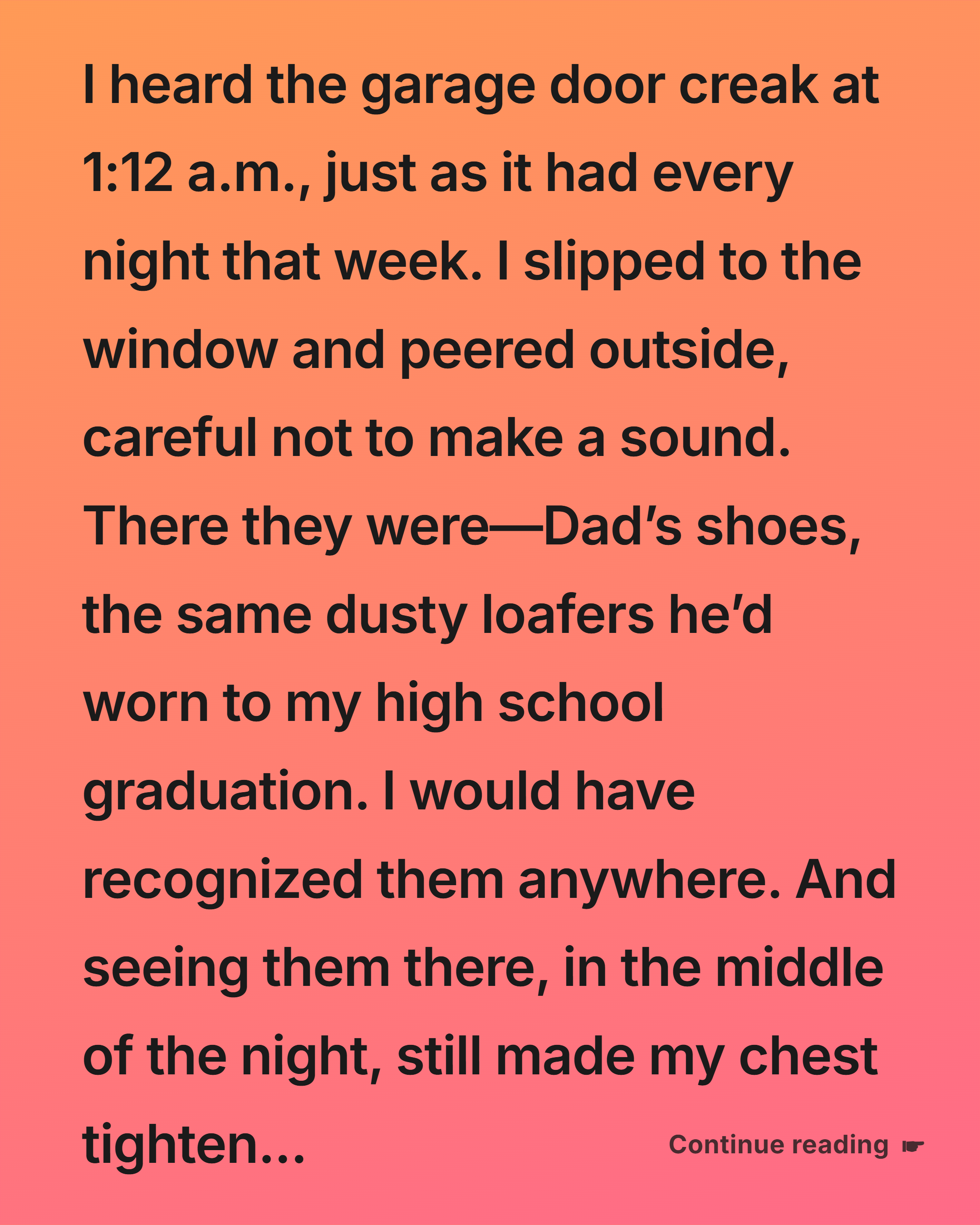
I heard the garage door creak at 1:12 a.m., just as it had every night that week. I slipped to the window and peered outside, careful not to make a sound. There they were—Dad’s shoes, the same dusty loafers he’d worn to my high school graduation. I would have recognized them anywhere. And seeing them there, in the middle of the night, still made my chest tighten.
He had left six months earlier. No warning, no proper explanation, just a note on the kitchen counter and the lingering scent of his cologne in the bathroom. He’d moved in with a woman named Rina, who sold handmade jewelry on Etsy and was barely five years older than me. For months, I refused to speak to him. Mom did the same. Neither of us knew how to make sense of the fact that he had walked away from our family as if twenty years together meant nothing.
Then, three weeks ago, he started showing up again. Not inside the house—he hadn’t crossed that threshold once—but in the garage. He parked around the corner and walked up the driveway like a man who no longer had a place in his own life. He brought a sleeping bag, sometimes a gym mat, and settled down on the concrete beside the lawnmower and the old paint cans. He never knocked, never called out, and never tried to explain himself. He simply slept there, as though being a few feet from the home he had abandoned was the closest he could get to feeling whole again.
Mom knew. Of course she knew. She kept cooking too much food for dinner, leaving aspirin on the counter “just in case,” and even restocking the little garage fridge with Gatorade. She never admitted any of it was for him, but I wasn’t stupid. Still, she wouldn’t say a word about what he was doing. Not even when I finally asked her outright why she thought he kept coming back. She looked at me for a long moment, her expression unreadable, before saying, “Sometimes shame looks like love.”
Last night, I left early to attend a friend’s birthday celebration. When I returned around midnight, his car was already parked around the corner. The garage door was half-open, leaving a narrow strip of light across the driveway. At first, I thought nothing of it. Then I noticed something beside his loafers that made me stop cold. Someone else’s shoes were sitting there, neatly placed next to his.
I froze in the driveway. The second pair was smaller, unmistakably different from Dad’s heavy, dusty loafers. They were women’s sandals, a little worn and coated with dust, but their bright red color stood out even in the dim light. I had never seen them before. I stared at them, trying to make sense of what I was seeing, while a strange uneasiness began creeping up my spine.
For a moment, I wondered whether Mom had finally gone out to speak to him. But she didn’t wear red. Not anymore. She had stopped wearing it in 2007, after her sister’s funeral. She used to say it was too loud a color, and she had endured enough loudness for one lifetime. She had never explained much beyond that, and I had never pushed her. But I knew those sandals weren’t hers.
So who the hell was in there?
I crept toward the side window and leaned close to the cracked blinds, holding my breath as I peered inside. Dad sat cross-legged on the garage floor, his face illuminated by the soft glow of the overhead bulb. Across from him, sitting just as still, was Rina. Her red sandals rested beside her, and she looked nothing like the woman I had imagined whenever I pictured the person who had taken my father away.
My stomach twisted. Of all the people I expected to find sitting in our garage at midnight, she was the last.
They weren’t touching. They weren’t even talking. They sat facing each other in complete silence, as if every argument had already been spoken and every explanation had already failed. There was no affection in their posture, no obvious anger either. Just two people sitting in the same pool of light, looking as though they had reached the end of something neither knew how to repair.
I backed away before either of them could notice me. I went inside and sat at the kitchen table with a glass of water I never drank. I kept listening for something—raised voices, footsteps, the slam of a door, anything that might explain what I had just witnessed. But the house remained silent. The minutes dragged by, and the unanswered questions grew heavier with every passing moment.
When I woke up at seven the next morning, the garage was empty. Both pairs of shoes were gone. The sleeping bag had disappeared, too, leaving behind only the familiar clutter of tools and old paint cans. Mom was already outside, trimming the rosemary bush beside the mailbox as calmly as if it were any other Tuesday. She didn’t look toward the garage, and she didn’t mention the night before. If she had noticed anything unusual, she gave no sign of it.
That afternoon, I saw Dad again, of all places, in the produce section of the grocery store. He stood there holding a mango, turning it slowly in his hand as if it contained the answers to every question he had ever been asked. I stopped at the end of the aisle, uncertain whether to turn around and pretend I hadn’t seen him or walk straight up and demand an explanation. Before I could decide, he looked up and spotted me.
His eyes widened. For a second, he looked almost frightened. Then his expression softened, and something like relief crossed his face. It was the look of someone who had been waiting for a door to open without knowing whether he deserved to knock.
“Saara,” he said quietly. “Hi.”
I gave him a stiff nod. My jaw was clenched so tightly that it hurt, and I could feel months of resentment pressing against the back of my throat. I had imagined seeing him again countless times, but never like this, beneath fluorescent lights and surrounded by neatly stacked fruit.
“I wasn’t expecting to see you,” he said. “You look good.”
“Why is she in the garage with you?” I blurted.
He blinked, apparently caught off guard by the question. “Rina?”
I didn’t answer. I simply stared at him, waiting to see whether he would lie, make an excuse, or pretend he had no idea what I was talking about.
He lowered his eyes to the mango, then carefully placed it back in the bin. After that, he rubbed his face with both hands, as if he were trying to wipe away the man he had become and start the conversation over as someone else.
“She left me,” he said. “About a month ago.”
I waited for him to say more. I wanted an explanation, but I also wanted him to feel the discomfort of having to offer one. For once, I wasn’t going to make things easier for him by filling the silence.
“She said I was obsessed with my past,” he continued. “That I made her feel like a visitor in someone else’s house. She was right.”
I stared at him, trying to decide whether I felt satisfaction, pity, or nothing at all. After everything he had done, it was difficult to summon sympathy for the fact that the life he had chosen hadn’t turned out the way he wanted.
“So now you sleep in ours?”
“I’m not trying to worm my way back in,” he said quickly. His voice carried a nervous urgency that made me wonder how many times he had rehearsed this explanation. “I just… I needed to be close.”
“Close to what? Mom?”
He didn’t answer immediately. For a moment, he looked past me, toward the supermarket entrance, as though the right words might be waiting somewhere beyond the automatic doors. Then he looked back at me.
“Everything,” he said. “You. Her. That version of me I threw away.”
I should have walked away. I wanted to. I had every reason to leave him standing there with his regrets and his mango, just as he had once left us with a note and an empty place at the dinner table. But something in his voice made me stay. It wasn’t an excuse or a plea for forgiveness. It sounded more like a man finally admitting that he had no idea how to live with the choices he had made.
We talked for fifteen minutes near the bananas. Nothing dramatic, nothing that could have repaired six months of hurt. We talked about how my classes were going, whether Mom still played the piano sometimes, and whether the water heater was still acting up. The ordinary questions felt almost unbearable. He remembered the small details of our lives, and I realized that, despite everything, he had never completely stopped thinking about them.
Then I finally asked the question that had been sitting between us since I saw those red sandals. “If you’re not trying to come back, then what is this? What’s the end goal?”
He swallowed hard. His fingers tightened briefly around the handle of his shopping basket before relaxing again. “I don’t know. But I can’t sleep anywhere else. I’ve tried. The garage is the only place I can breathe.”
I left him standing there with an empty basket and a bewildered expression on his face. I didn’t know whether he was telling the truth, whether he was trying to make me feel sorry for him, or whether he had finally realized that running away from one life didn’t automatically give him another. All I knew was that I wasn’t ready to help him find his way back.
That night, I told Mom everything. The garage, the red sandals, Rina sitting across from Dad, and the conversation at the grocery store. I expected her to become angry, or at least look surprised when I mentioned that Rina had been there. I had spent the entire day imagining how she might react, and I was prepared for almost anything except the calm expression she wore as she listened.
She simply sipped her tea and said, “I know she left him. He told me two weeks ago.”
I stared at her. “He *talked* to you?”
“Briefly. It wasn’t a conversation I wanted to have, but he insisted.” She set her cup down with deliberate care. “I didn’t let him inside.”
“Why didn’t you tell me?”
“Because you’re not the one who got left behind. I am. And I get to decide when and how I deal with it.”
I had no immediate answer to that. Part of me wanted to argue that I had been hurt, too, that his leaving had changed my life just as surely as it had changed hers. But Mom wasn’t dismissing my pain. She was reminding me that hers belonged to her, and that I couldn’t demand access to it simply because I wanted to understand what was happening. It wasn’t the answer I had expected, but it was fair enough.
For the next week, the garage remained quiet. No loafers appeared beside the door. No red sandals showed up in the shadows. There were no late-night visits, no sleeping bag on the concrete, and no quiet signs that Dad had been there. The house settled back into its usual rhythm, filled with the familiar creaks, the hum of the refrigerator, and the distant sounds of the neighborhood. I thought perhaps he had finally accepted that he couldn’t keep returning to the edges of our lives without deciding what he actually wanted.
Then, one morning, Mom woke me up unusually early. It was around 5:30 a.m., the kind of hour when the world still feels unfinished and even familiar rooms look strange in the half-light.
“Put on shoes,” she said. “We’re going somewhere.”
I was half-asleep and grumpy, and I briefly considered asking whether wherever we were going could wait until a more reasonable hour. But something in her voice stopped me. She wasn’t upset or hurried. She sounded certain, as though she had made a decision and had no intention of explaining it until we arrived. So I got dressed, pulled on my shoes, and followed her outside.
We drove in silence for most of the way, with Mom occasionally humming along to an old Tamil song playing on the radio. The sky was beginning to lighten, and the streets were quieter than I had ever seen them during the day. I watched the familiar buildings pass by, wondering why she had chosen this particular morning to take me somewhere without telling me where we were going.
Eventually, we pulled into the marina.
Mom parked the car and turned to look at me. For a moment, she seemed younger, or perhaps simply farther away from the hurt that had occupied so much of our lives lately. “You know your father and I used to come here every Friday before you were born,” she said. “We’d get fried fish and talk about the future. He always wanted a boat, did you know that?”
I shook my head. There were so many stories about my parents’ life before I came along that I had never heard. I had always known them as Mom and Dad, two people who had built a home and raised a family. It was strange to remember that they had once been young, that they had made plans together, and that they had loved each other long before I existed.
“He used to say, ‘If things ever go sideways, at least we’ll have water and wind.’ I thought it was romantic.”
She looked out across the horizon, where the water caught the faint morning light. For a while, she said nothing. I waited, sensing that this trip wasn’t simply about old memories or the man my father had once been. Then she took a slow breath and said, “He told me last night he wants to sell the house.”
I turned sharply toward her. “What? This house?”
She nodded. “He says he wants to give me the money and start over somewhere far away. Somewhere I’ll never see him again. He thinks that’ll help me ‘heal.’”
“That’s—he can’t just—why would he do that?”
“Because he’s ashamed,” she said. “He thinks sacrifice will fix it. He thinks if he gives up the house, he can somehow make up for what he did. But the damage isn’t about the house.”
I looked out at the water, trying to imagine Dad making such an offer. He had walked away from us to build a different life, and now he wanted to give up the home we had shared as though abandoning another piece of himself would somehow undo the first abandonment. It was a familiar kind of thinking for him: make a grand gesture, call it love, and hope nobody asks him to sit still long enough to face the consequences.
We sat quietly for a while, listening to the gentle movement of the water against the marina. Then Mom said something I would never forget. “You know what hurts more than being left? Being treated like I’m too fragile to feel rage. Or peace. Or closure.”
I turned to look at her. She wasn’t crying, and she wasn’t trying to hide her anger. For the first time in a long while, I understood that her calmness didn’t mean she had accepted what happened or that she had stopped hurting. She simply refused to let Dad’s guilt dictate what she was allowed to feel. He didn’t get to decide what would heal her, just as he hadn’t given her the courtesy of deciding whether their marriage was worth saving before he left.
The next night, the garage door creaked again. I was standing by the window, as I had been so many times before, watching the familiar shadows gather around the driveway. Dad was back. His shoes were in their usual place, and the garage door stood partly open, spilling a narrow strip of light onto the concrete.
But this time, Mom went outside.
She didn’t take anything with her. She didn’t bring food, aspirin, or Gatorade, and she didn’t carry a blanket to make his stay more comfortable. She simply wrapped a shawl around her shoulders and walked barefoot down the driveway. I watched her disappear through the half-open garage door, my heart beating faster as I wondered what she would say to him and whether this would finally be the conversation neither of them could avoid.
They sat out there for nearly an hour. I couldn’t hear their words from the house, and I didn’t try to move closer. Through the window, I could see only their shapes beneath the overhead bulb, sometimes still and sometimes shifting as they spoke. Every so often, one of them would gesture with a hand, and the other would respond. Whatever they were discussing, it didn’t look like a fight. It looked like two people finally allowing themselves to speak without pretending the past could be undone.
Eventually, Mom came back inside. Her eyes weren’t red, and she didn’t look broken. She didn’t seem relieved in any obvious way, either. She simply walked through the kitchen, set her shawl aside, and went about her evening as though she had finally put down something heavy she had been carrying for months.
Just… finished.
Dad never came back after that night.
A week later, the garage was cleaned out. His sleeping bag was gone, along with the gym mat. The mini fridge was empty again, and even the half-used packs of Gatorade had disappeared. The space looked ordinary, almost disappointingly so, with nothing left to suggest that a man who had once lived in our house had spent his nights sleeping on its concrete floor. I stood in the doorway for a long time, waiting for the familiar feeling of his presence to return, but there was only the smell of dust and old paint.
I thought that was it.
Then, two months later, a letter arrived. It was handwritten, with no return address on the envelope. I turned it over in my hands before opening it, wondering who would write to us without wanting to be identified. When I finally unfolded the paper and saw the name at the bottom, I felt the same uneasy twist in my stomach that I had felt when I first saw those red sandals beside Dad’s loafers.
It was from Rina.
She apologized. She wrote that she had never meant to blow up anyone’s life and that she had loved my father, but not enough to become his anchor. Her words were careful, almost painfully honest, as if she had spent a long time trying to understand what their relationship had meant and what it had never been able to become.
“I think I was just a lifeboat,” she wrote. “He needed to escape, and I happened to be available.”
I read that sentence several times. It was a strange thing to hear from the woman my father had chosen over his family, but it also made a terrible kind of sense. Perhaps she had believed they were beginning something new together, only to discover that he had brought his old life with him in ways neither of them knew how to handle. Perhaps she had eventually realized that being needed by someone was not the same as being loved in a way that could sustain a life together.
But the part that stayed with me was this: “He told me your mother was the strongest woman he’s ever met. That he didn’t deserve her grace. I agreed. You should know that.”
I showed the letter to Mom. She read it without interrupting, then folded it neatly along its original creases and handed it back to me. For a moment, I thought she might say something bitter about Rina or dismiss the whole letter as too little, too late. Instead, she looked at me and said, “She’s wrong. He didn’t need an anchor. He needed a mirror.”
I didn’t fully understand what she meant at first. Then I thought about Dad sitting alone in the garage, surrounded by the belongings he had left behind, trying to get close to a life he no longer knew how to enter. Perhaps what he had wanted all along wasn’t someone to save him from his mistakes. Perhaps he had wanted someone who would let him avoid looking too closely at them. And perhaps, eventually, both Mom and Rina had refused to keep doing that for him.
That fall, Mom started taking art classes at the community center. She mostly painted still lifes, spending hours working on ordinary objects as though they held secrets worth discovering. She met a man there named Arun. He was soft-spoken, and his laugh sounded like a slow drumroll. I didn’t know much about him at first, except that Mom seemed comfortable around him and occasionally came home with stories about the things they discussed during class.
They’re not dating. At least, not officially.
But he brings her coffee every Thursday, and she hasn’t worn black in months. Sometimes I catch her standing by the window with a paintbrush in her hand, looking out at the garden as though she’s considering what color to use next. She seems more present now, less like someone waiting for the next painful thing to happen. I don’t know what the future holds for her and Arun, and I don’t think she does either. For once, that uncertainty doesn’t seem to frighten her.
As for Dad, I received a postcard from him a few weeks ago. It came from coastal Oregon, with a photograph of the ocean on the front and a short message written on the back. He said he had bought a small fishing boat and named it “Second Wind.”
There was no return address, of course. Just the picture of the ocean and a few handwritten lines: “Tell your mother thank you. And tell yourself you’re braver than I ever was.”
I held the postcard for a long time after reading it. Part of me wanted to write back, to ask where he was living or whether he had finally found the peace he had been searching for. Another part of me wanted to throw it away and let the silence remain. In the end, I put it aside. I didn’t hate him anymore, but I didn’t forgive him either. I was still trying to understand how both things could be true at once, how you could care about someone and still refuse to excuse what they had done.
I think I understand now. Sometimes people leave because they convince themselves they’re doing everyone a favor. Sometimes they come back because they finally realize they weren’t the only ones hurting. They may regret what they did, and they may even try to make things right, but regret doesn’t erase the damage, and returning doesn’t automatically restore what was lost.
Life doesn’t hand out clean slates. You have to make your peace with the mess, one difficult truth at a time. You have to decide what you can forgive, what you can live with, and what you must leave behind, even when the person responsible for the hurt is someone you once trusted completely.
Mom once said that shame looks like love. For a long time, I thought she meant that Dad’s late-night visits were his way of showing us he still cared, even though he was too ashamed to come inside. But now I think it can work the other way around, too. Sometimes love shows up wearing shame’s clothes—quiet, awkward, and imperfect, making mistakes even as it tries to make things right. It doesn’t always know what to say or how to fix what it has broken. And sometimes, despite its best intentions, it has to accept that the people it hurt may no longer be willing to let it in.
I still walk past the garage sometimes and pause in the doorway. It’s just a room now, nothing more than a place to store the lawnmower, old paint cans, and things we don’t know where else to put. There are no ghosts, no loafers, and no sleeping bag tucked against the wall. The concrete floor is empty, and the little fridge hums quietly when it’s plugged in. Yet every now and then, when I least expect it, I swear I catch the faint scent of Dad’s cologne.
If you made it this far, thank you for reading. Life is messy, and not every story ends with forgiveness, reconciliation, or a perfect goodbye. Sometimes all we get is a little distance, a few hard-earned truths, and the chance to begin again. But even in the aftermath of the things we cannot undo, there can still be beauty in the cleanup.