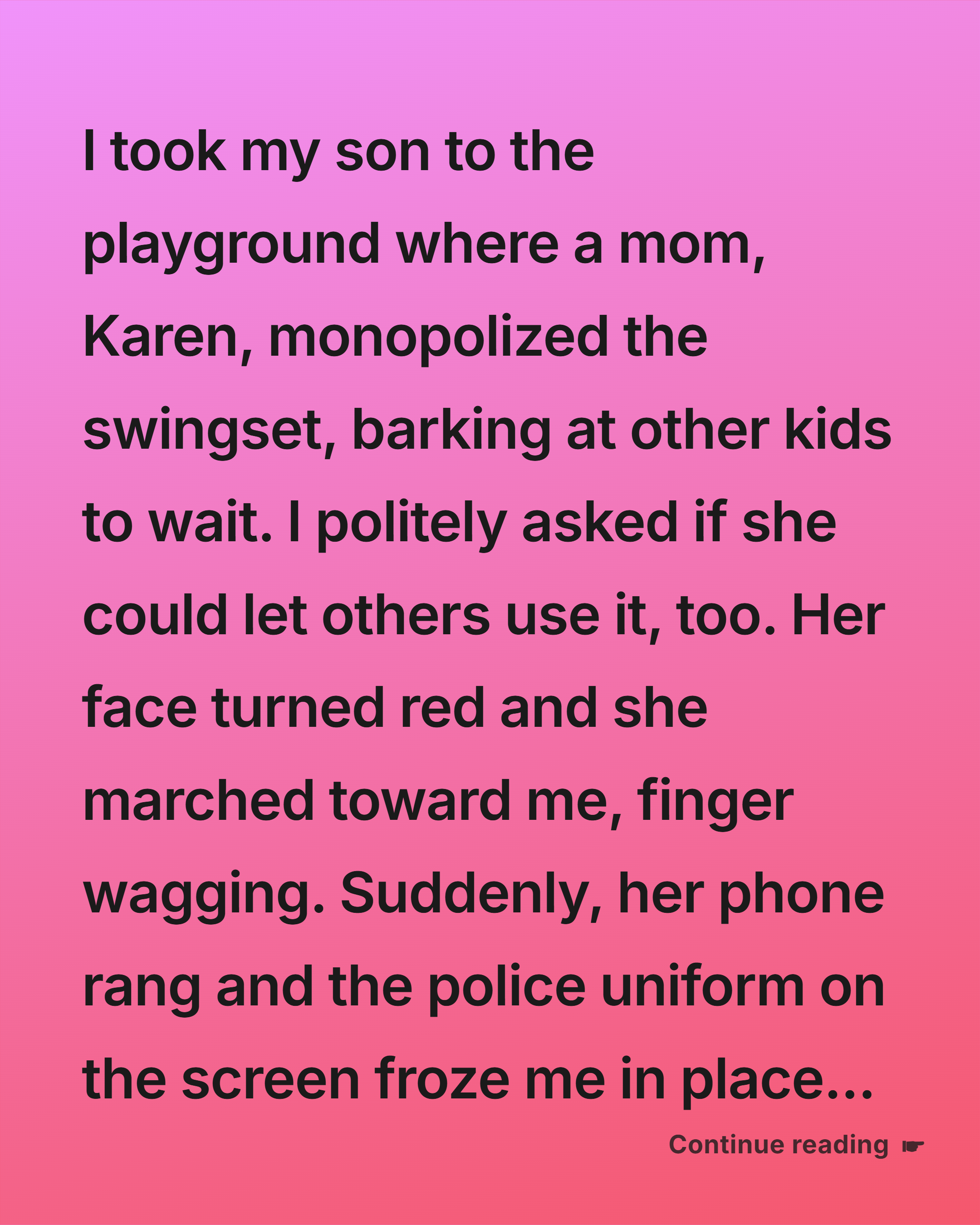
I took my son to the playground where a mom, Karen, monopolized the swingset, barking at other kids to wait. She had been there for nearly twenty minutes, occupying both swings while her own child sat nearby playing with a toy truck. Every time another child approached, Karen would immediately raise a hand and say, “Not yet. You’ll have to wait.” I watched several parents quietly steer their children toward the slide instead. Finally, when my son tugged on my sleeve and asked if he could have a turn, I politely asked if she could let others use it, too. Her face turned red almost instantly, and she marched toward me, finger wagging. I expected an argument, perhaps even a scene in front of all the children. But then her phone rang. She glanced at the screen, and the image of a police uniform appeared beside the caller’s name. For some reason, that tiny detail froze me in place.
I swallowed my anxiety, unsure of what would happen next. Karen’s demeanor shifted as she turned away, leaving a trail of mumbled apologies that sounded nothing like the confident woman who had been ordering children away from the swings moments earlier. “Yes, I’m here,” she whispered into the phone. Then her expression changed completely. The color seemed to drain from her face. She asked the caller to repeat something, then looked toward the parking lot as though expecting someone to appear there. It was odd how quickly her attitude changed with a single call. I couldn’t hear everything she said, but I distinctly caught the words “hospital,” “my daughter,” and “please don’t tell him yet.” Suddenly, the playground dispute felt terribly insignificant.
While she stepped back, still talking on her phone, I saw an opening and directed my son to the now vacant swing. He giggled joyously as the wind whisked his hair, completely unaware that the mood around him had changed. I pushed him gently, watching his little shoes rise and fall as he laughed. Behind us, Karen paced in tight circles, one hand pressed against her forehead. At one point, she stopped and whispered, “No, no, no,” so quietly that I almost wondered if I had imagined it. Whatever was happening had nothing to do with swings, playground manners, or the argument we had nearly had.
A few other parents eyed our interaction curiously, nodding subtly in agreement. They had clearly noticed Karen’s strange reaction too, though none of us knew what it meant. One mother whispered that she had never seen Karen look frightened before. Another simply shrugged and told her child to stay close. The playground rhythm resumed, children’s laughter filling the air, but there was an unmistakable undercurrent of unease among the adults. We had all witnessed something we didn’t understand.
Beside me, a dad in a Yankees cap offered a reassuring smile, acknowledging the small victory. “Sometimes,” he said quietly, “you never know what somebody is carrying.” I nodded, though at that moment I wasn’t sure whether he was defending Karen or simply reminding me not to judge too quickly. His words stayed with me longer than I expected. These moments of camaraderie lightened our day-to-day challenges, but they also reminded me that every parent arriving at that playground brought an invisible story with them.
Karen returned looking a little more deflated, burdens of unseen struggles perhaps weighing on her. She stared at her son for several seconds before kneeling beside him and pulling him into an unusually tight hug. Then she looked at me. For a moment, I thought another confrontation was coming. Instead, she mumbled an apology, albeit reluctantly. “I shouldn’t have spoken to you like that,” she said. Her voice trembled slightly. Before I could respond, her phone rang again. She glanced at the screen, immediately gathered her son, and hurried toward the parking lot without another word.
In the following days, Karen was less territorial about the swingset. A simple head nod between us became the status quo. She no longer chased other children away, and sometimes she even helped younger kids onto the swings. Still, something about her seemed different. She checked her phone constantly, sometimes stepping away from the playground to answer calls. Once, I saw her sitting alone on a bench with tears running down her face. When she noticed me looking, she quickly wiped them away and smiled as though nothing had happened.
One morning, Karen didn’t appear at the playground, and her absence was palpable. The swingset seemed oddly vacant without her energy. My son asked where she was, and I told him I didn’t know. By then, I’d grown accustomed to seeing her there, even if our first interaction had been unpleasant. That morning, I noticed a folded piece of paper lying beneath the bench where Karen usually sat. I picked it up intending to give it to the park office, but it wasn’t trash. It was a child’s drawing, with three stick figures holding hands beneath a crooked yellow sun. Across the bottom, in childish handwriting, were the words, “Mommy, don’t be scared.”
About a week later, I overheard parents discussing a sudden emergency, mentioning Karen’s family. My concern deepened, wondering if everything was alright with her. Nobody seemed to know the whole story. One parent said Karen’s daughter had been taken to the hospital. Another said it involved the police. Someone else insisted there had been a family crisis. The details changed with every retelling, and I realized how quickly uncertainty could turn into rumor. I decided not to repeat any of it. Whatever Karen was facing, she deserved privacy more than speculation.
A new family, the Hamiltons, began frequenting the playground, bringing a sense of renewal. Their cheerful energy uplifted the atmosphere remarkably. They arrived with picnic baskets, sidewalk chalk, and enough snacks to feed half the playground. They seemed genuinely interested in meeting everyone rather than keeping to themselves. Slowly, other parents began lingering longer after their children finished playing. The playground started feeling less like a collection of separate families and more like a neighborhood.
Their son, Toby, quickly bonded with mine over a shared love of dinosaurs. Both boys roamed the sandpit, digging for imaginary fossils. They named every buried pebble after some prehistoric creature and argued happily over which dinosaur would have won imaginary battles. Watching them laugh reminded me how uncomplicated childhood could be. They didn’t care who had argued with whom or what secrets adults carried. To them, friendship could begin with nothing more than a shared toy and a pile of sand.
Running into Mr. Hamilton one day, we chatted briefly about schools and local events. He mentioned a neighborhood gathering, extending an invitation. I almost declined because I wasn’t particularly social, but my son immediately insisted we go after hearing there would be games. Mr. Hamilton laughed and said, “Then I guess we have one confirmed guest.” His easygoing nature made the invitation difficult to refuse.
Our family attended, eager for community connection. The event brimmed with laughter, food, and festive light displays. Someone had strung lights between the trees, children ran through the grass with glow sticks, and neighbors who had barely exchanged greetings before were suddenly sharing tables. It softened the hardships we’d endured recently. For a few hours, nobody seemed interested in gossip or old disagreements. We simply ate, laughed, and enjoyed watching our children discover new friendships.
Mrs. Hamilton approached, her warmth as inviting as the setting sun. Her community spirit proved contagious, fostering deeper ties among neighbors. She moved from table to table making sure no one was standing alone. At one point, she noticed an elderly neighbor sitting quietly and brought him a plate of food without making a fuss. I realized that kindness often worked that way. It didn’t announce itself. It simply noticed what was needed and quietly filled the gap.
People shared recipes, contact numbers, even babysitting networks—resources that would strengthen our micro-community. Hope and gratitude were foundational here. Someone created a neighborhood group chat, another offered to organize school-supply exchanges, and parents began talking about helping one another during emergencies. It was remarkable how quickly strangers could become dependable allies when someone simply opened the door.
I thought often of Karen during these gatherings, wishing she’d find similar circles of support, knowing how tricky life could be. I couldn’t forget the frightened expression on her face when she had received that mysterious phone call. Whatever had happened, it was obvious that the angry woman at the swings had only been one version of Karen. There was another Karen underneath—the woman who was frightened, exhausted, and apparently trying desperately to hold something together.
Rumors swirled among parents about Karen’s recent behavior. Some speculated it was stress from her demanding job; others thought family issues. One person claimed she had been dealing with a serious problem involving her teenage daughter. Another insisted the police had been called to her house. None of us actually knew the truth. I finally told the group, “Maybe we should stop guessing.” The conversation went quiet, and for once, everyone seemed to understand that not knowing was better than being wrong.
A few weeks later, Karen reappeared at the playground, noticeably softer in demeanor. Her smile was a bit warmer, less of a veneer. She looked tired, but there was something calmer about her too. Her son ran toward the swings, and instead of taking over the entire set, Karen motioned for another child to go first. She even laughed when the little girl thanked her. It was such a small moment, yet I recognized it as something much bigger.
She approached me deliberately, shielded by an air of cautious sincerity. An unexpected olive branch, delivered with honesty and humility. “Can I talk to you?” she asked. I agreed. For several seconds, she stared at the ground before finally looking up. “I owe you more than an apology,” she said. “That day you asked me about the swings, I was waiting for a call from the police. My daughter had run away, and I was terrified something had happened to her.” Suddenly, the mysterious phone calls made sense.
In our brief exchange, Karen apologized genuinely for her prior behavior. Her admission drew from life lessons she’d learned of late. She told me her daughter had eventually been found safe, but the weeks that followed had forced their entire family to confront problems they had ignored for too long. She had been angry at everyone because she was terrified of losing control. “I thought if I controlled everything around me, I could somehow control what was happening at home,” she admitted. “But I couldn’t.” Her eyes filled with tears, and this time she didn’t hide them.
We acknowledged this hurdle in the paths of parenthood—one none of us could claim perfection over. Empathy blossomed, burying past grudges. I told her I hadn’t understood what she was going through, and she admitted that I hadn’t deserved the way she had treated me. Neither of us tried to rewrite what had happened. We simply decided that it didn’t have to define what happened next. Sometimes forgiveness doesn’t erase the past; it simply refuses to let the past control the future.
The weeks rolled on, our turned corners solidifying into fresh perspectives. The swingset debacle now a distant memory, a minor footnote. Karen began arriving with a different attitude. She no longer watched the playground like someone guarding territory. She watched her son play, laughed with other parents, and occasionally sat beside me. The strange tension that had once existed between us gradually disappeared.
The playground atmosphere seemed transformed—our shared laughter testament to deeper bonds formed. Children’s friendships mirrored our own budding alliances. Parents began trading school recommendations, helping with rides, and checking on one another during difficult weeks. What had once been a place where everyone competed for space had become a place where people made room.
Unity grew, respect weaving through our exchanges. Differences were embraced, each family bringing unique colors, painting a harmonious community portrait. We still disagreed sometimes. Children still argued over toys. Someone still complained about the weather, and someone else still forgot whose turn it was on the slide. But those ordinary disagreements no longer felt like battles. We had learned that community didn’t mean everyone behaved perfectly. It meant people cared enough to keep trying.
In small gestures, Karen’s impact was felt—leading storytime, organizing a book swap, even initiating a community garden project. She seemed determined to turn the difficult season of her life into something useful. The same woman who once guarded two swings now spent Saturday mornings making sure every child had something to do. She organized donated books into little reading baskets and encouraged parents to contribute seeds for the garden.
She found peace amid purpose, weaving supportive threads throughout our circle. Watching her, I saw how people could indeed change. Not suddenly, not magically, and certainly not without setbacks. But slowly, through uncomfortable honesty and repeated choices. Karen never pretended she had become a different person overnight. She simply kept choosing to be better than she had been the day before.
An unexpected turn, but a welcome one nonetheless. Life reshaped through shared trials, understanding, and forgiveness—a powerful transformation for everyone involved. I sometimes thought back to that first phone call and wondered what would have happened if I had responded to Karen’s anger with more anger of my own. Perhaps nothing would have changed. Perhaps we would have remained enemies over a playground swing. Instead, one frightening phone call had revealed a human being behind the hostility.
One afternoon, my son pointed excitedly to the garden’s sprouting seeds, a metaphor for growth and possibilities it held for our community. He crouched beside the soil, carefully inspecting the tiny green shoots as though they were priceless treasures. “Mom, look!” he shouted. “They made it!” I smiled at the simplicity of his words. The plants had survived rain, heat, careless footsteps, and days when we thought nothing would grow. In their own quiet way, they reminded us of ourselves.
Everyone contributed as their time allowed, kids learning alongside adults. The garden flourished before long, bearing fruits from collective effort. Even Karen’s son began watering the plants with my son. They had no idea how much history existed between the adults around them. To them, it was simply their garden. They measured success by tomatoes, flowers, and the number of worms they discovered.
Friendships rooted deeply within the community, nourished by shared experiences and newfound resilience. Karen’s journey became a lesson in renewal. Her story reminded us that the person who irritates us may also be carrying something we cannot see. That doesn’t excuse hurtful behavior, but understanding its roots can sometimes create a path toward healing.
Witnessing Karen’s growth fostered mirrors upon ourselves, urging reflections on empathy, resilience, and the shared journey of life challenges. I realized I had changed too. I was slower to judge, quicker to listen, and more willing to wonder what might be happening behind someone’s difficult behavior. None of us knew what phone call another parent might receive after leaving the playground.
The sacrifices made not for self-gain, but for communal benefit, wove new stories and strengthened bonds we longed to pass down. Parents donated tools, children carried watering cans, and neighbors shared whatever they could. No one contribution seemed enormous by itself. Together, however, they became something none of us could have created alone.
The playground became a symbol of unity, where laughter and life lessons were freely distributed, enriching every heart that visited there. The swings that had once caused our first confrontation became almost symbolic. Children waited their turns without being told, sometimes helping smaller kids climb aboard. Every now and then, I would catch Karen watching them with a quiet smile.
Even challenging days brightened knowing how far we had all come, together as parents, neighbors, and friends—we thrived better united. There were still hard mornings, family arguments, missed school buses, and exhausted parents arriving with barely enough energy to supervise their children. But now there was always someone willing to help. A snack appeared when another child was hungry. A ride was offered when someone was stranded. A sympathetic ear was never far away.
Shared stories and small kindnesses paving the way for a brighter tomorrow, understanding the richness of diversity that our community offered. We learned that community wasn’t created by grand speeches or perfect harmony. It was created through hundreds of ordinary choices: saving someone a seat, sharing a book, checking on a neighbor, or simply asking, “Are you okay?” and meaning it.
Each time Karen initiated another project or event, the past shed its weight, mirrored only by the promise of today’s joys. She still occasionally apologized when she became impatient, and we all laughed because none of us had suddenly become saints. But there was a difference now. When difficult moments came, Karen no longer tried to control everything around her. She asked for help.
Then came the day I knew my son learned something special from all of this—sharing his favorite toy, unprompted, with a shy new child. The little boy had been standing near the sandbox for nearly ten minutes, clutching his mother’s hand and refusing to join the others. My son walked over, held out his favorite dinosaur, and said, “You can play with him. I’ll share.” I watched from the bench, stunned by how naturally he had done it.
His radiant smile spoke volumes, silently honoring the community spirit we cherished together—his heart, a culmination of many lessons learned. He didn’t know about Karen’s phone call, her daughter’s crisis, our first confrontation, or the rumors that had circulated afterward. He only knew that someone looked lonely, and he had something that might make that person feel welcome.
In this circle, what began as minor disputes blossomed newfound acceptance, a story of growth threaded with kindness and heartfelt connections. The swingset that once seemed like a battleground had become just another part of a much larger story. Sometimes the smallest conflicts reveal the biggest opportunities to see one another differently.
In a small way, Karen stayed etched in my mind, a teacher of change through improbable means—a beacon of hope and second chances. I never forgot the woman who had once wagged her finger at me over a playground swing. But I also never forgot the woman who later admitted she had been terrified, overwhelmed, and desperate for control while her family was falling apart. Both women were Karen. And perhaps that was the most important lesson of all.
The playground still echoed with children’s laughter, every interaction a subtle reminder that life’s greatest lessons often sprout from unexpected seeds. Sometimes those seeds are planted by kindness. Sometimes by conflict. Sometimes by fear. And sometimes by a single phone call that forces us to stop seeing a stranger as an obstacle and start seeing them as a person.
A lesson I hoped my son would carry into his own world one day, understanding that change and growth begin within, extending outward. I wanted him to learn that sharing doesn’t mean giving up what matters to you. It means recognizing that someone else matters too. I wanted him to understand that strength isn’t always about standing your ground. Sometimes it is about knowing when to soften.
Together, we stood there witnessing the cycles of life swirling around us—infused with gratitude for these moments shared, tethered by love. Karen was sitting on the opposite bench that afternoon, watching her son play with Toby and my son. Our eyes met. She smiled, and I smiled back. No words were necessary. We both remembered where everything had started.
As seasons changed, the playground’s vibrant energy never waned, its roots strengthened by the multitude of stories it cradled over time. The trees changed colors, the garden produced new growth, and children who had once been strangers became inseparable friends. Families came and went, but the small community we had built remained. And whenever someone new arrived, we made room.
Our journey, punctuated by woven connections, bore testament to the enduring power of community and the transformative nature of second chances. I often wondered what would have happened if Karen’s phone had never rung that day. Perhaps I would have walked away angry. Perhaps she would have remained defensive. Perhaps two families would have continued avoiding each other. Instead, something frightening had opened a door neither of us knew was there.
May our story lead you to kindness within your circle, remembering every shared moment enriches us further than we could journey alone. Because sometimes the person standing across from you isn’t simply being difficult. Sometimes they’re fighting a battle you cannot see. That doesn’t mean we should accept cruelty or abandon boundaries. It simply means that before we decide who someone is, we might leave a little room for the possibility that their story is bigger than the moment we witnessed. And sometimes, the smallest playground conflict can become the beginning of something neither person ever expected—a second chance, a stronger community, and a reminder that kindness, once planted, can grow far beyond where it began.