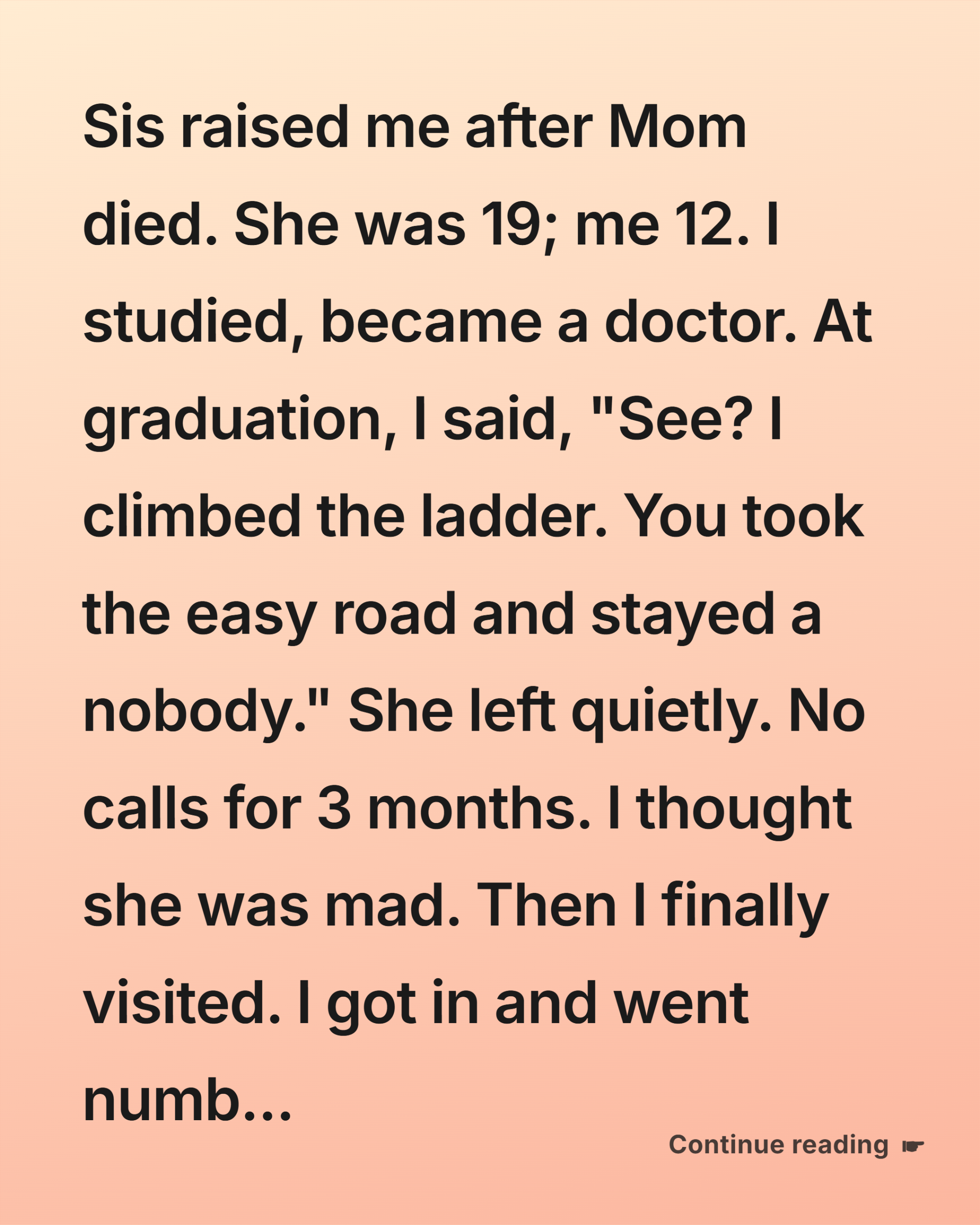
My sister Denise raised me after Mom died. She was nineteen. I was twelve. She worked double shifts at a diner, packed my lunches, helped with homework she barely understood herself, often falling asleep mid-sentence at the kitchen table with a pencil still in her hand. I studied. Got into med school. Graduated top of my class, believing I had earned every inch of it alone.
At my graduation dinner, the champagne made me bold in a way I still wish I could erase. “See?” I said, laughing too loudly. “I climbed the ladder. You took the easy road and stayed a nobody.” I didn’t notice how her fingers tightened around her glass, or how the air shifted the moment the words left my mouth.
The table went quiet in a way that felt almost violent. Denise’s smile didn’t reach her eyes. It flickered there for a second, then died completely. She nodded slowly, stood up without a word, and left. No hug. No congrats. Just gone, like she had been erased from the room.
Three months of silence followed. At first, I told myself she was being dramatic. Maybe jealous. Maybe stubborn. I sent a few texts that turned into longer messages, then shorter ones, then nothing at all. When no reply came, I convinced myself I didn’t need one. Finally, I drove to her apartment anyway, telling myself it was just to “check in.”
The building looked the same, but somehow colder. Her car wasn’t there. The curtains were gone too. I used the spare key she gave me years ago, the one I had almost forgotten existed.
The door creaked open like it had been waiting too long to move.
The living room was empty. No couch. No TV. Just dust outlines where furniture used to be, like ghosts refusing to fade. A “FOR SALE” sign leaned against the wall at an angle that made my stomach drop.
My heart started pounding before I even understood why.
I walked to the kitchen, every step louder than it should have been. On the counter was a single envelope with my name on it, written in handwriting I recognized instantly but hadn’t seen in years. My hands shook as I opened it.
Inside was a stack of papers. Bank statements. All in her name.
Withdrawals. Thousands of dollars. Monthly. For fourteen years without interruption, like a second heartbeat I had never known existed.
At the bottom of the stack was a handwritten note, creased as if it had been read and rewritten in her mind a thousand times before being left there.
“These are the receipts for your tuition, your books, your apartment deposit, your first car. I took out loans I’ll never pay off. I skipped meals so you could eat. I stayed a ‘nobody’ so you could be somebody. The house is sold because I can’t afford it anymore. The cancer treatment costs more than I saved. I didn’t tell you because I didn’t want you to feel guilty. But I guess I was the easy road, huh?”
I dropped the papers, but they didn’t fall fast enough. It felt like they were dragging me down with them.
I ran to the bedroom. Empty. Not even a trace of her perfume.
I ran to the bathroom. Empty. The mirror reflected back someone I didn’t recognize.
I stood in the middle of the hallway, gasping for air, as if the walls themselves were closing in.
Then I heard a voice behind me.
“You looking for Denise?”
I spun around so fast my vision blurred. A neighbor stood in the doorway, holding a casserole dish that felt absurdly out of place.
“She’s been at Mercy Hospital for two weeks now,” the woman said. “Didn’t she tell you?”
I shook my head, tears already forming before I fully understood what they meant.
The neighbor’s face softened in a way that made everything worse. “Room 304. But honey…” She paused, her voice cracking slightly as if she had been holding this secret for too long. “You should hurry. The doctors said she only has…”
The woman’s voice faded into a dull roar in my ears. The word “hurry” hit me like a gunshot that didn’t just wound—it launched me forward. I didn’t thank her. I didn’t even close the apartment door behind me.
I just ran.
The drive to Mercy Hospital was a blur of red lights, impatient horns, and my own reckless urgency cutting through traffic. Every second felt like something being stolen permanently. My arrogant, stupid words from my graduation dinner played on a loop in my head, louder with every mile.
“You took the easy road.”
“Stayed a nobody.”
The shame wasn’t just emotional anymore—it was physical. A crushing weight pressing into my ribs, stealing air from my lungs. I was a doctor, trained to see symptoms, to diagnose, to understand. But I had missed the most important diagnosis of my life: the slow, silent sacrifice of the only person who ever truly carried me.
I parked my expensive car, the one she helped me buy without hesitation, in the first spot I saw. I sprinted through the automatic doors, the sterile hospital air hitting me like a slap.
“Denise Miller, room 304,” I gasped at the front desk.
The nurse looked up, her expression calm in the way only people used to tragedy can be. She pointed down a long hallway without speaking. I didn’t wait.
Room 304. The door was slightly ajar, like it couldn’t decide whether to let me in. I pushed it open gently, my heart hammering against my ribs like it wanted out.
And there she was.
She was so small in the hospital bed that it didn’t feel real at first. Her hair, once always tied in a messy but vibrant ponytail, was gone completely. Her skin was pale, almost translucent, stretched tight over bones I suddenly realized I had never paid attention to before. An IV line snaked into her arm, the one with the small bird tattoo she got when she was eighteen—the only rebellious thing she ever did for herself.
She was sleeping, her breathing shallow, fragile, as if even air was asking permission.
I sank into the chair beside her bed, the plastic groaning under my weight. I reached out and took her hand. It was cold. Not just cold—unfinished.
For the first time since I was a boy crying over a scraped knee, I let myself fall apart completely. I rested my head on the edge of her bed and sobbed. Not loudly. Not dramatically. Just broken, silent sobs that shook my entire body as if something inside me was finally collapsing.
I cried for the words I said and the ones I should have protected her from. I cried for the years I took without realizing what they cost her. I cried because everything I had ever achieved suddenly felt like it was built on her disappearing.
“Denise,” I whispered, my voice barely holding together. “I’m so sorry.”
I don’t know how long I stayed there, holding her hand and watching the faint rise and fall of her chest like it might stop at any second. Eventually, a man in a white coat came in. Dr. Evans. Her oncologist.
I stood up quickly, wiping my face, forcing my mind into something familiar. The doctor in me returned out of habit, even as the brother in me was still breaking.
“I’m her brother,” I said. “I’m a doctor. Tell me everything.”
Dr. Evans sighed, the kind of sigh that belonged to someone who had already said this too many times in too many rooms.
“Stage four ovarian,” he said quietly. “Aggressive. By the time we found it, it had already spread too far.”
“Treatment options?” I asked immediately, my mind racing through protocols like a lifeline.
“We started chemo, but she’s not responding well. At this point, we’re focusing on palliative care. Comfort.”
“Comfort,” I repeated, like the word was foreign. Like it didn’t belong in medicine. It sounded like surrender.
“No,” I said sharply. “There have to be other options. Immunotherapy. Trials. PARP inhibitors—there’s a new study at Johns Hopkins…”
Dr. Evans looked at me with quiet pity, the kind that hurts more than anger.
“Her body is too weak. Even if she qualified, she couldn’t survive the treatment. We’re talking weeks. Maybe a month.”
A month. He was reducing her entire life to a countdown.
The fight drained out of me in a single moment. I was a doctor who couldn’t heal his sister. A success story that had failed at the only metric that mattered.
I stayed by her side for two days. I talked even when she slept. I told her everything I had never said out loud. The nights she waited up for me. The lunches she packed with little notes. The way she pretended not to be exhausted so I wouldn’t worry.
On the third day, her eyes flickered open.
“Hey,” she rasped, her voice barely there.
“Hey, Den,” I said immediately, squeezing her hand.
She looked at me like she was trying to remember something far away. “You came.”
“Of course I came,” I said quickly. “Denise, I saw the note. The papers. I’m so sorry. I was wrong. I was completely wrong.”
A faint, tired smile touched her lips. “Took you long enough.”
We sat in silence after that. Not empty silence—heavy silence. The kind built from years of things neither of us had known how to say.
“Why didn’t you tell me?” I asked finally. “About the money. About the illness?”
She turned her head slightly toward the window. “I didn’t want to be a burden,” she said softly. “You were finally moving forward. I didn’t want to pull you back.”
“You were never a burden,” I said, voice breaking. “You were the reason I made it at all.”
She closed her eyes, exhausted by even that small conversation. I could see it—the effort it took just to exist.
“I’m going to get some air,” I said quietly, kissing her forehead. “I’ll be right back.”
Instead of going outside, I drove to the diner.
The “Cozy Corner” looked unchanged, like time had refused to move there. Red booths, spinning stools, the smell of coffee and grease that clung to everything.
A man in his sixties was wiping the counter. He looked up as I entered.
“Can I help you?”
“I’m looking for Denise Miller,” I said. “I’m her brother.”
His entire expression shifted instantly.
“I’m George Henderson,” he said, setting the rag down. “I own this place. I’ve known Denise since she was a teenager. How is she?”
My throat tightened. “She’s… not good.”
George exhaled slowly and gestured to a booth. “Sit.”
He brought coffee without asking again. His hands shook slightly as he set it down.
“That girl,” he said quietly. “She worked like someone trying to outrun something her whole life. Never complained. Never once.”
“I know she worked hard,” I said. “For me.”
George nodded slowly. “That’s part of it. But not all.”
He leaned forward. “When your mom died, Denise was about to leave for art school. Full scholarship. Top program in the country.”
My breath stopped.
“Art school?” I repeated.
“She never told you,” he said. “She gave it up. Walked in here with that acceptance letter and asked for full-time shifts instead. Said she had a brother to raise.”
My hands went cold.
“She had dreams,” George added quietly. “Real ones. She used to sketch between orders. She was… extraordinary.”
My stomach turned.
“She kept all her drawings in a box in the attic,” he said. “Said she couldn’t look at them anymore.”
I felt like the floor had disappeared beneath me.
The empty apartment wasn’t just empty. It was erased.
She hadn’t taken the easy road. She had buried her entire life so I could walk mine.
I drove back to the hospital like something inside me had snapped into place.
I walked into her room.
She was awake.
“Turn it off,” I said.
She blinked at me.
“We’re fighting this,” I said firmly. “I don’t accept palliative care. I don’t accept ‘a month.’ Not for you.”
“I’m tired,” she whispered.
“Then let me carry it,” I said. “Let me do what you did for me.”
Something flickered in her eyes. Not hope yet—but the memory of it.
She nodded slightly.
That was enough.
I spent 72 hours making calls, breaking savings, selling everything I owned. Nothing mattered except time. Hers.
Eventually, I found a trial in Boston. Experimental. Risky. But possible.
“She’s eligible,” the doctor said.
A chance. I would take anything that resembled one.
We moved her. The first weeks were brutal. She wanted to give up more than once. I refused to let go.
The diner community showed up in ways I never expected. George organized fundraisers. Customers sent money. A neighbor drove hours just to sit with her.
Slowly, impossibly, she began to come back.
A millimeter of change on a scan became a victory. A slightly stronger blood test became a celebration.
After eight months, Dr. Albright walked in smiling.
“No active disease,” she said. “You’re in remission.”
We both broke down.
What came after wasn’t the life we had before. It was something new. Fragile, but real.
We moved into a small apartment. I took a job at a clinic where people were treated like people, not charts.
One day, I brought back a box from her old attic.
She stared at it for a long time.
“I thought it was gone,” she whispered.
“It wasn’t,” I said.
Inside were her drawings. Entire worlds she had hidden away.
And for the first time, she didn’t look like someone who had been saved.
She looked like someone who had been returned to herself.
Today, our apartment is filled with color, canvases, and light. Denise paints again. Not for survival. Not for sacrifice. But for herself.
And I finally understand something I never learned in all my years of medicine: the deepest healing doesn’t happen in hospitals. It happens when someone finally sees what love cost—and decides it was never too much to repay.