I have interviewed happy people, studied happy people, and spent years trying to understand what separates the ones who genuinely feel good about their lives from everyone else. The answer is never the salary, never the title, never the house. It is almost always the same thing: a life quietly oriented around kindness, empathy, and compassion toward others and eventually toward themselves. These 12 real moments prove that kindness is not a personality trait you are born with or without. It is a decision, made in small moments, often invisible to everyone else, that accumulates into the only kind of happiness that actually lasts. And sometimes, those moments arrive so unexpectedly they change the course of a life forever.
1.
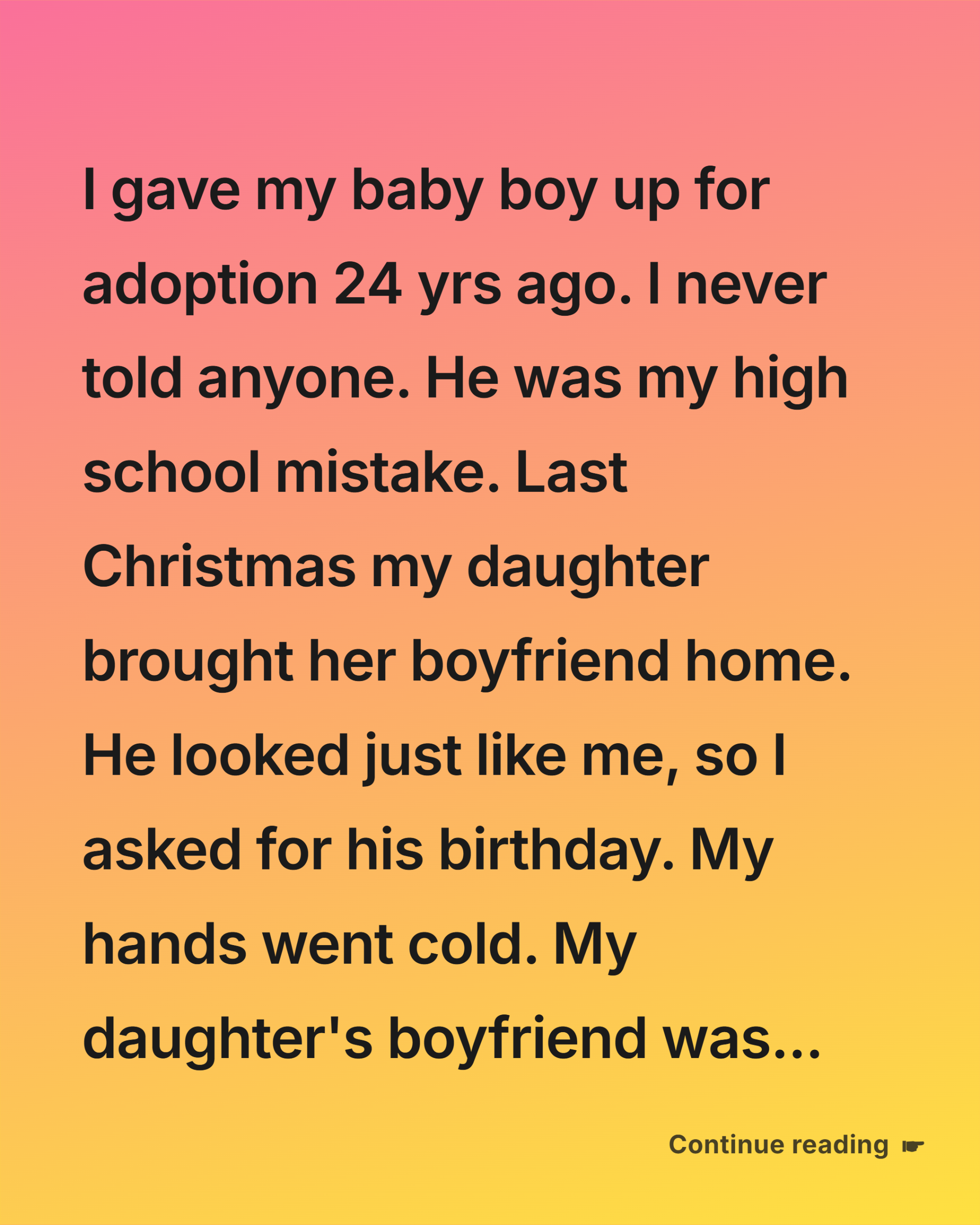
I gave my baby boy up for adoption 24 years ago and never told a single person, not my parents, not my closest friends, nobody. He was my high school mistake and I had buried it so completely that some years I almost convinced myself it had not happened. Last Christmas my daughter brought her boyfriend home and something about his face stopped me cold, the way he held his jaw, the shape of his hands, the exact way he laughed at something across the room. It hit me so suddenly I nearly dropped the wine glass I was holding.
I asked him casually when his birthday was and my hands went cold when he answered because it was the same date, the same year, the same hospital city.
For the rest of dinner I could barely hear the conversation around me. Every time he smiled I saw flashes of the infant I had held once and spent decades trying not to remember. At one point he caught me staring and gave me the strangest look, almost like he recognized something too.
I excused myself and went to the bathroom and stood there for a long time looking at my own face in the mirror, trying to steady my breathing. My daughter’s boyfriend was my son.
I did not say anything that evening. I barely slept that night. I called an adoption registry the following morning and submitted my information and three weeks later I got a confirmation that he had registered too, years earlier, looking for me.
I told my daughter first. She was silent for a very long time and then she said, “So he is my brother.”
I said yes.
She thought about it for another long moment and then said, “Good. I always wanted one.”
We told him together. The room was so quiet I could hear my own heartbeat. And then he surprised us both by saying softly, “I already know.”
He had figured it out that Christmas evening and had spent three weeks deciding whether I deserved to be found. He said he had watched me all night and seen the panic in my face every time I looked at him. Part of him had wanted to walk away and never come back.
But he decided not to.
He decided I did deserve the chance.
I am still not sure he was right but I am spending the rest of my life trying to be.
2.
My mother and I had been estranged for 6 years over something that had felt enormous at the time and had slowly become something neither of us knew how to climb back over. Pride hardened into silence and silence turned into years.
One evening she called my number by accident, meant to call someone else, and left a voicemail she did not know she had left. It was forty seconds of her talking to a friend, not knowing I could hear, saying, “I drive past her street sometimes just to see if the lights are on. I just need to know she is okay.”
Then there was a pause and her voice cracked in a way I had never heard before.
I sat with that voicemail for three days. I listened to it over and over, hearing all the love neither of us had known how to say directly. Every excuse I had made for staying angry suddenly sounded exhausted and old.
Then I called her back.
She picked up on the first ring like she had been waiting for six years, which it turned out she had been. For a few seconds neither of us spoke. I could hear her breathing.
We did not talk about the thing that had separated us, not that night. We just talked. About dinner. About weather. About nothing important at all.
And somehow, by the end of the call, something that had felt permanent had quietly stopped being so.
3.
My husband had a long surgery and I sat alone in the waiting room for 7 hours the way you do, staring at nothing, running through every possible version of what comes next. Every time the doors opened my stomach dropped.
Families came and went around me. Vending machines hummed. The television on the wall played a daytime show nobody was watching. Time became strange.
When the surgeon finally came out I stood so quickly my knees almost gave out.
He told me everything had gone well and relief hit me so hard I thought I might collapse. Then he did something I was not expecting: he sat down next to me in the waiting room chair and stayed for twenty minutes.
Not giving me information, just sitting there while I came back to myself.
At one point I realized he looked exhausted too. There were faint marks on his face from his mask and tiredness in his eyes. He had other patients, other families, other rooms that needed him, and still he stayed because he could see I was unraveling.
He waited until my hands stopped shaking.
I never told my husband about those twenty minutes because some kindness feels too private to share. But I have thought about that surgeon every single day since and what it means to have enough humanity left after a six hour surgery to notice that someone needed you to just sit down.
4.
When my grandmother passed we found a box under her bed that none of us had ever seen. At first we thought it was just old paperwork. Instead, inside was a letter for every grandchild, every child, every person she had loved, each one sealed with their name on the front in her handwriting.
Mine was three pages long.
Her handwriting grew shakier toward the final page and I realized with a sudden ache that she had probably written it while she was already sick, already knowing there were things she would not live long enough to say out loud.
She had written about the specific moment she knew I was going to be okay, a moment I had completely forgotten, a random Tuesday when I was nineteen and had said something at the dinner table that made her understand I was going to find my way.
I had no memory of it at all.
But she had been carrying that moment for twenty years and had written it down so I would have it after she was gone.
Near the end she wrote, “There will come a time when you doubt yourself terribly. Read this again when that day comes.”
I read that letter when I was at the lowest point of my adult life and it was the only thing that got me through that particular week because she had written it precisely for that, for a version of me she had never met but had somehow known was coming.
5.
My father spent the last weeks of his life in a facility where the days blurred together and the faces changed constantly and nothing felt personal or particular to him as a human being.
Except one nurse named Patricia.
She called him by his first name every single time she entered the room. She remembered that he had been a carpenter and asked him questions about it like it mattered. She brought him a small wooden puzzle one afternoon just because she had seen one in a shop and thought of him.
My father, who had become increasingly withdrawn, lit up around her in a way that reminded me painfully of who he had been before the illness.
One evening I arrived late and found them laughing together quietly over the puzzle spread across his tray table. For a second I saw my father again, not the patient, not the dying man, just him.
She was not his primary nurse. She did not have to do any of it.
But she had decided that his name and his history and his particular humanness mattered and she acted accordingly every single time, and in doing so she gave my family the gift of seeing our father seen one more time before he was gone.
6.
My brother and I had not spoken properly in four years, not from any dramatic falling out but from that slow drift that happens between adults who are busy and assume there will always be more time.
Birthdays became texts. Texts became silence.
One night at eleven pm he called and I almost did not answer because I assumed it was bad news. Calls that late usually are.
When I picked up he said he had been going through some old things and found a photo of the two of us as kids, maybe seven and nine, sitting on a wall somewhere eating ice cream, and that he had sat with it for a long time before picking up the phone because he did not want to be the kind of brother who only called with emergencies.
His voice cracked halfway through saying it.
We talked for two hours. Nothing important was discussed. Work, memories, stupid childhood stories, people we had forgotten existed.
Everything important was repaired.
Before hanging up he said quietly, “I missed you more than I realized.”
He sent me a copy of the photo the next morning. I have it on my desk now and every time I look at it I think about how close I came to not answering and how much would have stayed broken if I had not.
7.
After my son died nobody said his name anymore. I understood why, people are afraid of causing pain, but the silence around his name felt like a second loss, like he was being quietly erased from conversations to make everyone else more comfortable.
People would refer to him indirectly. “Your loss.” “What happened.” Never Marcus.
About a year after he passed I was at a gathering and a woman I barely knew said, completely naturally in the middle of a conversation, “Your son Marcus would have found that funny.”
Just like that.
Present tense almost. Like he was still someone worth referencing.
The room seemed to go silent around me. For one terrible second I thought everyone would freeze awkwardly or change the subject.
Nobody did.
I had to leave the room for a few minutes because hearing his name out loud after so long felt like someone opening a locked door inside my chest.
When I came back she did not make it awkward or apologize for saying it. She just handed me a drink and carried on talking.
She had given me the thing I had needed most for a year without knowing it, which was simply to hear that he still existed in someone else’s memory as a real and particular person.
8.
5 months after my son struggled badly at school, failed important exams, and went through a period I was frightened we would not come back from, I received a letter in the post from one of his teachers.
Not an email. A proper handwritten letter.
I remember staring at the envelope in panic before opening it because I thought it was going to contain more bad news.
Instead, she wrote that she had watched him that year and wanted me to know that she had never seen a student work as hard under that kind of pressure, that his character had impressed her more than any grade ever could, and that she believed absolutely that he was going to be fine.
She wrote that she worried parents only ever heard from schools when something had gone wrong.
I sat at the kitchen table and cried harder than I had in months because someone else had seen the effort too, not just the failure.
She had written it and posted it on her own time because she thought a mother who had been worrying for months deserved to hear something good from someone who had been in the room with him every day.
My son is twenty two now and doing well. I still have that letter and I have never told him about it because some things a mother keeps.
9.
I was going through a period of real darkness and a friend booked me a therapy appointment, paid for it, and drove me there without telling me where we were going until we arrived.
The entire drive she kept the conversation light and ordinary. I remember realizing something was strange when she parked outside the building and turned off the engine without speaking.
Then she handed me the appointment card.
I was furious for about thirty seconds.
Then I was sitting in a waiting room.
Then I was talking to someone for the first time in months.
By the end of the session something had cracked open just enough to let a little light through.
Later my friend admitted she had spent weeks debating whether to intervene because she was terrified I would hate her for it. But she had watched me disappear into myself day by day and decided that waiting for me to ask for help was not a strategy she was willing to accept.
She had done the one thing I needed most in the one way I would not have been able to refuse.
I have been in therapy ever since.
She has never once said I told you so, not even close, and that restraint is its own form of profound kindness.
10.
My father was not a demonstrative man and I had spent most of my adult life making peace with that, with the particular loneliness of loving someone who does not know how to say it back.
The morning after I told him about my diagnosis, which I had been terrified to do, I came downstairs and smelled breakfast before I reached the kitchen.
A full proper breakfast.
The kind he used to make when we were children on Sunday mornings.
He was standing at the stove with his back to me not saying anything. I could tell from the stiffness in his shoulders that he had probably been awake for hours.
I sat down and he put the plate in front of me and went back to the counter and that was it, no conversation about the diagnosis, no dramatic reassurance, no words about how he felt.
But his hands shook slightly when he poured the coffee.
Just breakfast, made carefully, on the hardest morning.
I ate every bite.
I understood every word he did not say.
11.
I bought a dress for my mother’s 80th birthday celebration and she passed away three days before the party.
The dress hung on my closet door untouched for weeks because I could not bear to look at it but also could not bring myself to move it.
Eventually I called the boutique to ask about returning it and explained what had happened, not looking for sympathy, just asking about the policy.
The woman on the phone was quiet for a moment and then said she was so sorry and that of course they would take it back and that she hoped I had someone around me.
When the refund came through it was slightly more than I had paid.
At first I thought it was an accounting error.
I called to mention the discrepancy and the owner said it was not a discrepancy. She had added a little because she had thought about my call all day and it was the only thing she could think of to do.
A stranger had thought about my grief all day and added twenty dollars to a refund because it was the only thing she had to give.
I cried after hanging up because grief makes you fragile in strange ways and because kindness from strangers can feel almost unbearable when you least expect it.
I have spent many times in that boutique since and I always will.
12.
When I was told I had a serious illness my first instinct was to protect everyone around me from the information for as long as possible.
My oldest friend figured it out before I told her. I still do not know how. Maybe she heard it in my voice. Maybe thirty years of friendship teaches you how to recognize fear before it is spoken.
One Saturday morning she showed up at my house and said she was taking me somewhere.
She drove me to the coast, three hours, and we sat on a beach for the rest of the day.
The ocean was gray and cold and the wind was sharp enough to sting our faces. At one point she bought terrible coffee from a tiny shop near the pier and we laughed about how awful it tasted like we were twenty again.
She did not bring up the illness once.
Not once.
We talked about everything else, old memories, things that had made us laugh over thirty years of friendship, plans she pretended to make for next summer with a lightness that told me she knew exactly what she was doing.
As the sun started setting I remember looking at her and suddenly understanding that this was her gift to me.
She was giving me one full day of being just myself before I had to become someone with a diagnosis.
I have never properly thanked her for it because I do not have words that are big enough.
But I think she knows.