When life turns cold and difficult, kindness and empathy can feel hard to hold onto—but they matter most then. These 12 moments show how compassion, understanding, and simple human care helped people stay connected, find hope, and bring warmth back into tough situations. In a world where judgment often arrives faster than understanding, these stories remind us that even the smallest act of humanity can quietly rescue someone standing at the edge of despair.
At the grocery store where I worked nights, an elderly cleaner named Yusuf walked an hour home after every shift. Even during storms, he never complained. We used to watch him leave with tired shoulders, carrying the same worn backpack that looked older every winter.
One evening, management gathered everyone near closing and surprised him with a mobility scooter bought by employees pooling their own money. Some coworkers had skipped holiday gifts to contribute.
Yusuf kept insisting he couldn’t accept it until someone told him he’d already earned it through years of kindness. His hands shook as he touched the handlebars, like he couldn’t believe something good had finally happened to him. The scooter meant safety, warmth, and dignity. Nobody posted about it or asked for credit. The store simply felt different afterward, softer somehow. Even customers noticed people smiling more. It was as if one act of compassion had quietly repaired something broken in all of us.
My mother remarried late in life, and her new husband made it clear I wasn’t part of his vision of family. I stopped visiting often because every dinner felt tense. Conversations became careful, polite, and painfully cold.
When my child developed learning difficulties, I struggled to afford specialized tutoring.
One day, the tutor mentioned payment had already been arranged long-term. I eventually discovered my stepfather had funded it anonymously. He had sold a personal collection he valued deeply to cover the costs. The collection had been his pride for decades, something he once refused to even let people touch. He never acknowledged it when I thanked him indirectly.
His actions contradicted years of emotional distance. Watching my child improve changed everything for me. Sometimes people care in ways they never learned to express aloud. And sometimes love hides behind silence because vulnerability terrifies the people who feel it most deeply.
I was awake for two nights at the hospital while my child recovered from surgery. Machines beeped constantly, and every sound made my heart jump. My clothes were wrinkled, and I barely recognized myself in the mirror.
A visitor passing by looked at me and whispered, “Some parents look like they don’t even try.” I pretended not to hear but felt deeply ashamed. Exhaustion made everything heavier.
A nurse noticed me struggling to stay awake. She brought me a blanket and insisted I rest while she watched over my child for a while. Her voice was gentle but firm, like she already understood I was too exhausted to admit I needed help.
When I woke up, I felt human again. The nurse had dimmed the lights and left warm tea beside my chair before quietly returning to work. That small act gave me strength to keep supporting my child. Compassion sometimes arrives when you’re too tired to ask.
I was a university student hiding the fact that I couldn’t afford textbooks that semester. I photographed pages in the library, hoping nobody noticed.
A student nearby laughed and said, “If you can’t afford materials, maybe drop out.” My stomach tightened instantly. I packed my bag quickly to avoid attention.
A librarian quietly stopped me before I left. She showed me a program that loaned digital copies for free. She helped me sign up and even printed sections I needed urgently.
Before I walked away, she slipped extra printed notes into my folder and softly said, “Needing help doesn’t mean you don’t belong here.” Her calm support erased my embarrassment. I returned to studying with renewed focus. That moment reminded me help often exists if someone guides you toward it.
I was newly divorced and moving my belongings alone into a tiny apartment. Every box felt like proof of failure. The hallway smelled like dust and old paint, and the silence inside the apartment felt unbearable.
A neighbor watched me struggle with heavy furniture and said, “Guess marriage didn’t work out for you.” I forced a polite smile while feeling crushed. My arms trembled from exhaustion.
Another neighbor came downstairs with tools and helped assemble my bed. He told me starting over takes courage, not shame.
We talked while working, and the apartment slowly felt livable. At one point he noticed me staring at the empty walls and quietly said, “Homes don’t begin with perfection. They begin when someone decides not to give up.” That simple assistance turned an empty space into a home. Kindness helped me accept my new beginning.
I was heavily pregnant and working café shifts because I couldn’t afford to stop. After I fainted behind the counter, I expected fewer hours or quiet dismissal. Instead, my boss drove me to a clinic and later handed me grocery cards collected from regular customers.
Someone donated a crib assembled from spare parts, and notes wished strength rather than pity. She even made a small rest space in storage so I could lie down during work. Customers started asking about the baby, like relatives.
One elderly customer began leaving fruit every morning with little handwritten encouragement notes beside it. Another quietly paid for my meals without saying a word. I came for a paycheck and accidentally found support I didn’t know existed. For the first time in months, the future stopped feeling so frightening.
I always believed my father preferred my younger sibling, especially after he funded their education but not mine. That resentment stayed with me into adulthood. Every conversation between us felt distant, unfinished, guarded.
When my business nearly collapsed, a bank officer informed me someone had guaranteed part of my loan. The guarantor requested anonymity.
Months later, paperwork revealed it was my father. He had risked his retirement savings without telling me. He never brought it up, even after my business recovered.
When I confronted him gently, he only shrugged and changed the subject to the weather. The discovery changed how I understood his silence over the years. Sometimes love hides behind poor communication. His sacrifice gave me a future I almost lost, and I realized too late that some parents express devotion through protection rather than affection.
A homeless man used to collect leftover pastries from our café politely every night. Even when customers ignored him, he always thanked us like we had done something extraordinary.
When new rules banned him from staying nearby, the owner followed him outside and offered a paid repair job instead. She said he’d already proven his skills fixing her bike months earlier.
Staff donated clothes, but she insisted on real wages, not charity. Soon neighboring shops relied on him for repairs. Customers started greeting him by name.
A few months later, he walked into the café wearing clean work clothes and carrying business cards with his own name printed on them. The biggest change wasn’t income — it was belonging. You could see it in the way he finally looked people in the eye.
I was a single dad running a failing food truck while raising my daughter, barely holding things together. One busy afternoon the engine died in the middle of service, and I honestly felt like everything was collapsing at once. Customers drifted away while smoke rose from under the hood.
A woman from a nearby stall closed her own booth and came over quietly, asking me to open the hood. She turned out to be a former mechanic and spent two hours fixing the engine with borrowed tools while my daughter handed her napkins like an assistant. She missed an entire sales day just helping me and refused any payment.
At one point I apologized repeatedly for wasting her time, but she just smiled and kept tightening bolts. When the truck finally started, she smiled and said kids need to see problems get solved, not abandoned. That night I earned enough to cover repairs and groceries. My daughter still calls her “the wrench hero.”
While caring for sick family members and younger siblings, I fell asleep during a warehouse shift and expected to be fired. The fluorescent lights blurred above me when I woke up in panic.
A coworker covered my station and finished my tasks without telling management.
Later she organized coworkers to bring meals to my family and even repair our leaking roof. She told me she understood raising siblings too young. Nobody wanted recognition; they just kept helping quietly.
One rainy evening I came home expecting another disaster and found coworkers on ladders fixing shingles under floodlights. I stood there speechless while they worked like it was the most normal thing in the world. That support carried us through the hardest year of my life.
After my divorce, my ex convinced most of our relatives that I had ruined the marriage, and invitations stopped coming almost immediately. I tried pretending it didn’t hurt, but the holidays became painfully quiet. Even familiar phone numbers stopped appearing on my screen.
When I lost my job a year later, I didn’t tell anyone because I was ashamed. My former brother-in-law, who had barely spoken to me since the split, called unexpectedly and offered freelance work at his company. I later learned he had argued with my ex to make it happen. He risked creating new conflict inside his own family just to help me stay afloat.
The work paid enough to keep my apartment and stability. He never mentioned loyalty or forgiveness. We mostly talked about deadlines and projects. That quiet professionalism carried more kindness than emotional speeches ever could. In a strange way, the person expected to choose sides chose humanity instead.
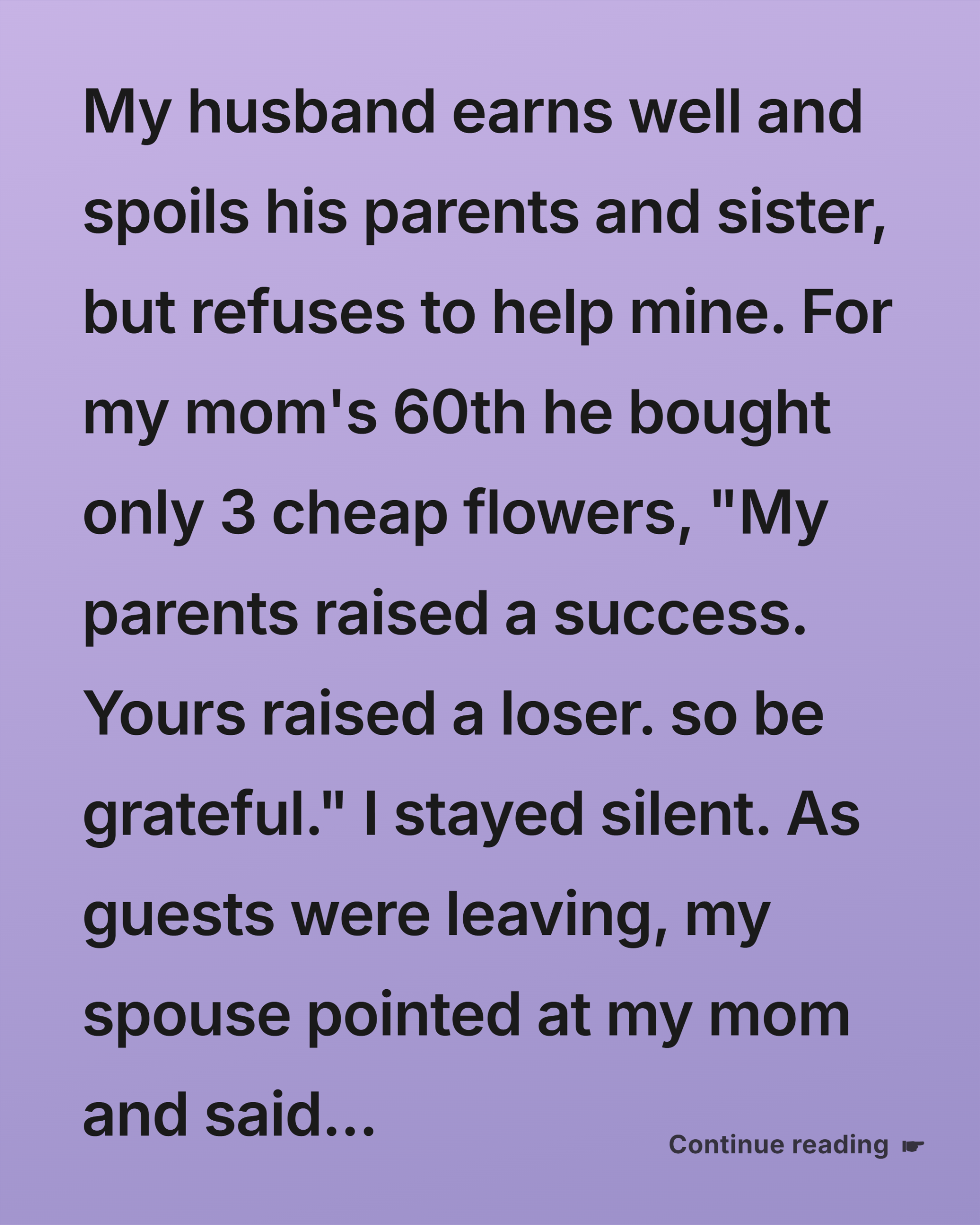
My husband has always been generous, just not with my family. He showers his parents and sister with expensive gifts: designer watches, luxury trips, anything they casually mention wanting. But when it comes to mine, suddenly generosity disappears.
For my mom’s 60th birthday, he showed up holding three cheap flowers wrapped in plastic. “My parents raised a successful man,” he said loudly enough for nearby guests to hear. “Yours raised poverty and failure.”
I stayed silent, partly from shock, partly because I didn’t want to ruin my mother’s celebration. She pretended not to notice and welcomed everyone with her usual warm smile. I told myself I would talk to him later. But he wasn’t finished.
As the evening ended and guests began putting on their coats, my husband suddenly pointed at my mom and added with a smirk, “By the way, you’re wearing that old shabby dress again. My mom would never let herself look like that — especially at this age.” The room went quiet.
The silence felt suffocating. Even the music in the background suddenly seemed too loud. My mother smiled awkwardly, the kind of smile people wear when dignity is the only shield they have left. She lowered her eyes and said nothing. I felt heat rush to my face. Years of excuses, embarrassment, and swallowed anger rose inside me all at once.
This time, I was ready to finally put my arrogant spouse in his place. Before I could speak, a small voice cut through the silence.
Our 5 YO son, shy, gentle, the kind of child who usually hides behind my leg around adults, stepped forward. He walked straight to my mom, wrapped his arms around her, and held her tightly.
Then he turned to his father and said loudly, so everyone could hear: “When I grow up, Daddy, I don’t want to be like you. I want to be like Grandma Sarah. She’s our fairy. I want to be kind like her.”
My husband froze. Ambition has always been his pride — he constantly talks about our son following his path, becoming successful like him. And now his quiet little boy had rejected that future in front of everyone.
For a moment nobody moved. My husband looked around the room as if waiting for someone to laugh it off, but nobody did. My mom began to cry, hugging her grandson as if he had just handed her the world back. Guests looked away, embarrassed for my husband, who stood there speechless, suddenly smaller than I had ever seen him.
And in that moment, I realized something simple and powerful: Kindness teaches louder than success ever can. Wealth can impress people, pride can intimidate them, but compassion is what truly stays in someone’s heart. That night, my 5-year-old proved he was already wiser than his father — and I have never been prouder of my little man.